
ISRO Scientist/Engineer Electronics 2025 question paper
All 95 questions of ISRO's written test for Scientist/Engineer 'SC' (Electronics), held on 26 October 2025, with ISRO's answer key. ISRO excluded Q.44, Q.49 and Q.82 from evaluation.
Answers from ISRO's final answer key of 15 May 2026.
- questions · 100 marks
- 95questions · 100 marks
- Part A: Electronics
- 80Part A: Electronics
- Part B: aptitude
- 15Part B: aptitude
How the paper is marked
- Part A (Q.1 to Q.80): 1 mark for a correct answer, 0 for no answer, minus 0.33 for a wrong answer.
- Part B (Q.81 to Q.95): 1 or 2 marks as printed with each question, 20 marks in all, no negative marking.
Source: the instructions printed in the question paper.
ISRO EC 2025 answer key
| Question | Part | Marks | Answer |
|---|---|---|---|
| Q.1 | A | 1 | B |
| Q.2 | A | 1 | C |
| Q.3 | A | 1 | C |
| Q.4 | A | 1 | D |
| Q.5 | A | 1 | C |
| Q.6 | A | 1 | D |
| Q.7 | A | 1 | C |
| Q.8 | A | 1 | D |
| Q.9 | A | 1 | C |
| Q.10 | A | 1 | A |
| Q.11 | A | 1 | B |
| Q.12 | A | 1 | B |
| Q.13 | A | 1 | D |
| Q.14 | A | 1 | B |
| Q.15 | A | 1 | C |
| Q.16 | A | 1 | A |
| Q.17 | A | 1 | B |
| Q.18 | A | 1 | C |
| Q.19 | A | 1 | C |
| Q.20 | A | 1 | A |
| Q.21 | A | 1 | A |
| Q.22 | A | 1 | C |
| Q.23 | A | 1 | C |
| Q.24 | A | 1 | B |
| Q.25 | A | 1 | B |
| Q.26 | A | 1 | B |
| Q.27 | A | 1 | D |
| Q.28 | A | 1 | B |
| Q.29 | A | 1 | C |
| Q.30 | A | 1 | A |
| Q.31 | A | 1 | D |
| Q.32 | A | 1 | D |
| Q.33 | A | 1 | C |
| Q.34 | A | 1 | C |
| Q.35 | A | 1 | A |
| Q.36 | A | 1 | C |
| Q.37 | A | 1 | D |
| Q.38 | A | 1 | C |
| Q.39 | A | 1 | B |
| Q.40 | A | 1 | C |
| Q.41 | A | 1 | C |
| Q.42 | A | 1 | A |
| Q.43 | A | 1 | B |
| Q.44 | A | 1 | Excluded |
| Q.45 | A | 1 | C |
| Q.46 | A | 1 | A |
| Q.47 | A | 1 | B |
| Q.48 | A | 1 | B |
| Q.49 | A | 1 | Excluded |
| Q.50 | A | 1 | D |
| Q.51 | A | 1 | B |
| Q.52 | A | 1 | C |
| Q.53 | A | 1 | D |
| Q.54 | A | 1 | A |
| Q.55 | A | 1 | A |
| Q.56 | A | 1 | D |
| Q.57 | A | 1 | A |
| Q.58 | A | 1 | B |
| Q.59 | A | 1 | C |
| Q.60 | A | 1 | B |
| Q.61 | A | 1 | A |
| Q.62 | A | 1 | B |
| Q.63 | A | 1 | C |
| Q.64 | A | 1 | C |
| Q.65 | A | 1 | B |
| Q.66 | A | 1 | C |
| Q.67 | A | 1 | C |
| Q.68 | A | 1 | A |
| Q.69 | A | 1 | A |
| Q.70 | A | 1 | A |
| Q.71 | A | 1 | A |
| Q.72 | A | 1 | A |
| Q.73 | A | 1 | C |
| Q.74 | A | 1 | C |
| Q.75 | A | 1 | C |
| Q.76 | A | 1 | C |
| Q.77 | A | 1 | C |
| Q.78 | A | 1 | A |
| Q.79 | A | 1 | B |
| Q.80 | A | 1 | B |
| Q.81 | B | 1 | D |
| Q.82 | B | 1 | Excluded |
| Q.83 | B | 2 | B |
| Q.84 | B | 1 | C |
| Q.85 | B | 1 | B |
| Q.86 | B | 2 | B |
| Q.87 | B | 1 | D |
| Q.88 | B | 1 | C |
| Q.89 | B | 2 | D |
| Q.90 | B | 1 | C |
| Q.91 | B | 1 | B |
| Q.92 | B | 2 | D |
| Q.93 | B | 1 | D |
| Q.94 | B | 1 | C |
| Q.95 | B | 2 | A |
ISRO excluded Q.44, Q.49 and Q.82 from evaluation.
Part A: Electronics Q.1 to Q.80
- Q.11 markOfficial answer: B
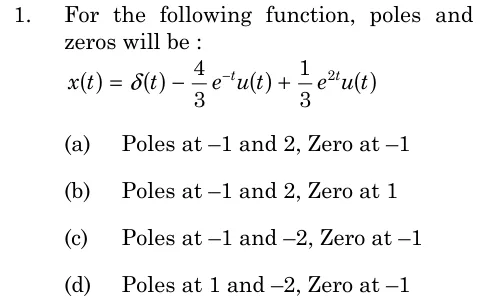 Tap to open full sizeFull solution
Transform each term, combine into a single rational function, and read poles from the denominator and zeros from the numerator after simplifying.
- Q.21 markOfficial answer: C
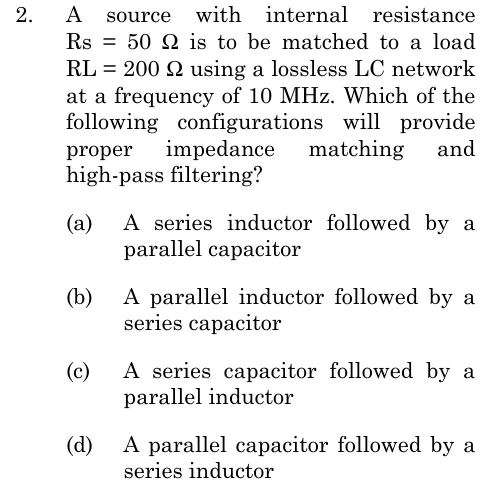 Tap to open full size
Networks (Electric Circuits) › AC, power & resonance
Full solutionIn an L-match the shunt element goes across the larger resistance and the series element on the smaller side, with . For a high-pass match, use a series capacitor and a shunt inductor.
- Q.31 markOfficial answer: C
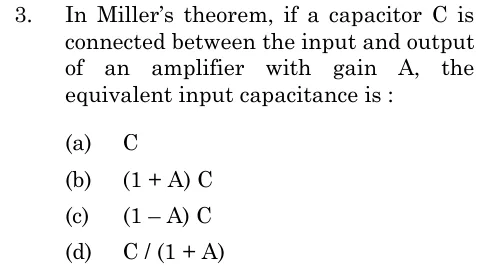 Tap to open full size
Earlier, ISRO's key gave B.
Analog Electronics › Amplifiers
Full solutionMiller's theorem: a bridging impedance appears at the input as , so a bridging capacitor appears as , where is signed.
- Q.41 markOfficial answer: D
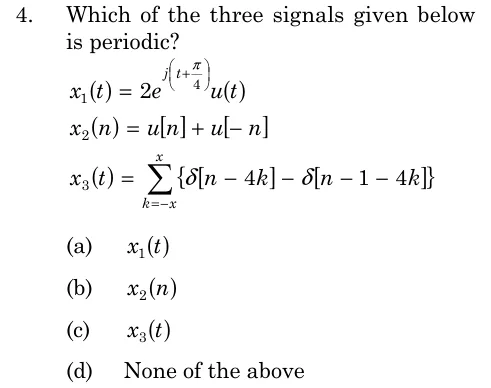 Tap to open full size
Earlier, ISRO's key gave C.
Signals and Systems › Signals basics
The question and its official answerA periodic signal must satisfy for all time. Multiplying by a unit step, or adding a single isolated sample, breaks periodicity. An impulse train that repeats every 4 samples, or a difference of two such trains, is periodic with period 4.
- Q.51 markOfficial answer: C
 Tap to open full sizeFull solution
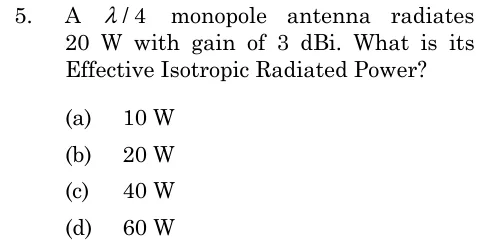
EIRP is radiated power multiplied by antenna gain over isotropic; 3 dBi is a power factor of about 2, so the EIRP is double the radiated power.
- Q.61 markOfficial answer: D
 Tap to open full size
- Q.71 markOfficial answer: C
 Tap to open full size
Signals and Systems › Fourier transform
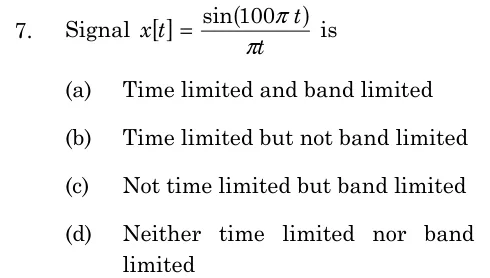
Full solutionA sinc in time is a rectangle in frequency: the spectrum has finite support (band limited), while the time signal extends over all time (not time limited). A non-zero signal cannot be limited in both domains.
- Q.81 markOfficial answer: D
 Tap to open full size
- Q.91 markOfficial answer: C
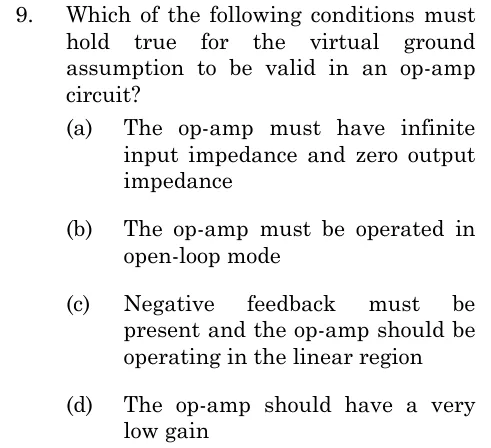 Tap to open full sizeFull solution
The virtual short comes from . It holds only when the output is finite (linear region, not saturated), which negative feedback ensures, together with a very high gain.
- Q.101 markOfficial answer: A
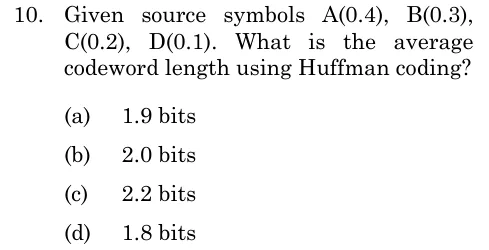 Tap to open full size
- Q.111 markOfficial answer: B
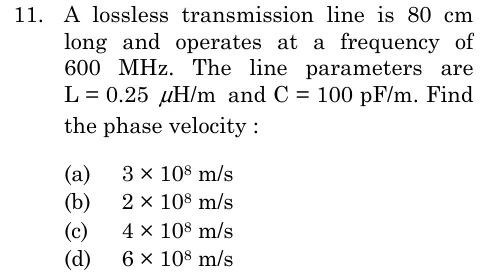 Tap to open full size
Electromagnetics › Transmission lines
Full solutionOn a lossless line, using the per-metre inductance and capacitance. Length and frequency are distractors.
- Q.121 markOfficial answer: B
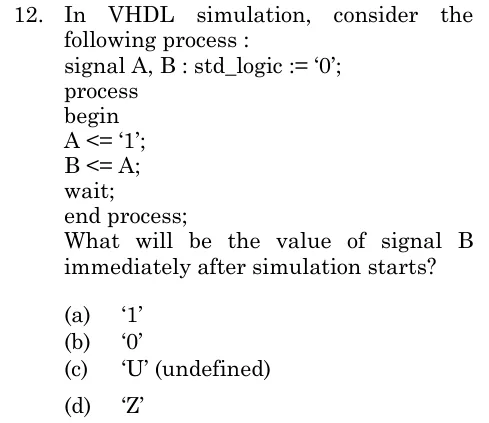 Tap to open full size
- Q.131 markOfficial answer: D
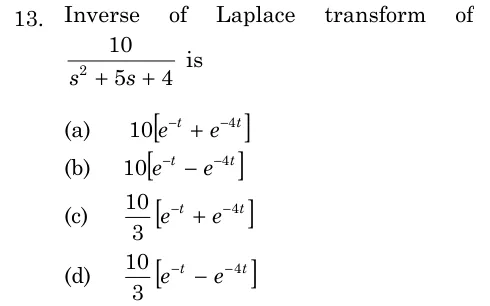 Tap to open full sizeFull solution
Factorise the denominator into real poles, expand in partial fractions using the residue at each pole, then use .
- Q.141 markOfficial answer: B
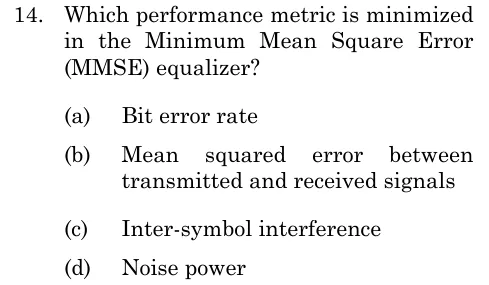 Tap to open full size
- Q.151 markOfficial answer: C
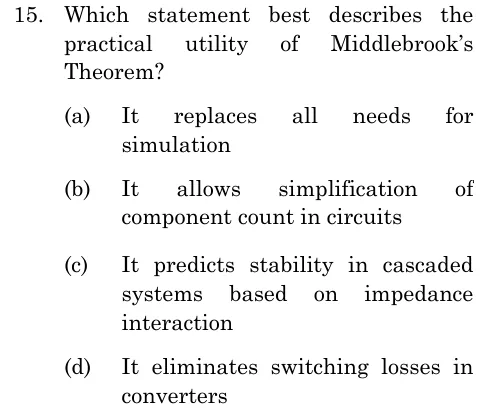 Tap to open full size
- Q.161 markOfficial answer: A
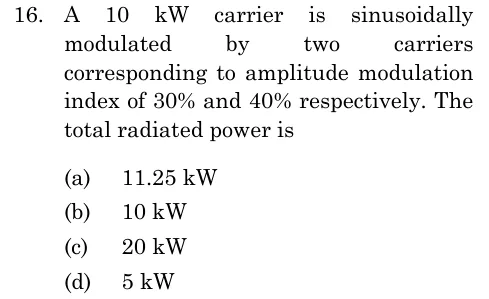 Tap to open full size
- Q.171 markOfficial answer: B
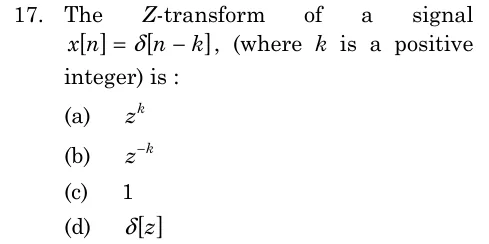 Tap to open full size
Signals and Systems › z-transform
Full solutionA delay of samples in time multiplies the Z-transform by , so . The sum keeps just the single term at .
- Q.181 markOfficial answer: C
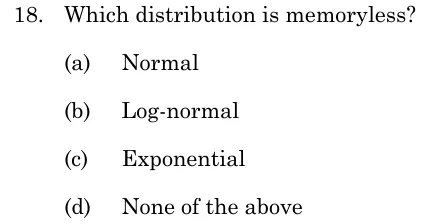 Tap to open full size
Engineering Mathematics › Probability & statistics
Full solutionMemoryless means . This forces the tail to satisfy , whose only continuous solution is , the exponential distribution (the geometric distribution is the discrete analogue).
- Q.191 markOfficial answer: C
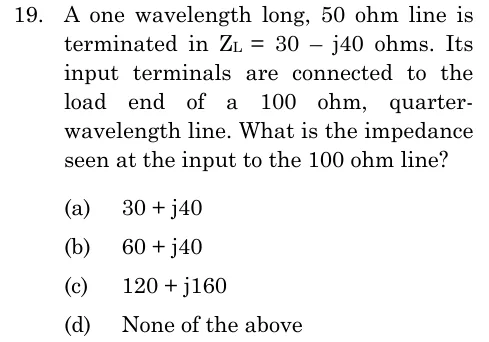 Tap to open full size
Electromagnetics › Transmission lines
Full solutionA line one wavelength long (or any whole number of half-wavelengths) repeats its load impedance, so only the quarter-wave section transforms it, by .
- Q.201 markOfficial answer: A
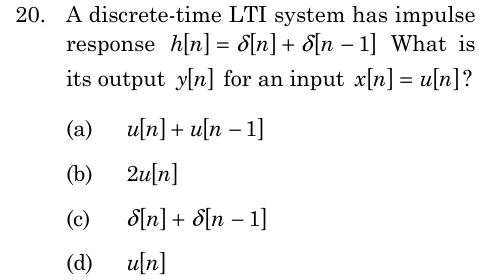 Tap to open full size
Signals and Systems › LTI & convolution
Full solutionConvolution with is a delay by samples, so an impulse response made of impulses gives an output made of delayed copies of the input.
- Q.211 markOfficial answer: A
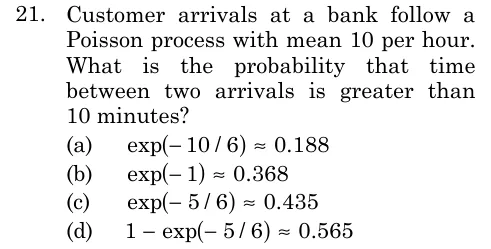 Tap to open full size
Engineering Mathematics › Probability & statistics
Full solutionGaps between arrivals of a Poisson process are exponential with the same rate, so , provided and are in the same time unit.
- Q.221 markOfficial answer: C
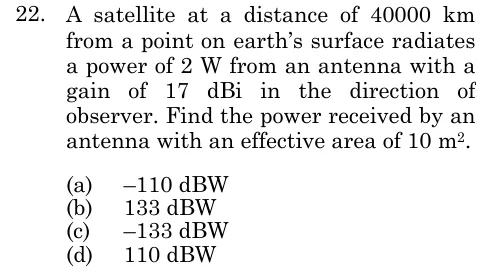 Tap to open full sizeFull solution
Add the dB terms: received power = EIRP (transmit power plus gain) minus the spreading loss plus . Keep in metres and the units consistent (dBW, dB relative to ).
- Q.231 markOfficial answer: C
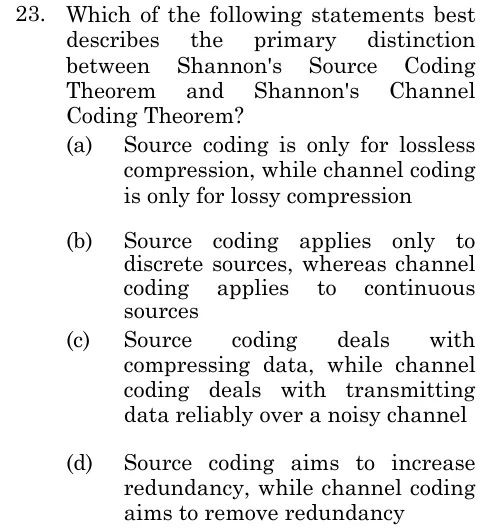 Tap to open full size
- Q.241 markOfficial answer: B
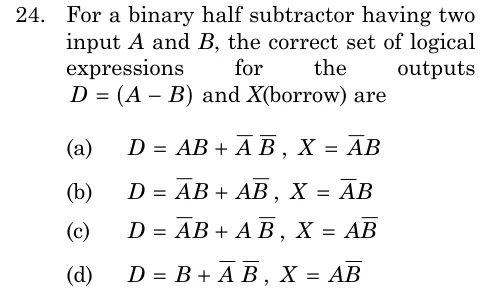 Tap to open full size
Digital Electronics › Combinational
Full solutionA half subtractor has and borrow , because a borrow occurs only for . Build the truth table first and read the expressions from it.
- Q.251 markOfficial answer: B
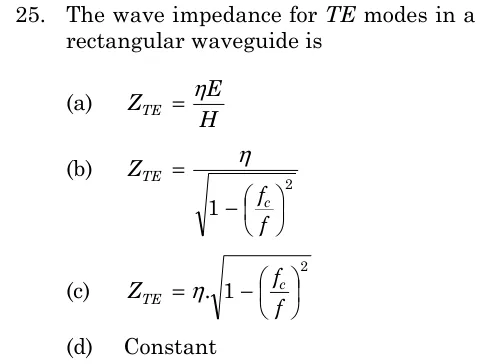 Tap to open full size
Electromagnetics › Waveguides & fibres
Full solutionTE wave impedance is . Because is smaller than , the impedance is larger than and grows without limit at cutoff. TM is the reverse: .
- Q.261 markOfficial answer: B
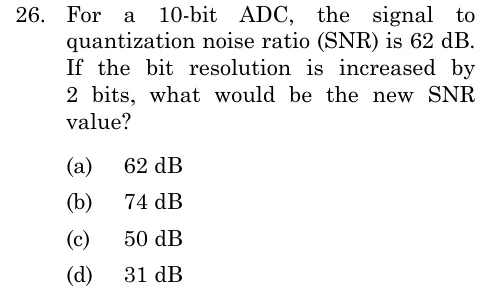 Tap to open full size
Digital Electronics › ADC & DAC
Full solutionAn ideal ADC gains about 6.02 dB of SNR for every extra bit (), so adding 2 bits adds about 12 dB.
- Q.271 markOfficial answer: D
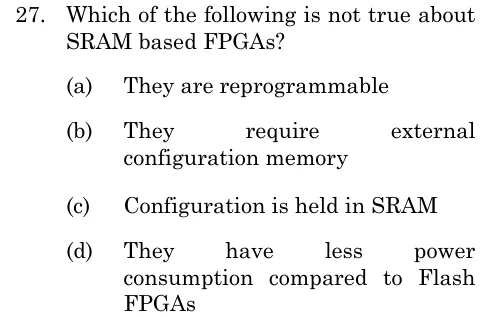 Tap to open full size
- Q.281 markOfficial answer: B
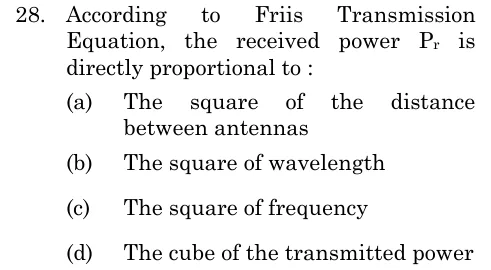 Tap to open full sizeFull solution
Friis equation: . Only the factor is a direct (positive) power-law dependence among the options; distance and frequency appear in the denominator, and transmitted power appears to the first power.
- Q.291 markOfficial answer: C
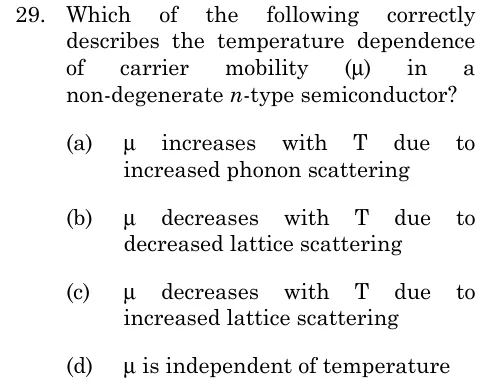 Tap to open full size
Electronic Devices › Carrier transport
Full solutionMobility is . At and above room temperature, phonon (lattice) scattering dominates and grows with , giving .
- Q.301 markOfficial answer: A
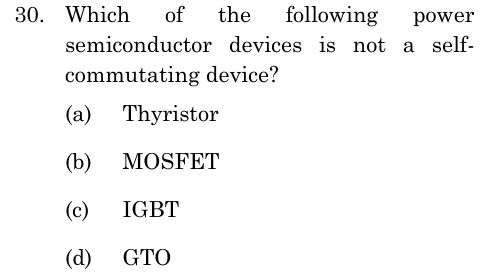 Tap to open full size
- Q.311 markOfficial answer: D
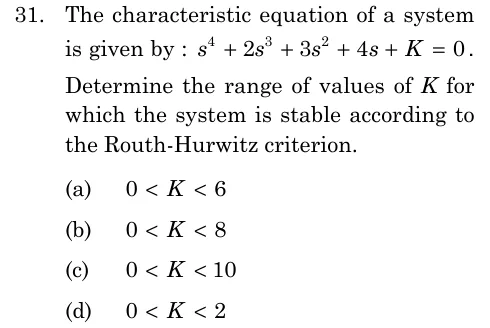 Tap to open full size
Control Systems › Routh–Hurwitz
Full solutionBuild the Routh array and require every first-column entry to be positive. The only entries that depend on are and , which give .
- Q.321 markOfficial answer: D
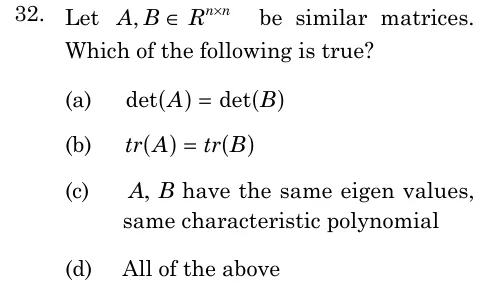 Tap to open full size
Engineering Mathematics › Linear algebra
Full solutionA similarity transformation preserves the characteristic polynomial, and with it the eigenvalues, trace (sum of eigenvalues) and determinant (product of eigenvalues).
- Q.331 markOfficial answer: C
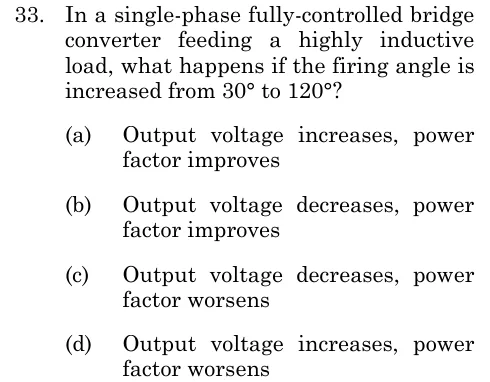 Tap to open full size
- Q.341 markOfficial answer: C
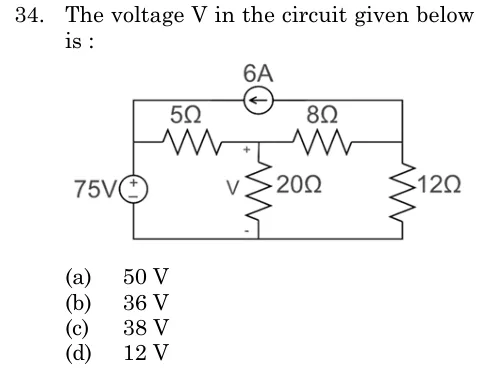 Tap to open full size
Networks (Electric Circuits) › Laws & node/mesh
Full solutionWrite KCL at the two unknown nodes. The ideal voltage source fixes the left node at , and the ideal current source simply forces out of the right node whatever the voltage across it.
- Q.351 markOfficial answer: A
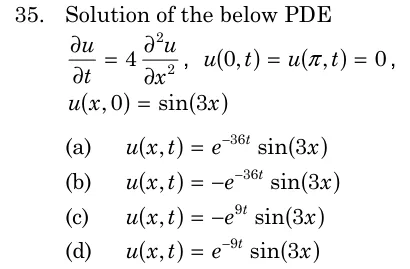 Tap to open full size
Engineering Mathematics › Differential equations
Full solutionFor with at , the mode decays as . A single-mode initial condition stays a single mode.
- Q.361 markOfficial answer: C
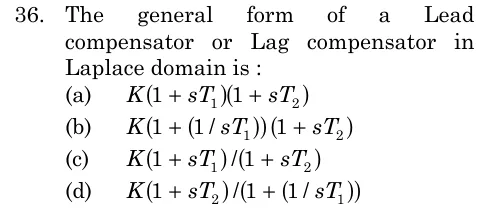 Tap to open full size
Control Systems › Compensators & PID
Full solutionLead and lag compensators share one form, a gain with a single zero and a single pole: . Lead when , lag when .
- Q.371 markOfficial answer: D
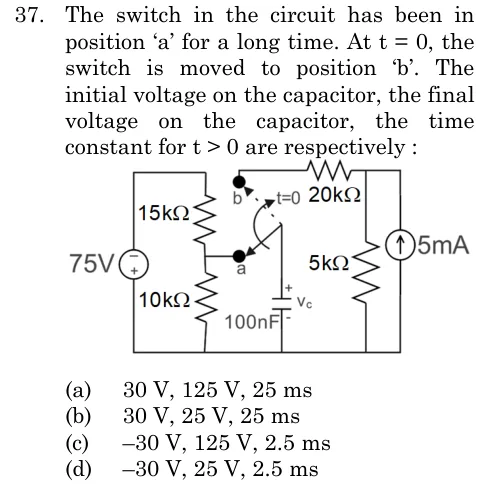 Tap to open full size
Networks (Electric Circuits) › Transients
Full solutionA capacitor voltage is continuous, so take the initial value from the old steady state (with its sign from the polarity marks) and the final value and time constant from the new circuit alone: open the capacitor for the final value, and switch off the sources (current source open) to find the resistance for the time constant.
- Q.381 markOfficial answer: C
 Tap to open full size
Analog Electronics › Amplifiers
Full solutionOutput resistance of a MOSFET in saturation is , so it is inversely proportional to : a larger gives a steeper - curve and a lower .
- Q.391 markOfficial answer: B
 Tap to open full size
- Q.401 markOfficial answer: C
 Tap to open full size
Digital Electronics › Sequential
Full solutionA Mealy detector must remember the count of recent 0s (none, one, two or more) and whether it is inside a qualifying run of 1s. Merge states with identical future behaviour, then check that the rest are pairwise distinguishable by some input sequence.
- Q.411 markOfficial answer: C
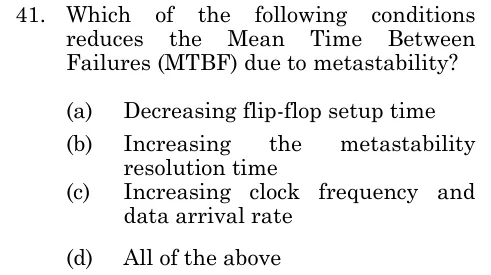 Tap to open full size
Digital Electronics › Sequential
Full solution: anything that adds more sampling events or data edges per second lowers MTBF, while a smaller window or more resolution time raises it.
- Q.421 markOfficial answer: A
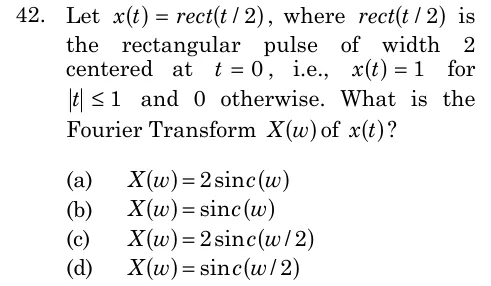 Tap to open full size
Signals and Systems › Fourier transform
Full solutionThe transform of a rectangular pulse of width and height 1 is : its value at is the pulse area, and its first zero is at . Here , so the area is 2 and the first zero is at .
- Q.431 markOfficial answer: B
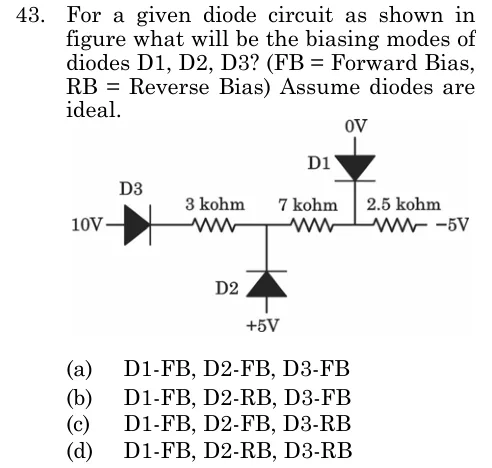 Tap to open full size
Analog Electronics › Diode circuits
Full solutionFor ideal diodes, assume a set of on/off states, solve the circuit, and keep the assumption only if every conducting diode carries positive current and every off diode has reverse voltage across it.
- Q.441 markExcluded from evaluation by ISRO
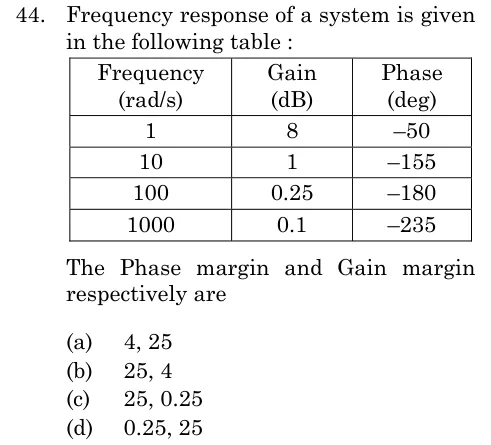 Tap to open full size
Earlier, ISRO's key gave B.
- Q.451 markOfficial answer: C
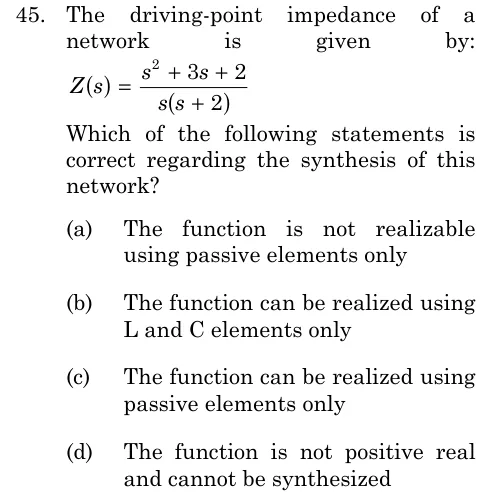 Tap to open full size
- Q.461 markOfficial answer: A
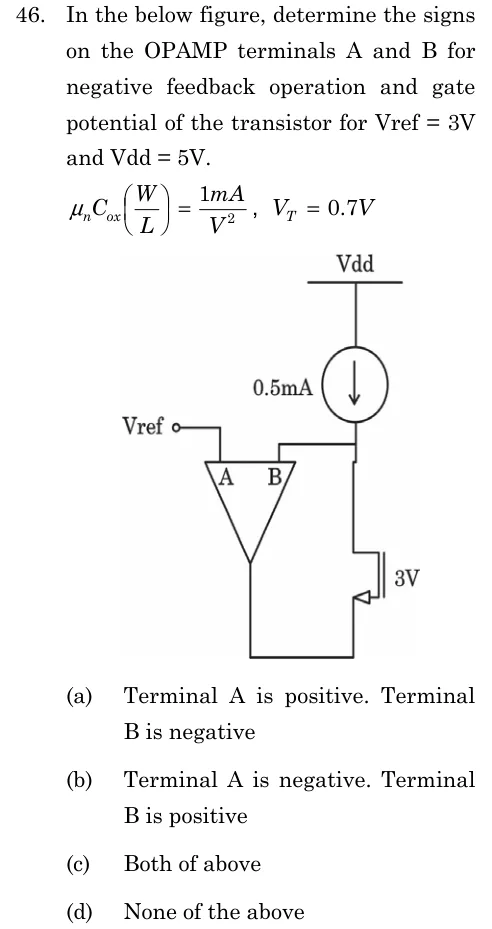 Tap to open full sizeFull solution
To find which op-amp input is inverting, raise the output and follow the loop through the circuit. The input that rises with the output must be the inverting one. Here a higher output lowers , so the transistor current falls and the drain node (terminal B) rises.
- Q.471 markOfficial answer: B
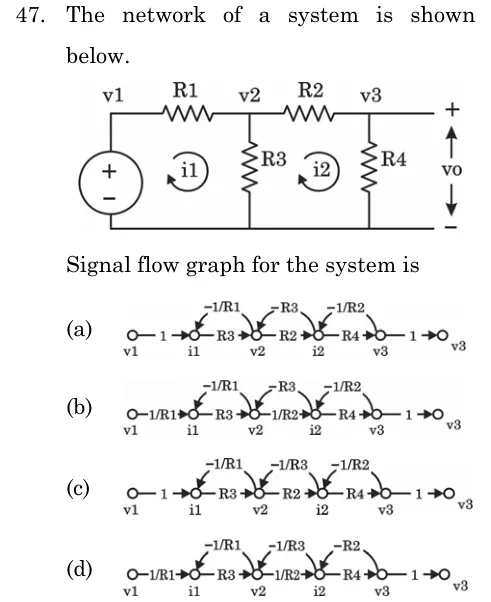 Tap to open full size
Control Systems › Block diagrams & SFG
Full solutionBuild the signal flow graph in alternating form. Each current is a conductance times a voltage difference, so its branches have gain . Each node voltage is a resistance times a current, so its branches have gain .
- Q.481 markOfficial answer: B
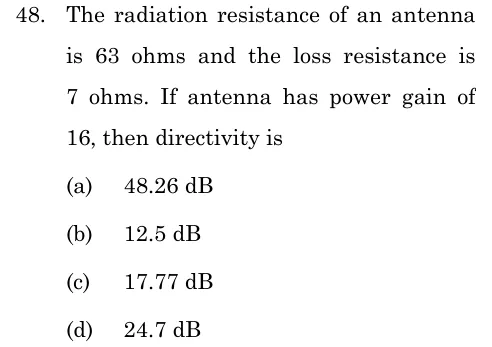 Tap to open full sizeFull solution
Gain includes the ohmic losses and directivity does not, so with . Find as a ratio first, then convert to dB.
- Q.491 markExcluded from evaluation by ISRO
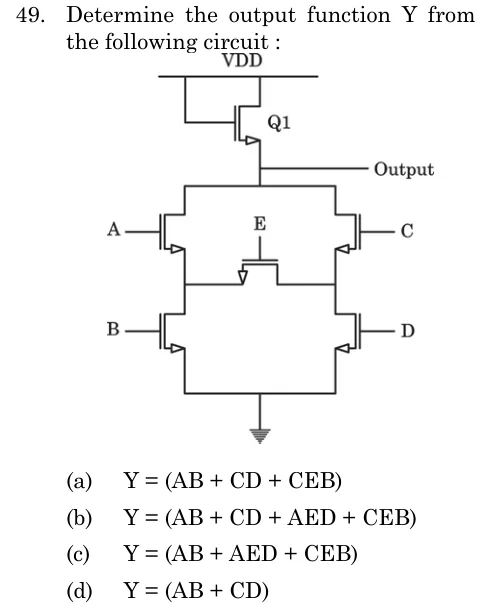 Tap to open full size
Earlier, ISRO's key gave B.
- Q.501 markOfficial answer: D
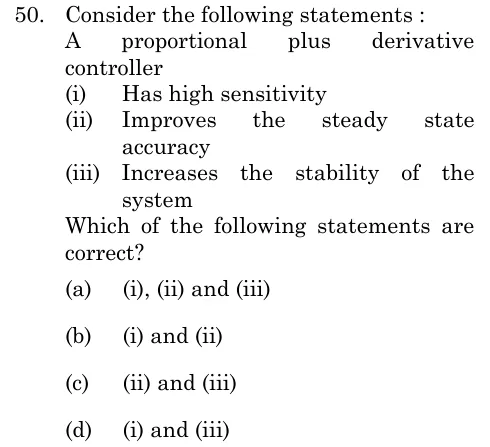 Tap to open full size
Control Systems › Compensators & PID
Full solutionPD control adds a zero: phase lead and damping improve stability and speed, but the gain rises with frequency (noise sensitivity), and it leaves the DC gain, and so the steady-state error, unchanged.
- Q.511 markOfficial answer: B
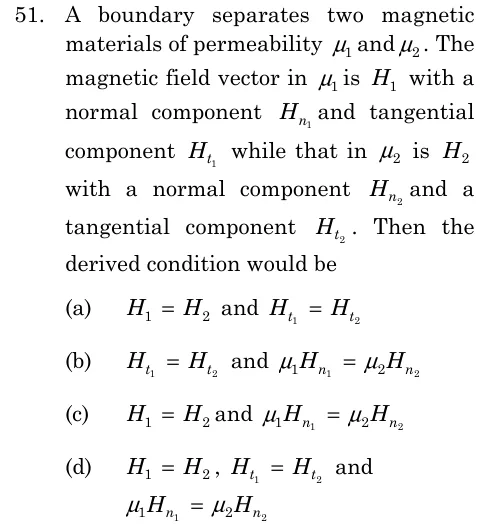 Tap to open full size
Electromagnetics › Maxwell's equations
Full solutionAcross a boundary with no surface current, tangential is continuous (Ampere's law) and normal is continuous (Gauss's law for magnetism), so normal jumps by the ratio of permeabilities.
- Q.521 markOfficial answer: C
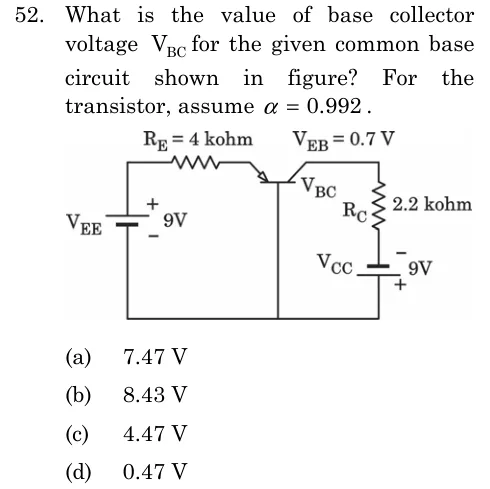 Tap to open full sizeFull solution
In the active region, find from the emitter loop, take , then apply KVL around the collector loop to get the collector voltage relative to the base.
- Q.531 markOfficial answer: D
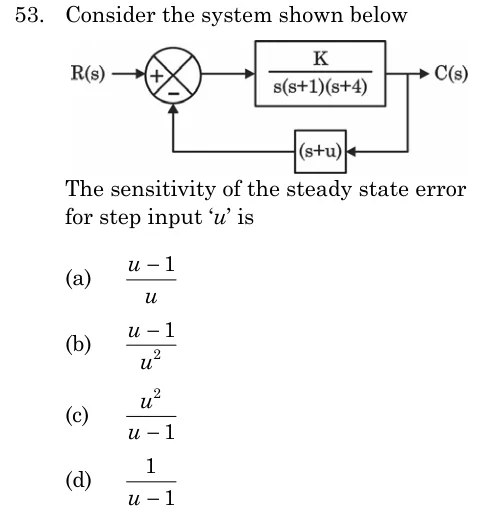 Tap to open full size
Control Systems › Time response
Full solutionWith non-unity feedback, define the error as , not as the summing-junction output. Get from the final value theorem, then apply .
- Q.541 markOfficial answer: A
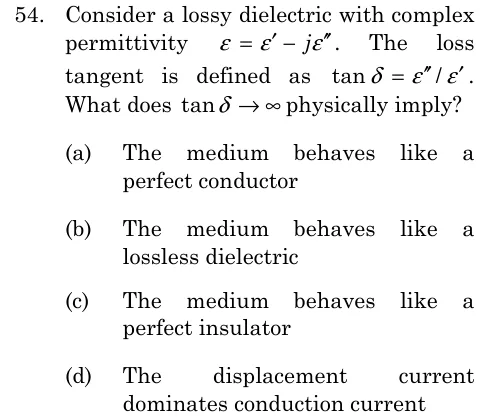 Tap to open full size
Electromagnetics › Plane waves
Full solutionThe loss tangent is the ratio of conduction current to displacement current, . A very large value means conduction dominates, which is conductor behaviour.
- Q.551 markOfficial answer: A
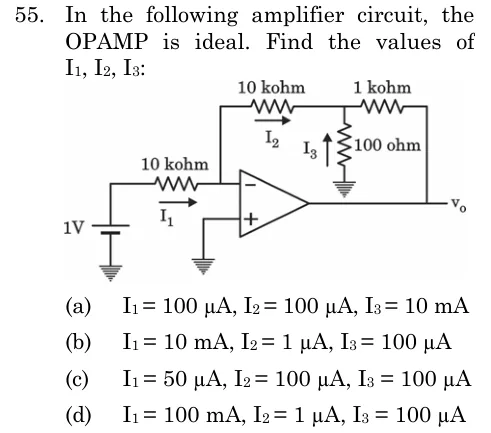 Tap to open full sizeFull solution
With negative feedback and the non-inverting input grounded, the inverting input is a virtual ground and draws no current, so the input current passes entirely through the feedback resistor. The voltage it drops fixes the junction voltage, and Ohm's law on the shunt resistor gives the third current.
- Q.561 markOfficial answer: D
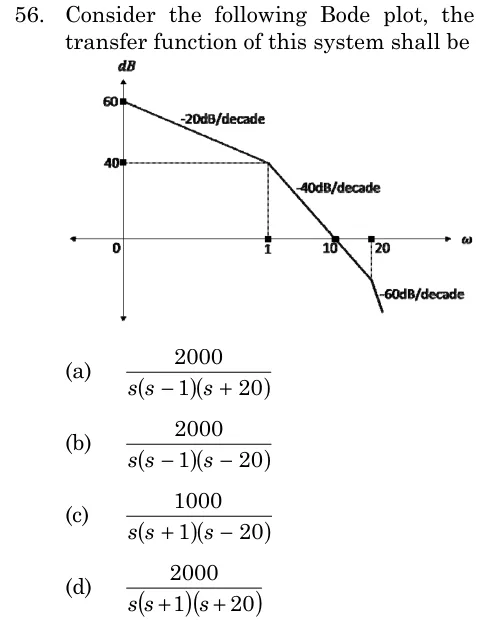 Tap to open full size
Control Systems › Bode & margins
Full solutionRead the corner frequencies and slope changes off the asymptotic Bode plot: each step is a simple pole, and the gain comes from the low-frequency segment, here at .
- Q.571 markOfficial answer: A
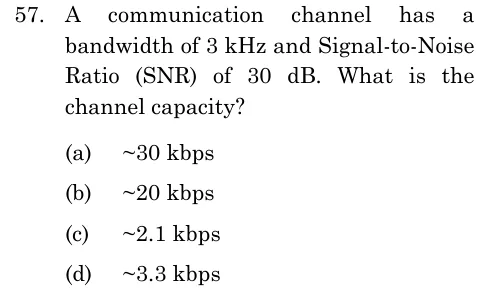 Tap to open full size
- Q.581 markOfficial answer: B
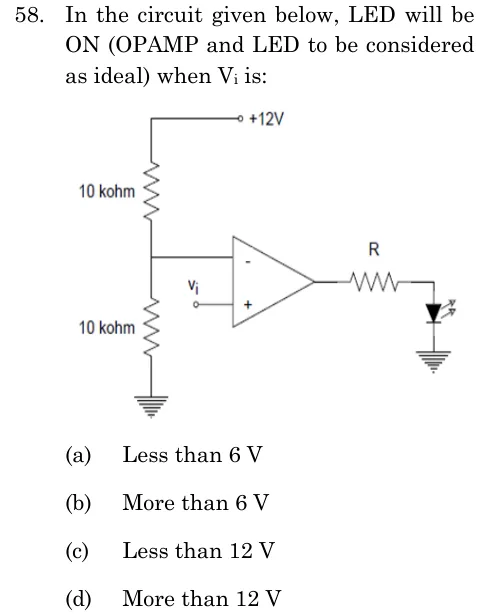 Tap to open full size
Analog Electronics › Filters & waveforms
Full solutionAn op-amp with no feedback is a comparator: the output goes high when the non-inverting input exceeds the inverting input. Find the reference from the resistor divider, then check which output polarity forward-biases the LED.
- Q.591 markOfficial answer: C
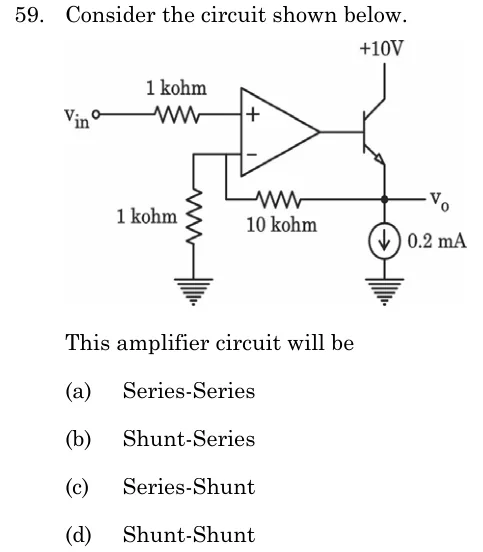 Tap to open full size
Analog Electronics › Feedback & oscillators
Full solutionIdentify the topology by two tests. At the output, set : if the feedback vanishes, the sampling is of voltage (shunt). At the input, ask whether the feedback is subtracted as a voltage in series with the source (series mixing) or as a current at a node (shunt mixing). Here the feedback is a voltage in series and it is sampled from , giving series-shunt.
- Q.601 markOfficial answer: B
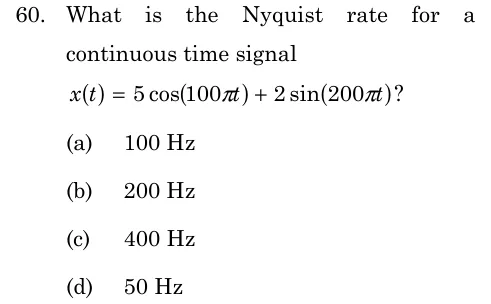 Tap to open full size
Signals and Systems › Sampling
Full solutionNyquist rate = 2 x the highest frequency present in the signal. Convert each angular frequency with and take the largest.
- Q.611 markOfficial answer: A
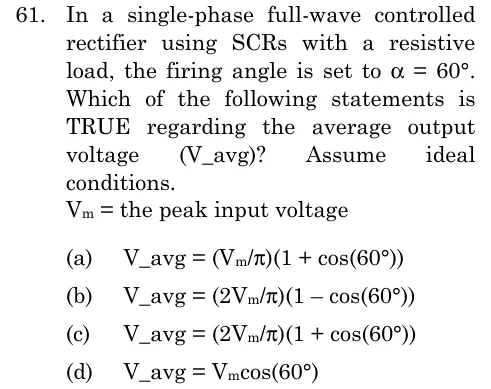 Tap to open full size
Earlier, ISRO's key gave C.
- Q.621 markOfficial answer: B
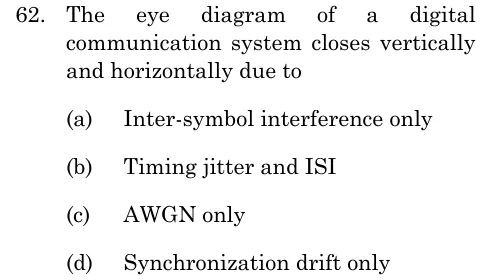 Tap to open full size
- Q.631 markOfficial answer: C
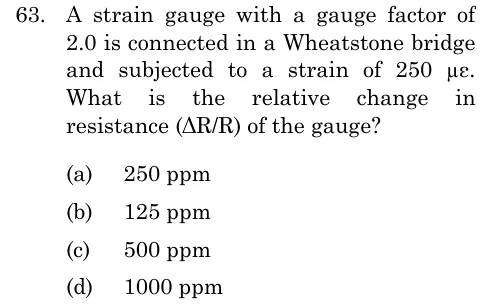 Tap to open full size
- Q.641 markOfficial answer: C
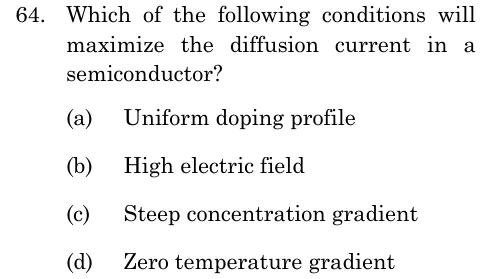 Tap to open full size
Electronic Devices › Carrier transport
Full solutionDiffusion current density is , so it grows with the concentration gradient and vanishes when the profile is uniform.
- Q.651 markOfficial answer: B
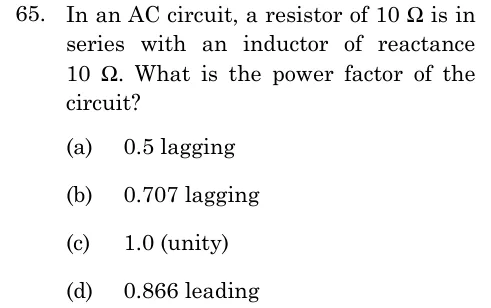 Tap to open full size
Networks (Electric Circuits) › AC, power & resonance
Full solutionFor a series R-L circuit, the power factor is , where . With the phase angle is . The current lags the voltage because the load is inductive.
- Q.661 markOfficial answer: C
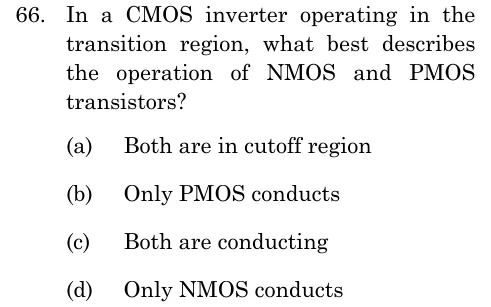 Tap to open full size
Digital Electronics › Logic families
Full solutionIn the transition region , so both the NMOS and the PMOS are on at once. Near both are in saturation, which gives the high gain and the short-circuit current peak.
- Q.671 markOfficial answer: C
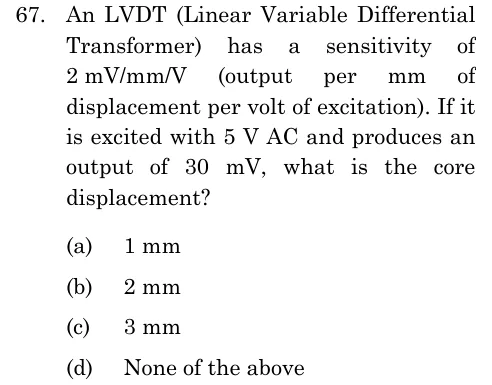 Tap to open full size
- Q.681 markOfficial answer: A
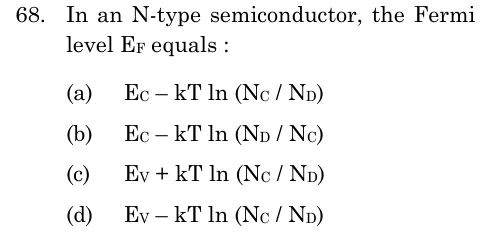 Tap to open full size
Electronic Devices › Semiconductors
Full solutionIn an N-type semiconductor , so sits below by .
- Q.691 markOfficial answer: A
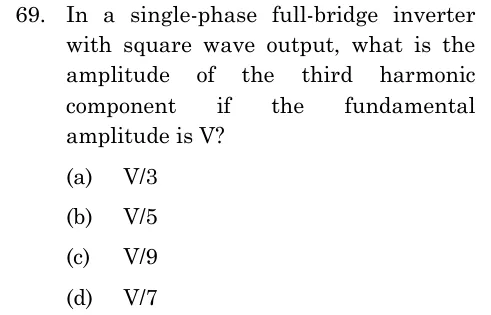 Tap to open full size
- Q.701 markOfficial answer: A
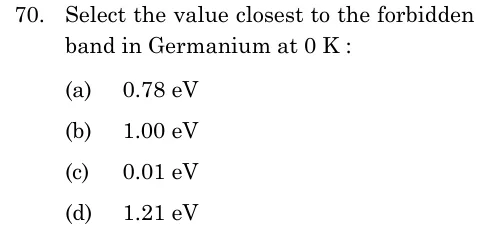 Tap to open full size
Electronic Devices › Semiconductors
Full solutionThe band gap of a semiconductor is largest at : about for germanium (versus at room temperature) and about for silicon (versus at room temperature).
- Q.711 markOfficial answer: A
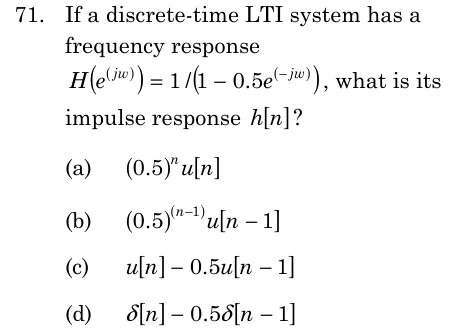 Tap to open full size
Signals and Systems › z-transform
Full solutionA first-order pole factor is the DTFT of the causal decaying exponential (for ).
- Q.721 markOfficial answer: A
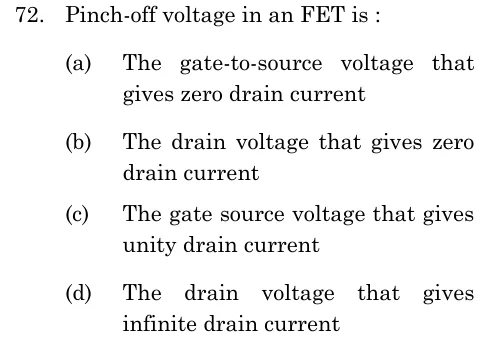 Tap to open full size
Electronic Devices › MOS devices
Full solutionis the gate-to-source voltage at which the channel is fully depleted and , so that vanishes at .
- Q.731 markOfficial answer: C
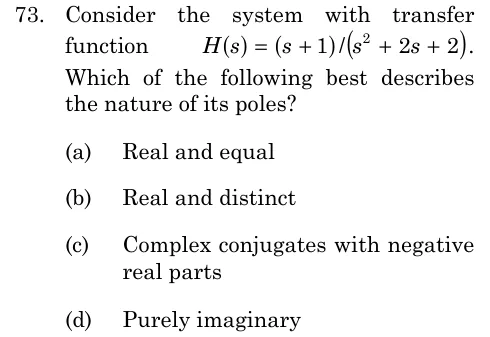 Tap to open full sizeFull solution
Poles are the roots of the denominator. A negative discriminant gives a complex-conjugate pair, and the sign of the real part () tells you stability.
- Q.741 markOfficial answer: C
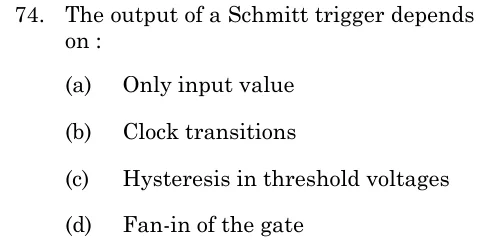 Tap to open full size
Analog Electronics › Filters & waveforms
Full solutionA Schmitt trigger has two thresholds, and . Its output depends on the input and on its previous state, through the hysteresis .
- Q.751 markOfficial answer: C
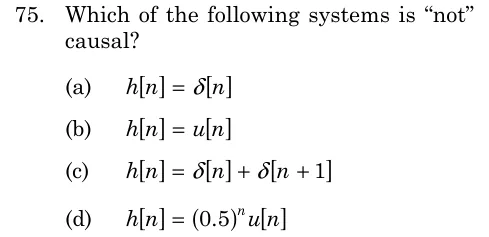 Tap to open full size
Signals and Systems › LTI & convolution
Full solutionAn LTI system is causal exactly when for all . Find where each shifted impulse or step is nonzero. A term like sits at , which is in the past, so it uses a future input.
- Q.761 markOfficial answer: C
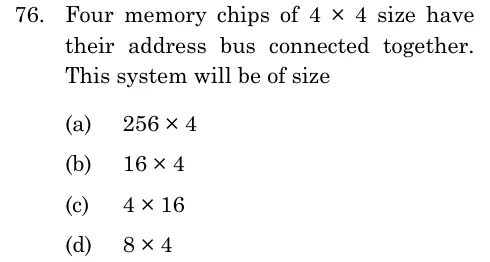 Tap to open full size
Digital Electronics › Processors & memory
Full solutionChips sharing the same address bus (and select) give word-size expansion: locations stay the same, data width adds up. Chips on different address ranges give depth expansion: locations add up, width stays the same.
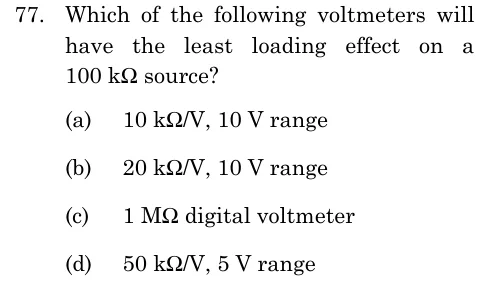
- Q.771 markOfficial answer: C
 Tap to open full size
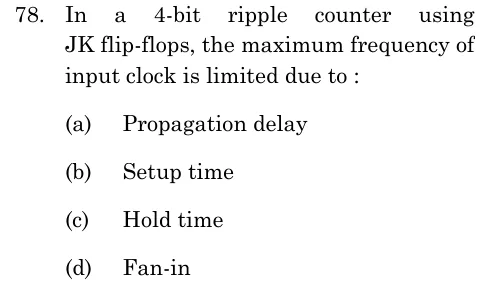
- Q.781 markOfficial answer: A
 Tap to open full size
Digital Electronics › Sequential
Full solutionStages of a ripple counter change one after another, so the total settling time grows as and caps the clock frequency at about .
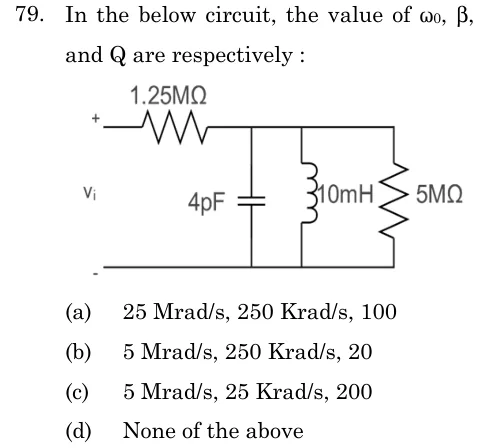
- Q.791 markOfficial answer: B
 Tap to open full size
Networks (Electric Circuits) › AC, power & resonance
Full solutionIn a parallel RLC circuit fed through a series resistor, the source resistance loads the tank: Q and bandwidth use the series resistor in parallel with the shunt resistor, while the resonant frequency depends only on L and C.
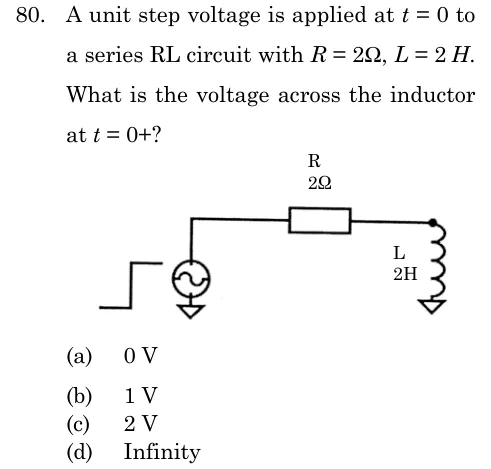
- Q.801 markOfficial answer: B
 Tap to open full size
Networks (Electric Circuits) › Transients
Full solutionAt an inductor with zero initial current behaves like an open circuit: its current stays at zero, so the resistor drops nothing and the whole source voltage appears across the inductor.
Part B: Aptitude Q.81 to Q.95
- Q.811 markOfficial answer: D
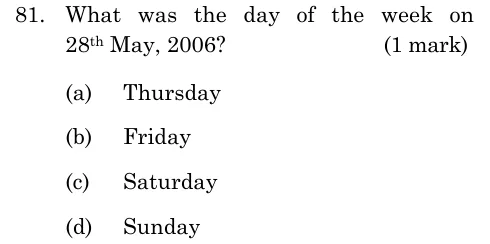 Tap to open full sizeFull solution
Count odd days (days modulo 7) from a known reference date: an ordinary year adds 1 odd day, a leap year adds 2, and a whole number of weeks adds 0.
- Q.821 markExcluded from evaluation by ISRO
 Tap to open full size
Earlier, ISRO's key gave B.
- Q.832 marksOfficial answer: B
 Tap to open full size
Earlier, ISRO's key gave A.
Full solutionA floor number tells you the least number of floors its building has. A 7th floor means at least 7 floors, which is more than 3, so the rule applies and that building has a lift. A conditional "if more than 3, then lift" says nothing about buildings with 3 or fewer floors.
- Q.841 markOfficial answer: C
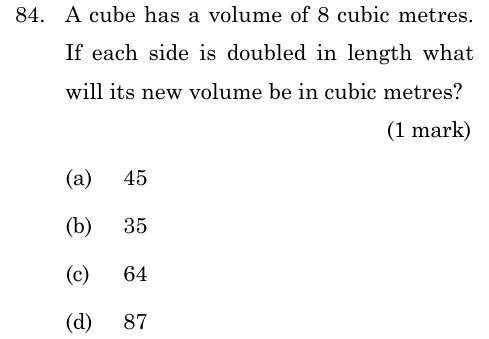 Tap to open full sizeFull solution
Volume scales as the cube of the linear scale factor: doubling every side multiplies the volume by .
- Q.851 markOfficial answer: B
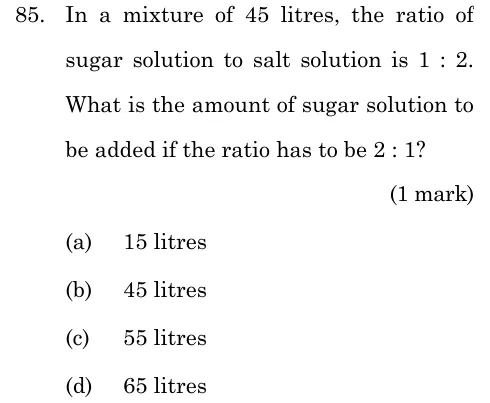 Tap to open full sizeFull solution
When only one component is added, the other component's quantity stays fixed. Use it as the anchor and set up the new ratio against it.
- Q.862 marksOfficial answer: B
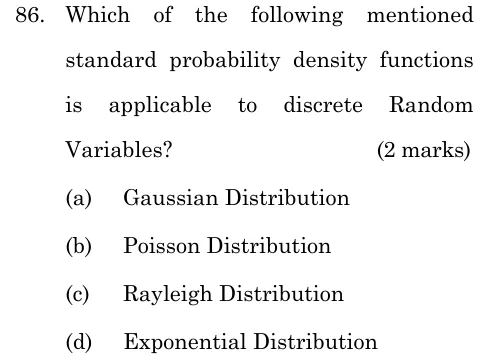 Tap to open full size
General Aptitude › Statistics & probability
Full solutionDiscrete variables take countable values and have a probability mass function. Poisson, binomial and geometric are the standard discrete laws. Gaussian, Rayleigh, exponential and uniform are continuous.
- Q.871 markOfficial answer: D
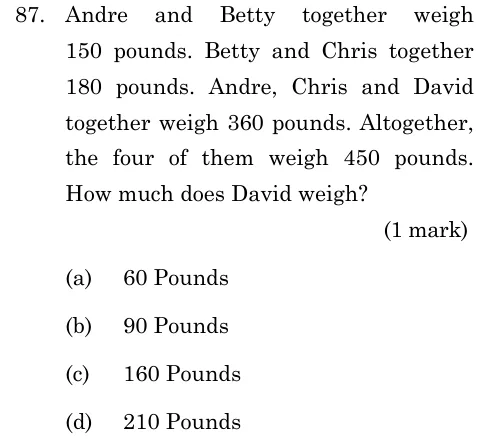 Tap to open full size
Earlier, ISRO's key gave C.
Full solutionSubtract the sum of the people in a given group from the total to isolate the one who is left out, then back-substitute into the other equations.
- Q.881 markOfficial answer: C
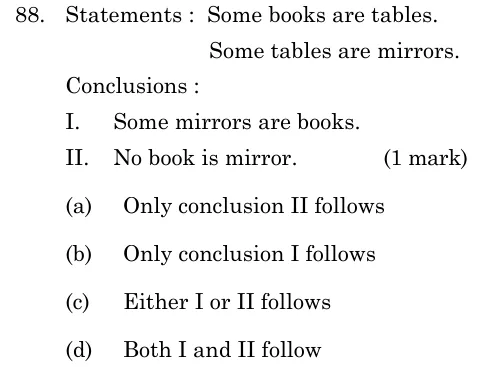 Tap to open full sizeFull solution
When neither conclusion follows by itself but the two are contradictories (a particular affirmative and a universal negative on the same two terms), one of them must be true, so the answer is 'Either I or II follows'.
- Q.892 marksOfficial answer: D
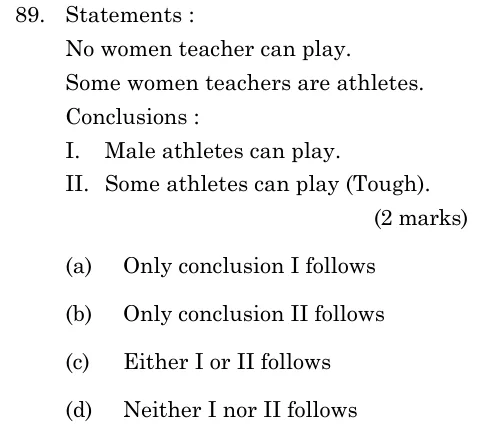 Tap to open full sizeFull solution
A conclusion follows only if the statements force it. Statements about women teachers say nothing positive about other athletes, so claims that other athletes can play are not forced.
- Q.901 markOfficial answer: C
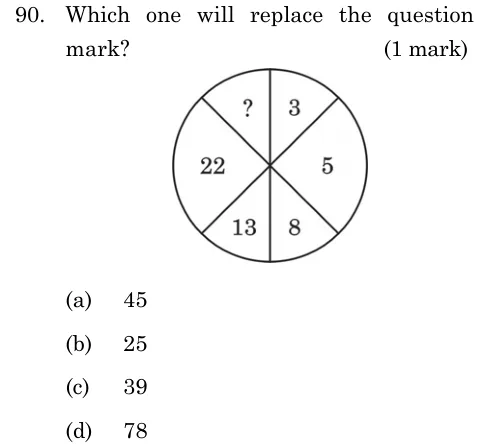 Tap to open full sizeFull solution
When a number series grows quickly, take successive differences, and if they are not constant take differences of the differences. Here the differences are , so the next one is .
- Q.911 markOfficial answer: B
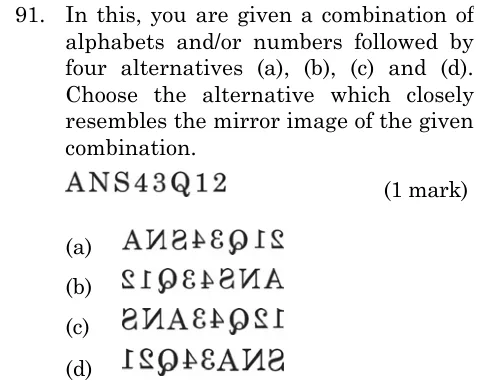 Tap to open full sizeFull solution
A mirror image does two things at once: it reverses the order of the characters and it flips every character left to right. Check the first and last characters of each option first, then check the glyph shapes.
- Q.922 marksOfficial answer: D
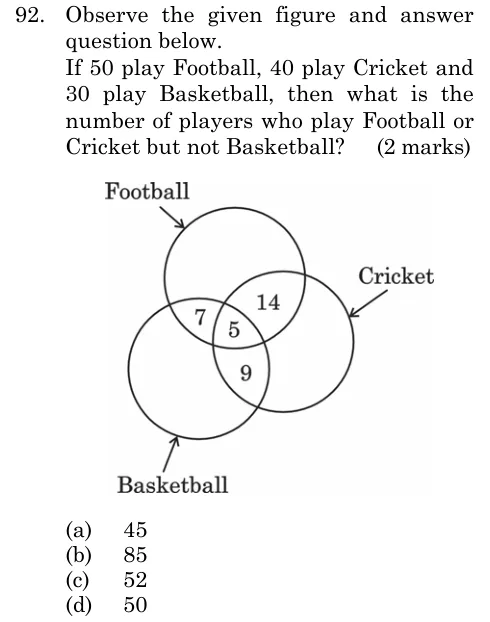 Tap to open full sizeFull solution
Each circle's total includes its overlap regions, so subtract the labelled overlaps to find the unlabelled "only" regions. Then add only the regions lying outside the excluded circle.
- Q.931 markOfficial answer: D
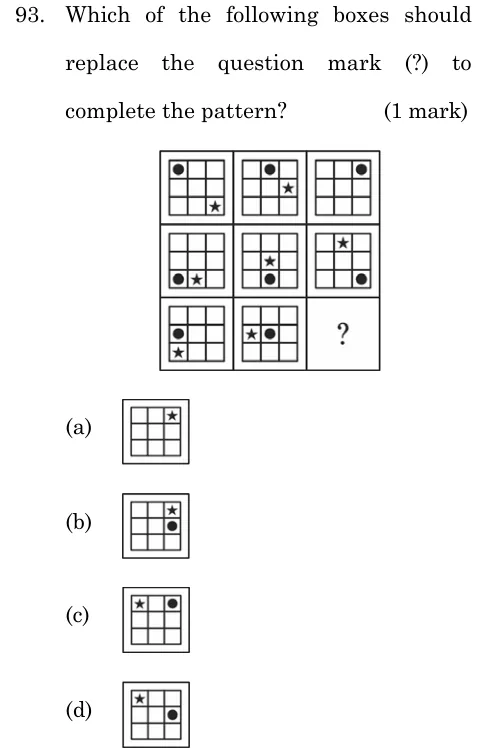 Tap to open full sizeFull solution
In a pattern grid, follow each symbol on its own. Here the circle shifts one square right and the star shifts one square up in every box along a row, and the same two shifts hold in all three rows.
- Q.941 markOfficial answer: C
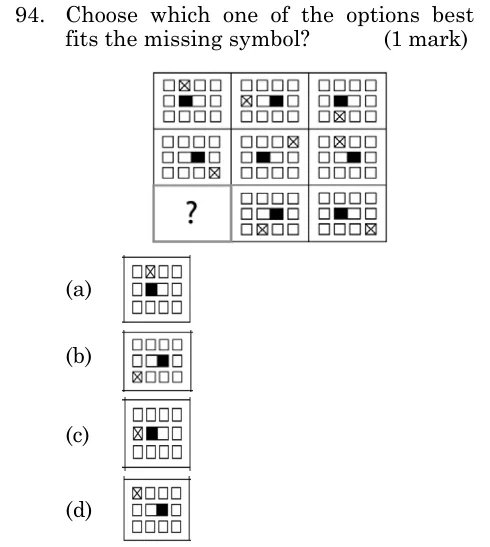 Tap to open full size
Earlier, ISRO's key gave A.
Full solutionSeparate the two marks. The black square follows a chessboard parity rule, and the crossed square repeats between cells a knight's move apart.
- Q.952 marksOfficial answer: A
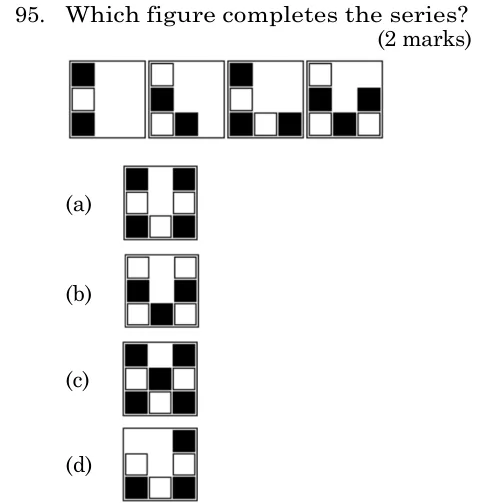 Tap to open full sizeFull solution
Track two things separately: how the shape grows (one square added along a fixed path) and how the colouring behaves (alternating along the path, flipping its starting colour each figure).