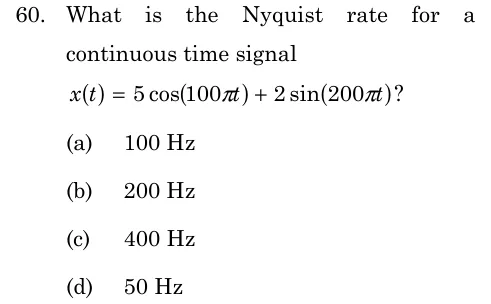
What is the Nyquist rate for a continuous time signal ?
- (A)
100 Hz
- (B)
200 Hz
- (C)
400 Hz
- (D)
50 Hz

What is the Nyquist rate for a continuous time signal ?
100 Hz
200 Hz
400 Hz
50 Hz
ANSWER
The Nyquist rate is , option (B).
Official answer: BSource: ISRO's final answer key of 15 May 2026
For a sinusoid or the frequency is .
First term: has , so .
Second term: has , so .
The spectrum of a sum of sinusoids has lines only at the component frequencies, so the signal is band-limited to .
The Nyquist rate is twice the highest frequency: .
Option (a) is itself, option (d) is the lower component, and option (c) is twice the Nyquist rate. Only option (b) is .
KEY IDEA
Nyquist rate = 2 x the highest frequency present in the signal. Convert each angular frequency with and take the largest.
WATCH OUT FOR
Using the angular frequency directly (200π) as if it were in Hz, or quoting the highest frequency (100 Hz) instead of twice it. Doubling again (400 Hz) is also wrong: the Nyquist rate is 2 f_max, not 4 f_max.
From the ISRO EC 2025 paper. Every question of this paper · The full paper (PDF, ISRO) · All 1 ISRO Sampling question, with notes