
IAE Academy

ISRO EC 2025 Q.95: solution and answer

ISRO 2025 · ECQ.95 · 2 marks · MCQ

Which figure completes the series?
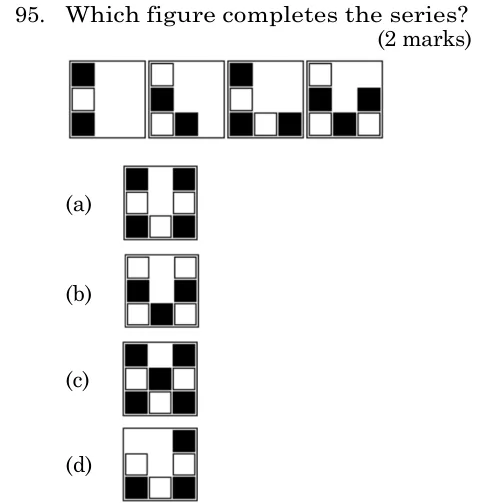
ISRO EC 2025 question 95: Four 3x3 grids form the series;Tap to open full size
Figure from the ISRO EC 2025 paper. It is part of the question.
Figure description

Four 3x3 grids form the series; unused cells are blank. Fig 1: left column only, top to bottom black, white, black. Fig 2: left column white, black, white; bottom row has its middle cell black (bottom-left is the white of the column). Fig 3: left column black, white, black; bottom row black, white, black. Fig 4: left column white, black, white; bottom row white, black, white; right column middle cell black. Four answer grids follow, each with the centre cell blank unless stated. (a) top row black, blank, black; middle row white, blank, white; bottom row black, white, black. (b) top row white, blank, white; middle row black, blank, black; bottom row white, black, white. (c) top row black, blank, black; middle row white, black, white; bottom row black, white, black. (d) top row blank, blank, black; middle row white, blank, white; bottom row black, white, black.

  1. (A)

    3x3 grid: top row black, blank, black; middle row white, blank, white; bottom row black, white, black

  2. (B)

    3x3 grid: top row white, blank, white; middle row black, blank, black; bottom row white, black, white

  3. (C)

    3x3 grid: top row black, blank, black; middle row white, black, white; bottom row black, white, black

  4. (D)

    3x3 grid: top row blank, blank, black; middle row white, blank, white; bottom row black, white, black

Answer and solution

ANSWER

The series grows by one square per figure along a U-shaped path, with colours alternating along it, so the fifth figure is the full U starting black: option (a).

Official answer: ASource: ISRO's final answer key of 15 May 2026

  1. Each figure is a path of squares along the left column (top to bottom), then the bottom row (left to right), then the right column (bottom to top). The centre cell is never used.

  2. Count the squares: Fig 1 has 3, Fig 2 has 4, Fig 3 has 5, Fig 4 has 6. One square is added at each step along the path, so Fig 5 has 7 squares: the full U, with the top-right cell added.

  3. Colours alternate along the path. Reading Fig 4 from the top-left: white, black, white (left column), black (bottom middle), white (bottom right), black (right column middle). Reading Fig 3: black, white, black, white, black. So the colouring along the path alternates, and each new figure starts with the opposite colour to the previous one (Fig 1 black, Fig 2 white, Fig 3 black, Fig 4 white). Fig 5 therefore starts black at the top-left.

  4. Fig 5 along the path from the top-left: black, white, black (left column down to the bottom-left corner), white (bottom middle), black (bottom-right corner), white (right column middle), black (right column top).

  5. As a grid: top row black, blank, black; middle row white, blank, white; bottom row black, white, black. This is option (a).

  6. The other options fail. (c) fills the centre cell, which the path never uses. (d) leaves the top-left square empty, so it has only 6 squares. (b) has all 7 squares but starts with white, which is the colouring of an even-numbered figure, not Fig 5.

KEY IDEA

Track two things separately: how the shape grows (one square added along a fixed path) and how the colouring behaves (alternating along the path, flipping its starting colour each figure).

WATCH OUT FOR

Looking only at the shape and picking the full U that starts with the wrong colour (option b), or filling the centre cell (option c). The shape alone does not decide it: the starting colour of an odd-numbered figure is black.

From the ISRO EC 2025 paper. Also Q.95 of the ISRO Scientist/Engineer Computer Science 2025 paper. Every question of this paper · The full paper (PDF, ISRO) · All 7 ISRO Spatial questions, with notes

More ISRO Spatial questions