
IAE Academy

ISRO EC 2025 Q.94: solution and answer

ISRO 2025 · ECQ.94 · 1 mark · MCQ

Choose which one of the options best fits the missing symbol? (1 mark)
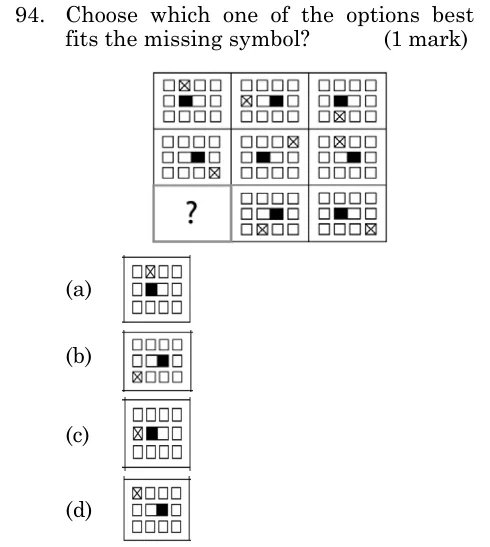
ISRO EC 2025 question 94: A 3x3 array of symbols;Tap to open full size
Figure from the ISRO EC 2025 paper. It is part of the question.
Figure description

A 3x3 array of symbols; bottom-left cell is blank with '?'. Each symbol is a 3-row by 4-column grid of small squares with one black square in the middle row and one square crossed with an X. Row1: (black col2, X top col2), (black col3, X middle col1), (black col2, X bottom col2). Row2: (black col3, X bottom col4), (black col2, X top col4), (black col3, X top col2). Row3: ?, (black col3, X bottom col2), (black col2, X bottom col4). Options are four such symbols: (a) black col2, X top col2; (b) black col3, X bottom col1; (c) black col2, X middle row col1; (d) black col3, X top col1.

  1. (A)

    Figure — symbol with black square at middle row column 2 and X at top row column 2

  2. (B)

    Figure — symbol with black square at middle row column 3 and X at bottom row column 1

  3. (C)

    Figure — symbol with black square at middle row column 2 and X at middle row column 1

  4. (D)

    Figure — symbol with black square at middle row column 3 and X at top row column 1

Answer and solution

ANSWER

Option (c): black square in the middle row, column 2, with the X in the middle row, column 1.

Official answer: CSource: ISRO's final answer key of 15 May 2026

  1. Each cell is a 3-row by 4-column grid of small squares. It carries two marks: one black square in the middle row, and one square crossed with an X. Treat the two marks separately.

  2. Black square. Number the array rows 1 to 3 and columns 1 to 3. The black square sits in column 2 of its cell when (row + column) is even and in column 3 when (row + column) is odd. All eight visible cells follow this: (1,1), (1,3), (2,2), (3,3) have it in column 2, and (1,2), (2,1), (2,3), (3,2) have it in column 3.

  3. The missing cell is (3,1), where row + column = 4 is even, so its black square is in column 2. Options (b) and (d) have it in column 3, so they are out. Options (a) and (c) remain, and they differ only in the position of the X.

  4. Crossed square. Write its position as (row, column) inside the cell: (1,1) has top row, column 2; (1,2) has middle row, column 1; (1,3) has bottom row, column 2; (2,1) has bottom row, column 4; (2,2) has top row, column 4; (2,3) has top row, column 2; (3,2) has bottom row, column 2; (3,3) has bottom row, column 4.

  5. Pair up cells whose crossed square is in the same place. Top row, column 2 occurs in (1,1) and (2,3). Bottom row, column 4 occurs in (2,1) and (3,3). Bottom row, column 2 occurs in (1,3) and (3,2). Each pair is a chess-knight move apart in the array (one step along one direction and two along the other).

  6. The centre cell (2,2) cannot be the end of any knight move inside a 3 by 3 array, so it is the only unpaired cell. That leaves (1,2), with its X at middle row, column 1, and the missing cell (3,1), which are also a knight move apart (two rows down, one column left). So the missing cell has the same X position as (1,2): middle row, column 1.

  7. The missing symbol therefore has its black square in the middle row, column 2 and its X in the middle row, column 1. That is option (c). Option (a) would copy the X of cell (1,1) instead, which breaks the knight-move pairing.

KEY IDEA

Separate the two marks. The black square follows a chessboard parity rule, and the crossed square repeats between cells a knight's move apart.

WATCH OUT FOR

Fixing on the black square alone leaves two options; picking between them by guessing "the new-looking one" is unreliable, since the X position must be matched to its knight-move partner cell.

From the ISRO EC 2025 paper. Also Q.94 of the ISRO Scientist/Engineer Computer Science 2025 paper. Every question of this paper · The full paper (PDF, ISRO) · All 7 ISRO Spatial questions, with notes

More ISRO Spatial questions