IAE Academy

ISRO EC 2025 Q.50: solution and answer

ISRO 2025 · ECQ.50 · 1 mark · MCQ

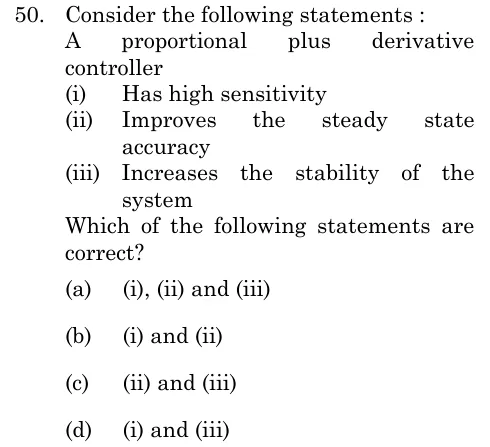
Consider the following statements: A proportional plus derivative controller (i) Has high sensitivity (ii) Improves the steady state accuracy (iii) Increases the stability of the system. Which of the following statements are correct?

  1. (A)

    (i), (ii) and (iii)

  2. (B)

    (i) and (ii)

  3. (C)

    (ii) and (iii)

  4. (D)

    (i) and (iii)

See the question in the paper

Answer and solution

ANSWER

The correct statements are (i) and (iii), option (d).

Official answer: DSource: ISRO's final answer key of 15 May 2026

  1. A PD controller has transfer function . It adds one zero at and no pole.

  2. Statement (iii), increases stability: the zero contributes phase lead . This raises the phase margin and adds damping, so relative stability improves and overshoot falls. True.

  3. Statement (ii), improves steady-state accuracy: at DC, , because the derivative term vanishes as . The system type and the error constants of the loop are unchanged, so the steady-state error is unchanged. Only an integral term improves steady-state accuracy. False.

  4. Statement (i), high sensitivity: the controller gain grows with frequency. The controller therefore amplifies high-frequency signals and noise, and widens the bandwidth, so it is highly sensitive to such inputs. This is the standard listed property of PD action. True.

  5. The correct statements are (i) and (iii), which is option (d).

KEY IDEA

PD control adds a zero: phase lead and damping improve stability and speed, but the gain rises with frequency (noise sensitivity), and it leaves the DC gain, and so the steady-state error, unchanged.

WATCH OUT FOR

Thinking that a faster, better-damped response also means better steady-state accuracy. Only integral action, which raises the system type, reduces steady-state error; the derivative term vanishes at DC.

From the ISRO EC 2025 paper. Every question of this paper · The full paper (PDF, ISRO) · All 3 ISRO Compensators & PID questions, with notes