
IAE Academy

ISRO EC 2025 Q.9: solution and answer

ISRO 2025 · ECQ.9 · 1 mark · MCQ

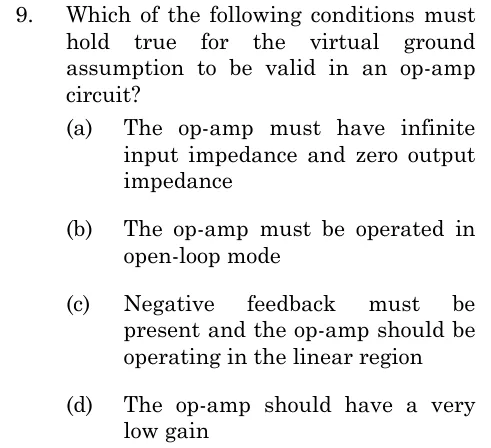
Which of the following conditions must hold true for the virtual ground assumption to be valid in an op-amp circuit?

  1. (A)

    The op-amp must have infinite input impedance and zero output impedance

  2. (B)

    The op-amp must be operated in open-loop mode

  3. (C)

    Negative feedback must be present and the op-amp should be operating in the linear region

  4. (D)

    The op-amp should have a very low gain
See the question in the paper

Answer and solution

ANSWER

Option (c): negative feedback must be present and the op-amp must operate in its linear region.

Official answer: CSource: ISRO's final answer key of 15 May 2026

  1. The virtual short means . Since , this difference is nearly zero only when stays finite (within the supply limits) and is very large.

  2. stays within the supply limits only if the output is not saturated. That needs negative feedback, which feeds part of the output back to the inverting input and drives the differential input toward zero, and it needs the op-amp to operate in its linear region.

  3. So the condition is negative feedback together with linear-region operation, which is option (c).

  4. Option (a) describes an ideal op-amp (infinite input impedance, zero output impedance). It does not guarantee a virtual short: in open loop an ideal op-amp still saturates and .

  5. Option (b) is wrong. In open loop the tiny differential input is multiplied by and drives the output into saturation, so there is no virtual ground.

  6. Option (d) is wrong. A very low gain makes non-negligible, so the virtual short fails. A very high gain is needed.

KEY IDEA

The virtual short comes from . It holds only when the output is finite (linear region, not saturated), which negative feedback ensures, together with a very high gain.

WATCH OUT FOR

Choosing (a) because it describes an ideal op-amp. Ideal parameters alone do not create a virtual short: without negative feedback the output saturates, and the inputs are not forced to be equal.

From the ISRO EC 2025 paper. Every question of this paper · The full paper (PDF, ISRO) · All 4 ISRO Op-amps questions, with notes

More ISRO Op-amps questions