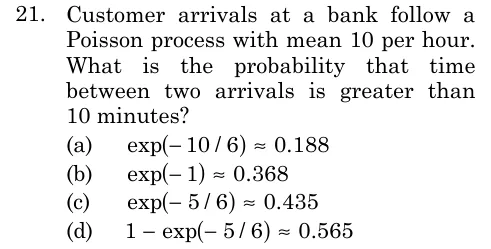
Customer arrivals at a bank follow a Poisson process with mean 10 per hour. What is the probability that time between two arrivals is greater than 10 minutes?
- (A)
exp(-10/6) ≈ 0.188
- (B)
exp(-1) ≈ 0.368
- (C)
exp(-5/6) ≈ 0.435
- (D)
1 - exp(-5/6) ≈ 0.565

Customer arrivals at a bank follow a Poisson process with mean 10 per hour. What is the probability that time between two arrivals is greater than 10 minutes?
exp(-10/6) ≈ 0.188
exp(-1) ≈ 0.368
exp(-5/6) ≈ 0.435
1 - exp(-5/6) ≈ 0.565
ANSWER
The probability is , option (a).
Official answer: ASource: ISRO's final answer key of 15 May 2026
In a Poisson process of rate , the time between successive arrivals is exponentially distributed with density , .
The mean arrival rate is per hour.
Express the time in the same unit as the rate: .
The survival function of the exponential distribution is .
This is option (a), (the value truncated to three places).
Option (b) has , which would need a rate of 6 per hour. Options (c) and (d) have , which corresponds to a rate of 5 per hour (or a mix-up of units); option (d) is simply minus option (c).
KEY IDEA
Gaps between arrivals of a Poisson process are exponential with the same rate, so , provided and are in the same time unit.
WATCH OUT FOR
Using with minutes without converting to hours, or using the cumulative probability (which is ) instead of the survival function.
From the ISRO EC 2025 paper. Every question of this paper · The full paper (PDF, ISRO) · All 4 ISRO Probability & statistics questions, with notes