IAE Academy

EVERY GATE PAPER

Geometry and mensuration

Geometry and mensuration covers the angle and length facts of lines, triangles, polygons and circles, the formulas of coordinate geometry, and the areas, surface areas and volumes of standard plane figures and solids. A question on this topic may show or describe a figure and ask for a length, angle, area or volume, or ask how a quantity changes when a figure is scaled, cut, or melted and recast. Solving such questions quickly depends on knowing each standard result exactly, together with the conditions under which it holds.

22 previous-year questions · 22 solved · 5 practice questions

Lines, angles and polygons

Angles are in degrees throughout these notes. Angles on a straight line (a linear pair) add to , angles round a point add to , and vertically opposite angles are equal. Two angles are complementary if they add to and supplementary if they add to .

When a transversal cuts two parallel lines, corresponding angles are equal, alternate interior angles are equal, alternate exterior angles are equal, and co-interior angles (the two interior angles on the same side of the transversal) add to . Each statement also works in reverse: if any one of them holds for two lines in a plane cut by a transversal, the lines are parallel. A standard move in figure questions is to draw an extra line through a vertex, parallel to a given line, and then follow the alternate angles.

INTERIOR ANGLE SUM OF A POLYGON

Any simple polygon with sides (sides do not cross), convex or not: for a triangle, for a quadrilateral, for a pentagon.

EXTERIOR ANGLE SUM OF A CONVEX POLYGON

One exterior angle taken at each vertex of a convex polygon; the sum is whatever the value of . At every vertex, interior angle exterior angle .

EACH ANGLE OF A REGULAR POLYGON

Regular polygon only (all sides equal and all angles equal).

NUMBER OF DIAGONALS

A diagonal joins two vertices that are not neighbours. Each vertex joins others by a diagonal (not itself and not its two neighbours); dividing by 2 stops each diagonal being counted twice.

WORKED EXAMPLE

The ratio of each interior angle to each exterior angle of a regular polygon is . Find the number of sides, each interior angle and the number of diagonals.

Solution
  1. Interior and exterior , so interior : exterior .

  2. Setting gives , so .

  3. Each exterior angle , so each interior angle . Check: .

  4. Diagonals .

Answer: 9 sides; each interior angle ; 27 diagonals.

EXAM TIP

To find for a regular polygon, go through the exterior angle: exterior interior, then exterior. If this is not a whole number (at least 3), no such regular polygon exists. For example, no regular polygon has an interior angle of , because .

Triangles: congruence, similarity, areas and centres

In every triangle the three angles add to , and an exterior angle equals the sum of the two interior opposite angles. The triangle inequality: the sum of any two sides is greater than the third side (equivalently, the difference of any two sides is less than the third). So three positive lengths form a triangle exactly when . The largest angle is opposite the longest side and the smallest angle is opposite the shortest side. Throughout, side is opposite angle , opposite and opposite .

Congruence tests (same shape and same size)

  1. SSS: all three pairs of sides equal.

  2. SAS: two pairs of sides equal and the angles between them equal.

  3. ASA: two pairs of angles equal and the sides between them equal.

  4. AAS: two pairs of angles equal and a pair of corresponding sides not between them equal.

  5. RHS: both right-angled, with equal hypotenuses and one other pair of equal sides.

  6. Not tests: SSA (two sides and an angle not between them) can fit two different triangles, and AAA fixes only the shape, not the size.

Similarity tests and their consequences

  1. AA: two angles of one triangle equal two angles of the other (the third angles then agree automatically).

  2. SSS: all three pairs of corresponding sides are in the same ratio.

  3. SAS: two pairs of corresponding sides are in the same ratio and the angles between them are equal.

  4. If the side ratio of two similar triangles is , every pair of corresponding lengths (altitudes, medians, angle bisectors, perimeters, inradii, circumradii) is in the ratio , and the areas are in the ratio .

  5. Basic proportionality theorem: a line parallel to one side of a triangle divides the other two sides in the same ratio. If with on and on , then and . Conversely, a line that divides two sides in the same ratio is parallel to the third side.

  6. Mid-point theorem: the segment joining the mid-points of two sides is parallel to the third side and half as long.

Areas can often be compared without computing them. Triangles with the same height (for example, with a common vertex and their bases on one straight line) have areas in the ratio of their bases, so a median divides a triangle into two triangles of equal area. Triangles on the same base and between the same parallels have equal areas, and each has half the area of a parallelogram on the same base and between the same parallels.

PYTHAGORAS' THEOREM AND THE ANGLE TEST

is the side opposite angle . Apply the test to the longest side: the triangle is acute, right or obtuse according to the angle opposite that side.

AREA OF A TRIANGLE

is the perpendicular height onto the base (in an obtuse triangle it can fall outside the triangle, on the extended base); is the angle between sides and .

HERON'S FORMULA

Any triangle whose three sides are known. If any of , , is zero or negative, the three lengths do not form a triangle.

ISOSCELES TRIANGLE WITH EQUAL SIDES A AND BASE B

is the height onto the base ; it bisects both the base and the angle between the equal sides. The lengths form a triangle only when .

EQUILATERAL TRIANGLE OF SIDE A

All four centres coincide at the centroid, which divides each height in the ratio from the vertex. So and , giving and .

INRADIUS AND CIRCUMRADIUS

Any triangle: is the radius of the incircle (touches all three sides), the radius of the circumcircle (passes through all three vertices) and the semi-perimeter.

RIGHT TRIANGLE WITH LEGS A, B AND HYPOTENUSE C

is the altitude from the right angle to the hypotenuse. If it cuts the hypotenuse into parts (next to leg ) and (next to leg ), then , and .

SINE RULE AND COSINE RULE

Any triangle. The cosine rule becomes Pythagoras' theorem when .

LENGTH OF A MEDIAN (APOLLONIUS)

is the mid-point of , so . In a right triangle the median to the hypotenuse is half the hypotenuse.

ANGLE BISECTOR THEOREM

is the internal bisector of angle , meeting at : it divides the opposite side in the ratio of the two sides that form the angle, and the second relation gives its length. When , the external bisector of angle meets produced at a point with .

The four centres of a triangle

Centre

Meeting point of

Key property

Position

Centroid

Medians (vertex to mid-point of the opposite side)

Divides each median from the vertex; the three medians cut the triangle into 6 triangles of equal area

Always inside

Incentre

Internal angle bisectors

Equidistant from the three sides (distance );

Always inside

Circumcentre

Perpendicular bisectors of the sides

Equidistant from the three vertices (distance ); when , and when is obtuse

Inside (acute triangle), mid-point of the hypotenuse (right), outside (obtuse)

Orthocentre

Altitudes

in an acute triangle

Inside (acute triangle), at the right-angle vertex (right), outside (obtuse)

In an equilateral triangle all four centres coincide, and in an isosceles triangle all four lie on the axis of symmetry. In every triangle that is not equilateral, , and lie on one straight line (the Euler line), with between and and .

WORKED EXAMPLE

In triangle , point lies on and point on with . Given cm, cm, cm and the area of triangle cm², find and the area of quadrilateral .

Solution
  1. Since , and (corresponding angles), so by AA.

  2. Side ratio . The ratio uses the whole side , not .

  3. cm.

  4. Area of cm².

  5. Area of cm².

Answer: cm; area of cm².

WORKED EXAMPLE

A triangle has sides 9 cm, 10 cm and 17 cm. Find its area, inradius and circumradius, and state whether its circumcentre lies inside or outside it.

Solution
  1. It is a triangle: .

  2. , so , , .

  3. cm².

  4. cm.

  5. cm.

  6. Angle test on the longest side: , so the angle opposite the 17 cm side is obtuse, and the circumcentre of an obtuse triangle lies outside it.

Answer: Area 36 cm², cm, cm; the triangle is obtuse, so its circumcentre lies outside it.

EXAM TIP

Right triangles with whole-number sides save time: ; ; ; ; ; , and any multiple of these (such as or ). The two set-square triangles have fixed side ratios: -- gives , and -- gives (the shortest side is opposite and the hypotenuse is twice it). For a right triangle the circumradius is simply half the hypotenuse, with no need for . For similar triangles, remember that areas go by the square of the side ratio: a side ratio of means an area ratio of .

Quadrilaterals and areas of plane figures

The interior angles of any quadrilateral add to . A parallelogram has opposite sides equal and parallel, opposite angles equal, adjacent angles supplementary, and diagonals that bisect each other. A rectangle is a parallelogram with equal diagonals; a rhombus is a parallelogram whose diagonals are perpendicular (and bisect its angles); a square has both properties. A trapezium has one pair of parallel sides. A kite has two pairs of equal adjacent sides; its diagonals are perpendicular, and the diagonal that is its axis of symmetry bisects the other. A quadrilateral is cyclic (its four vertices lie on one circle) exactly when a pair of opposite angles adds to .

Areas and perimeters of plane figures

Figure

Area

Perimeter

Also useful

Square, side

Diagonal

Rectangle,

Diagonal

Parallelogram, sides and

is the height onto side and the angle between the sides;

Rhombus, side , diagonals and

, since the diagonals bisect each other at right angles

Kite, sides , diagonals and

The diagonals are perpendicular

Trapezium, parallel sides and

Sum of the four sides

is the distance between the parallel sides

Any quadrilateral, diagonals and

Sum of the four sides

is the angle between the diagonals

Circle, radius

Semicircle: area , perimeter

Ring (annulus), radii

, counting both edges

Width of the ring

Regular hexagon, side

Made of six equilateral triangles of side ; circumradius

QUADRILATERAL AREAS

Parallelogram: is the angle between sides and , and the height onto base . Trapezium: and are the parallel sides and the distance between them. Any quadrilateral: is the angle between the diagonals ( for a rhombus, a square or a kite).

SQUARE, RECTANGLE AND RING

is the diagonal. For the ring, and are the outer and inner radii.

CYCLIC QUADRILATERAL (BRAHMAGUPTA)

Only for a cyclic quadrilateral (opposite angles supplementary), with sides . Putting gives Heron's formula.

REGULAR POLYGON OF N SIDES, EACH OF LENGTH A

Regular polygons only. gives and gives .

PATHS OF UNIFORM WIDTH

A path of width running all round the outside or the inside of a rectangular plot . The crossing roads are two roads of width through the plot, one parallel to each pair of sides; the square where they cross is counted once, which is why is subtracted. A circular path of width round the outside of a circle of radius has area .

Inscribed and circumscribed plane figures

  1. Square of side : incircle radius , circumcircle radius (half the diagonal), so the circumcircle has twice the area of the incircle.

  2. Circle of radius : the square inscribed in it has side and area ; the square drawn round it has side and area .

  3. Equilateral triangle of side : and , so the circumcircle has four times the area of the incircle.

  4. Regular hexagon of side : circumradius , inradius .

  5. A rectangle inscribed in a circle has a diameter as each diagonal, and a right triangle inscribed in a circle has a diameter as its hypotenuse.

  6. A circle can be drawn touching all four sides of a convex quadrilateral exactly when the two pairs of opposite sides have equal sums, (tangents from each vertex are equal). The area of such a quadrilateral, like that of a triangle, is , with the semi-perimeter.

WORKED EXAMPLE

The diagonals of a rhombus are 24 cm and 10 cm. Find its side, perimeter, area and the distance between a pair of opposite sides.

Solution
  1. The diagonals of a rhombus bisect each other at right angles, so each side is the hypotenuse of a right triangle with legs cm and cm.

  2. Side cm, so the perimeter cm.

  3. Area cm².

  4. A rhombus is a parallelogram, so area base height: , giving cm.

Answer: Side 13 cm, perimeter 52 cm, area 120 cm², distance between opposite sides cm.

EXAM TIP

Fix the shape before choosing a formula. works for a rhombus, a square or a kite only because their diagonals are perpendicular; for a parallelogram that is not a rhombus, use base height or . For a shaded region, write it as (whole figure) minus (the pieces removed), and check that the pieces do not overlap.

LARGEST AREA FOR A GIVEN PERIMETER

For a fixed perimeter, the square has the largest area of all rectangles (indeed of all quadrilaterals), the equilateral triangle the largest of all triangles, and the circle the largest of all plane figures. Equivalently, for a fixed area these shapes have the smallest perimeter. A wire 44 cm long encloses cm² when bent into a square, but cm² when bent into a circle (radius 7 cm, taking ).

Circles: chords, tangents, arcs and sectors

Chord, angle and tangent facts

  1. The perpendicular from the centre to a chord bisects the chord. Conversely, the line from the centre to the mid-point of a chord is perpendicular to it, and the perpendicular bisector of any chord passes through the centre.

  2. In the same circle, or in circles of equal radius, equal chords are equidistant from the centre and subtend equal angles at the centre; the converses also hold.

  3. The angle an arc subtends at the centre is twice the angle it subtends at any point on the remaining part of the circle.

  4. Angles in the same segment are equal. The angle in a semicircle is ; an angle in a minor segment is obtuse and an angle in a major segment is acute.

  5. Opposite angles of a cyclic quadrilateral add to , and an exterior angle of a cyclic quadrilateral equals the interior opposite angle.

  6. A tangent is perpendicular to the radius at the point of contact. The two tangents drawn from an external point are equal in length, and the line from that point to the centre bisects the angle between them.

  7. If the tangents from touch the circle at and and is the centre, then .

  8. Alternate segment theorem: the angle between a tangent and a chord through the point of contact equals the angle that chord subtends in the alternate segment.

  9. Intersecting chords and secants: if two lines through a point cut the circle at and at , then , whether is inside or outside the circle. If is a tangent from an external point and a line through cuts the circle at and , then .

CIRCUMFERENCE AND AREA OF A CIRCLE

Radius , diameter . A wheel of radius rolling without slipping moves forward in one complete revolution.

ARC LENGTH AND SECTOR AREA

is the angle at the centre, in degrees. With in radians the same results read and .

SEGMENT AREA AND CHORD LENGTH

Minor segment cut off by a chord that subtends (degrees) at the centre: sector minus triangle. is the perpendicular distance of the chord from the centre. Major segment minor segment.

TANGENT LENGTHS

: tangent from a point at distance from the centre of a circle of radius . For two circles of radii with centres apart: a direct common tangent has both circles on the same side of it and exists only if ; a transverse common tangent passes between them and exists only if . Each length is measured between the two points of contact.

Two circles: relative position and number of common tangents

Distance between centres

Position

Common tangents

Separate, each outside the other

4 (2 direct, 2 transverse)

Touch externally

3

Intersect at two points

2 (both direct)

with

Touch internally

1

One inside the other, not touching

0

WORKED EXAMPLE

A chord of a circle with centre and radius 14 cm subtends a right angle at the centre. Find the length of , the length of the minor arc , and the areas of the minor and major segments. (Use .)

Solution
  1. Chord cm. (Equivalently, is a right isosceles triangle with legs of 14 cm.)

  2. Minor arc cm.

  3. Minor sector cm².

  4. Triangle cm².

  5. Minor segment cm². Major segment cm².

Answer: cm, minor arc cm, minor segment cm², major segment cm².

EXAM TIP

Two parallel chords at distances and from the centre can lie on the same side of the centre or on opposite sides, so the distance between them is or ; a well-posed question says which, so read for it. Watch also for a diameter given where every formula above needs the radius, and for the difference between the arc (a curved length) and the chord (a straight length).

Coordinate geometry

Points are written in a rectangular (Cartesian) system, and the angle a line makes is measured anticlockwise from the positive -axis. The basic tools are distance, section (dividing a segment in a given ratio), slope, and the area of a triangle from its vertices. A quick sketch of the points catches most sign slips.

DISTANCE AND MID-POINT

Between and . The distance of from the origin is .

SECTION FORMULA

divides in the ratio , that is , from towards . External division needs . The ratio gives the mid-point.

CENTROID AND INCENTRE FROM COORDINATES

Triangle , , with , , : in the incentre, each vertex is weighted by the length of the side opposite it.

AREA OF A TRIANGLE FROM ITS VERTICES

Take the absolute value: the expression inside is negative when the vertices are listed clockwise. means the three points are collinear. For a polygon, list the vertices in order round the boundary and use the shoelace sum , returning to the first vertex at the end.

SLOPE, PARALLEL AND PERPENDICULAR LINES

is the angle the line makes with the positive -axis, measured anticlockwise. A horizontal line has ; a vertical line has no defined slope. The perpendicularity condition applies when neither line is vertical (a horizontal line is perpendicular to a vertical one).

EQUATIONS OF A STRAIGHT LINE

The two-point form needs (otherwise the line is ). The intercept form needs and , so it cannot describe a line through the origin or a line parallel to an axis. A horizontal line is and a vertical line is . The line forms a right triangle of area with the coordinate axes.

DISTANCE FROM A POINT TO A LINE

Perpendicular distance of from . For the parallel lines and , first make the and coefficients identical in both equations.

ANGLE BETWEEN TWO LINES

is the acute angle between lines of slopes and . If the lines are perpendicular.

EQUATION OF A CIRCLE

Centre , radius . The general form is a real circle only when (it is a single point when this is zero). A point lies inside, on or outside the circle according as its distance from the centre is less than, equal to or greater than .

WORKED EXAMPLE

Point divides the segment joining and internally in the ratio (so ). Find , the equation of the line through perpendicular to , the area of the triangle this line forms with the coordinate axes, and the distance of from this line.

Solution
  1. .

  2. Slope of , so the perpendicular has slope , because .

  3. Line through : , that is , or in intercept form .

  4. It meets the axes at and , so the triangle it forms with the axes has area square units.

  5. Distance of from : units. This equals , as it must, because the line is perpendicular to at .

Answer: ; line ; area 9 square units; distance units.

EXAM TIP

In the section formula the first term of the ratio multiplies the coordinates of the far end , not those of . Sanity check: when , must come out nearer to . To test three points for collinearity, check whether the triangle area is zero; this avoids dividing by zero when one of the joining lines is vertical.

Surface areas and volumes of solids

For a solid, the lateral or curved surface area (LSA or CSA) leaves out the flat ends, and the total surface area (TSA) includes them. An open container (no lid) has one flat face fewer than the closed solid. For a hollow object, the volume of material is the outer volume minus the inner volume. Units: and litres.

Surface areas and volumes at a glance

Solid

Lateral or curved surface

Total surface

Volume

Cube, edge

Cuboid,

Cylinder, radius , height

Cone, radius , height , slant height

Sphere, radius

Hemisphere, radius

Frustum, end radii and , height , slant height

Right prism (any base), height

base perimeter

LSA base area

base area

Pyramid (any base), height

base perimeter slant height (regular pyramid; slant height height of each triangular face)

LSA base area

base area

CUBE AND CUBOID

The diagonal here is the space (body) diagonal, from a corner to the opposite corner through the interior; a face diagonal of a cube is . The four walls of a room of length , breadth and height have area .

RIGHT CIRCULAR CYLINDER

Hollow cylinder (pipe) of outer radius , inner radius and length : volume of material .

RIGHT CIRCULAR CONE

is the vertical height and the slant height; do not interchange them. A cone has one third of the volume of a cylinder with the same base and height.

SPHERE AND HEMISPHERE

A solid hemisphere's total surface includes its flat circular face (). Spherical shell with outer radius and inner radius : volume of material .

FRUSTUM OF A CONE

The part of a cone between its base and a cut parallel to the base; and are the radii of the two circular ends and is the perpendicular distance between them. Putting gives the cone formulas.

PRISM AND PYRAMID

is the perpendicular height; both volume formulas hold for any base, and for a slanting (oblique) solid too. Lateral surface of a right prism base perimeter ; of a regular pyramid base perimeter slant height, where the slant height is the height of each triangular face, not the length of a sloping edge.

VERTICES, EDGES AND FACES OF A POLYHEDRON

Any convex polyhedron with vertices, edges and faces. Cube: ; triangular prism: ; square-based pyramid: .

WORKED EXAMPLE

An open bucket is a frustum of a cone with depth 21 cm, top radius 20 cm and bottom radius 10 cm. Taking , find its capacity in litres and the area of metal sheet used to make it (curved surface plus the bottom; there is no lid).

Solution
  1. Capacity cm³.

  2. Since litre cm³, the capacity is litres.

  3. Slant height cm.

  4. Curved surface cm²; bottom cm².

  5. Metal sheet cm². The open top is not counted, and the bottom is the smaller circle.

Answer: Capacity 15.4 litres; metal sheet cm².

EXAM TIP

Two relations worth knowing: a cone, a hemisphere and a cylinder with the same radius and height have volumes in the ratio . A sphere that just fits inside a cylinder () has of the cylinder's volume, and its surface area equals the cylinder's curved surface area (both ).

Solids inside solids

  1. Largest sphere inside a cube of edge : radius . Sphere through all eight corners of the cube: the space diagonal is a diameter, so the radius is .

  2. Largest cube inside a sphere of radius : its space diagonal is a diameter, so its edge is .

  3. A cylinder or a cone standing on one face of a cube of edge and touching the other faces has radius and height .

  4. A cube of edge cut into equal cubes of edge : the volume is unchanged, but the total surface area becomes times the original ().

SECTOR FOLDED INTO A CONE

When a sector of radius and central angle is bent into a cone without overlap, the sector's radius becomes the cone's slant height (), its arc becomes the base circumference (, so ), and its area becomes the cone's curved surface. Then find the height from .

Scaling, recasting and changing dimensions

If every length of a figure is multiplied by the same factor , the new figure is similar to the old one: every length (sides, radii, perimeters, diagonals, slant heights) is multiplied by , every area (including surface areas) by , and every volume by . Angles do not change. The same rule compares any two similar figures, such as triangles with equal angles, two spheres, two cubes, or two cones with the same ratio of radius to height.

SCALING LAW FOR SIMILAR FIGURES

Holds only when ALL linear dimensions change by the same factor. Doubling the radius of a sphere multiplies its surface area by 4 and its volume by 8.

PERCENTAGE CHANGE UNDER UNIFORM SCALING

Every length changes by of its original value ( for a decrease). A increase in every length raises area by and volume by ; a decrease lowers area by and volume by .

When dimensions change by different factors, raise each factor to the power with which that dimension appears in the formula, and multiply. The volume of a cylinder is proportional to , so doubling and halving doubles the volume (), while the curved surface, proportional to , is unchanged (). A total surface such as is a sum of terms that scale differently, so its percentage change depends on the actual values of and .

Melting, recasting and pouring: the procedure

  1. Volume is conserved (no loss of material unless the question says otherwise); surface area is not conserved.

  2. Write the volume of what you start with, using one unit throughout.

  3. Set it equal to the volume of what is made: one new solid, or identical pieces ( the volume of one piece).

  4. Solve for the unknown dimension or for . If the question asks how many complete pieces can be made, round down.

  5. For liquid poured into a container of uniform cross-section (a cylinder or a cuboid), or a solid fully immersed in the liquid in it, the rise in level multiplied by the cross-sectional area equals the volume added or immersed, provided nothing overflows.

  6. One sphere of radius recast into equal spheres of radius : , and the total surface area is multiplied by .

WORKED EXAMPLE

The radius of a closed cylinder is increased by and its height is decreased by (both percentages of the original values). Find the percentage change in (a) its volume and (b) its curved surface area. (c) If originally , find the percentage change in its total surface area.

Solution
  1. (a) : new/old , an increase of .

  2. (b) CSA : new/old , a decrease of .

  3. (c) TSA . Take originally: old TSA ; new TSA .

  4. Change increase. With a different original ratio of to this answer would be different.

Answer: (a) Increase of ; (b) decrease of ; (c) increase of when originally.

WORKED EXAMPLE

A hollow metal sphere has outer radius 6 cm and inner radius 3 cm. It is melted and recast, with no loss of metal, into a solid cylinder of radius 6 cm. Find the height of the cylinder, and the ratio of the cylinder's total surface area to the outer surface area of the sphere.

Solution
  1. Metal in the shell cm³.

  2. Cylinder: , so and cm.

  3. Cylinder TSA cm²; outer surface of the sphere cm².

  4. Ratio . The volume was conserved; the surface area was not.

Answer: Height 7 cm; surface areas in the ratio .

TRAPS

  • Percentage changes in length do not add up for area: on each side of a square gives in area (), not .
  • To get the length factor from an area or volume factor, take the square root or the cube root: a cube whose volume becomes 27 times larger has edges 3 times longer and a surface area 9 times larger.
  • If a cone is cut parallel to its base so that the small top cone has times the full height, the small cone has of the original volume and the frustum keeps the remaining .
  • Use the value of the question gives (for example ); otherwise keep symbolic as long as possible and round only the final answer.

PREVIOUS-YEAR QUESTIONS

22 questions from the EC, EE and IN papers

Try each question first, then open the answer. We placed each question under a topic ourselves; the exam paper does not label topics.

See these papers in full: GATE ECE 2026 · GATE ECE 2025 · GATE ECE 2024 · GATE ECE 2022 · GATE ECE 2020 · GATE ECE 2018 · GATE EE 2026 · GATE EE 2025 · GATE EE 2024 · GATE EE 2023 · GATE EE 2020 · GATE IN 2026 · GATE IN 2025 · GATE IN 2024 · GATE IN 2022 · GATE IN 2020 · GATE IN 2018

GATE 2026 EC GA Q.9

GATE 2026 · ECGA Q.9 · 2 marks · MCQ

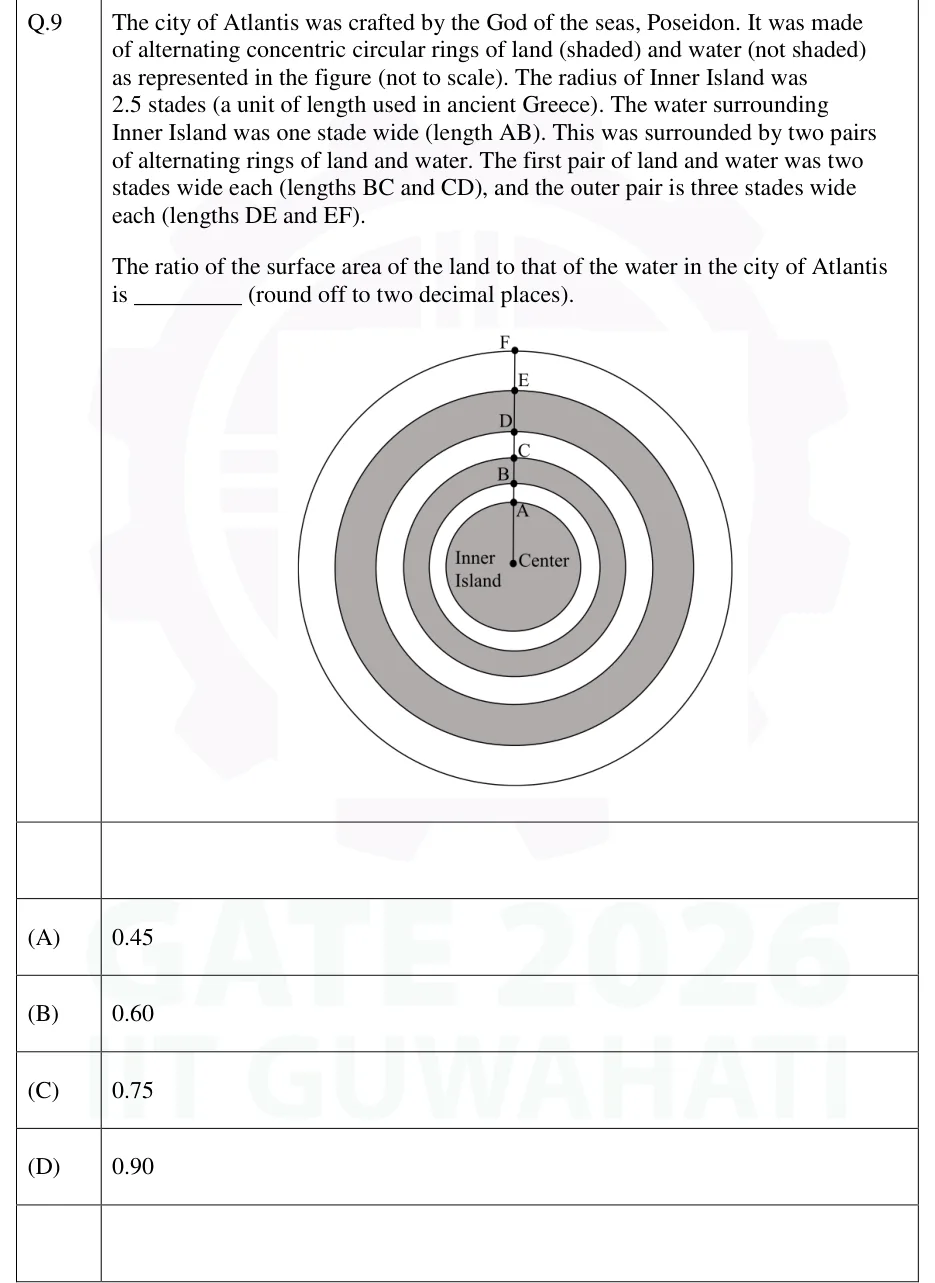
The city of Atlantis was crafted by the God of the seas, Poseidon. It was made of alternating concentric circular rings of land (shaded) and water (not shaded) as represented in the figure (not to scale). The radius of Inner Island was 2.5 stades (a unit of length used in ancient Greece). The water surrounding Inner Island was one stade wide (length AB). This was surrounded by two pairs of alternating rings of land and water. The first pair of land and water was two stades wide each (lengths BC and CD), and the outer pair is three stades wide each (lengths DE and EF).

The ratio of the surface area of the land to that of the water in the city of Atlantis is ______ (round off to two decimal places).
GATE 2026 EC GA question 9: Six concentric circles around a common centre, marked with a dot labelled "Center".Tap to open full size
Figure from the GATE 2026 EC paper. It is part of the question.
Figure description

Six concentric circles around a common centre, marked with a dot labelled "Center". From the centre outward: (1) a shaded (grey) disc labelled "Inner Island", the land; (2) an unshaded (white) ring, the water; (3) a shaded ring; (4) an unshaded ring; (5) a wider shaded ring; (6) the widest unshaded ring on the outside. A vertical line runs straight up from the centre to the outermost circle. Six dots on it mark where it crosses each circle's edge, labelled from inside to outside: A (edge of Inner Island), B (outer edge of the first water ring), C (outer edge of the first land ring), D (outer edge of the second water ring), E (outer edge of the outer land ring) and F (outer edge of the outer water ring, the boundary of the city). So AB = first water ring, BC = first land ring, CD = second water ring, DE = outer land ring, EF = outer water ring. The figure is marked as not to scale.

  1. (A)

    0.45

  2. (B)

    0.60

  3. (C)

    0.75

  4. (D)

    0.90

Answer and solution
GATE 2026 EC GA Q.9: answer and solution

GATE 2026 EE GA Q.7

GATE 2026 · EEGA Q.7 · 2 marks · MCQ

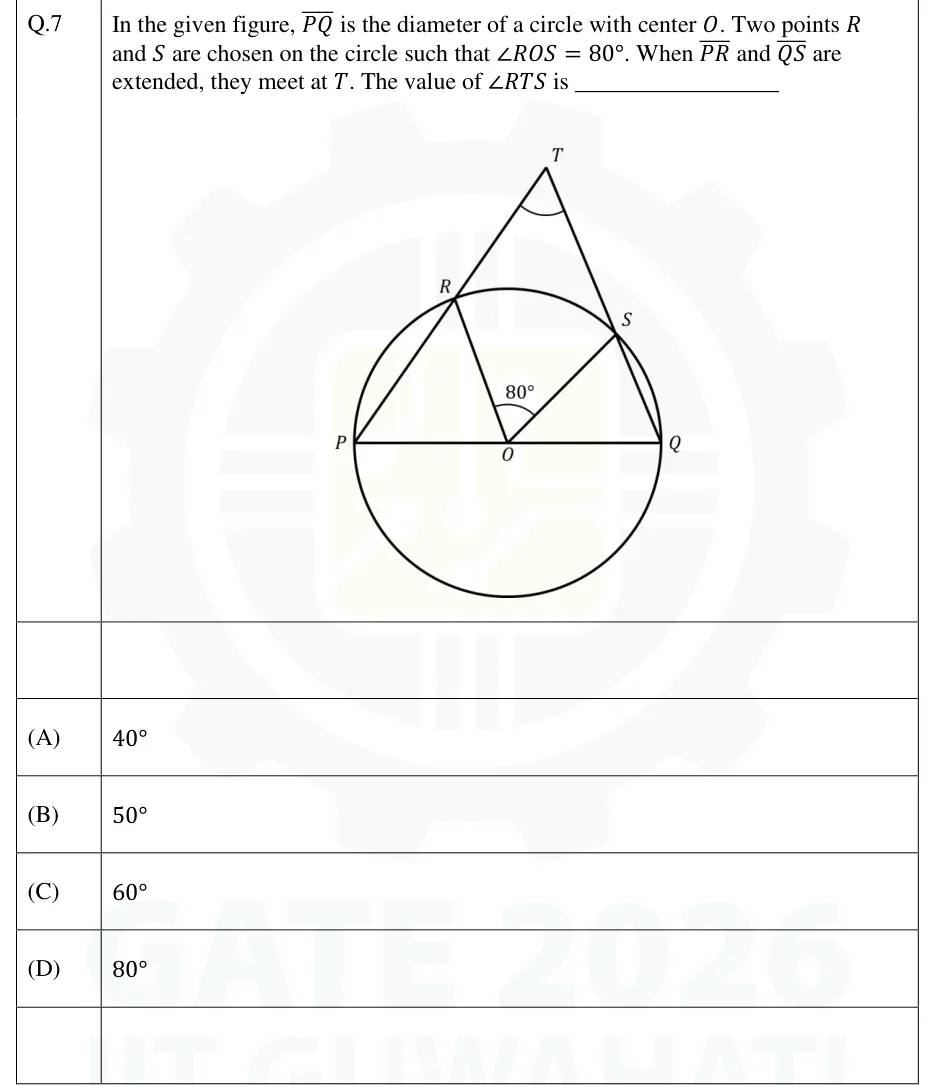
In the given figure, is the diameter of a circle with center . Two points and are chosen on the circle such that . When and are extended, they meet at . The value of is ______

GATE 2026 EE GA question 7: A circle with center O.Tap to open full size
Figure from the GATE 2026 EE paper. It is part of the question.
Figure description

A circle with center O. A horizontal diameter PQ runs through O, with P at the left end and Q at the right end. Two points lie on the upper half of the circle: R at the upper left (about 110 degrees from OQ) and S at the upper right (about 45 degrees above OQ). Radii OR and OS are drawn, and the angle between them at O is marked with an arc labelled 80°. The figure is not to scale: the angle as drawn is visibly smaller than 80°. Line PR continues past R, and line QS continues past S. The two lines meet at T, a point above and outside the circle, slightly to the right of O. The angle at T (angle RTS) is marked with an arc and has no value. Chord RQ is not drawn. The finished figure shows triangle PTQ with base PQ (the diameter), side PT passing through R and side QT passing through S.

  1. (A)

  2. (B)

  3. (C)

  4. (D)

Answer and solution
GATE 2026 EE GA Q.7: answer and solution

GATE 2026 IN GA Q.10

GATE 2026 · INGA Q.10 · 2 marks · MCQ

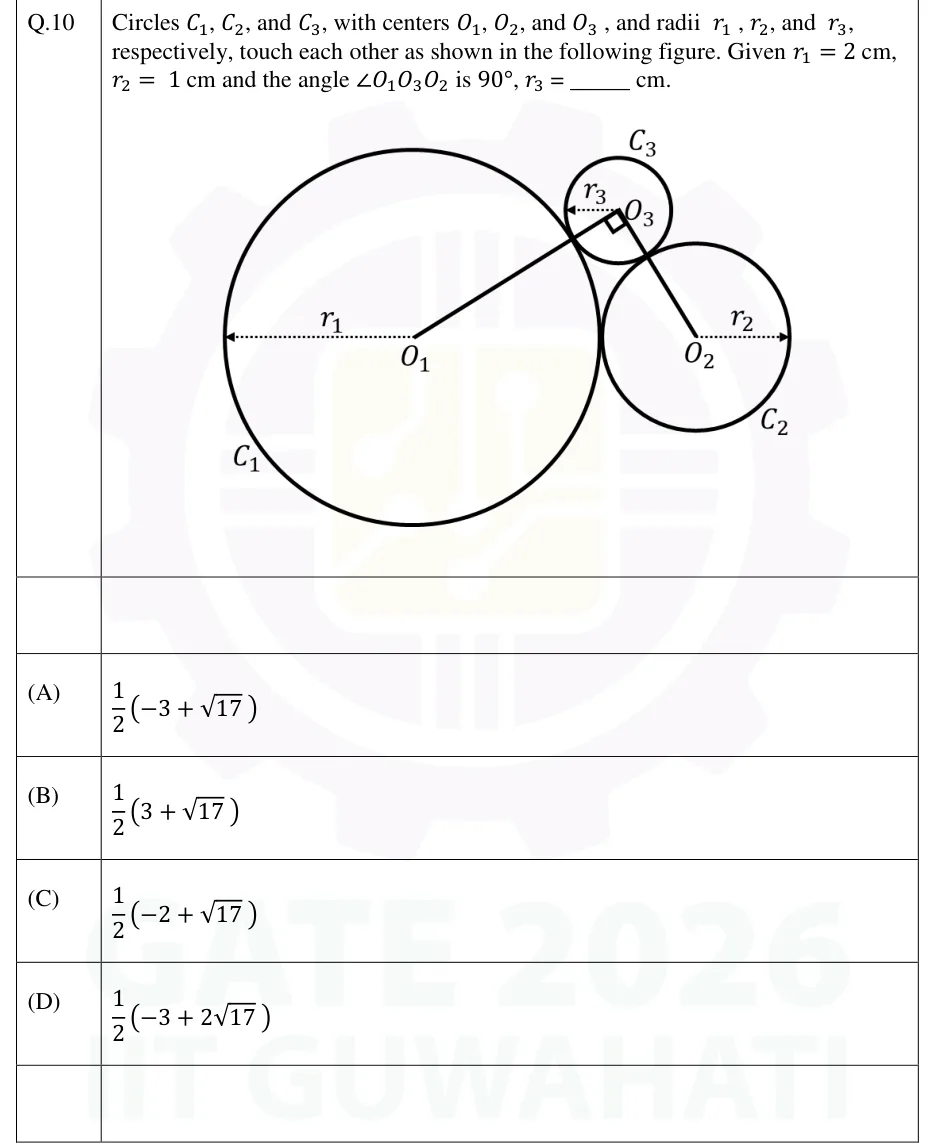
Circles , , and , with centers , , and , and radii , , and , respectively, touch each other as shown in the following figure. Given cm, cm and the angle is , ______ cm.

GATE 2026 IN GA question 10: Three circles, each touching the other two externally.Tap to open full size
Figure from the GATE 2026 IN paper. It is part of the question.
Figure description

Three circles, each touching the other two externally. The large circle C1 (label C1 at its lower left) has its centre O1 slightly left of the middle of the figure. A dotted horizontal arrow labelled r1 runs left from O1 to the circle's leftmost point. The medium circle C2 (label C2 at its lower right) sits to the right of C1 and touches it on C1's right side. Its centre O2 is at the same height as O1, and a dotted horizontal arrow labelled r2 runs right from O2 to C2's rightmost point. The small circle C3 (label C3 above it) sits in the notch above the point where C1 and C2 touch, and touches both. Its centre is O3, and a dotted horizontal arrow labelled r3 runs left from O3 to C3's leftmost point. A solid segment joins O1 to O3, running up and to the right through the point where C1 touches C3. A second solid segment joins O3 to O2, running down and to the right through the point where C3 touches C2. A small square at O3 marks the angle O1O3O2 between these two segments as a right angle. O1 and O2 are not joined in the figure.

  1. (A)

  2. (B)

  3. (C)

  4. (D)

Answer and solution
GATE 2026 IN GA Q.10: answer and solution

GATE 2025 EC GA Q.7

GATE 2025 · ECGA Q.7 · 2 marks · MCQ

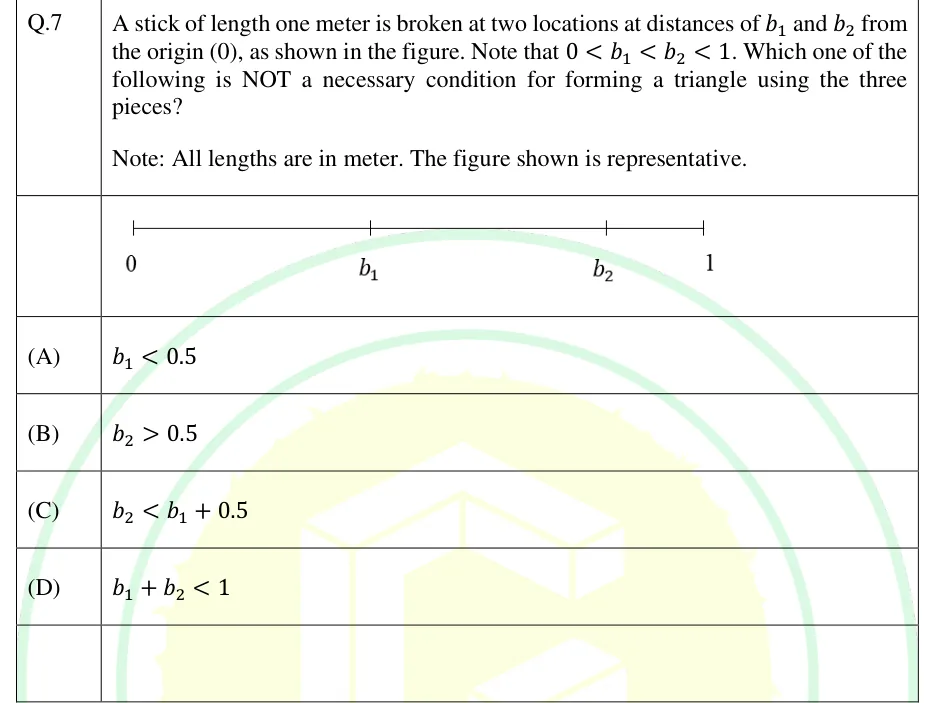
A stick of length one meter is broken at two locations at distances of and from the origin (0), as shown in the figure. Note that . Which one of the following is NOT a necessary condition for forming a triangle using the three pieces?

Note: All lengths are in meter. The figure shown is representative.

GATE 2025 EC GA question 7: A horizontal line segment representing the stick, with short vertical tick marks at its left end, at two interior points…Tap to open full size
Figure from the GATE 2025 EC paper. It is part of the question.
Figure description

A horizontal line segment representing the stick, with short vertical tick marks at its left end, at two interior points and at its right end. Below the ticks, from left to right, are the labels 0 (left end), b_1 (first interior tick, a little left of the middle), b_2 (second interior tick, about four-fifths of the way along) and 1 (right end). The figure is marked as representative, not to scale.

  1. (A)

  2. (B)

  3. (C)

  4. (D)

Answer and solution
GATE 2025 EC GA Q.7: answer and solution

GATE 2025 EE GA Q.3

GATE 2025 · EEGA Q.3 · 1 mark · MCQ

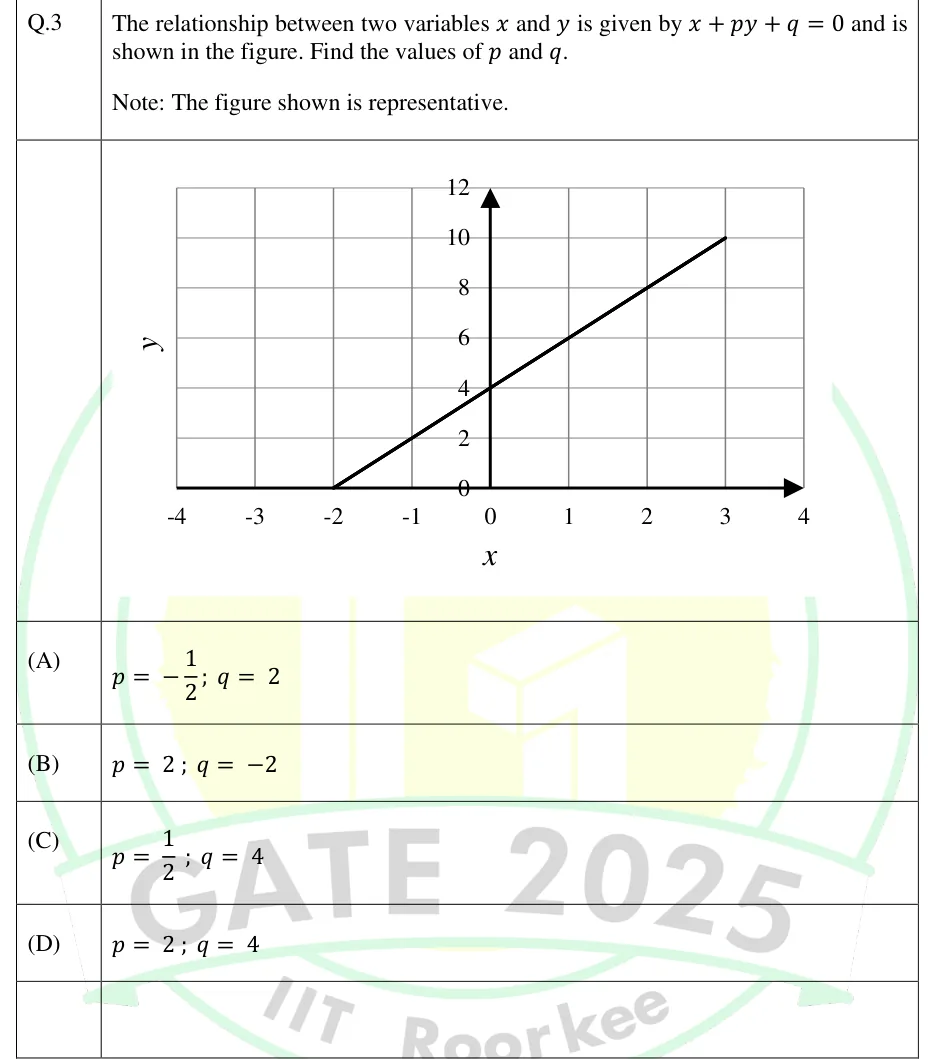
The relationship between two variables and is given by and is shown in the figure. Find the values of and .

Note: The figure shown is representative.

GATE 2025 EE GA question 3: A Cartesian graph on a square grid.Tap to open full size
Figure from the GATE 2025 EE paper. It is part of the question.
Figure description

A Cartesian graph on a square grid. Horizontal axis labelled x, with tick labels -4, -3, -2, -1, 0, 1, 2, 3, 4 (one grid column per unit); the x-axis is drawn as a thick line from x=-4 to x=4 with an arrowhead at the right end. Vertical axis labelled y (label placed at the left of the grid), drawn as a thick line at x=0 from y=0 up to y=12 with an arrowhead at the top; tick labels 0, 2, 4, 6, 8, 10, 12 printed just left of the y-axis (one grid row per 2 units). Horizontal grid lines at y = 0, 2, 4, 6, 8, 10, 12; vertical grid lines at x = -4, -3,, 4. A single straight thick line segment starts on the x-axis at (-2, 0), rises to the right, crosses the y-axis at (0, 4), passes through (1, 6) and (2, 8), and ends at (3, 10).

  1. (A)

  2. (B)

  3. (C)

  4. (D)

Answer and solution
GATE 2025 EE GA Q.3: answer and solution

GATE 2025 EE GA Q.9

GATE 2025 · EEGA Q.9 · 2 marks · MCQ

Spheres of unit diameter are centered at where , , and take every possible integer values.

The distance between two spheres is computed from the center of one sphere to the center of the other sphere. For a given sphere, is the distance to its nearest sphere and is the distance to its next nearest sphere. The value of is:

  1. (A)

  2. (B)

  3. (C)

  4. (D)

Answer and solution
See the question in the paper
GATE 2025 EE GA Q.9: answer and solution

GATE 2025 EE GA Q.10

GATE 2025 · EEGA Q.10 · 2 marks · MCQ

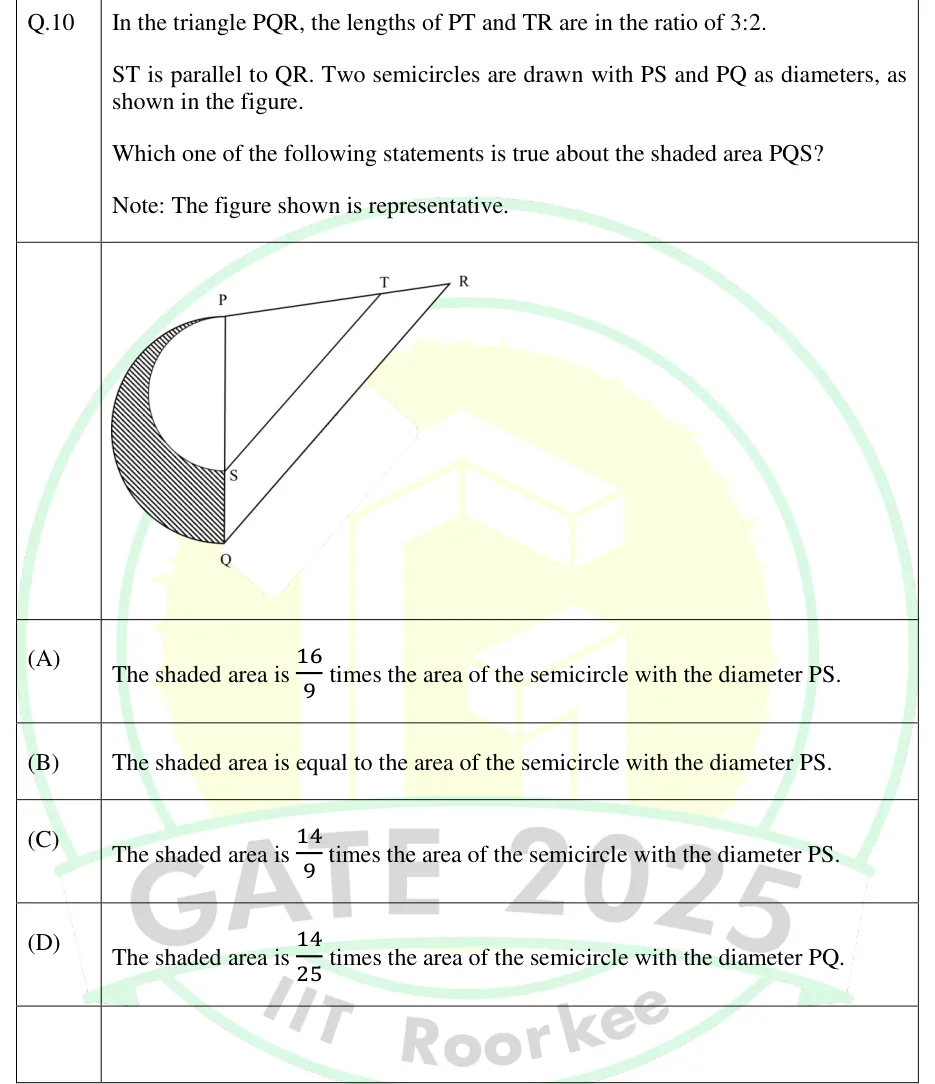
In the triangle PQR, the lengths of PT and TR are in the ratio of 3:2.

ST is parallel to QR. Two semicircles are drawn with PS and PQ as diameters, as shown in the figure.

Which one of the following statements is true about the shaded area PQS?

Note: The figure shown is representative.

GATE 2025 EE GA question 10: Triangle PQR with side PQ drawn vertically: P at the top, Q at the bottom.Tap to open full size
Figure from the GATE 2025 EE paper. It is part of the question.
Figure description

Triangle PQR with side PQ drawn vertically: P at the top, Q at the bottom. R is at the upper right, a little higher than P, so side PR rises gently to the right and side QR runs diagonally from Q up to R. Point T lies on PR, closer to R than to P (PT:TR = 3:2). Point S lies on PQ, below its midpoint and closer to Q. Segment ST is drawn parallel to QR. On the left of PQ there are two semicircles, both bulging to the left: a large one with diameter PQ (its arc runs from P round to Q) and a smaller one with diameter PS (its arc runs from P round to S). The crescent-shaped region between the large arc and the small arc, closed off by segment SQ, is hatched with diagonal lines. This hatched region is the shaded area PQS. The inside of the small semicircle is not shaded.

  1. (A)

    The shaded area is times the area of the semicircle with the diameter PS.

  2. (B)

    The shaded area is equal to the area of the semicircle with the diameter PS.

  3. (C)

    The shaded area is times the area of the semicircle with the diameter PS.

  4. (D)

    The shaded area is times the area of the semicircle with the diameter PQ.

Answer and solution
GATE 2025 EE GA Q.10: answer and solution

GATE 2025 IN GA Q.9

GATE 2025 · INGA Q.9 · 2 marks · MCQ

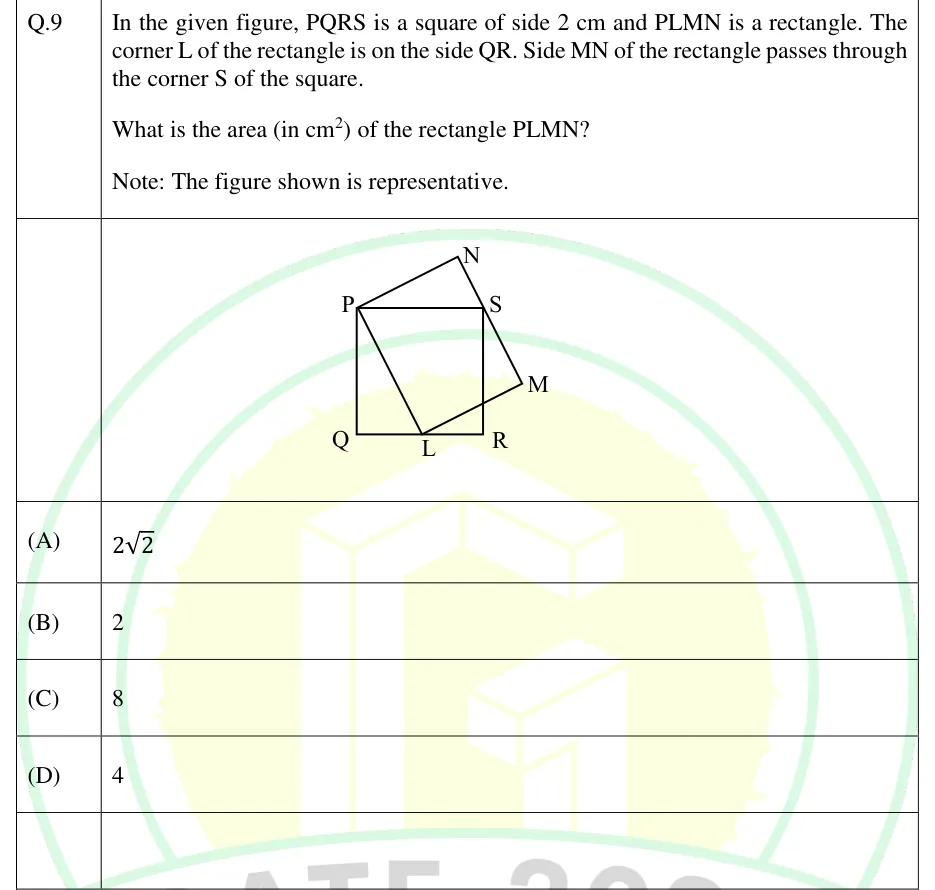
In the given figure, PQRS is a square of side 2 cm and PLMN is a rectangle. The corner L of the rectangle is on the side QR. Side MN of the rectangle passes through the corner S of the square.

What is the area (in ) of the rectangle PLMN?

Note: The figure shown is representative.

GATE 2025 IN GA question 9: Square PQRS with horizontal and vertical sides: P top-left, S top-right, R bottom-right, Q bottom-left, so PS is the top…Tap to open full size
Figure from the GATE 2025 IN paper. It is part of the question.
Figure description

Square PQRS with horizontal and vertical sides: P top-left, S top-right, R bottom-right, Q bottom-left, so PS is the top side and QR is the bottom side. Point L lies on the bottom side QR at about its midpoint. A tilted rectangle PLMN shares corner P with the square. Side PL runs diagonally down and to the right from P to L. Side LM runs up and to the right from L, crosses side SR, and ends at M outside the square, to the right of SR. Side MN runs up and to the left from M, passes exactly through corner S, and ends at N above the square, a little left of S. Side NP runs down and to the left from N back to P. Labels: P (top-left), S (top-right), Q (bottom-left), R (bottom-right), L (on QR), M (right, outside the square), N (top, outside the square). The figure marks no lengths.

  1. (A)

  2. (B)

  3. (C)

  4. (D)

Answer and solution
GATE 2025 IN GA Q.9: answer and solution

GATE 2024 EC GA Q.7

GATE 2024 · ECGA Q.7 · 2 marks · MCQ

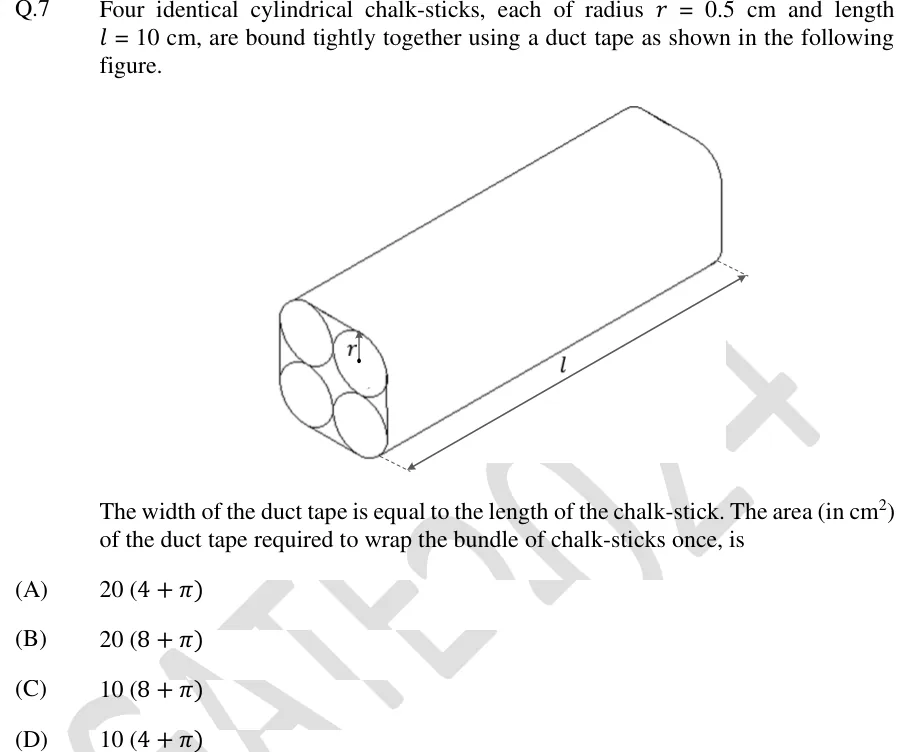
Four identical cylindrical chalk-sticks, each of radius cm and length cm, are bound tightly together using a duct tape as shown in the following figure.

The width of the duct tape is equal to the length of the chalk-stick. The area (in ) of the duct tape required to wrap the bundle of chalk-sticks once, is

GATE 2024 EC GA question 7: An oblique 3-D line drawing of the taped bundle.Tap to open full size
Figure from the GATE 2024 EC paper. It is part of the question.
Figure description

An oblique 3-D line drawing of the taped bundle. The near end face, at lower left, shows four equal circles packed in a 2 x 2 square arrangement, each touching its two neighbours. The perspective makes the square look like a tilted parallelogram: circles at upper-left, upper-right, lower-left and lower-right. The tape outline runs tangent around the four circles: four straight segments joined by rounded corners, one corner around each circle. In the upper-right circle a short arrow from the centre (marked by a dot) to the rim is labelled r. From the end face the bundle runs back towards the upper right as a long box with rounded longitudinal edges; the far end at the upper right shows the rounded corners of the wrapped outline. Along the lower-right edge, a double-headed arrow between two dashed extension lines is labelled l and gives the length of the sticks.

  1. (A)

  2. (B)

  3. (C)

  4. (D)

Answer and solution
GATE 2024 EC GA Q.7: answer and solution

GATE 2024 EE GA Q.7

GATE 2024 · EEGA Q.7 · 2 marks · MCQ

In the following figure,

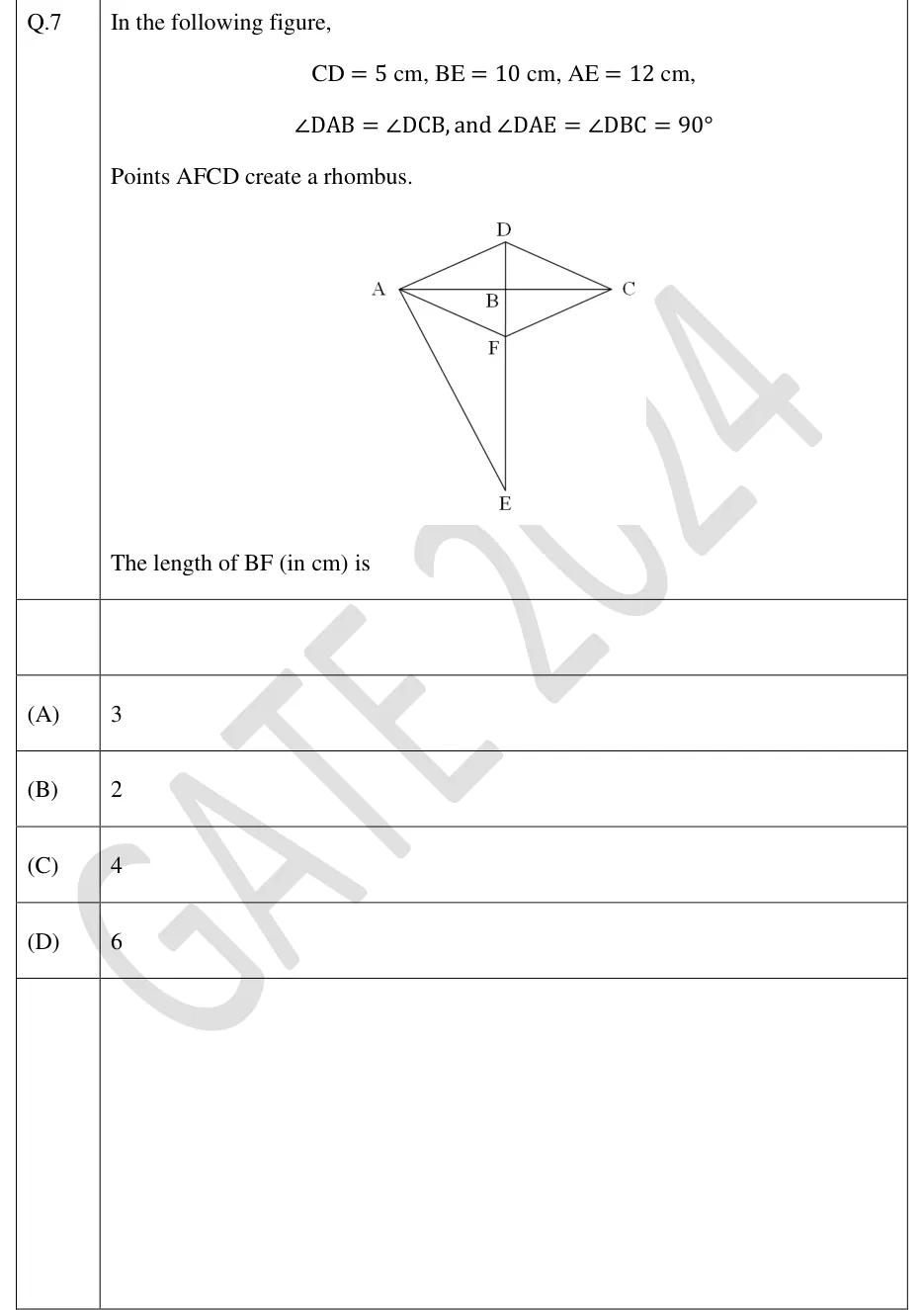
Points AFCD create a rhombus.

[Figure]

The length of BF (in cm) is

GATE 2024 EE GA question 7: Rhombus AFCD drawn with A at the left vertex, D at the top, C at the right and F at the bottom, so the sides are AD, DC…Tap to open full size
Figure from the GATE 2024 EE paper. It is part of the question.
Figure description

Rhombus AFCD drawn with A at the left vertex, D at the top, C at the right and F at the bottom, so the sides are AD, DC, CF and FA. The horizontal diagonal AC and the vertical diagonal DF cross at B (label B written just below and left of the crossing). The vertical line through D and B is continued below F down to a point E, well below the rhombus (BE is visibly the longest part of that line). A straight segment joins A to E, forming a tall triangle ADE with the vertical line DE. Labels: A (left), D (top), C (right), B (at the diagonals' crossing), F (bottom vertex of the rhombus, on the vertical line just below B), E (bottom end of the vertical line). No lengths or angle marks are drawn on the figure; the measurements are given only in the text.

  1. (A)

    3

  2. (B)

    2

  3. (C)

    4

  4. (D)

    6

Answer and solution
GATE 2024 EE GA Q.7: answer and solution

GATE 2024 EE GA Q.10

GATE 2024 · EEGA Q.10 · 2 marks · MCQ

A surveyor has to measure the horizontal distance from her position to a distant reference point C. Using her position as the center, a 200 m horizontal line segment is drawn with the two endpoints A and B. Points A, B, and C are not collinear. Each of the angles and are measured as . The distance (in m) of the reference point C from her position is nearest to

  1. (A)

    2603

  2. (B)

    2606

  3. (C)

    2306

  4. (D)

    2063

Answer and solution
See the question in the paper
GATE 2024 EE GA Q.10: answer and solution

GATE 2024 IN GA Q.7

GATE 2024 · INGA Q.7 · 2 marks · MCQ

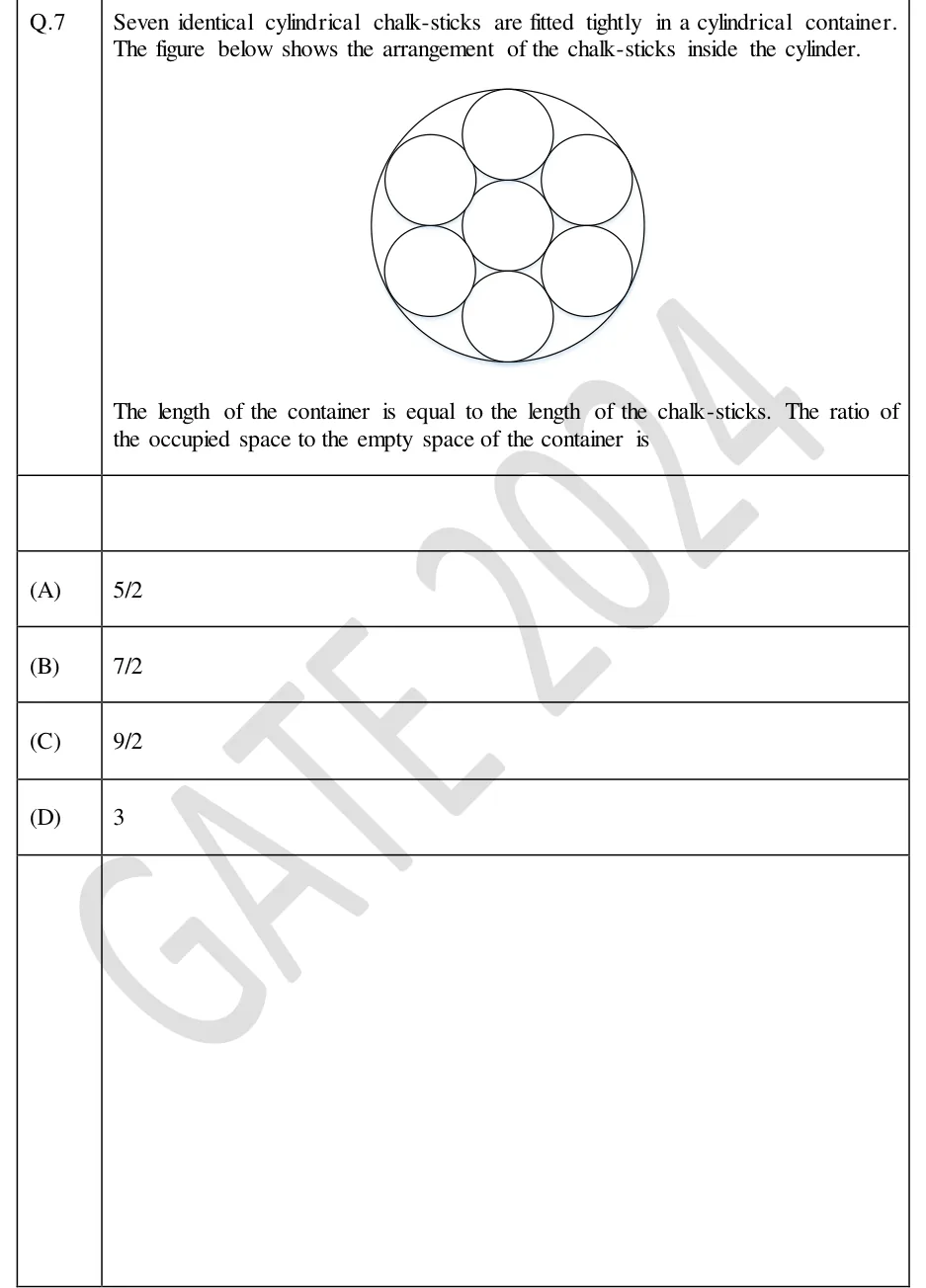
Seven identical cylindrical chalk-sticks are fitted tightly in a cylindrical container. The figure below shows the arrangement of the chalk-sticks inside the cylinder.

[Figure]

The length of the container is equal to the length of the chalk-sticks. The ratio of the occupied space to the empty space of the container is

GATE 2024 IN GA question 7: Cross-section of the container: one large circle containing seven equal small circles.Tap to open full size
Figure from the GATE 2024 IN paper. It is part of the question.
Figure description

Cross-section of the container: one large circle containing seven equal small circles. One small circle sits at the centre of the large circle. The other six are arranged in a ring around it, centred on the vertices of a regular hexagon: one directly above the centre, one directly below, two on the left (upper-left and lower-left) and two on the right (upper-right and lower-right). Each outer small circle touches the central circle, its two neighbouring small circles and the inside of the large circle. There is no shading and there are no labels.

  1. (A)

    5/2

  2. (B)

    7/2

  3. (C)

    9/2

  4. (D)

    3

Answer and solution
GATE 2024 IN GA Q.7: answer and solution

GATE 2023 EE GA Q.10

GATE 2023 · EEGA Q.10 · 2 marks · MCQ

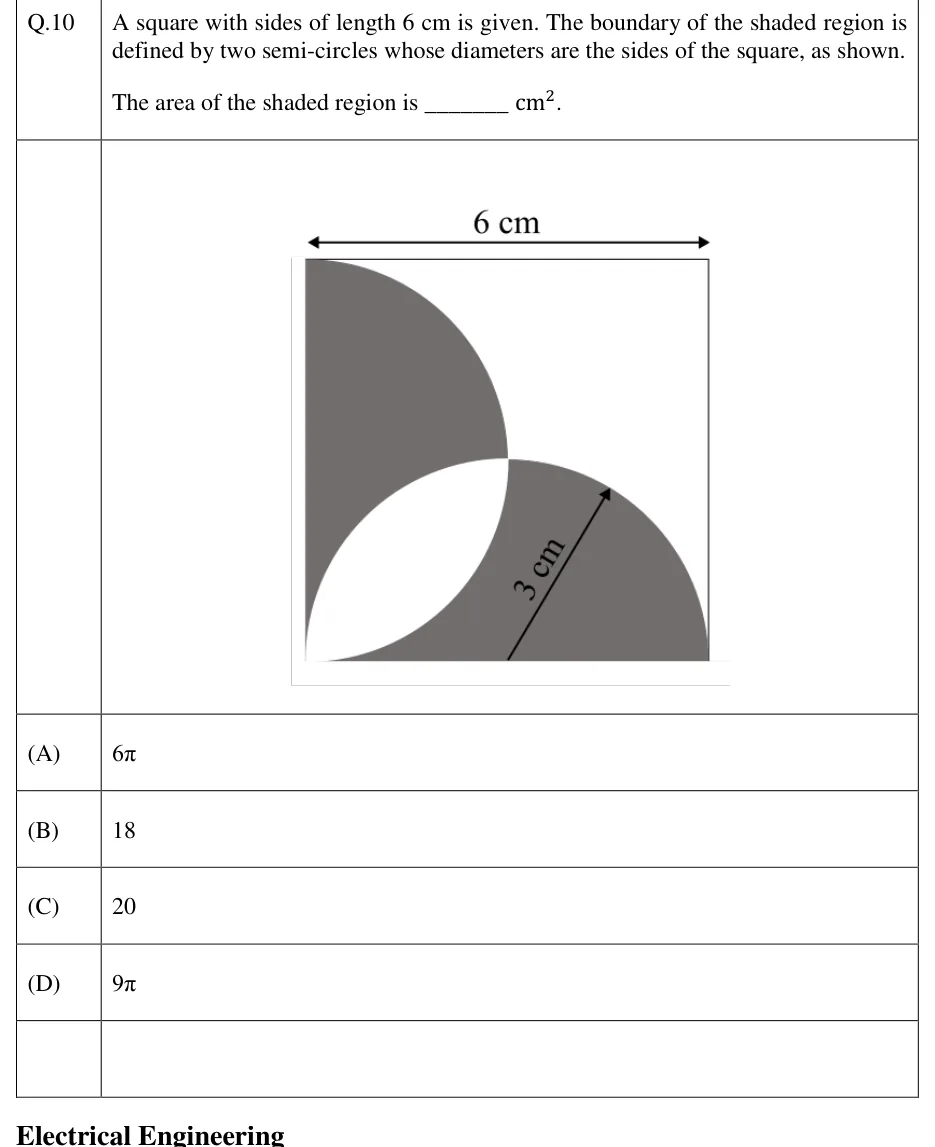
A square with sides of length 6 cm is given. The boundary of the shaded region is defined by two semi-circles whose diameters are the sides of the square, as shown.

The area of the shaded region is ______ .

GATE 2023 EE GA question 10: A square of side 6 cm, with a double-headed arrow above its top edge labelled "6 cm".Tap to open full size
Figure from the GATE 2023 EE paper. It is part of the question.
Figure description

A square of side 6 cm, with a double-headed arrow above its top edge labelled "6 cm". Put the bottom-left corner at the origin, so the square runs from (0,0) to (6,6). Semicircle 1 has the left side of the square, from (0,0) to (0,6), as its diameter. Its centre is (0,3) and its radius is 3. It bulges rightward and just reaches the centre of the square, (3,3). Semicircle 2 has the bottom side, from (0,0) to (6,0), as its diameter. Its centre is (3,0) and its radius is 3. It bulges upward and also just reaches (3,3). The two arcs cross at the bottom-left corner (0,0) and at the centre (3,3). The lens-shaped overlap of the two semicircles, between (0,0) and (3,3), is white (unshaded). The rest of semicircle 1 is shaded dark grey. This upper-left piece includes a thin sliver that runs down along the left side to (0,0). The rest of semicircle 2 is also shaded dark grey. This lower-right piece includes a thin sliver that runs along the bottom side to (0,0). The two shaded pieces touch at (3,3). The part of the square outside both semicircles (upper right) is white. A radius line with an arrowhead runs from the midpoint of the bottom side, (3,0), up and to the right to the arc of semicircle 2. It is labelled "3 cm".

  1. (A)

  2. (B)

  3. (C)

  4. (D)

Answer and solution
GATE 2023 EE GA Q.10: answer and solution

GATE 2020 EC GA Q.8

GATE 2020 · ECGA Q.8 · 2 marks · MCQ

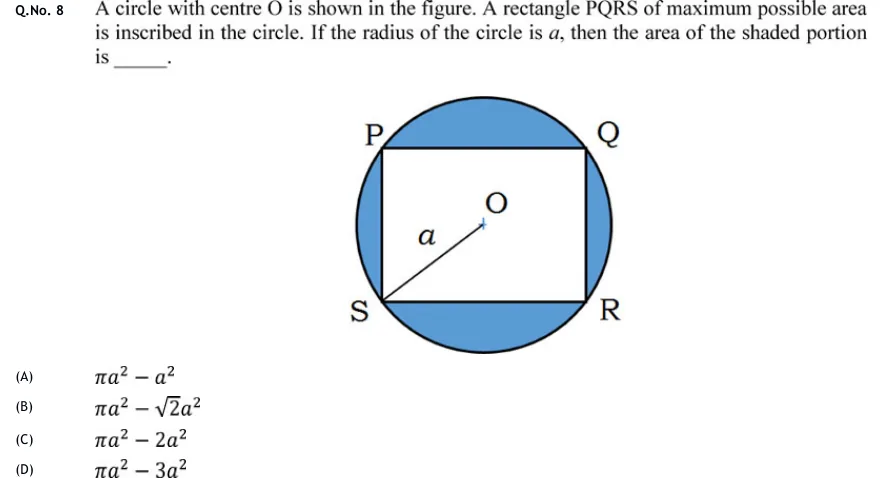
A circle with centre O is shown in the figure. A rectangle PQRS of maximum possible area is inscribed in the circle. If the radius of the circle is , then the area of the shaded portion is ______.

GATE 2020 EC GA question 8: A circle with centre O (marked with a small cross, labelled O just above it).Tap to open full size
Figure from the GATE 2020 EC paper. It is part of the question.
Figure description

A circle with centre O (marked with a small cross, labelled O just above it). A rectangle PQRS is inscribed in the circle with all four vertices on the circle: P at the top-left, Q at the top-right, R at the bottom-right, S at the bottom-left; sides PQ and SR are horizontal and PS and QR are vertical. The rectangle is drawn slightly wider than it is tall. A straight line segment runs from vertex S to the centre O and is labelled a (the radius). The four regions inside the circle but outside the rectangle (the circular segments above PQ, below SR, left of PS and right of QR) are shaded blue; the interior of the rectangle is white (unshaded).

  1. (A)

  2. (B)

  3. (C)

  4. (D)

Answer and solution
GATE 2020 EC GA Q.8: answer and solution

GATE 2020 EE GA Q.9

GATE 2020 · EEGA Q.9 · 2 marks · MCQ

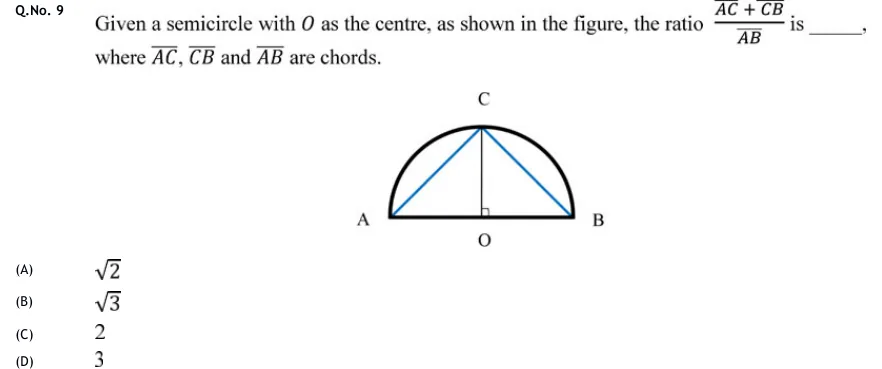
Given a semicircle with as the centre, as shown in the figure, the ratio is ______, where , and are chords.

GATE 2020 EE GA question 9: A semicircle drawn with a thick black arc above a horizontal diameter AB.Tap to open full size
Figure from the GATE 2020 EE paper. It is part of the question.
Figure description

A semicircle drawn with a thick black arc above a horizontal diameter AB. A is labelled at the left end of the diameter and B at the right end. The centre O is labelled below the midpoint of AB. Point C is labelled above the highest point of the arc. A thin vertical black segment joins O to C, with a small right-angle mark at O showing that OC is perpendicular to AB. Two blue straight segments (chords) join A to C and C to B, forming a triangle ACB inscribed in the semicircle with AB as its base.

  1. (A)

  2. (B)

  3. (C)

  4. (D)

Answer and solution
GATE 2020 EE GA Q.9: answer and solution

GATE 2018 IN GA Q.5

GATE 2018 · INGA Q.5 · 1 mark · MCQ

Arrange the following three-dimensional objects in the descending order of their volumes:

(i) A cuboid with dimensions 10 cm, 8 cm and 6 cm

(ii) A cube of side 8 cm

(iii) A cylinder with base radius 7 cm and height 7 cm

(iv) A sphere of radius 7 cm

  1. (A)

    (i), (ii), (iii), (iv)

  2. (B)

    (ii), (i), (iv), (iii)

  3. (C)

    (iii), (ii), (i), (iv)

  4. (D)

    (iv), (iii), (ii), (i)

Answer and solution
See the question in the paper
GATE 2018 IN GA Q.5: answer and solution

PRACTICE

5 questions to test yourself

PRACTICE 11 mark · MCQ

Each interior angle of a regular polygon is . The number of sides of the polygon is

  1. (A)

    12

  2. (B)

    14

  3. (C)

    15

  4. (D)

    18

Answer and solution

Answer: (C)

  1. Each exterior angle .

  2. The exterior angles of a convex polygon add to , so .

  3. Check: .

PRACTICE 21 mark · NAT

A solid metal sphere of radius 6 cm is melted and recast, with no loss of metal, into identical solid spheres of radius 2 cm. The total surface area of all the new spheres divided by the surface area of the original sphere is ________.

Answer and solution

Answer:

  1. Number of new spheres .

  2. Total new surface area cm²; original surface area cm².

  3. Ratio , which equals .

PRACTICE 32 marks · MSQ

The vertices of triangle are , and . Which of the following statements is/are correct?

  1. (A)

    Triangle is right-angled at .

  2. (B)

    The area of triangle is 12.5 square units.

  3. (C)

    The circumradius of triangle is 5 units.

  4. (D)

    The orthocentre of triangle is the point .

Answer and solution

Answer: (A), (B)

  1. Slope of and slope of . Their product is , so and the right angle is at : (A) is correct.

  2. Area . Check: , so the area is . (B) is correct.

  3. The hypotenuse is , so the circumradius is , not 5. (C) is wrong.

  4. The altitudes of a right triangle meet at the right-angle vertex, so the orthocentre is . The point is the mid-point of , which is the circumcentre. (D) is wrong.

PRACTICE 42 marks · MCQ

A sector with central angle is cut from a circular sheet of radius 15 cm and bent, without overlap or gap, to form the curved surface of a right circular cone. The volume of the cone, in cm³, is

  1. (A)

  2. (B)

  3. (C)

  4. (D)

Answer and solution

Answer: (B)

  1. The radius of the sheet becomes the slant height: cm.

  2. The arc of the sector becomes the base circumference: , so cm.

  3. Height cm.

  4. Volume cm³. (Using the slant height as the height gives ; leaving out the gives ; swapping the radius and the height gives .)

PRACTICE 52 marks · NAT

The sides of a triangle are 25 cm, 29 cm and 36 cm. The radius of its circumcircle, in cm, is ________ (rounded off to three decimal places).

Answer and solution

Answer: (accepted range )

  1. Semi-perimeter , so , , .

  2. Heron's formula: cm².

  3. cm.

  4. Check: can never be less than half the longest side ( cm), and equals it only for a right triangle. Here , so the triangle is acute, not right, and is consistent.

OFFICIAL GATE 2027 SYLLABUS WORDING

Copied from the GATE 2027 syllabus; see all 2027 syllabi.

EVERY GATE PAPER

Mensuration and geometry

Preparing in Kolkata? See IAE Academy’s GATE courses.