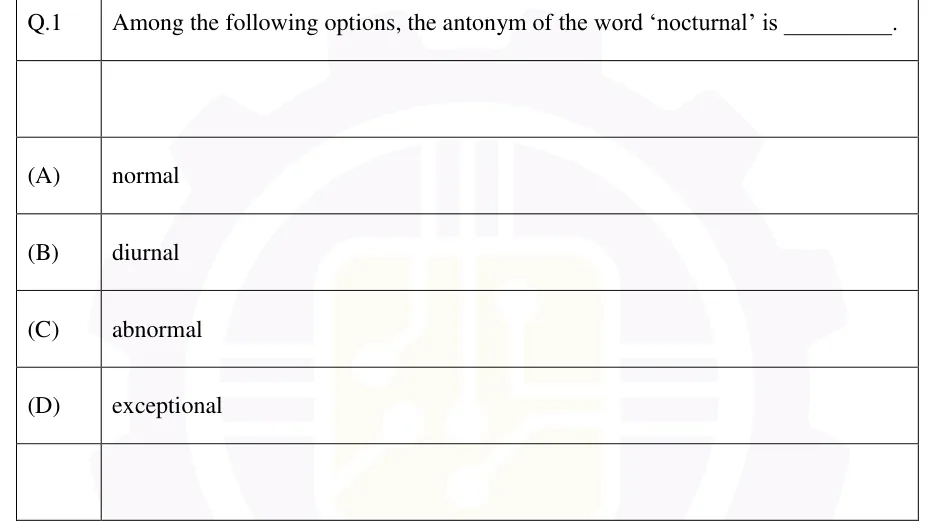
GATE 2026 EC GA Q.1
Among the following options, the antonym of the word ‘nocturnal’ is _________.
- (A)
normal
- (B)
diurnal
- (C)
abnormal
- (D)
exceptional

EVERY GATE PAPER
Grammar and vocabulary questions ask you to choose the word or form that makes a sentence correct and meaningful: the right tense, article, preposition, conjunction or verb form, or the word, idiom or phrasal verb that fits the context. Each one is decided by a rule you can name or by a clue somewhere in the sentence. Once you know the rules below and eliminate options on purpose instead of going by what sounds right, you can answer these questions quickly, with a reason for every choice.
32 previous-year questions · 32 solved · 6 practice questions
The questions are short and self-contained. The usual formats are a sentence with one or two blanks and four options, a choice of the correct (or the incorrect) sentence, the meaning of a word, idiom or phrasal verb as used in a given sentence, and odd-one-out or analogy sets of words. What decides the answer is almost always written in the sentence itself: a time phrase, a contrast word, a singular or plural head noun, or the tone of the other clause. It pays to eliminate options by rule rather than choose by ear, because an option that sounds natural in speech can still be wrong in formal writing ('between you and I' is the classic case).
Conventions used in these notes. Spelling and usage follow Indian/British English, as in the GATE question papers: colour and favourite, for example. 'Correct' means correct in formal written English. Verb forms are written V1 = base form (write), V2 = past simple (wrote), V3 = past participle (written), V-ing = present participle or gerund (writing). Where current usage accepts two forms (for example singular 'their' after 'everyone', or 'none of them is/are'), the notes say so rather than treat either as an error. Every example sentence here is written for these notes.
Procedure for a fill-in-the-blank question
Read the whole sentence, including the part after the blank. Mark the signal words: time markers (since, for, ago, by, yesterday, next), contrast words (but, although, however, despite, yet), cause or continuation words (because, so, and, moreover), and the head noun of the subject.
Decide what the blank needs grammatically: the part of speech (noun, verb, adjective, adverb, preposition), singular or plural, and the tense.
Strike out every option that fails on grammar. This often leaves two.
Decide what the blank needs in meaning: the same direction as the rest of the sentence after a continuation word, the opposite direction after a contrast word, and the right tone (positive or negative).
With two blanks, fill the more tightly constrained blank first and strike out every option that fails it before you look at the other blank.
Read the complete sentence with the option that survives. It must be correct in formal written English, not merely understandable.
EXAM TIP
In 'choose the INCORRECT sentence' questions, underline 'incorrect' or 'not' in the stem before you start, and test every option instead of stopping at the first one that looks right. In MSQ versions, each option is judged on its own, so a sentence is not correct just because the others are wrong.
A tense question is decided by a time signal in the sentence and, when there are two actions, by their order. First fix the time frame (past, present or future), then ask whether the action is a plain fact, is in progress, or is complete before some other point. Stative verbs describe states, not actions (know, believe, understand, belong, own, contain, consist, seem, prefer, want, and see or hear in the sense of perceiving). They are normally not used in the continuous tenses: 'I know the answer', not 'I am knowing the answer'. Some verbs are stative in one sense and describe an action in another, and in the action sense the continuous is correct: 'I am thinking of applying' (think = consider), 'The doctor is seeing a patient' (see = meet), 'We are having lunch' (have = eat). Check which sense the sentence uses before you reject a continuous form.
The twelve tense forms (active)
Tense | Form (active) | Typical signals | Original example |
|---|---|---|---|
Present simple | V1 / V1 + s | habits, facts, timetables; always, usually, every day | Water boils at 100 degrees Celsius at sea level. |
Present continuous | is / am / are + V-ing | now, at present, currently, this week; also a fixed future arrangement | The team is testing the new software this week. We are meeting the dean tomorrow. |
Present perfect | has / have + V3 | already, yet, just, ever, never, so far, since, for | We have already submitted the form. |
Present perfect continuous | has / have been + V-ing | since, for, how long | She has been teaching here since June. |
Past simple | V2 | yesterday, ago, last week, in 2019, just now | The results came out two days ago. |
Past continuous | was / were + V-ing | while; an action interrupted by another | I was reading when the power failed. |
Past perfect | had + V3 | the earlier of two past actions; before, after, by the time (past) | The guests had left before we arrived. |
Past perfect continuous | had been + V-ing | for or since, running up to a point in the past | She had been waiting for an hour when the bus finally came. |
Future simple | will + V1 (traditionally shall with I / we) | tomorrow, next week, soon | The course will begin in July. |
Future continuous | will be + V-ing | at this time tomorrow | At 10 a.m. tomorrow I will be writing the paper. |
Future perfect | will have + V3 | by + a future time | By December, the contractor will have finished the bridge. |
Future perfect continuous | will have been + V-ing | by + a future time, with for + a period | By June, he will have been working here for ten years. |
PRESENT PERFECT
A past action with a present result, or a period that runs up to now. Never with a finished past time (yesterday, ago, last year, in 2019).
PRESENT PERFECT CONTINUOUS
An action that began in the past and is still going on: 'She has been teaching here since June' / 'for three months'. It is also used for an activity that has only just stopped, leaving a visible result: 'The roads are wet; it has been raining.' Use since or for here, not from.
PAST PERFECT
Marks an action completed before another past action or a stated past time: 'The train had left when we reached the platform.' Not for a lone past event: 'I went there yesterday', not 'I had gone there yesterday'.
FUTURE PERFECT
An action that will be complete before a stated future point: 'By March, the team will have tested every unit.'
FUTURE TIME IN TIME AND CONDITION CLAUSES
These clauses (also before, after, once) take the present simple, or the present perfect for an action that will be complete, even for future time; 'will' goes only in the main clause: 'I will call you when I reach the station', not 'when I will reach the station'; 'You may leave once you have signed the register.' The rule covers clauses of time and condition only. A when- or if-clause that is the object of a verb such as know, ask, tell or wonder is a noun clause and takes 'will' as usual: 'Nobody knows when the results will be declared.' 'If you will' is also correct where 'will' means willingness, as in a polite request: 'If you will wait here, I will fetch the form.'
ZERO CONDITIONAL
A general truth or a rule that always holds: 'If you mix blue and yellow paint, you get green.'
FIRST CONDITIONAL
A real, possible future: 'If the supply fails, the backup will start.'
SECOND CONDITIONAL
An unreal present or an unlikely future. Formal English uses 'were' for every person: 'If I were the organiser, I would start earlier.'
THIRD CONDITIONAL
An unreal past. 'Would have' never goes in the if-clause. Inverted form without 'if': 'Had I known, I would have helped.' A mixed conditional joins an unreal past condition to a present result: 'If I had taken that job, I would be living in Pune now.'
SEQUENCE OF TENSES
'She said that she was tired.' In reported speech after a past reporting verb, each tense moves one step back: is → was, is doing → was doing, has done → had done, did → had done (often left as did when the order of events is clear), will → would, can → could, may → might. A universal truth keeps the present: 'The teacher said that light travels faster than sound.' After a present or future reporting verb nothing shifts: 'She says that she is tired.'
PASSIVE VOICE
Only transitive verbs have a passive. Happen, occur, arrive, die, seem and other intransitive verbs cannot be made passive: 'The accident happened', never 'was happened'. Not every transitive verb has one either: have (in the sense of own), resemble, lack and suit are not normally passive ('Ravi resembles his father', never 'His father is resembled by Ravi').
In the passive, the object of the active sentence becomes the subject, 'be' takes the tense of the active verb, and the main verb becomes V3: 'The committee approved the plan' becomes 'The plan was approved by the committee'. Continuous passives use being (is being repaired), perfect passives use been (has been repaired), and modal passives use be (must be repaired). Verbs such as make, see and hear drop 'to' in the active but take it back in the passive: 'They made him wait' becomes 'He was made to wait'.
Other fixed verb-form patterns
It is (high) time + past simple, for something that should already be happening: 'It is high time we revised the plan.'
wish + past simple for a present regret (with 'were' for 'be' in formal English), wish + past perfect for a past regret: 'I wish I knew her number.' 'I wish I were closer to the college.' 'I wish I had left earlier.'
would rather + subject + past simple when the two subjects differ: 'I would rather you called before visiting.' With one subject, would rather + V1 + than + V1: 'I would rather walk than wait for the bus.'
suggest / recommend / insist / demand that + subject + (should) + V1: 'The doctor recommended that he (should) rest for a week.' 'Suggest' never takes an object + to-infinitive: not 'The doctor suggested him to rest'.
as if / as though + past simple (with 'were' for 'be') for an unreal comparison: 'He talks as if he were the owner.' For something that may well be true, the present is also correct: 'It looks as if the meeting is over.'
lest + (should) + V1, with no 'not' after lest: 'Note down the roll number lest you (should) forget it.'
It is (or has been) + period + since + past simple: 'It is three years since the plant closed.'
After do / does / did and after every modal, use V1: 'Did the parcel arrive?', not 'Did the parcel arrived?'
Modals
Modal | Main uses | Original example | Watch for |
|---|---|---|---|
can / could | ability, permission; could = past ability, polite request, possibility | She can read three scripts. Could you repeat the question? | Never 'can able to'; use 'be able to' for other tenses ('will be able to'). |
may / might | permission (formal); possibility, might being weaker | You may leave after the test. The train might be late. | 'might have + V3' = a possibility about the past. |
must | obligation; confident deduction | Candidates must carry an ID card. The road is wet; it must have rained. | 'must not' = prohibition; 'need not' = no necessity. |
should / ought to | advice, duty | You ought to inform the office. | 'ought' is followed by 'to'; 'should have + V3' = the right action was not taken. |
will / would | future; would = conditional, polite request, past habit | Every morning he would walk to the college. | Past-habit 'would' is for repeated actions, not states: 'He used to own a scooter', not 'He would own a scooter'. |
need (as a modal) | no necessity, in negatives and questions | You need not bring a calculator. | 'need not have + V3' = it was done but was unnecessary. |
used to | a past habit or state that is no longer true | He used to live in Asansol. | Different from 'be used to + V-ing' = be accustomed to: 'I am used to waking early.' |
all modals | followed by V1, no -s, no 'to' (except ought to and used to) | She can swim. (not 'can swims') | Never two modals together: 'will be able to', not 'will can'. |
WORKED EXAMPLE · TENSE IN A TIME CLAUSE
Choose the option that correctly fills both blanks.
By the time the auditors ______ next Monday, the accounts team ______ all the pending files.
(A) will arrive; will complete
(B) arrive; will have completed
(C) will arrive; will have completed
(D) arrived; had completed
The first blank is inside a 'by the time' clause about the future. A future time clause takes the present simple, not 'will', so (A) and (C) are out.
'Next Monday' is a future time, so the past forms in (D) cannot be right.
In (B), 'arrive' fits the clause, and 'by the time' asks for an action that will be finished before that future point: the future perfect 'will have completed'.
Answer: (B) arrive; will have completed
EXAM TIP
A finished past time (yesterday, ago, last year, in 2019, when I was in school, just now) rules out the present perfect: 'I met him yesterday', never 'I have met him yesterday'; 'He left just now', not 'He has left just now'. 'Since' takes a point of time (since 2019, since Monday) and 'for' a length of time (for two years, for a week).
The verb agrees with the head noun of the subject, not with whichever noun happens to sit next to it. Strip away prepositional phrases (of the samples, in the lab), relative clauses and added phrases (along with, as well as), then read the head noun directly with the verb. 'The quality of the samples ______ checked' becomes 'The quality ______ checked', which needs a singular verb ('was' or 'is'). The GATE syllabus calls this verb-noun agreement.
PROXIMITY RULE
Also for plain 'X or Y'. The verb agrees with the nearer subject: 'Neither the lecturer nor the students were informed.' 'Either the students or the lecturer is responsible.'
ADDED-PHRASE RULE
Also 'in addition to', 'accompanied by', 'like', 'including'. 'The captain, along with his players, was felicitated.' Of the joining words, only 'and' makes a plural subject, and even 'and' does not when the two nouns name one person or one idea (see the list below).
ONE OF THE ...
'One of the valves is faulty.' But in 'one of the + plural noun + who/that + verb', the relative clause refers to the plural noun, so its verb is plural: 'She is one of the engineers who have designed the dam.' With 'the only one of ... who', it is singular again.
THE NUMBER / A NUMBER
'The number of applicants has doubled.' 'A number of applicants have complained.'
EACH, EVERY, EITHER, NEITHER
'Each of / Either of / Neither of + plural noun' is also singular in formal English: 'Neither of the answers is correct.' Exception: 'each' AFTER a plural subject keeps the verb plural: 'The boys each have a locker.'
Further agreement rules
Two subjects joined by 'and' take a plural verb: 'The manager and the accountant are away.' If they name one person or one idea, the verb is singular: 'The director and chief engineer (one person) has approved the design.' 'Idli and sambar is the hostel's usual breakfast.' One article before the pair means one person; two articles ('the director and the chief engineer') mean two people and a plural verb.
'Both X and Y' always takes a plural verb.
'Each' or 'every' before nouns joined by 'and' keeps the verb singular: 'Every student and teacher has to carry an ID card.'
'More than one + singular noun' takes a singular verb: 'More than one bridge was damaged.' So does 'many a + singular noun': 'Many a candidate has made this mistake.'
everyone, everybody, someone, somebody, nobody, anything and each one take a singular verb: 'Everybody in the hostel knows the warden.'
A single amount of time, money, distance or weight takes a singular verb: 'Five hours is enough for the revision.' 'Ten thousand rupees is a fair price.'
Nouns plural in form but singular in meaning take a singular verb: news, mathematics, physics, economics (as a subject), measles. 'The news is encouraging.'
Nouns that are always plural take a plural verb: scissors, trousers, spectacles, cattle, police, people. 'The police have sealed the area.' 'A pair of' makes the subject singular: 'A pair of scissors is on the desk.'
Uncountable nouns have no plural and take a singular verb: furniture, information, advice, equipment, luggage, machinery, scenery. 'The equipment is new', not 'The equipments are new'. Count them with 'a piece of' or 'an item of'.
'The + adjective' naming a class of people is plural: 'The elderly need regular check-ups.'
Collective nouns (committee, jury, team, staff, government, family) take a singular verb when the group acts as one unit: 'The jury has reached its verdict.' In British and Indian usage they take a plural verb when the sentence stresses the individual members: 'The jury are divided in their opinions.' Whichever you use, keep the later pronouns consistent with it.
In 'there is / there are' sentences the verb agrees with the noun that follows: 'There are two errors in this line.'
'None of + uncountable noun' is singular: 'None of the water was wasted.' 'None of + plural noun' is traditionally singular in formal English, and the plural is also accepted today.
Pronoun case
Case | Pronouns | Used as | Original example |
|---|---|---|---|
Subjective | I, we, he, she, they, who | subject of a verb; after 'than' or 'as' when a verb is understood | She writes faster than I (do). |
Objective | me, us, him, her, them, whom | object of a verb or of a preposition | Between you and me, the plan is weak. Whom did the panel select? |
Possessive | mine, ours, his, hers, theirs, whose; its (no apostrophe) | ownership | The laptop is hers. The firm changed its logo. |
Reflexive | myself, himself, themselves, ... | object when the doer and the receiver are the same; emphasis; never a plain subject | He hurt himself. The supervisor and I (not myself) will attend. |
Pronoun rules
A pronoun agrees with its antecedent in number and person: 'The company has revised its policy', not 'their policy' after a singular verb.
After each, every and everyone, traditional formal English uses 'his or her'. Singular 'their' ('Everyone has submitted their form') is also accepted in current usage, so do not reject an option for that alone.
After 'than' and 'as', the case depends on the verb understood after it: 'She is taller than I (am).' 'He trusts you more than (he trusts) me.'
'Who' is the subject form and 'whom' the object form. Test by answering with he or him: 'Whom did the panel select?' (The panel selected him.) 'The candidate who I think is best' keeps 'who', because it is the subject of 'is'.
'Who' refers to people and 'which' to things; 'that' can refer to either, but only in a defining clause (one that tells you which person or thing is meant, written without commas). A non-defining clause, set off by commas, takes 'who' or 'which', never 'that': 'The new lab, which opened in May, is air-conditioned.' 'Whose' may refer to things as well as people: 'a firm whose profits fell'.
When 'one' is the subject, continue with 'one's': 'One should keep one's promises.'
Courtesy order when pronouns are listed together: second person, third person, first person. 'You, she and I have been shortlisted.' Traditional grammar reverses this when a fault is being admitted: 'I and my partner are to blame for the delay.'
WORKED EXAMPLE · AGREEMENT
Select the grammatically correct sentence.
(A) The quality of the samples were checked twice.
(B) Each of the engineers have signed the report.
(C) The manager, along with his assistants, was present at the inspection.
(D) Neither the contractor nor the workers was paid on time.
(A) Strip 'of the samples': the head noun is 'quality', which is singular, so 'were' is wrong ('was checked').
(B) 'Each of the engineers' is singular, so 'have' is wrong ('has signed').
(C) The head noun is 'manager'; 'along with his assistants' does not change the number, so 'was' is correct.
(D) With 'neither ... nor' the verb agrees with the nearer subject, 'the workers', so it should be 'were paid'.
Answer: (C)
EXAM TIP
Commas around 'along with' or 'as well as' do not make a subject plural; only 'and' does. In a long sentence, cover the words between the head noun and the verb with your finger and read the two together.
Articles
Rule | Original examples |
|---|---|
a / an is chosen by the first SOUND of the next word: a before a consonant sound, an before a vowel sound | a university, a one-rupee coin, a European, an hour, an honest officer, an MLA, an X-ray |
the for something specific or already mentioned | I bought a pen and a notebook; the pen leaks. |
the with unique things, superlatives and ordinals | the sun, the best answer, the third floor |
the with rivers, seas, oceans, mountain ranges, groups of islands, and country names that are plural or contain Republic, Kingdom, States or Union | the Hooghly, the Arabian Sea, the Himalayas, the Andaman Islands, the Netherlands, the United Kingdom |
the with a musical instrument that is played (but no article with games) | She plays the sitar; her brother plays chess. |
the + adjective for a whole class of people (plural verb) | The poor need better access to healthcare. |
no article with plural or uncountable nouns used in a general sense | Engineers solve problems. Honesty pays. |
no article with meals, languages, games, single mountains, most countries and cities | have lunch, speak Bengali, play chess, Mount Everest, India, Kolkata |
no article with an institution used for its purpose, and with by + transport | go to school / hospital / bed; travel by train. But: 'She went to the school to meet the principal' (the building). |
Few, a few, little, a little. 'A few' and 'a little' are positive (some, enough to matter): 'A few students stayed back to help.' 'Few' and 'little' are negative (hardly any): 'Few students understood the proof.' 'The few' means all of a small number: 'The few books he owned were old.' Use few and a few with countable nouns, little and a little with uncountable nouns.
ORDER OF ADJECTIVES BEFORE A NOUN
Articles, possessives and numbers come first. 'a beautiful old Kashmiri woollen shawl' (opinion, age, origin, material); 'a large round wooden table' (size, shape, material).
LATIN COMPARATIVES
These take 'to', never 'than', and never 'more' in front ('more superior' and 'more preferable' are wrong): 'She is senior to me by two years.' Likewise the verb 'prefer X to Y': 'He prefers trains to buses.' With infinitives, use 'rather than': 'He prefers to walk rather than wait.'
PARALLEL COMPARATIVES
Two changes that move together: 'The more you practice, the fewer mistakes you make.'
Comparison rules
Use the comparative for two and the superlative for three or more: 'the taller of the two towers', 'the tallest of the five towers'.
Never double a comparison: 'better', not 'more better'; 'cleverest' or 'most clever', not 'most cleverest'.
Compare like with like: 'The population of this district is larger than that of the next district.' 'That of' is needed, because a population is being compared with a population, not with a district.
When one member is compared with the rest of its own group, use 'other': 'This bridge is longer than any other bridge in the state.'
'Elder' and 'eldest' are used for members of a family, before a noun ('my elder sister'), and never with 'than'. Use 'older than'.
'Fewer' goes with countable nouns (fewer errors) and 'less' with uncountable nouns (less time). In the same way, 'many' and 'number' go with countable nouns, 'much' and 'amount' with uncountable ones.
'Later' and 'latest' refer to time; 'latter' and 'last' refer to order. Of two things just named, the second is 'the latter'. 'Further' also means 'additional' (further details); for distance, both 'farther' and 'further' are used.
Absolute adjectives such as unique, perfect, complete and infinite are not normally compared in formal English: 'a unique design', not 'a more unique design'.
Two adjectives of the same kind are joined by a comma or 'and' ('a long, tiring journey'); adjectives of different kinds follow the order above without commas.
Fixed prepositions
After | Correct patterns | Original example |
|---|---|---|
Verbs | depend on, insist on, abide by, refrain from, prevent (someone) from, accuse (someone) of, charge (someone) with, congratulate (someone) on, apologise to (a person) for (a thing), consist of, listen to, reply to | He apologised to the examiner for his late arrival. |
Verbs that take NO preposition | discuss, describe, enter (a place), resemble, comprise, attend (be present at), request, emphasise, reach. The matching nouns can take one: a discussion on, a request for, an emphasis on. | We discussed the design (not 'discussed about'). The book comprises six chapters. |
Adjectives | afraid of, aware of, capable of, fond of, good at, interested in, keen on, similar to, different from, accustomed to, averse to, proficient in, angry with (a person), angry at or about (a thing) | She is proficient in three languages. |
Nouns | interest in, need for, demand for, respect for, reason for, access to, solution to, key to, approach to, objection to, emphasis on | The demand for skilled welders has risen. |
Time | at + clock time (also at night, at noon); on + day or date; in + month, year or part of the day (in the morning); since + point; for + period; by = not later than; till or until = up to | Submit the form by Friday. The office is open till 7 p.m. |
Pairs often confused | between (two; also more than two when each is related to each separately, as in a treaty between three states) / among (more than two, taken as a group); beside (next to) / besides (in addition to); in (position) / into (movement inward); in time (early enough) / on time (punctual) | Besides English, he speaks Odia. The cat jumped into the box. |
PARALLEL CORRELATIVE PAIRS
Each half stands directly before matching words: noun with noun, verb with verb. 'She is not only a singer but also a dancer.' 'He not only designs circuits but also tests them.' Also whether ... or, neither ... nor.
NO SOONER / HARDLY / SCARCELY
Inverted order after the negative opener. 'No sooner had the lecture begun than the lights went out.' 'Hardly had we sat down when the bell rang.' 'Before' may replace 'when' after hardly and scarcely, and the past simple form 'No sooner did + subject + V1 ... than' is also correct: 'No sooner did the lecture begin than the lights went out.' Never 'No sooner ... when' or 'Hardly ... than'.
Conjunction rules
'Although' or 'though' is not followed by 'but' in the same sentence: 'Although it was raining, the match continued.'
'Unless' means 'if not' and 'until' means 'up to the time when'; neither takes an extra 'not'. 'Unless you register today, you will miss the test', not 'Unless you do not register'. 'Wait here until I return', not 'until I do not return'.
'Lest' is followed by 'should' + V1 or by V1 alone, never by 'not'.
'Neither' pairs only with 'nor', and 'either' only with 'or': 'Neither the lift nor the stairs were usable', not 'neither ... or'.
Use 'between ... and' and 'from ... to': 'between 10 a.m. and noon', 'from Monday to Friday'. Never 'between ... to'.
Use 'both ... and', never 'both ... as well as'.
'So ... that' and 'such ... that' express a result: 'The hall was so crowded that we stood outside.' 'It was such a long queue that we left.'
Formal English prefers 'The reason ... is that' to 'The reason ... is because': 'The reason for the delay is that the supplier closed early.'
'Whether ... or' offers alternatives: 'Tell me whether you will attend or not.'
EXAM TIP
Choose a or an by sound, not by letter: 'a unit', 'a one-day workshop', 'a European', but 'an hour', 'an NGO', 'an SMS'. An abbreviation read letter by letter follows the sound of its first letter's name: A, E, F, H (read 'aitch'), I, L, M, N, O, R, S and X begin with a vowel sound ('an FIR', 'an LED'), while U begins with a 'y' sound ('a UN agency'). An abbreviation read as a word follows the sound of that word: 'an SMS' (read as letters) but 'a SIM card' (read as one word).
Many options differ only in form: 'to go' or 'going', 'lie' or 'lay', 'good' or 'well'. Decide what the surrounding words demand. A verb such as avoid or a preposition such as to in look forward to fixes the form that follows. A linking verb such as seem takes an adjective, while an action verb takes an adverb. A word like only changes the meaning according to where it stands.
Gerund or infinitive
Pattern | Verbs and expressions | Original example |
|---|---|---|
Verb + V-ing | avoid, enjoy, finish, mind, consider, deny, admit, suggest, practice, risk, postpone, keep, can't help | She avoided answering the question. |
Preposition 'to' + V-ing | look forward to, object to, be used to, be accustomed to, with a view to, be committed to | We look forward to meeting you. |
Verb + to + V1 | agree, decide, hope, refuse, plan, promise, want, afford, manage, fail, offer, pretend | The firm agreed to extend the deadline. |
Verb + object + V1 (no 'to') | let, make, have (in the sense of 'get someone to'), see / hear / watch (a whole action); help takes V1 with or without 'to' | The guard let us enter. They made him wait; in the passive, 'He was made to wait.' |
Meaning changes with the form | stop, remember, forget, try, regret | 'He stopped to check the map' (paused in order to check it); 'He stopped checking the map' (gave up checking it). 'Remember to lock the lab' (a duty ahead); 'I remember locking the lab' (a memory of a past act); forget works the same way. 'Try to loosen the bolt' (attempt it); 'Try spraying some oil on it' (do it as an experiment to see whether it helps). 'We regret to inform you' (sorry to say it now); 'He regrets leaving the job' (sorry about a past act). |
Verb forms, adverbs and modifiers
lie (to recline, takes no object): lie, lay, lain, lying. lay (to put down, needs an object): lay, laid, laid, laying. lie (to tell an untruth): lie, lied, lied. 'The files lay on the desk all day' (past of lie); 'She laid the files on the desk' (past of lay).
rise (no object): rise, rose, risen. raise (needs an object): raise, raised, raised. 'Prices have risen.' 'The shop has raised its prices.'
Keep the past simple (V2) and past participle (V3) apart: began / begun, rang / rung, drank / drunk, swam / swum, wrote / written, broke / broken. 'Hanged' is used for execution, 'hung' for objects.
After a linking verb (be, seem, appear, become, look, feel, taste, smell, sound), use an adjective: 'The soup tastes good.' 'She looked calm.' After an action verb, use an adverb: 'She looked calmly at the clock.' 'Well' is an adjective only when it means healthy: 'I feel well today.'
Some adverbs look alike but differ in meaning: 'hard' (with effort) and 'hardly' (scarcely), 'late' (not on time) and 'lately' (recently). 'She works hard' praises her; 'She hardly works' criticises her.
Place 'only' directly before the word it limits: 'Only the supervisor checked the wiring' (no one else checked it) is different from 'The supervisor checked only the wiring' (checked nothing else).
'Hardly', 'scarcely' and 'barely' are already negative: 'I could hardly hear the speaker', not 'could not hardly'. Avoid double negatives in general ('did not say anything', not 'did not say nothing').
'Too' means more than enough, with a negative result: 'The box is too heavy to lift' (it cannot be lifted). 'Enough' comes after an adjective or adverb ('old enough to vote') and usually before a noun ('enough time').
A participle phrase at the start of a sentence must refer to the subject that follows it: 'Walking to the lab, I noticed a crack in the wall', not 'Walking to the lab, a crack in the wall caught my eye' (the crack was not walking).
EXAM TIP
When an option puts 'to' before a verb, ask whether that 'to' is a preposition (look forward to, object to, be used to, with a view to) or part of an infinitive (want to, decide to). After the preposition the verb takes V-ing ('look forward to hearing'); after the infinitive marker it takes V1 ('want to hear'). You can test it by putting a noun after 'to': 'look forward to the holiday' works, so 'to' is a preposition.
Vocabulary questions test meaning in context. The same word can be right in one sentence and wrong in another, and an idiom means something quite different from the sum of its words. First decide what part of speech and what tone the blank needs, then test each option by its exact meaning. Homophones (words that sound alike but differ in spelling and meaning) give no help by sound, so decide by meaning and part of speech.
Commonly confused words
Pair | Meaning and part of speech | Original example |
|---|---|---|
affect / effect | affect: verb, to influence. effect: noun, a result; as a verb, 'effect' means to bring about | Late trains affect attendance; the effect shows on Mondays. The new dean effected several reforms. |
principle / principal | principle: noun, a rule or belief. principal: the head of a school; as an adjective, main; also a sum of money lent | She refused on principle. The principal reason was cost. |
compliment / complement | compliment: praise. complement: something that completes or suits another thing | The guests complimented the cook. Plain rice is a good complement to a spicy curry. |
stationary / stationery | stationary: adjective, not moving. stationery: noun, paper, pens and envelopes | The truck was stationary at the signal. Buy the stationery before term begins. |
lose / loose | lose: verb, to misplace or fail to win. loose: adjective, not tight | Do not lose the admit card. A loose wire caused the spark. |
discreet / discrete | discreet: tactful, careful not to reveal. discrete: separate, distinct | Please be discreet about the results. A digital signal takes discrete values. |
elicit / illicit | elicit: verb, to draw out. illicit: adjective, illegal | The survey elicited frank answers. The police seized illicit liquor. |
eminent / imminent | eminent: distinguished. imminent: about to happen | an eminent surgeon; heavy rain is imminent |
adverse / averse | adverse: unfavourable. averse (to): unwilling, opposed | adverse weather; he is averse to taking risks |
precede / proceed | precede: come before. proceed: go ahead, continue | A short talk will precede the test. Proceed to Hall B. |
ensure / insure / assure | ensure: make certain. insure: protect with insurance. assure: tell someone confidently | Ensure the doors are locked. Insure the car. I assure you the bridge is safe. |
continual / continuous | continual: repeated, with breaks. continuous: without any break | continual interruptions; a continuous hum from the transformer |
economic / economical | economic: relating to the economy. economical: thrifty, not wasteful | economic growth; an economical car |
disinterested / uninterested | disinterested: impartial, with nothing to gain (in careful formal English; informally it is also used to mean 'not interested'). uninterested: not interested | a disinterested referee; an uninterested audience |
imply / infer | imply: the speaker suggests. infer: the listener concludes | Her tone implied disapproval; I inferred that she was upset. |
advice / advise | the first is the noun, the second the verb | Take my advice: I advise you to rest. |
credible / creditable / credulous | believable / deserving praise / too ready to believe | a credible witness; a creditable effort; a credulous buyer |
personal / personnel | personal: private, of one person. personnel: the staff of an organisation | a personal matter; all personnel must wear helmets |
Homophones that turn up in blanks
its (possessive: 'The firm changed its logo') / it's (= it is or it has: 'It's been a long day')
their (belonging to them) / there (a place; 'there is') / they're (= they are)
whose (possessive) / who's (= who is or who has); your / you're (= you are)
weather (climate) / whether (if); brake (to stop a vehicle) / break (to shatter; a pause)
fair (just; an exhibition) / fare (the price of a journey); coarse (rough) / course (a path; a programme of study)
role (a part played) / roll (to turn over; a list of names); peace (calm) / piece (a part)
cite (to quote) / site (a place) / sight (vision); compliment / complement and stationary / stationery also sound alike
Memory aids: stationery has e for envelopes, stationary has a for 'at rest'; complement completes, compliment says 'I like it'.
Phrasal verbs and idioms, by meaning
Expression | Meaning | Original example |
|---|---|---|
call off | cancel | The college called off the fest after the flood warning. |
put off | postpone | The seminar has been put off till next month. |
carry out | perform, execute | The lab carried out forty trials. |
look into | investigate | The committee will look into the complaint. |
give in / give up | yield to pressure / stop trying, or abandon a habit | The management gave in to the demands. He gave up smoking. |
turn down | reject | She turned down the offer from the start-up. |
put up with | tolerate | Commuters cannot put up with such delays for long. |
make up for | compensate for | Extra classes will make up for the lost week. |
run out of | use up the supply of | The printer has run out of ink. |
see through | (1) persist with something to the end; (2) not be deceived by | She saw the project through. The examiner saw through his excuse. |
bite the bullet | face something unpleasant with courage | He bit the bullet and told the client about the delay. |
burn the midnight oil | work or study late into the night | Before the viva she burnt the midnight oil for a week. |
cut corners | do something cheaply or carelessly to save time or money | The builder cut corners, and the roof leaked. |
hit the nail on the head | say or identify exactly the right thing | Your diagnosis of the fault hit the nail on the head. |
beat about the bush | avoid coming to the point | Stop beating about the bush and give us the figure. |
a blessing in disguise | something that seemed bad but turned out well | Missing that bus was a blessing in disguise; it later broke down. |
the last straw | the final problem that makes a situation unbearable | The third power cut in an hour was the last straw. |
get cold feet | become too nervous to go ahead with a plan | He got cold feet just before the interview. |
let the cat out of the bag | reveal a secret by mistake | Someone let the cat out of the bag about the surprise party. |
take with a pinch of salt | not believe completely | Take online rumours about exam dates with a pinch of salt. |
once in a blue moon | very rarely | He visits his old school once in a blue moon. |
Synonyms, antonyms, odd one out and analogy: the method
Synonym or antonym in context: decide which sense the word has in the given sentence (many words have several: in 'a sound argument', sound means valid, not noisy), then choose the option with the same sense (or the opposite sense) and the same part of speech. An option that matches a different sense of the word is the trap to check for.
Odd one out: look for a relation in MEANING shared by three of the words (synonyms, one category, the same tone) and clearly absent in the fourth. Check the exact meaning of each word, not a vague association.
Make sure only one word breaks the relation. If two words could be odd, the relation is too loose; tighten it (for example 'words for careful work', not just 'words about work').
Ignore shallow differences (length, spelling, first letter) unless no relation of meaning exists.
Analogy (A : B :: C : D): state the link between the given pair as a short sentence ('A thermometer measures temperature'), then test each option in the same sentence.
If two options fit, make the sentence more precise, and check the direction (A : B, not B : A) and the degree (warm : hot is milder-to-stronger; drizzle : downpour likewise).
WORKED EXAMPLE · TWO BLANKS, VOCABULARY
Choose the pair of words that best fills the blanks.
Throughout the hearing the judge remained ______, and her final ruling was widely praised for its ______.
(A) disinterested; fairness
(B) uninterested; fairness
(C) disinterested; bias
(D) uninterested; partiality
Fill the second blank first: 'praised for its ______' needs a good quality in a ruling. 'Bias' and 'partiality' are faults, so (C) and (D) are out.
First blank: 'disinterested' means impartial, having nothing to gain; 'uninterested' means bored or not paying attention.
A judge who stays impartial matches a ruling praised for its fairness; a bored judge does not fit the praise. The 'and' joins two clauses pointing the same way.
Answer: (A) disinterested; fairness
EXAM TIP
With a confused pair, decide the part of speech the blank needs before thinking about meaning: after 'will', a modal, an infinitive 'to' or a subject you need a verb (affect, advise, lose); after 'the', 'its' or an adjective you need a noun (effect, advice). That alone often settles it.
Run through these checks on every grammar option
Find the head noun of the subject and read it with the verb; ignore everything between them.
Match the time markers to the tense: 'since' with a perfect tense; 'for' + a period with a perfect tense if the action runs up to now, but with the past simple if it is over ('I lived there for two years'); ago, yesterday, just now or 'in 2019' with the past simple; 'by + future time' with the future perfect.
No 'will' inside if / when / until / unless / as soon as / by the time clauses of time or condition. A when- or if-clause that is the object of know, ask or tell (a noun clause) can take 'will'.
Conditionals: zero = if + present, present; first = if + present, will + V1; second = if + past, would + V1; third = if + had + V3, would have + V3.
Correlatives come in fixed pairs (no sooner ... than; hardly ... when; both ... and; neither ... nor; between ... and), and both halves are parallel.
a/an by sound; 'the' for rivers, ranges and superlatives; no article for meals, languages and games.
Uncountable nouns (furniture, information, advice, equipment, luggage, news) take no plural and no 'a'.
Fixed prepositions: senior to, prefer to, consist of, insist on; and no preposition after discuss, describe, enter, resemble, comprise.
After a modal or do/does/did, use V1; after 'to' as a preposition, use V-ing.
For vocabulary, fix the part of speech and the tone first, then the exact meaning; after a contrast word the blank opposes the other clause.
Reread the whole sentence with your choice before moving on.
EXAM TIP
If two options both seem right, look for the rule that separates them: agreement, tense signal, fixed preposition, or part of speech. If you can name the rule one option breaks, you have your answer. If you cannot, decide by the meaning of the whole sentence, never by which option 'sounds' more formal.
PREVIOUS-YEAR QUESTIONS
Try each question first, then open the answer. We placed each question under a topic ourselves; the exam paper does not label topics.
See these papers in full: GATE ECE 2026 · GATE ECE 2025 · GATE ECE 2023 · GATE ECE 2022 · GATE ECE 2020 · GATE ECE 2018 · GATE EE 2026 · GATE EE 2025 · GATE EE 2024 · GATE EE 2023 · GATE EE 2022 · GATE EE 2020 · GATE EE 2018 · GATE IN 2026 · GATE IN 2025 · GATE IN 2024 · GATE IN 2023 · GATE IN 2022 · GATE IN 2020 · GATE IN 2018
Among the following options, the antonym of the word ‘nocturnal’ is _________.
normal
diurnal
abnormal
exceptional
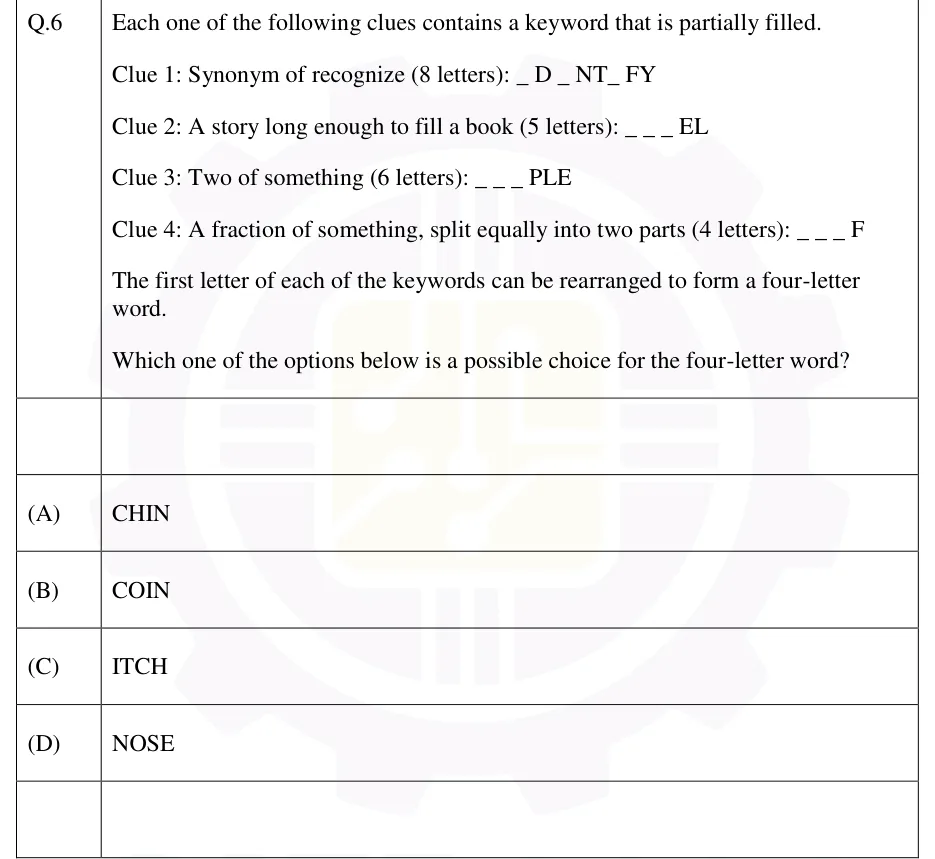
Each one of the following clues contains a keyword that is partially filled.
Clue 1: Synonym of recognize (8 letters): _ D _ NT_ FY
Clue 2: A story long enough to fill a book (5 letters): _ _ _ EL
Clue 3: Two of something (6 letters): _ _ _ PLE
Clue 4: A fraction of something, split equally into two parts (4 letters): _ _ _ F
The first letter of each of the keywords can be rearranged to form a four-letter word.
Which one of the options below is a possible choice for the four-letter word?
CHIN
COIN
ITCH
NOSE
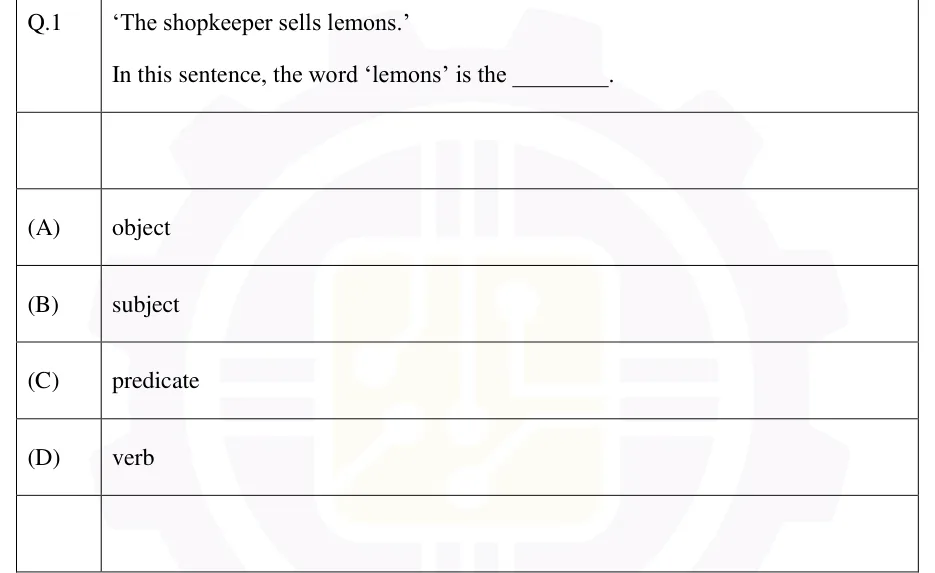
‘The shopkeeper sells lemons.’
In this sentence, the word ‘lemons’ is the ______.
object
subject
predicate
verb
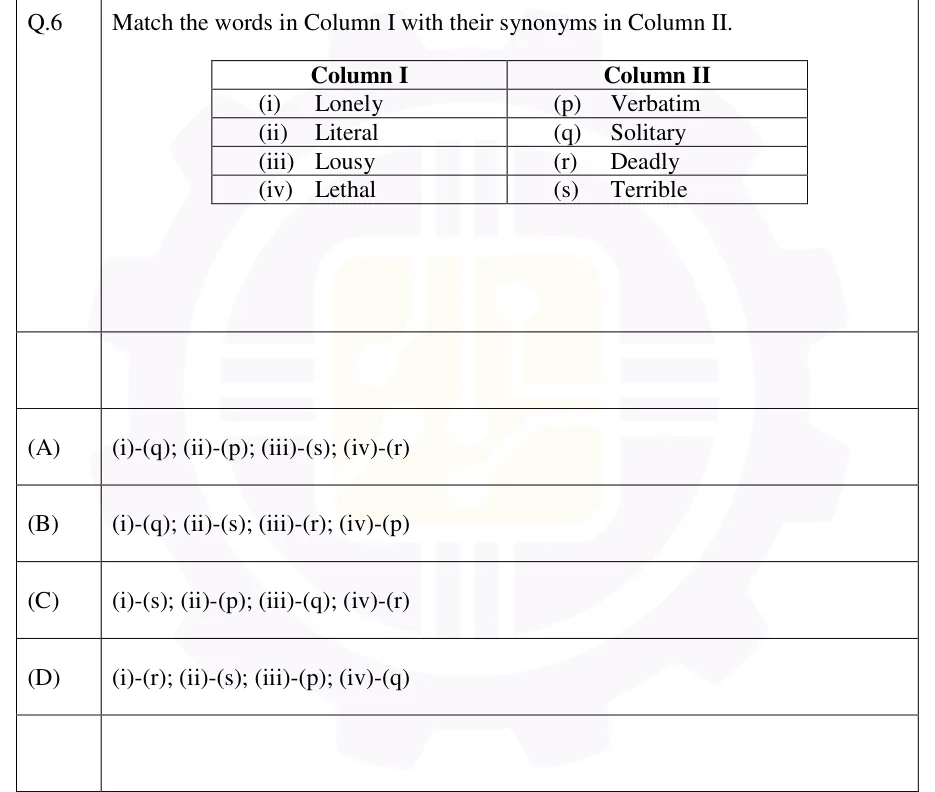
Match the words in Column I with their synonyms in Column II.
| Column I | Column II |
|---|---|
| (i) Lonely | (p) Verbatim |
| (ii) Literal | (q) Solitary |
| (iii) Lousy | (r) Deadly |
| (iv) Lethal | (s) Terrible |
(i)-(q); (ii)-(p); (iii)-(s); (iv)-(r)
(i)-(q); (ii)-(s); (iii)-(r); (iv)-(p)
(i)-(s); (ii)-(p); (iii)-(q); (iv)-(r)
(i)-(r); (ii)-(s); (iii)-(p); (iv)-(q)
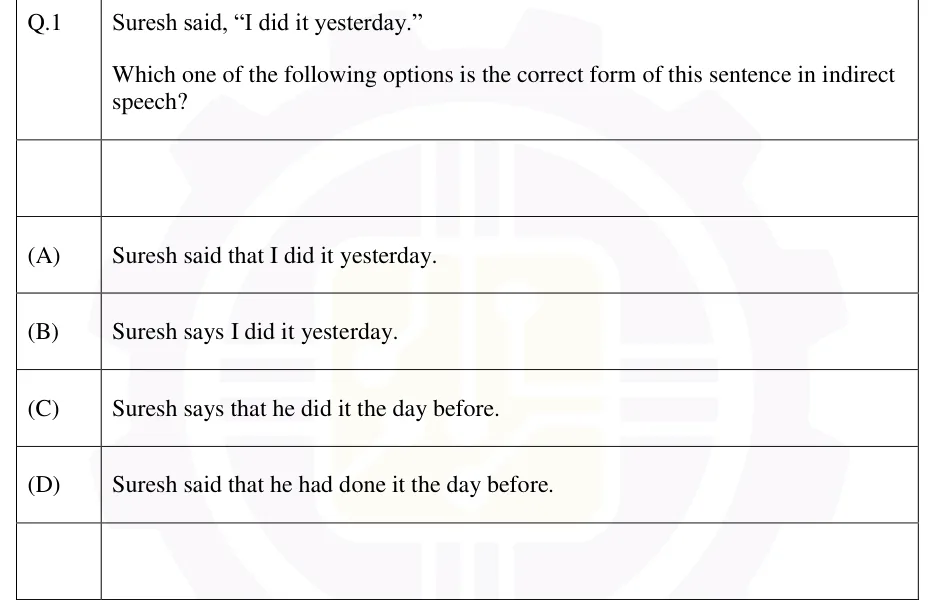
Suresh said, “I did it yesterday.”
Which one of the following options is the correct form of this sentence in indirect speech?
Suresh said that I did it yesterday.
Suresh says I did it yesterday.
Suresh says that he did it the day before.
Suresh said that he had done it the day before.
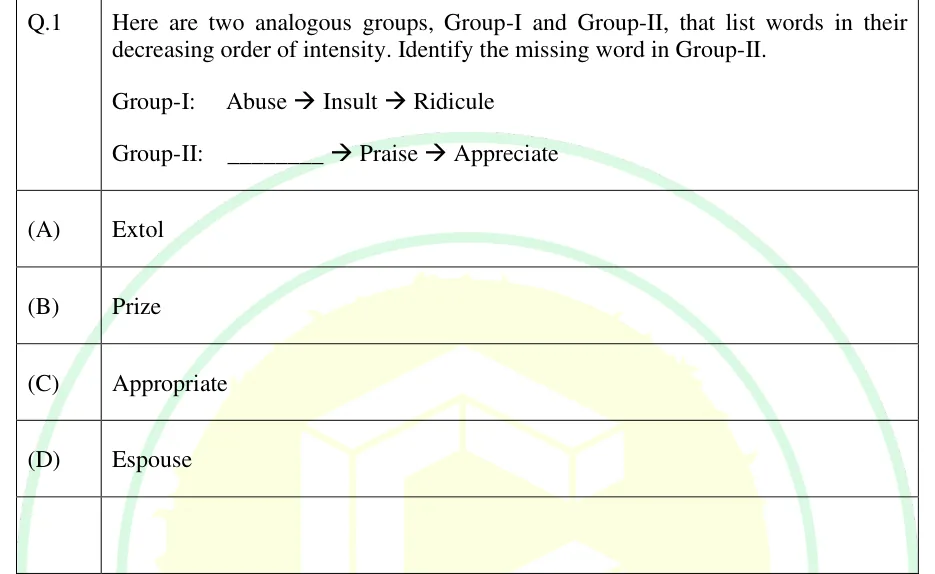
Here are two analogous groups, Group-I and Group-II, that list words in their decreasing order of intensity. Identify the missing word in Group-II.
Group-I: Abuse → Insult → Ridicule
Group-II: ______ → Praise → Appreciate
Extol
Prize
Appropriate
Espouse
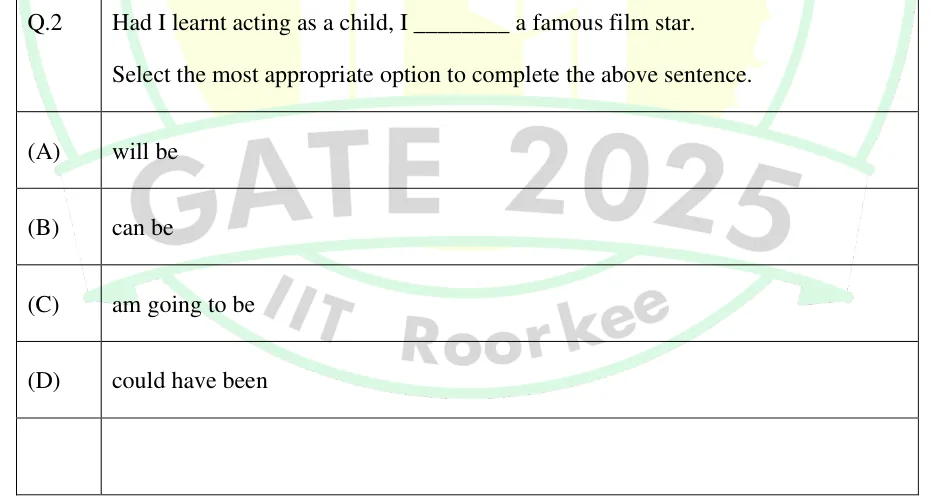
Had I learnt acting as a child, I ______ a famous film star.
Select the most appropriate option to complete the above sentence.
will be
can be
am going to be
could have been
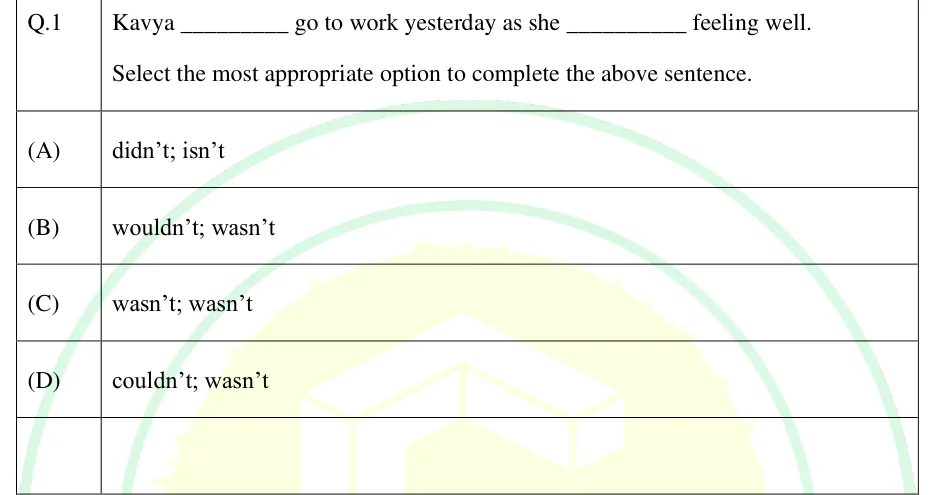
Kavya _________ go to work yesterday as she __________ feeling well.
Select the most appropriate option to complete the above sentence.
didn’t; isn’t
wouldn’t; wasn’t
wasn’t; wasn’t
couldn’t; wasn’t
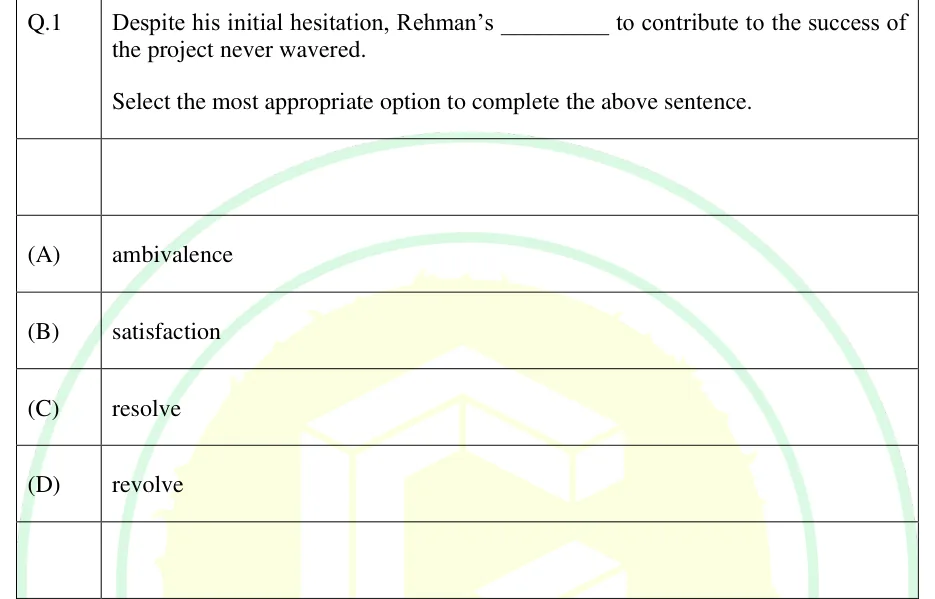
Despite his initial hesitation, Rehman’s _________ to contribute to the success of the project never wavered.
Select the most appropriate option to complete the above sentence.
ambivalence
satisfaction
resolve
revolve
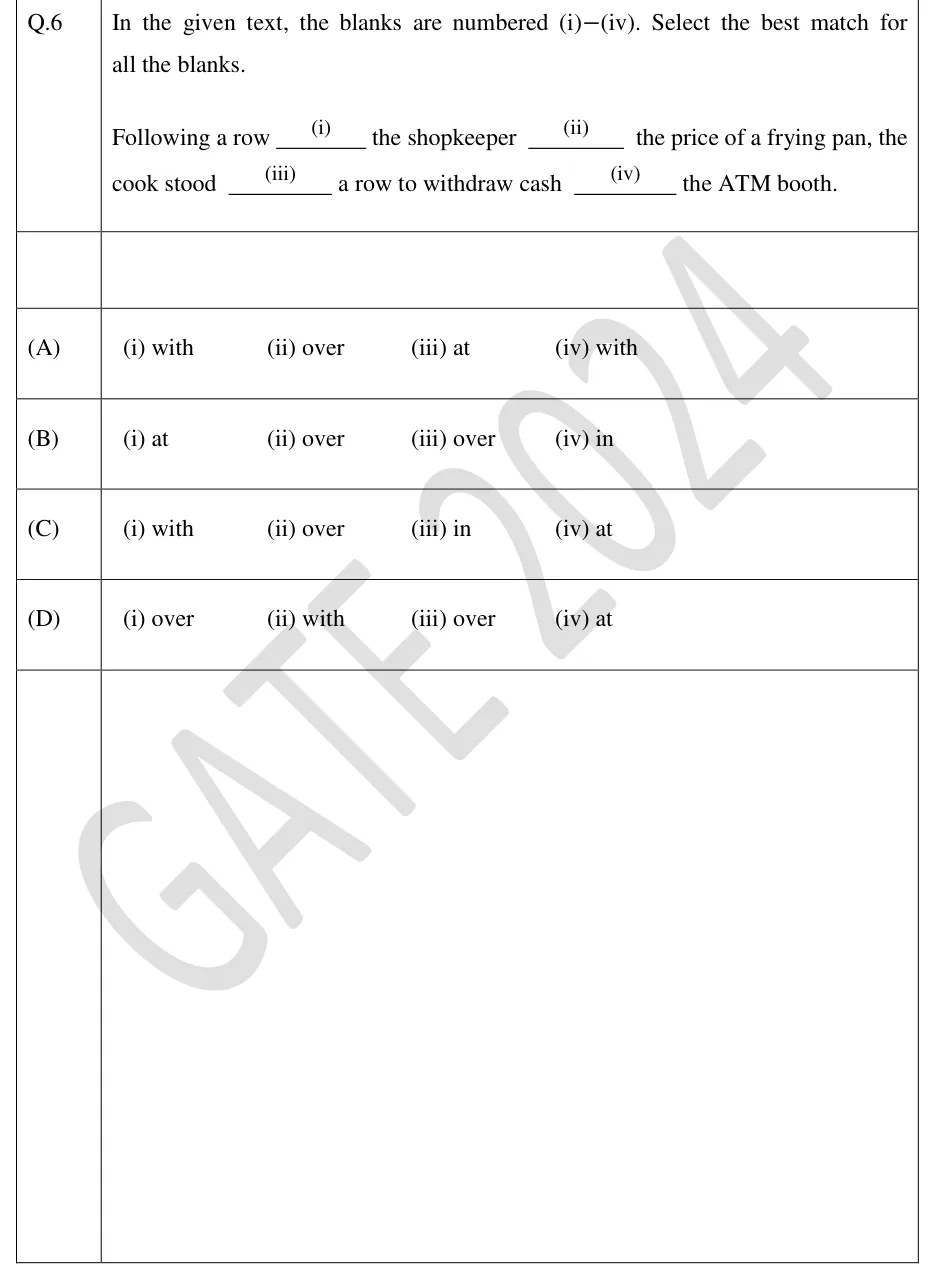
In the given text, the blanks are numbered (i)−(iv). Select the best match for all the blanks.
Following a row ______(i) the shopkeeper ______(ii) the price of a frying pan, the cook stood ______(iii) a row to withdraw cash ______(iv) the ATM booth.
(i) with (ii) over (iii) at (iv) with
(i) at (ii) over (iii) over (iv) in
(i) with (ii) over (iii) in (iv) at
(i) over (ii) with (iii) over (iv) at
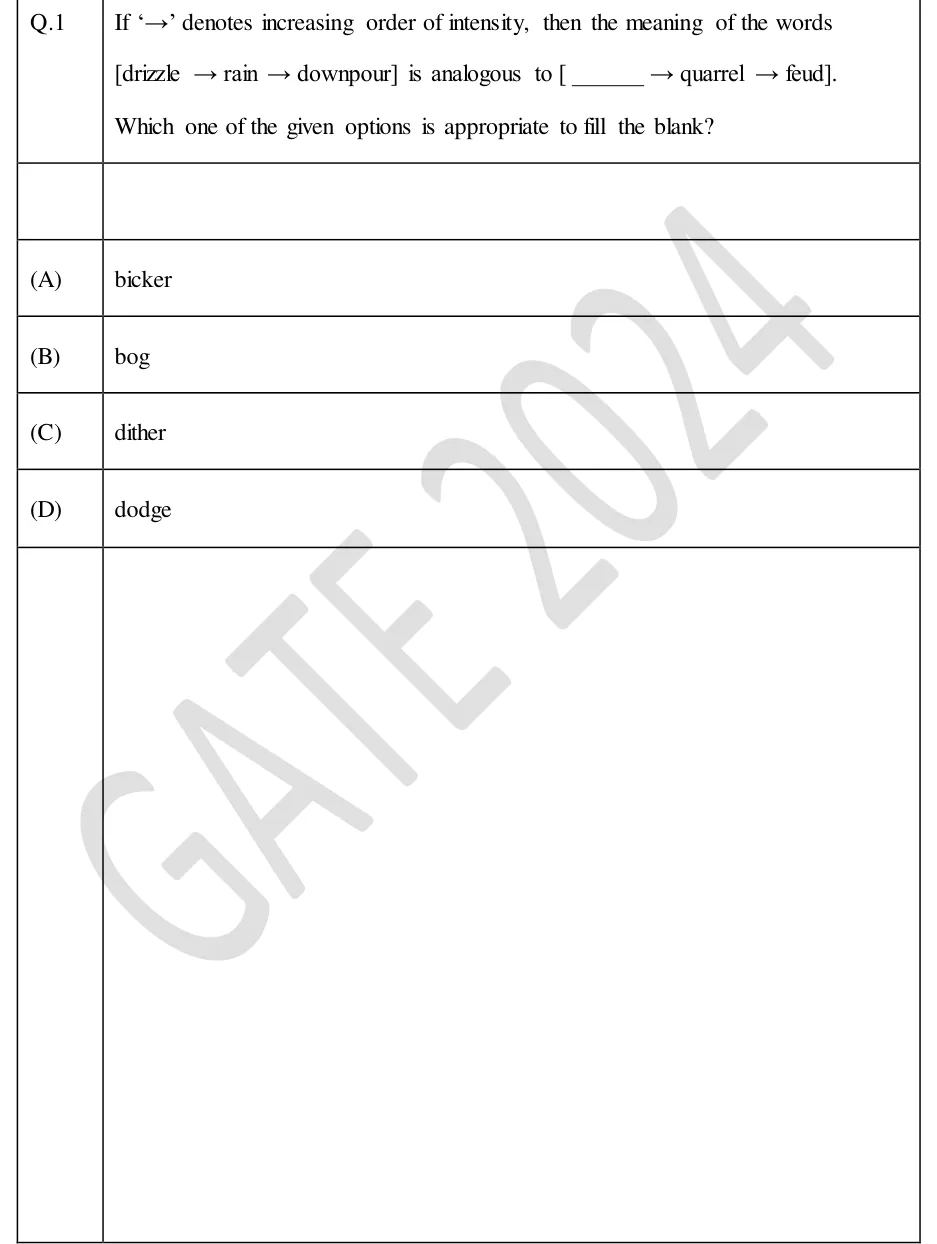
If ‘→’ denotes increasing order of intensity, then the meaning of the words [drizzle → rain → downpour] is analogous to [ ______ → quarrel → feud]. Which one of the given options is appropriate to fill the blank?
bicker
bog
dither
dodge
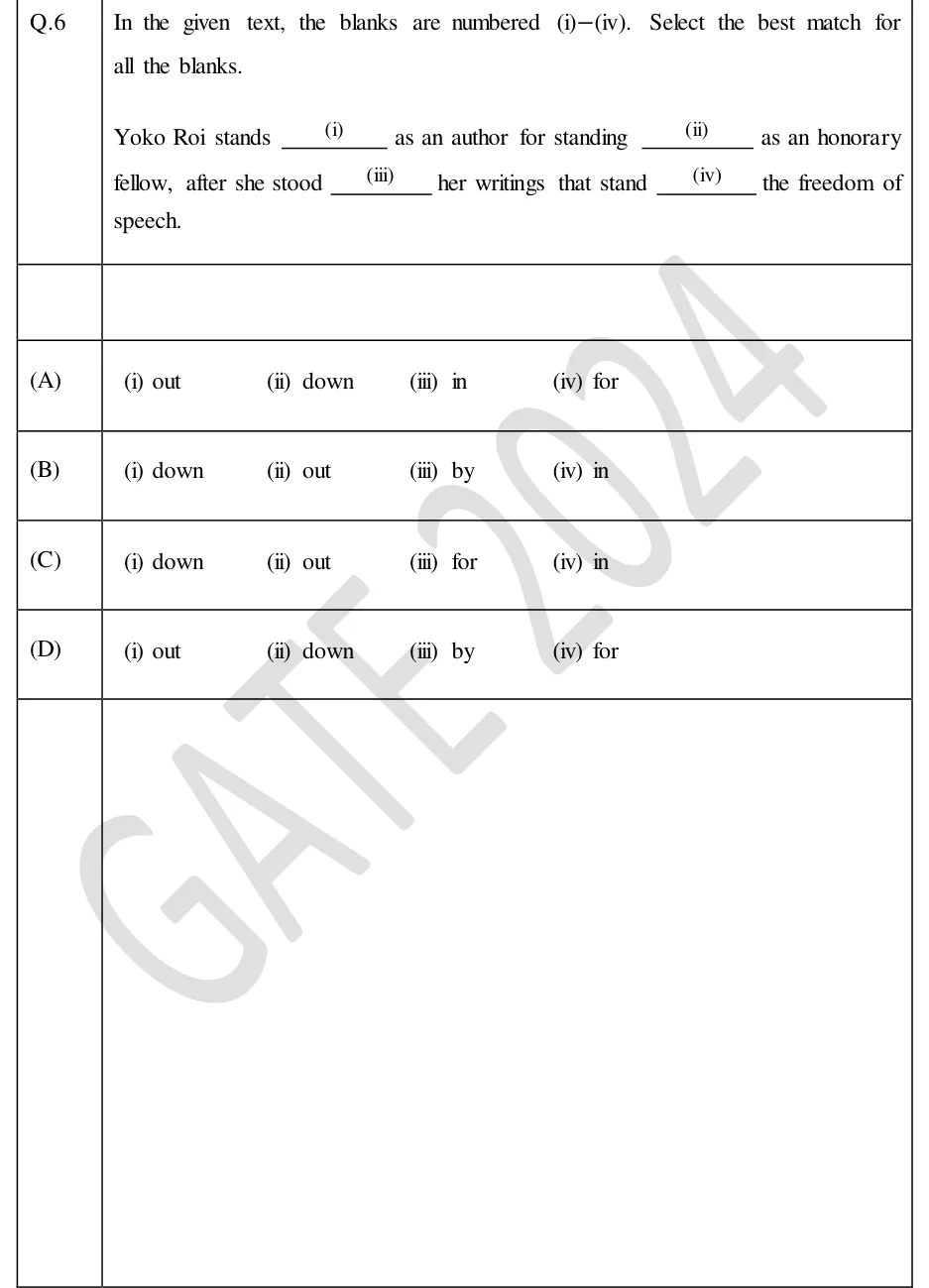
In the given text, the blanks are numbered (i)−(iv). Select the best match for all the blanks.
Yoko Roi stands ______ (i) as an author for standing ______ (ii) as an honorary fellow, after she stood ______ (iii) her writings that stand ______ (iv) the freedom of speech.
(i) out (ii) down (iii) in (iv) for
(i) down (ii) out (iii) by (iv) in
(i) down (ii) out (iii) for (iv) in
(i) out (ii) down (iii) by (iv) for
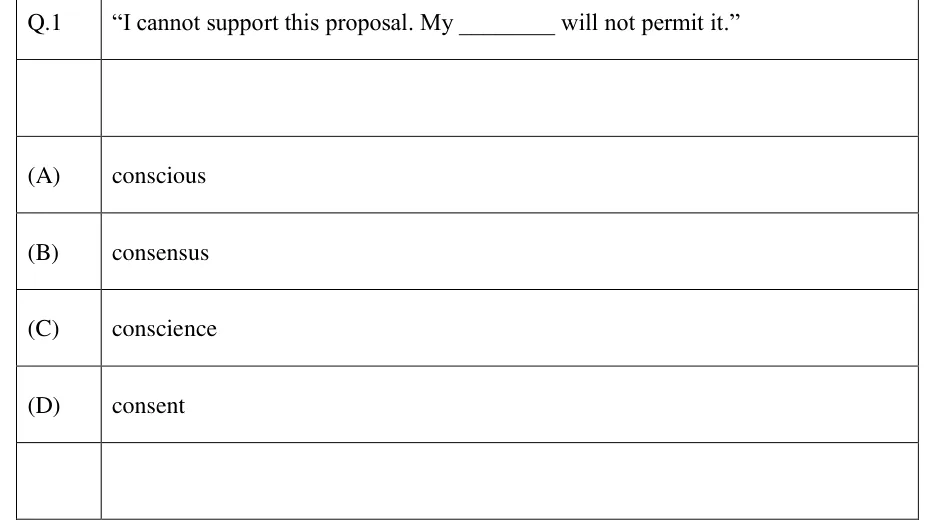
“I cannot support this proposal. My ______ will not permit it.”
conscious
consensus
conscience
consent
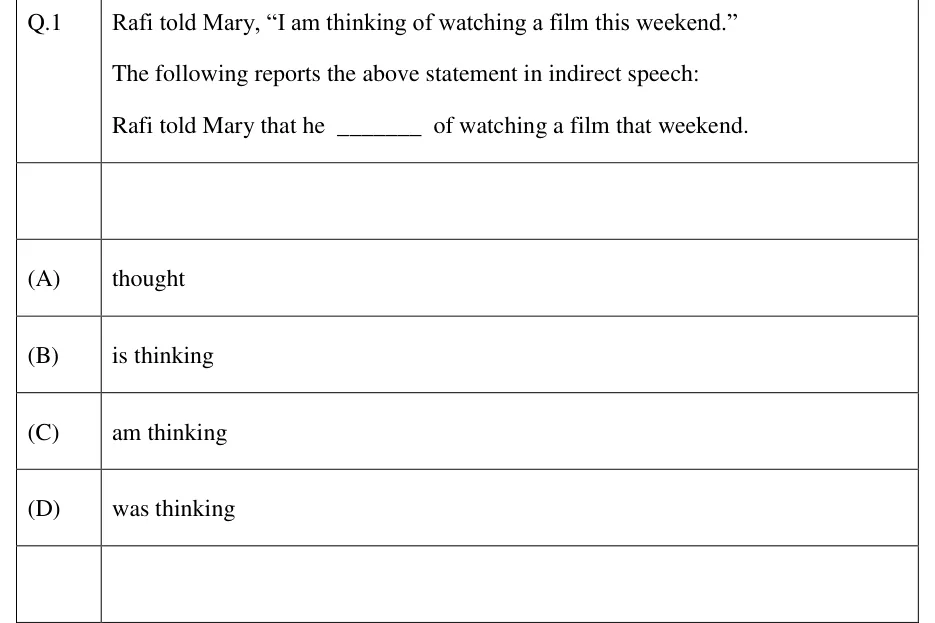
Rafi told Mary, “I am thinking of watching a film this weekend.”
The following reports the above statement in indirect speech:
Rafi told Mary that he ______ of watching a film that weekend.
thought
is thinking
am thinking
was thinking
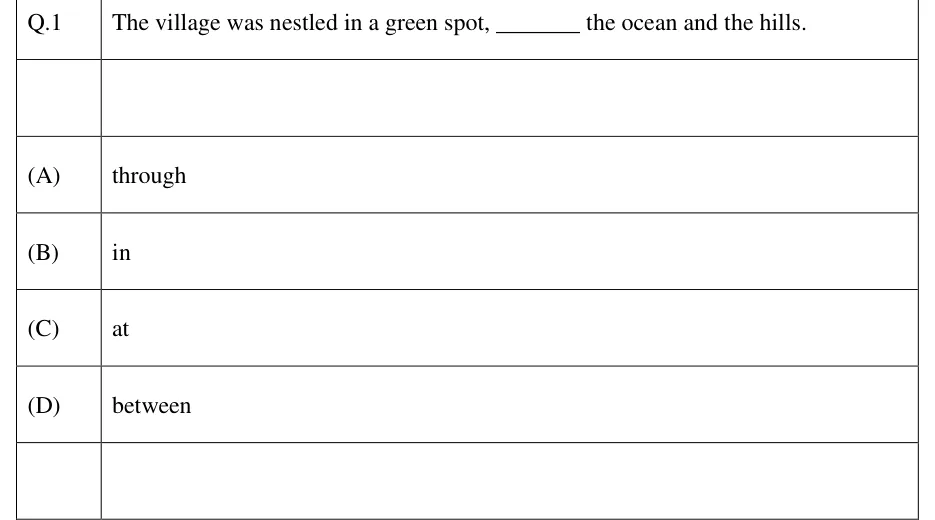
The village was nestled in a green spot, ______ the ocean and the hills.
through
in
at
between
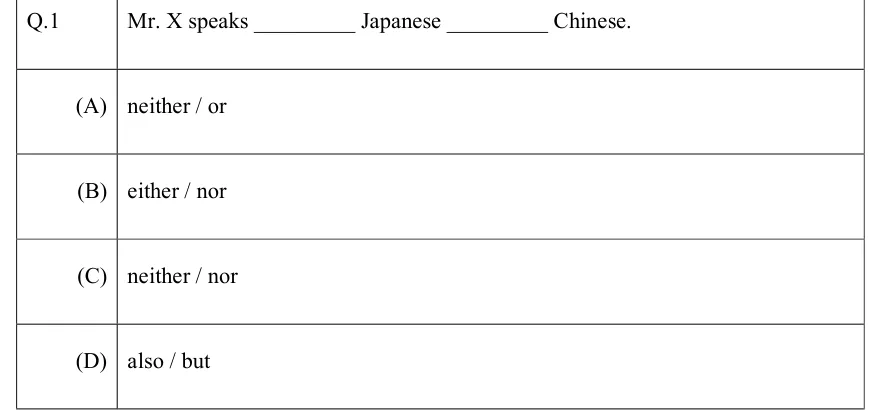
Mr. X speaks ______ Japanese ______ Chinese.
neither / or
either / nor
neither / nor
also / but
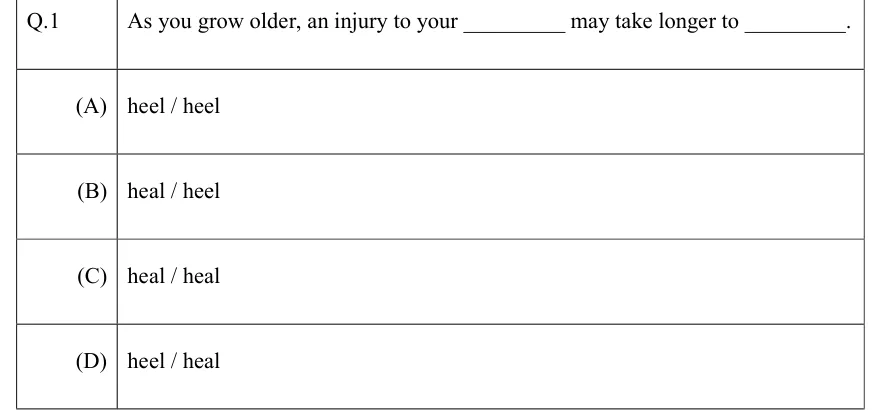
As you grow older, an injury to your _________ may take longer to _________.
heel / heel
heal / heel
heal / heal
heel / heal
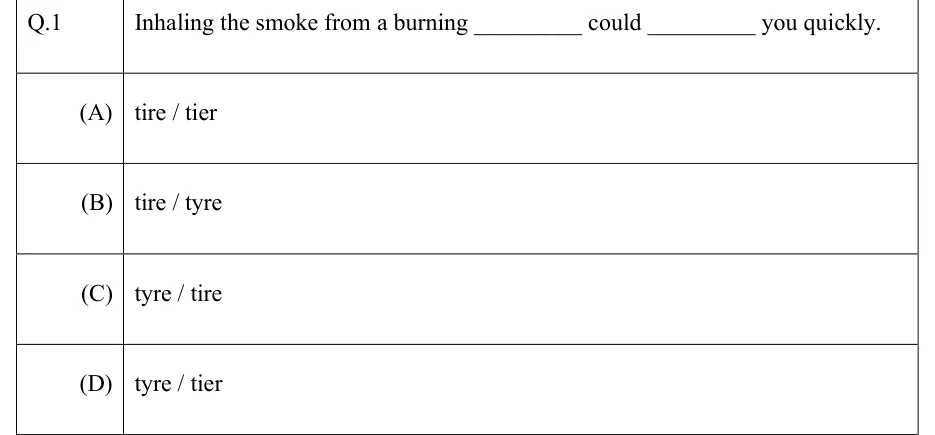
Inhaling the smoke from a burning ______ could ______ you quickly.
tire / tier
tire / tyre
tyre / tire
tyre / tier
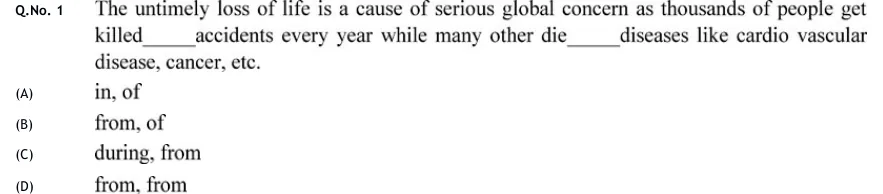
The untimely loss of life is a cause of serious global concern as thousands of people get killed______accidents every year while many other die______diseases like cardio vascular disease, cancer, etc.
in, of
from, of
during, from
from, from
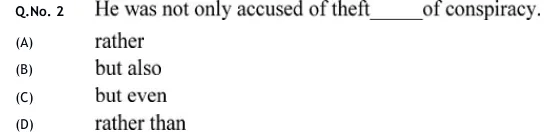
He was not only accused of theft______of conspiracy.
rather
but also
but even
rather than
This book, including all its chapters, ______ interesting. The students as well as the instructor ______ in agreement about it.
is, was
are, are
is, are
were, was
People were prohibited ______ their vehicles near the entrance of the main administrative building.
to park
from parking
parking
to have parked
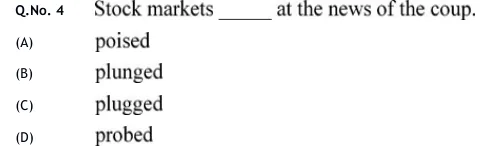
Stock markets ______ at the news of the coup.
poised
plunged
plugged
probed
He is known for his unscrupulous ways. He always sheds______tears to deceive people.
fox’s
crocodile’s
crocodile
fox
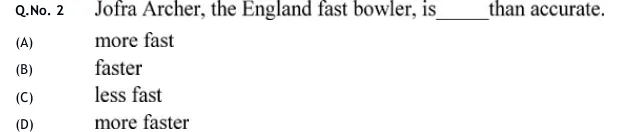
Jofra Archer, the England fast bowler, is______than accurate.
more fast
faster
less fast
more faster
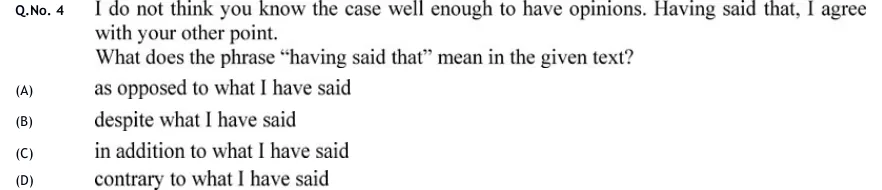
I do not think you know the case well enough to have opinions. Having said that, I agree with your other point.
What does the phrase “having said that” mean in the given text?
as opposed to what I have said
despite what I have said
in addition to what I have said
contrary to what I have said
"By giving him the last ______ of the cake, you will ensure lasting ______ in our house today."
The words that best fill the blanks in the above sentence are
peas, piece
piece, peace
peace, piece
peace, peas
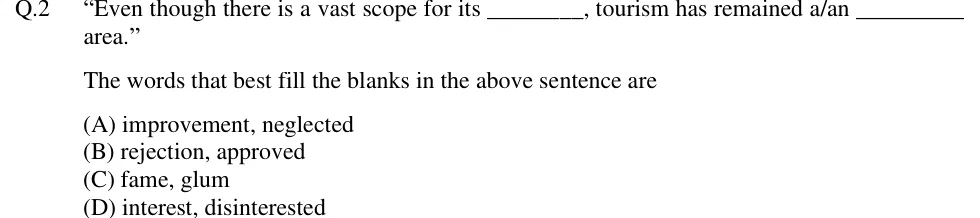
“Even though there is a vast scope for its ________, tourism has remained a/an _________ area.”
The words that best fill the blanks in the above sentence are
improvement, neglected
rejection, approved
fame, glum
interest, disinterested
“Since you have gone off the ______, the ______ sand is likely to damage the car.”
The words that best fill the blanks in the above sentence are
course, coarse
course, course
coarse, course
coarse, coarse
“A common misconception among writers is that sentence structure mirrors thought; the more __________ the structure, the more complicated the ideas.”
The word that best fills the blank in the above sentence is
detailed
simple
clear
convoluted
“When she fell down the ______, she received many ______ but little help.”
The words that best fill the blanks in the above sentence are
stairs, stares
stairs, stairs
stares, stairs
stares, stares
“In spite of being warned repeatedly, he failed to correct his ______ behaviour.”
The word that best fills the blank in the above sentence is
rational
reasonable
errant
good
PRACTICE
Choose the option that correctly fills the blank.
Neither the project manager nor the site engineers ______ informed about the revised deadline.
was
has been
were
is
Answer: (C)
With 'neither ... nor', the verb agrees with the nearer subject.
The nearer subject is 'the site engineers', which is plural.
'was', 'has been' and 'is' are all singular; only 'were' is plural, giving 'were informed'.
Select ALL the sentences that are grammatically correct.
Each of the students has submitted the assignment.
Hardly had the train left the platform when it began to rain.
One of the bridges that was built last year have developed cracks.
No sooner had the bell rang than the children ran out.
Answer: (A), (B)
(A) 'Each of + plural noun' takes a singular verb, and 'has submitted' is singular. Correct.
(B) 'Hardly' at the start is followed by the inverted 'had + subject + V3' and is paired with 'when'. Correct.
(C) Two errors. The subject of the main verb is 'One', which is singular, so 'have developed' should be 'has developed'. The relative clause 'that ... built last year' refers to the plural noun 'bridges', so it should be 'that were built'. Incorrect.
(D) After 'had' the past participle is needed: 'had the bell rung', not 'rang'. Incorrect.
So the correct sentences are (A) and (B).
Read the sentence and choose the option closest in meaning to the phrase in bold.
After three unsuccessful attempts, the candidate refused to throw in the towel and enrolled for the next session.
lose one's temper
admit defeat and give up
tidy up after finishing a task
start again from the beginning
Answer: (B)
The idiom 'throw in the towel' means to admit defeat and stop trying.
Context check: the candidate 'refused to' do it and then 'enrolled for the next session', that is, carried on. Refusing to give up fits exactly.
(D) contradicts the sentence: refusing to start again cannot be followed by enrolling again. (A) and (C) have nothing to do with the context.
Select ALL the sentences that are grammatically correct.
I will send you the marks as soon as the results are declared.
I will send you the marks as soon as the results will be declared.
Nobody in the office knows when the results will be declared.
By the time the inspectors will arrive, the site will have been cleared.
Answer: (A), (C)
(A) 'As soon as' opens a time clause about the future, which takes the present tense ('are declared'), with 'will' only in the main clause. Correct.
(B) The same time clause with 'will be declared' breaks that rule. Incorrect.
(C) Here 'when the results will be declared' is the object of 'knows': it is a noun clause, not a time clause, so 'will' is correct. Correct.
(D) 'By the time' opens a time clause, so it should be 'By the time the inspectors arrive'. Incorrect.
So the correct sentences are (A) and (C).
Choose the pair of words that correctly fills the blanks.
The proposed change in the timetable will ______ only the evening batch, and its ______ on the morning batch will be negligible.
affect; effect
effect; affect
affect; affect
effect; effect
Answer: (A)
First blank: after 'will' a verb meaning 'to influence' is needed. That is 'affect'. ('Effect' as a verb means 'to bring about', and 'bring about the evening batch' makes no sense.) This leaves (A) and (C).
Second blank: after 'its' a noun meaning 'result' is needed. That is 'effect', which rules out (C).
Only (A) gives: 'will affect only the evening batch, and its effect on the morning batch will be negligible'.
How many of the following seven sentences contain a grammatical error?
(i) She is senior than me by two years.
(ii) He prefers tea to coffee.
(iii) He was awarded a one-year fellowship.
(iv) The furnitures in this room are new.
(v) I have been living in Kolkata since five years.
(vi) If I were you, I would accept the offer.
(vii) Between you and I, the plan will fail.
Answer:
(i) 'Senior' takes 'to', not 'than': 'senior to me'. Error.
(ii) 'prefer X to Y' is the correct pattern. No error.
(iii) 'one' begins with a consonant sound (w), so 'a one-year fellowship' is correct. No error.
(iv) 'Furniture' is uncountable: 'The furniture in this room is new'. Error.
(v) 'Five years' is a length of time, so it takes 'for': 'for five years'. Error.
(vi) Second conditional with 'were' for every person: correct. No error.
(vii) After the preposition 'between', the object case is needed: 'between you and me'. Error.
Sentences with errors: (i), (iv), (v), (vii), which makes 4.
OFFICIAL GATE 2027 SYLLABUS WORDING
Copied from the GATE 2027 syllabus; see all 2027 syllabi.
EVERY GATE PAPER
Basic English grammar: tenses, articles, adjectives, prepositions, conjunctions, verb-noun agreement, and other parts of speech. Basic vocabulary: words, idioms, and phrases in context
Preparing in Kolkata? See IAE Academy’s GATE courses.