IAE Academy

GATE 2020 IN GA Q.4: solution and answer

GATE 2020 · INGA Q.4 · 1 mark · MCQ

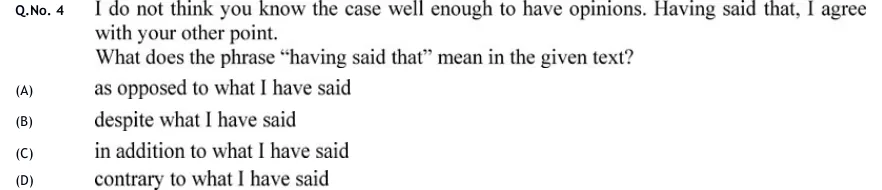
I do not think you know the case well enough to have opinions. Having said that, I agree with your other point.
What does the phrase “having said that” mean in the given text?

  1. (A)

    as opposed to what I have said

  2. (B)

    despite what I have said

  3. (C)

    in addition to what I have said

  4. (D)

    contrary to what I have said

See the question in the paper

Answer and solution

ANSWER

(B) despite what I have said

Official answer: BSource: Official answer key, GATE 2020 IN (IIT Delhi)

  1. What the phrase means: "having said that" is a discourse marker of concession. It means "even though I have just said that", or "nevertheless". The speaker keeps the earlier statement and then adds a point that seems to pull the other way.

  2. First sentence: the speaker criticises the listener: "I do not think you know the case well enough to have opinions."

  3. Second sentence: the speaker still agrees with the listener's other point. After that criticism, agreeing is the unexpected turn. So the two sentences are linked by concession ("in spite of that"), not by addition.

  4. Why not (A) or (D): "as opposed to" and "contrary to" would mean the speaker contradicts or takes back the first sentence. The speaker does not withdraw it. The criticism still stands, and both statements are meant to be true together.

  5. Why not (C): "in addition to" continues in the same direction, like "moreover". Agreeing with someone is not a further criticism, so this option loses the contrast between the two sentences.

  6. Why (B) works: put the option in place of the phrase and read the sentence again: "Despite what I have said, I agree with your other point." The meaning does not change. The answer is (B).

KEY IDEA

"Having said that" is a concessive connector, like "nevertheless" or "even so". The speaker stands by the earlier statement and then adds a point that runs against it. Check an option by putting it in the phrase's place: the right one leaves the meaning unchanged.

WATCH OUT FOR

Picking (D) "contrary to" or (A) "as opposed to" because the two sentences contrast. Both of those mean the speaker is contradicting or withdrawing the first statement, but the speaker keeps it. Picking (C) "in addition to" misses the contrast altogether.

From the GATE 2020 IN paper. Every question of this paper · Download the full paper · All 32 Grammar & vocabulary questions, with notes

More Grammar & vocabulary questions