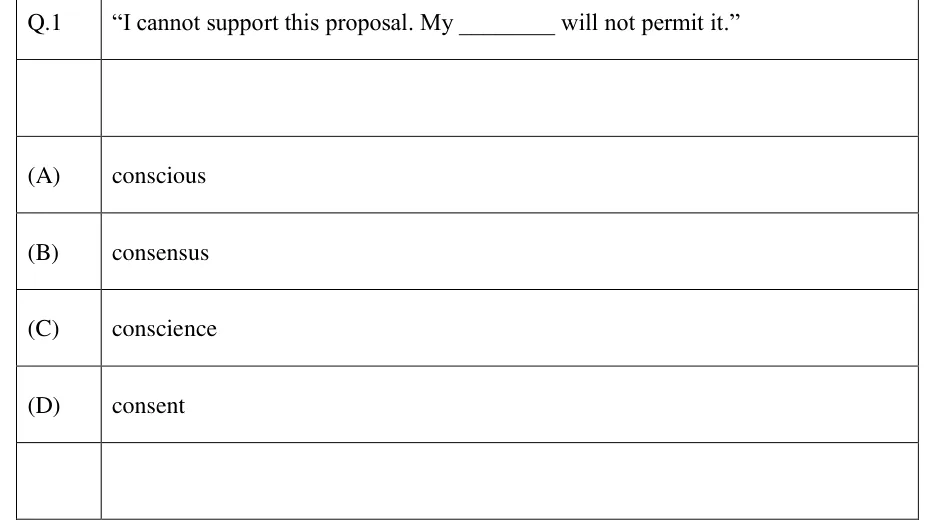
“I cannot support this proposal. My ______ will not permit it.”
- (A)
conscious
- (B)
consensus
- (C)
conscience
- (D)
consent

“I cannot support this proposal. My ______ will not permit it.”
conscious
consensus
conscience
consent
ANSWER
(C) conscience. \"My conscience will not permit it\" is the standard way to refuse something on moral grounds.
Official answer: CSource: Official answer key, GATE 2023 EC (IIT Kanpur)
Start with the grammar. The blank follows the possessive My and is the subject of will not permit, so it must be a noun.
(A) conscious is an adjective meaning aware or awake, as in "conscious of the risk". An adjective cannot stand alone after My as the subject of a verb, so (A) is out.
(B) consensus is a noun, but it means general agreement within a group. One person cannot have a consensus, so My consensus is not idiomatic. (B) is out.
(D) consent is a noun meaning the permission that I give. Consent is the permission itself; it does not act as an agent that permits or forbids anything. The idiomatic forms are I will not give my consent or it does not have my consent, so My consent will not permit it is not natural English. (D) is out.
(C) conscience is a noun meaning a person's inner sense of right and wrong. My conscience will not permit it is a fixed English expression for refusing something on moral grounds.
Check the meaning. The speaker refuses to support the proposal and gives a personal, moral reason. Only conscience fits both the grammar and the meaning, so the answer is (C) conscience.
KEY IDEA
The four options look alike, so check two things: part of speech, then meaning. The blank must be a noun that belongs to one person and can act as the subject of \"will not permit\". Only conscience, a person's inner moral sense, does all of that, and \"my conscience will not permit it\" is a fixed idiom.
WATCH OUT FOR
Picking (A) conscious because it sounds like conscience, when it is an adjective. The other trap is (D) consent, because refusing permission seems to fit. But consent is the permission itself, which you give or withhold; it cannot \"permit\" anything. (B) consensus is always a group's agreement, never one person's.
From the GATE 2023 EC paper. Every question of this paper · Download the full paper · All 32 Grammar & vocabulary questions, with notes