
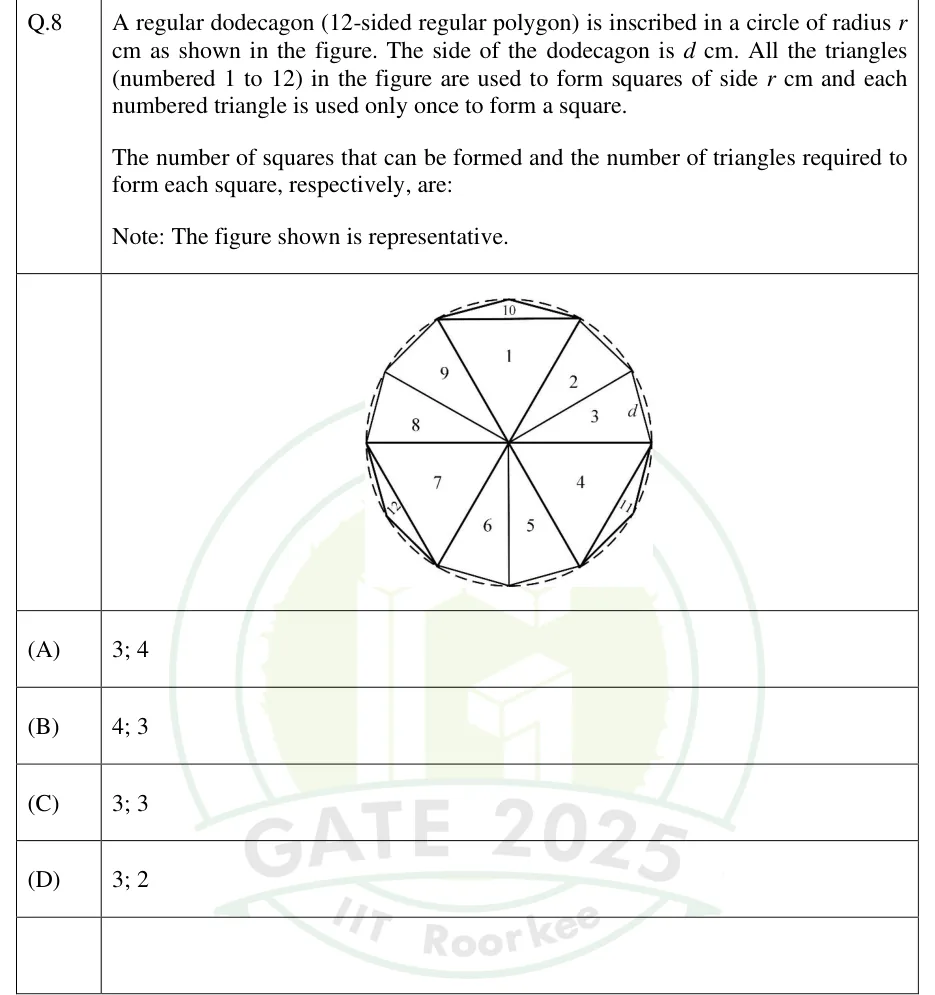
A regular dodecagon (12-sided regular polygon) is inscribed in a circle of radius r cm as shown in the figure. The side of the dodecagon is d cm. All the triangles (numbered 1 to 12) in the figure are used to form squares of side r cm and each numbered triangle is used only once to form a square.
The number of squares that can be formed and the number of triangles required to form each square, respectively, are:
Note: The figure shown is representative.
 Tap to open full size
Figure description
A circle of radius r with a regular dodecagon inscribed in it. Lines from the centre to all 12 vertices split the dodecagon into 12 congruent isosceles triangles, numbered 1 to 12 going around the circle (1 at the top centre, 2 and 3 on the upper right, 4 and 5 and 6 below right and bottom, 7 and 8 on the left, 9 on the upper left, 10 at the top just under the circle's top edge, 11 at the lower right edge, 12 at the lower left edge). The side of the dodecagon, on the outer edge of a triangle, is labelled d (shown near triangle 3), and the circle is drawn dashed around the polygon.
- (A)
3; 4
- (B)
4; 3
- (C)
3; 3
- (D)
3; 2