
IAE Academy

GATE 2025 EE GA Q.10: solution and answer

GATE 2025 · EEGA Q.10 · 2 marks · MCQ

In the triangle PQR, the lengths of PT and TR are in the ratio of 3:2.

ST is parallel to QR. Two semicircles are drawn with PS and PQ as diameters, as shown in the figure.

Which one of the following statements is true about the shaded area PQS?

Note: The figure shown is representative.
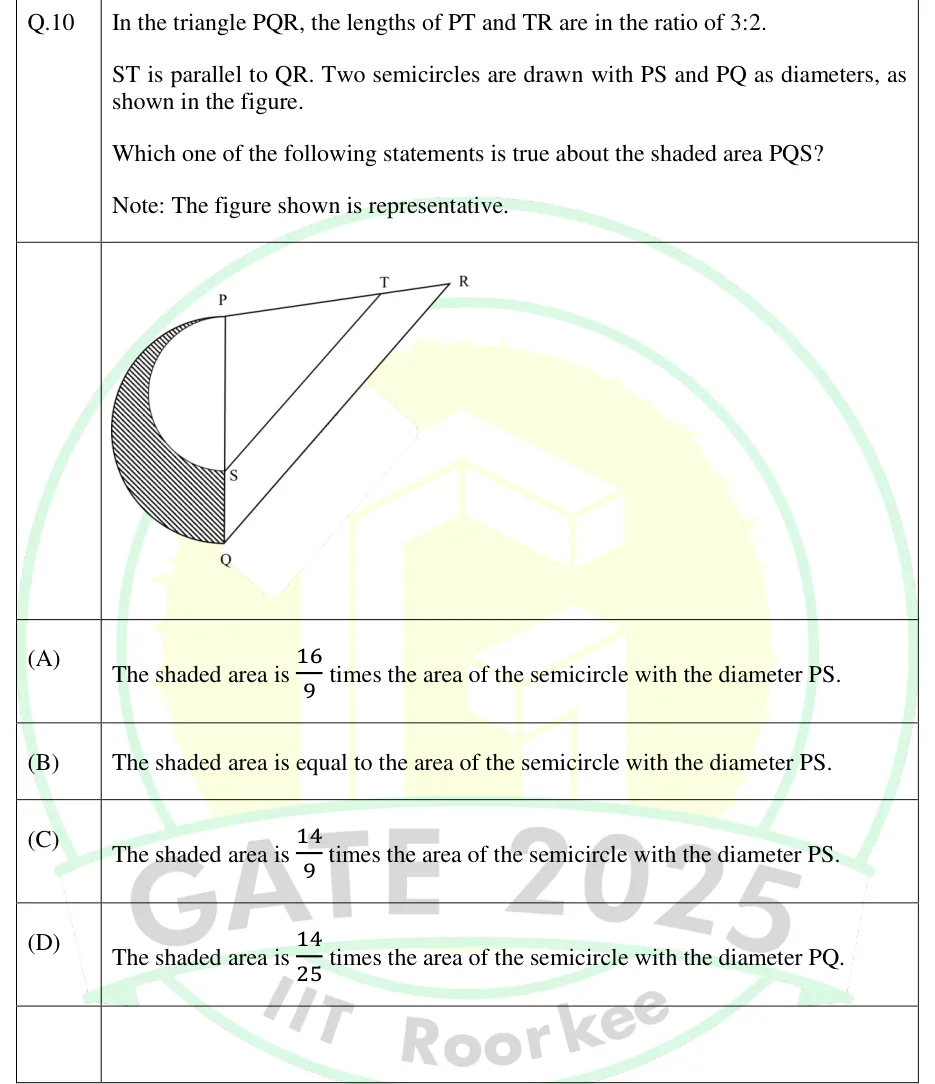
GATE 2025 EE GA question 10: Triangle PQR with side PQ drawn vertically: P at the top, Q at the bottom.Tap to open full size
Figure from the GATE 2025 EE paper. It is part of the question.
Figure description

Triangle PQR with side PQ drawn vertically: P at the top, Q at the bottom. R is at the upper right, a little higher than P, so side PR rises gently to the right and side QR runs diagonally from Q up to R. Point T lies on PR, closer to R than to P (PT:TR = 3:2). Point S lies on PQ, below its midpoint and closer to Q. Segment ST is drawn parallel to QR. On the left of PQ there are two semicircles, both bulging to the left: a large one with diameter PQ (its arc runs from P round to Q) and a smaller one with diameter PS (its arc runs from P round to S). The crescent-shaped region between the large arc and the small arc, closed off by segment SQ, is hatched with diagonal lines. This hatched region is the shaded area PQS. The inside of the small semicircle is not shaded.

  1. (A)

    The shaded area is times the area of the semicircle with the diameter PS.

  2. (B)

    The shaded area is equal to the area of the semicircle with the diameter PS.

  3. (C)

    The shaded area is times the area of the semicircle with the diameter PS.

  4. (D)

    The shaded area is times the area of the semicircle with the diameter PQ.

Answer and solution

ANSWER

(A) The shaded area is times the area of the semicircle with the diameter PS.

Official answer: ASource: Official answer key, GATE 2025 EE (IIT Roorkee)

  1. Basic proportionality theorem (Thales): ST is parallel to QR, so it divides the sides PQ and PR in the same ratio. That gives .

  2. Take and , so .

  3. A semicircle with diameter has area . So the semicircle on PS has area , and the semicircle on PQ has area .

  4. Both semicircles lie on the same side of PQ and share the end point P. The circle on PS touches the circle on PQ from inside at P, so the small semicircle lies entirely inside the large one. The shaded region is the large semicircle with the small one removed:

  5. Compare this with the semicircle on PS: This matches option (A).

  6. Check the other options. Against the semicircle on PQ the ratio is , not , so (D) is false. Since and , (B) and (C) are false as well.

KEY IDEA

Because ST is parallel to QR, the basic proportionality theorem gives , so the diameters PS and PQ are in the ratio . Semicircle areas go as the square of the diameter (), and the shaded crescent is the difference, parts. Against the PS semicircle's 9 parts, that is .

WATCH OUT FOR

Taking PQ as 3 + 2 but then comparing lengths instead of areas, which gives a ratio such as or . Area scales with the square of the diameter. A second trap is reading as because S looks close to Q in the figure. The figure is only representative, so the ratio has to come from the parallel line, not from how the drawing looks. Getting the ratio the wrong way round leads to , which is not an option.

From the GATE 2025 EE paper. Every question of this paper · Download the full paper · All 22 Geometry questions, with notes

More Geometry questions