
ISRO Scientist/Engineer Electronics 2023 question paper
All 95 questions of ISRO's written test for Scientist/Engineer 'SC' (Electronics), held on 7 January 2024, with ISRO's answer key. ISRO excluded Q.23, Q.32 and Q.44 from evaluation.
Answers from ISRO's revised and final answer key of 16 February 2024.
- questions · 100 marks
- 95questions · 100 marks
- Part A: Electronics
- 80Part A: Electronics
- Part B: aptitude
- 15Part B: aptitude
How the paper is marked
- Part A (Q.1 to Q.80): 1 mark for a correct answer, minus 1/3 for a wrong answer.
- Part B (Q.81 to Q.95): 1 or 2 marks as printed with each question, 20 marks in all, no negative marking.
Source: ISRO's recruitment advertisement ISRO:ICRB:02(EMC):2023 of 25 May 2023, item 16(b).
ISRO EC 2023 answer key
| Question | Part | Marks | Answer |
|---|---|---|---|
| Q.1 | A | 1 | C |
| Q.2 | A | 1 | C |
| Q.3 | A | 1 | C |
| Q.4 | A | 1 | C |
| Q.5 | A | 1 | D |
| Q.6 | A | 1 | B |
| Q.7 | A | 1 | B |
| Q.8 | A | 1 | A |
| Q.9 | A | 1 | A |
| Q.10 | A | 1 | C |
| Q.11 | A | 1 | B |
| Q.12 | A | 1 | B |
| Q.13 | A | 1 | A |
| Q.14 | A | 1 | C |
| Q.15 | A | 1 | B |
| Q.16 | A | 1 | C |
| Q.17 | A | 1 | A |
| Q.18 | A | 1 | C |
| Q.19 | A | 1 | D |
| Q.20 | A | 1 | B |
| Q.21 | A | 1 | B or C |
| Q.22 | A | 1 | B |
| Q.23 | A | 1 | Excluded |
| Q.24 | A | 1 | A |
| Q.25 | A | 1 | D |
| Q.26 | A | 1 | C |
| Q.27 | A | 1 | A |
| Q.28 | A | 1 | D |
| Q.29 | A | 1 | C |
| Q.30 | A | 1 | A |
| Q.31 | A | 1 | B |
| Q.32 | A | 1 | Excluded |
| Q.33 | A | 1 | C |
| Q.34 | A | 1 | B |
| Q.35 | A | 1 | A |
| Q.36 | A | 1 | B |
| Q.37 | A | 1 | A |
| Q.38 | A | 1 | A |
| Q.39 | A | 1 | A |
| Q.40 | A | 1 | B |
| Q.41 | A | 1 | B |
| Q.42 | A | 1 | A |
| Q.43 | A | 1 | C |
| Q.44 | A | 1 | Excluded |
| Q.45 | A | 1 | A |
| Q.46 | A | 1 | D |
| Q.47 | A | 1 | B |
| Q.48 | A | 1 | D |
| Q.49 | A | 1 | A |
| Q.50 | A | 1 | D |
| Q.51 | A | 1 | B |
| Q.52 | A | 1 | C |
| Q.53 | A | 1 | D |
| Q.54 | A | 1 | A |
| Q.55 | A | 1 | B |
| Q.56 | A | 1 | C |
| Q.57 | A | 1 | A |
| Q.58 | A | 1 | C |
| Q.59 | A | 1 | A |
| Q.60 | A | 1 | C |
| Q.61 | A | 1 | C |
| Q.62 | A | 1 | A |
| Q.63 | A | 1 | C |
| Q.64 | A | 1 | A |
| Q.65 | A | 1 | A |
| Q.66 | A | 1 | A |
| Q.67 | A | 1 | C |
| Q.68 | A | 1 | A |
| Q.69 | A | 1 | A |
| Q.70 | A | 1 | A |
| Q.71 | A | 1 | B |
| Q.72 | A | 1 | B |
| Q.73 | A | 1 | B |
| Q.74 | A | 1 | A |
| Q.75 | A | 1 | A |
| Q.76 | A | 1 | C |
| Q.77 | A | 1 | B |
| Q.78 | A | 1 | C |
| Q.79 | A | 1 | A |
| Q.80 | A | 1 | D |
| Q.81 | B | 1 | D |
| Q.82 | B | 1 | D |
| Q.83 | B | 2 | B |
| Q.84 | B | 1 | A |
| Q.85 | B | 1 | A |
| Q.86 | B | 2 | A |
| Q.87 | B | 1 | A |
| Q.88 | B | 1 | C |
| Q.89 | B | 2 | C |
| Q.90 | B | 1 | C |
| Q.91 | B | 1 | D |
| Q.92 | B | 2 | D |
| Q.93 | B | 1 | A |
| Q.94 | B | 1 | C |
| Q.95 | B | 2 | A |
ISRO excluded Q.23, Q.32 and Q.44 from evaluation.
Part A: Electronics Q.1 to Q.80
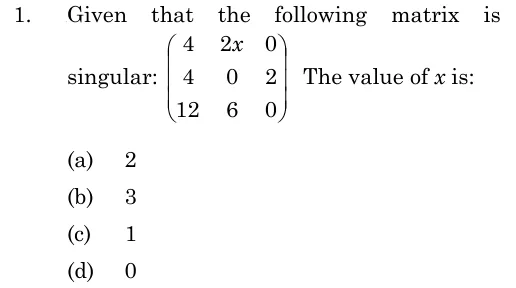
- Q.11 markOfficial answer: C
 Tap to open full size
Engineering Mathematics › Linear algebra
Full solutionA square matrix is singular when its determinant is zero. Expand the determinant along a row, then solve the resulting linear equation for the unknown.
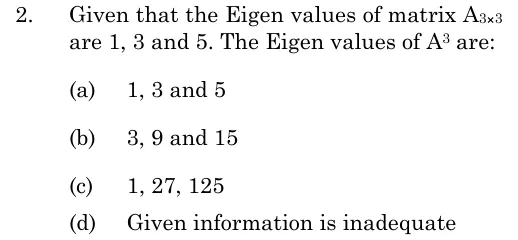
- Q.21 markOfficial answer: C
 Tap to open full size
Engineering Mathematics › Linear algebra
Full solutionFor any positive integer , if is an eigenvalue of then is an eigenvalue of , with the same eigenvector. Raise each eigenvalue to the power.
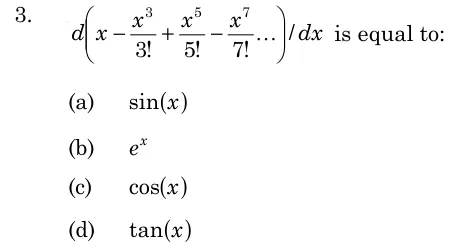
- Q.31 markOfficial answer: C
 Tap to open full size
Engineering Mathematics › Calculus
Full solutionThe given series is the Maclaurin series of , and differentiating (or the series term by term) gives .
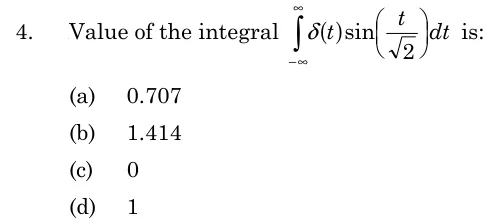
- Q.41 markOfficial answer: C
 Tap to open full size
Signals and Systems › Signals basics
Full solutionThe sifting property of the unit impulse: . Only the value of the function at the impulse location matters.
- Q.51 markOfficial answer: D
 Tap to open full size
Signals and Systems › Fourier series
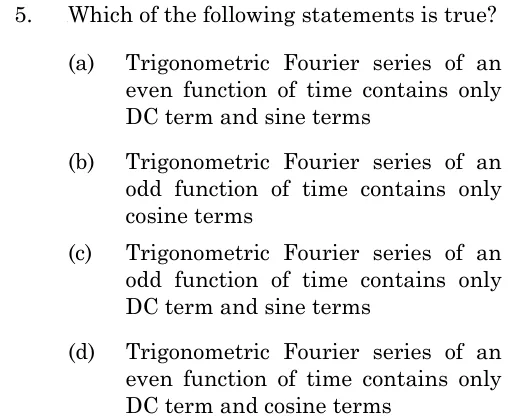
Full solutionSymmetry kills integrals: an even makes every vanish (sine terms drop out), leaving and cosines; an odd makes and every vanish, leaving only sines.
- Q.61 markOfficial answer: B
 Tap to open full size
Engineering Mathematics › Probability & statistics
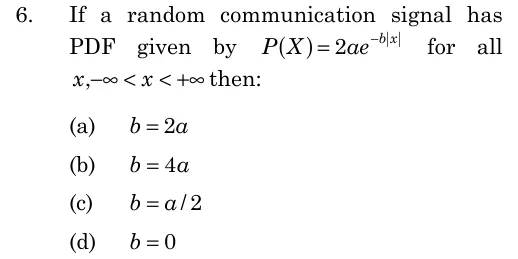
Full solutionA PDF must have total area 1. Normalising the two-sided exponential gives .
- Q.71 markOfficial answer: B
 Tap to open full size
Analog Electronics › Noise & shielding (IN)
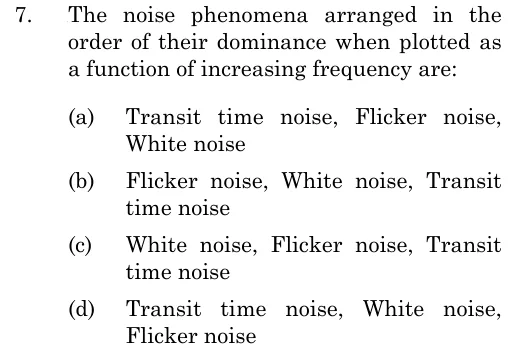
Full solutionA noise spectrum has three regions: (flicker) noise at low frequency, a flat white-noise floor in the middle, and a rise from transit-time effects at very high frequency.
- Q.81 markOfficial answer: A
 Tap to open full size
- Q.91 markOfficial answer: A
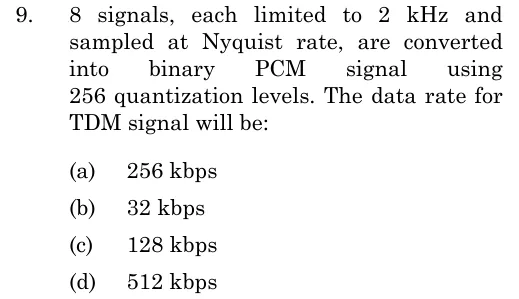 Tap to open full size
- Q.101 markOfficial answer: C
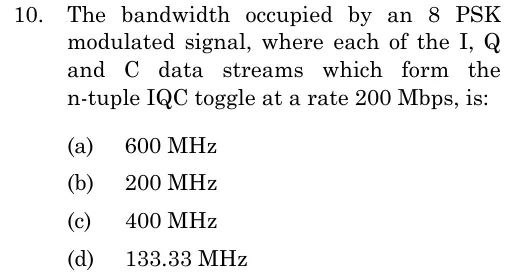 Tap to open full size
- Q.111 markOfficial answer: B
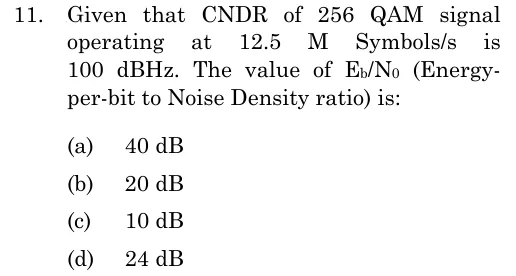 Tap to open full size
- Q.121 markOfficial answer: B
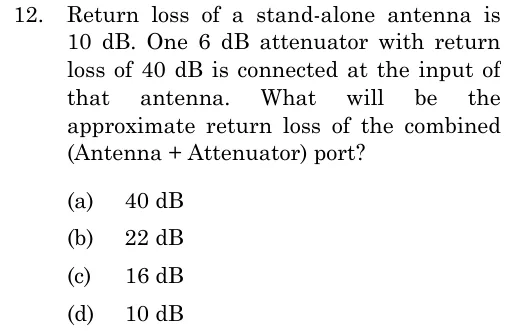 Tap to open full size
Electromagnetics › Transmission lines
Full solutionA reflection from a load behind an attenuator crosses the attenuator twice, so the return loss seen at the input is the load's return loss plus twice the attenuation (in dB), provided the attenuator's own reflection is small.
- Q.131 markOfficial answer: A
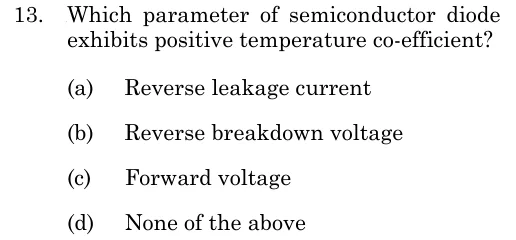 Tap to open full size
Electronic Devices › P-N junction
Full solutionThermally generated minority carriers make reverse saturation current grow rapidly with temperature, about doubling per . Forward voltage falls with temperature at about .
- Q.141 markOfficial answer: C
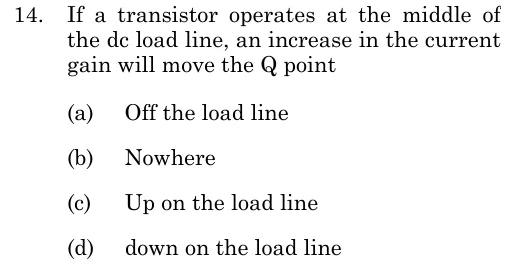 Tap to open full sizeFull solution
With a fixed base current, grows with while falls. The Q point slides along the dc load line toward saturation, which is the upper end.
- Q.151 markOfficial answer: B
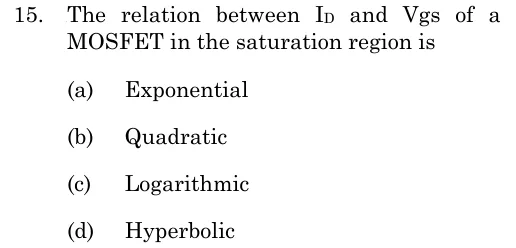 Tap to open full size
Electronic Devices › MOS devices
Full solutionIn strong-inversion saturation , so varies as the square of .
- Q.161 markOfficial answer: C
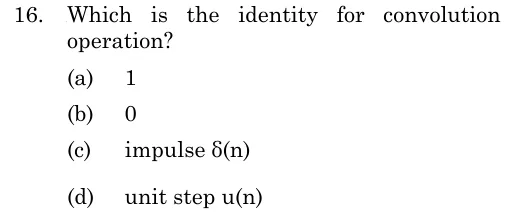 Tap to open full size
Signals and Systems › LTI & convolution
Full solutionConvolving any signal with the unit impulse returns the signal unchanged, since by the sifting property; the impulse plays the role that plays for ordinary multiplication.
- Q.171 markOfficial answer: A
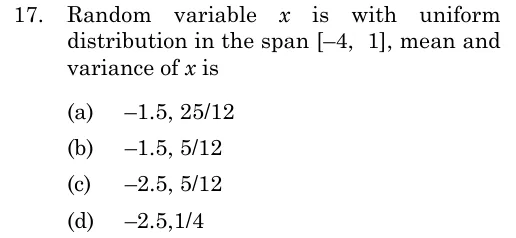 Tap to open full size
Engineering Mathematics › Probability & statistics
Full solutionFor a uniform distribution on , the mean is the midpoint and the variance is .
- Q.181 markOfficial answer: C
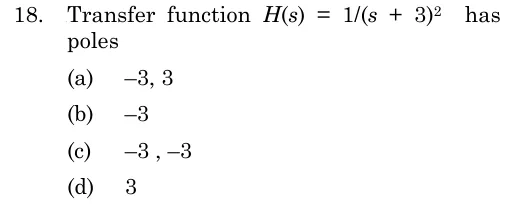 Tap to open full sizeFull solution
Poles are the roots of the denominator, and a squared factor gives a repeated pole at , counted twice.
- Q.191 markOfficial answer: D
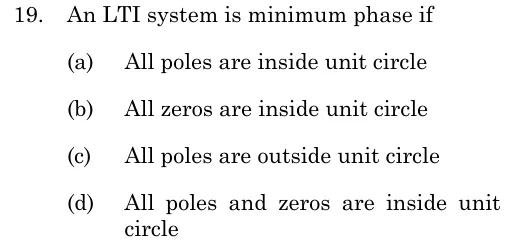 Tap to open full size
Signals and Systems › z-transform
Full solutionA minimum phase system and its inverse are both causal and stable, which puts every pole and every zero of inside the unit circle.
- Q.201 markOfficial answer: B
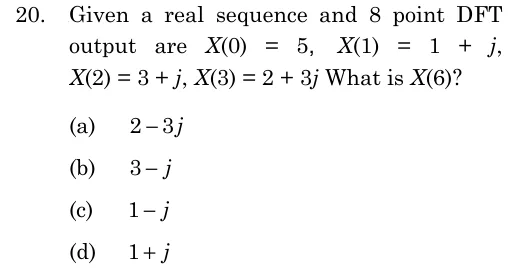 Tap to open full size
Signals and Systems › DTFT & DFT
Full solutionFor a real sequence, the -point DFT is conjugate-symmetric: . With , bin 6 is the mirror of bin 2.
- Q.211 markOfficial answer: B or C
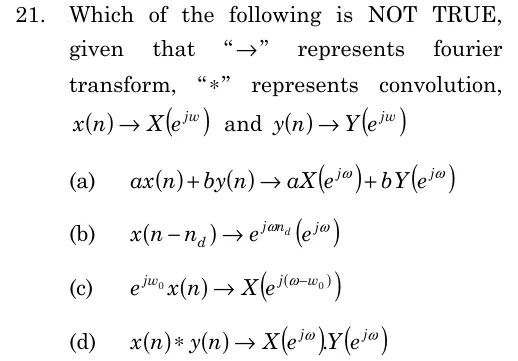 Tap to open full size
Earlier, ISRO's key gave B.
Signals and Systems › DTFT & DFT
Full solutionA delay by in time multiplies the DTFT by (a linear phase), while multiplying by in time shifts the spectrum to .
- Q.221 markOfficial answer: B
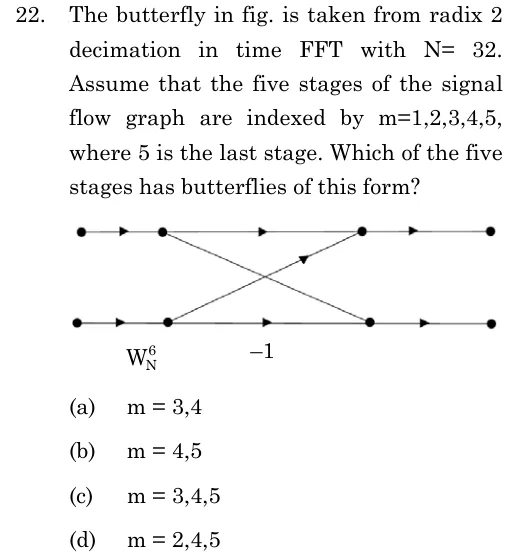 Tap to open full size
Signals and Systems › DTFT & DFT
Full solutionStage of a radix-2 DIT FFT uses for , so its exponents are multiples of below . A given exponent appears only in the stages where it is such a multiple.
- Q.231 markExcluded from evaluation by ISRO
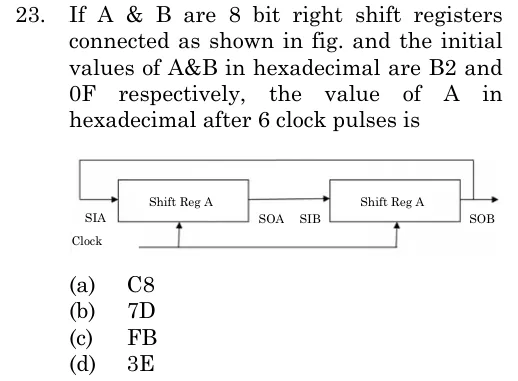 Tap to open full size
Earlier, ISRO's key gave D.
- Q.241 markOfficial answer: A
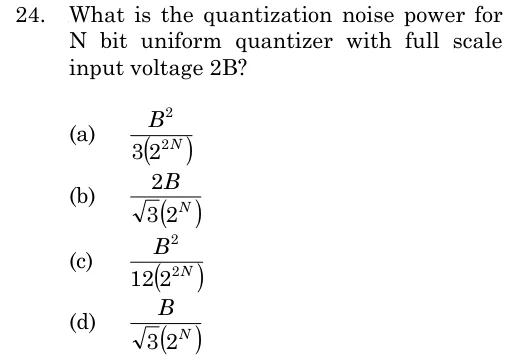 Tap to open full size
Digital Electronics › ADC & DAC
Full solutionQuantization noise power for a uniform quantizer is , where the step equals the full-scale range divided by .
- Q.251 markOfficial answer: D
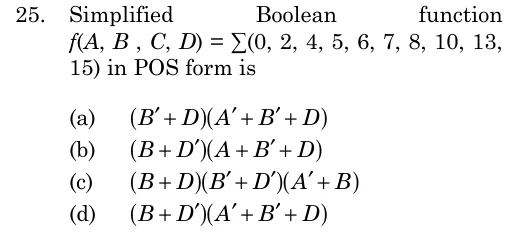 Tap to open full size
Digital Electronics › Boolean logic
Full solutionFor a POS answer, group the zeros of the function (maxterms) on the K-map, write as a sum of products, then complement it with De Morgan's theorem.
- Q.261 markOfficial answer: C
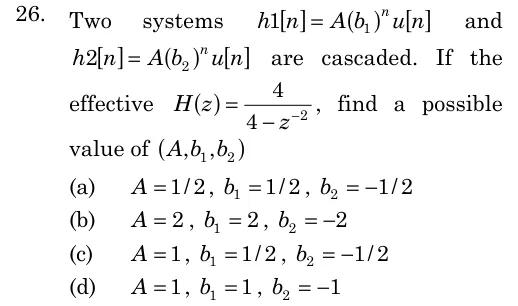 Tap to open full size
Signals and Systems › z-transform
Full solutionCascaded systems multiply their -transforms. Write the target with a leading 1 in the denominator, then match the coefficients of and and the numerator constant.
- Q.271 markOfficial answer: A
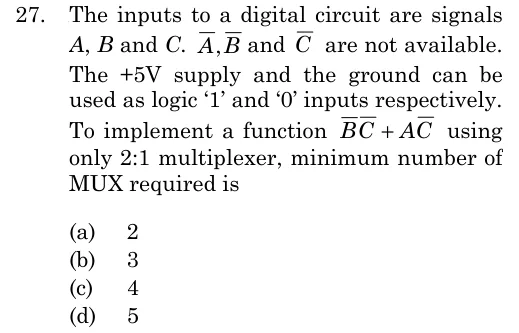 Tap to open full size
Earlier, ISRO's key gave B.
Digital Electronics › Combinational
Full solutionA 2:1 MUX gives both and for free, and the constants 0 and 1 can feed its data inputs. So factor the function into nested forms with a plain input, and use one MUX per nesting level.
- Q.281 markOfficial answer: D
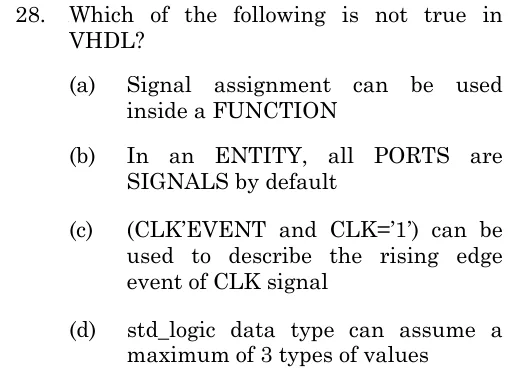 Tap to open full size
- Q.291 markOfficial answer: C
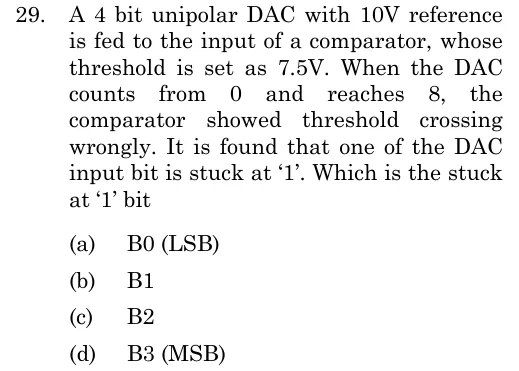 Tap to open full size
Digital Electronics › ADC & DAC
Full solutionConvert the threshold to a DAC code ( is code 12, ). Then find which stuck bit changes code 8 () to a code of at least 12 without causing an earlier crossing.
- Q.301 markOfficial answer: A
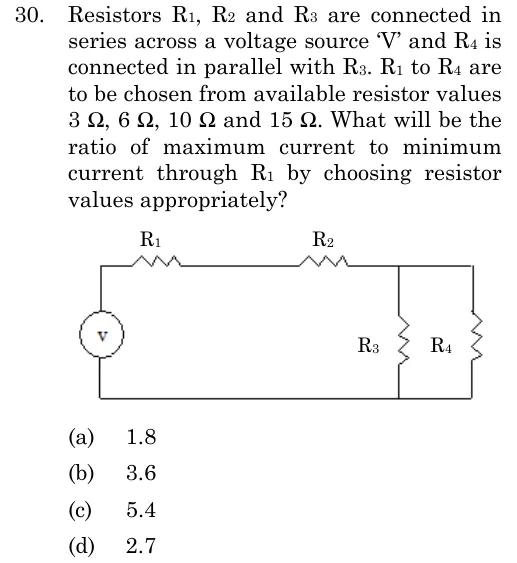 Tap to open full size
Networks (Electric Circuits) › Laws & node/mesh
Full solutionWith a fixed source, the current through R1 is V divided by the total resistance, so the current ratio equals the ratio of the largest to the smallest total resistance over all ways of assigning the four values.
- Q.311 markOfficial answer: B
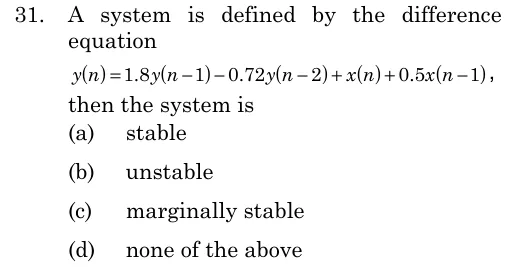 Tap to open full size
Signals and Systems › z-transform
Full solutionStability of a causal discrete-time system depends only on the poles of : all of them must lie strictly inside the unit circle. Find them from the roots of the denominator polynomial.
- Q.321 markExcluded from evaluation by ISRO
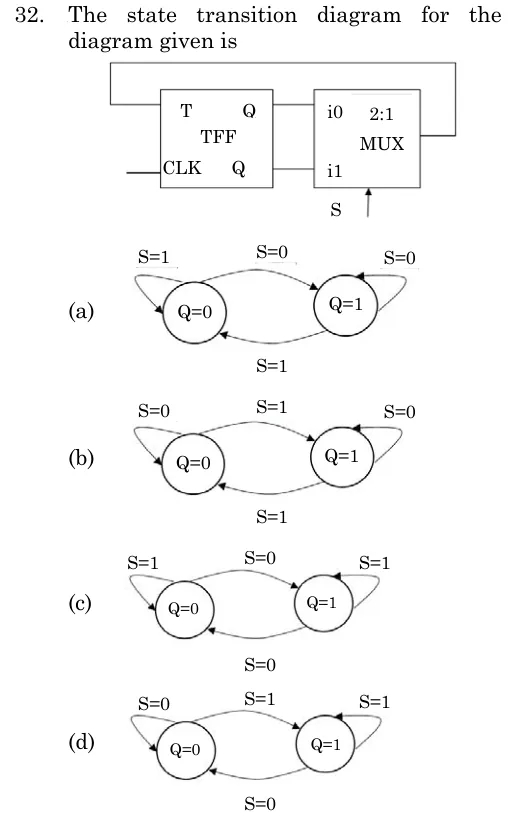 Tap to open full size
Earlier, ISRO's key gave D.
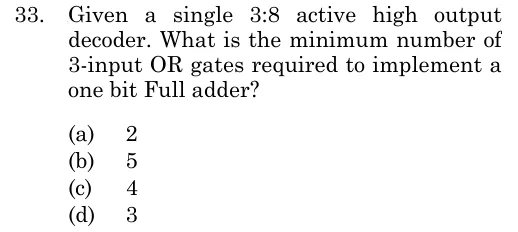
- Q.331 markOfficial answer: C
 Tap to open full size
Digital Electronics › Combinational
Full solutionA 3:8 decoder produces every minterm, so the sum and carry of a full adder are each the OR of four minterms. A 3-input OR gate needs two gates to combine four signals, and the two outputs share no gate.
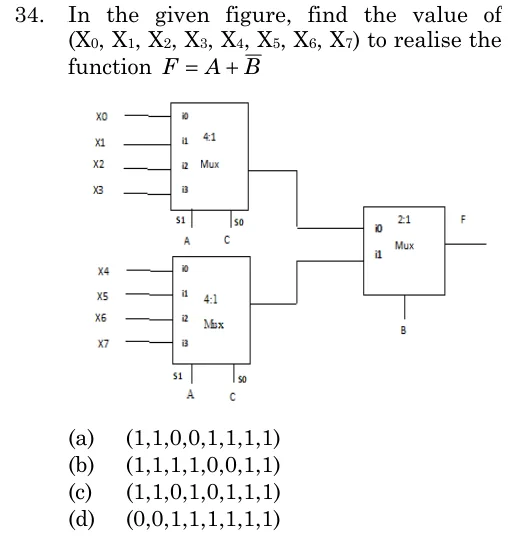
- Q.341 markOfficial answer: B
 Tap to open full size
Digital Electronics › Combinational
Full solutionSplit the function by the select variable of the final multiplexer. Each value of that select picks one first-stage multiplexer, and the function for that value of fixes that multiplexer's data inputs.
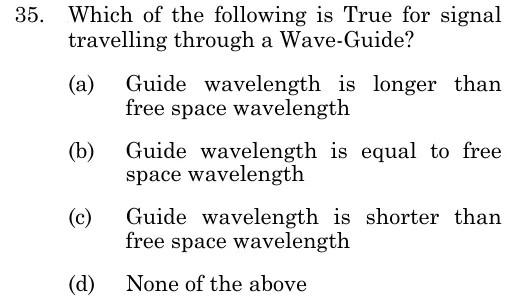
- Q.351 markOfficial answer: A
 Tap to open full size
Electromagnetics › Waveguides & fibres
Full solutionIn a waveguide, , so the guide wavelength always exceeds the free-space wavelength, and it grows without limit as approaches .
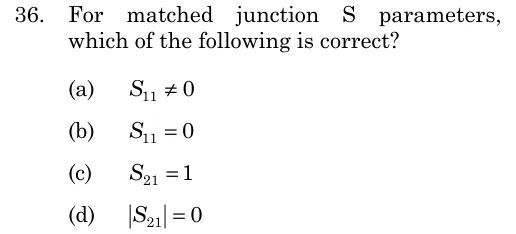
- Q.361 markOfficial answer: B
 Tap to open full size
Earlier, ISRO's key gave C.
Electromagnetics › Transmission lines
Full solutionA matched port reflects nothing, so its reflection coefficient (with the other port matched-terminated) is zero. Matching says nothing about the transmission coefficient .
- Q.371 markOfficial answer: A
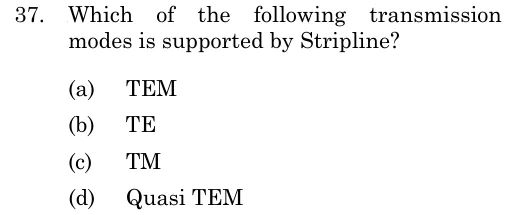 Tap to open full size
Earlier, ISRO's key gave D.
Electromagnetics › Transmission lines
Full solutionA stripline has a homogeneous dielectric and more than one conductor, so it carries a pure TEM wave with and no cutoff frequency.
- Q.381 markOfficial answer: A
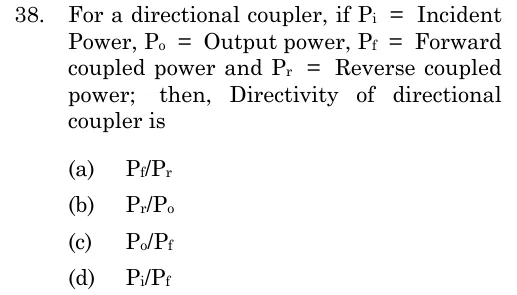 Tap to open full size
- Q.391 markOfficial answer: A
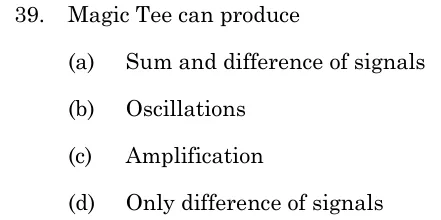 Tap to open full size
- Q.401 markOfficial answer: B
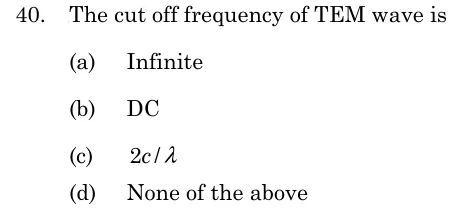 Tap to open full size
Electromagnetics › Waveguides & fibres
Full solutionA TEM mode has , so it has no low-frequency cut-off and propagates from DC upward; only TE and TM modes in a hollow guide have a non-zero cut-off.
- Q.411 markOfficial answer: B
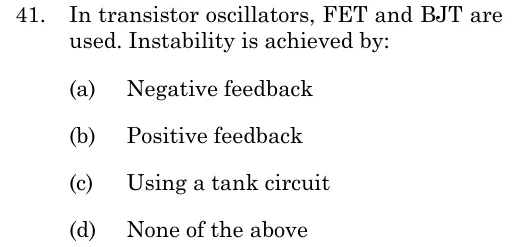 Tap to open full size
Analog Electronics › Feedback & oscillators
Full solutionAn oscillator needs a loop gain of or more at one frequency. Zero total phase shift is positive feedback, and it drives the closed-loop gain to infinity.
- Q.421 markOfficial answer: A
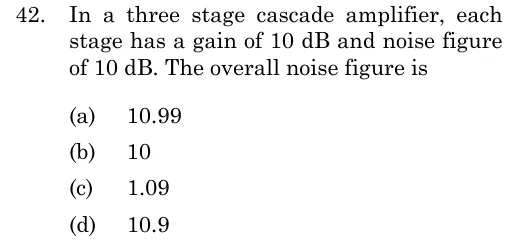 Tap to open full size
Analog Electronics › Noise & shielding (IN)
Full solutionConvert dB values to plain ratios, then apply Friis' formula: each later stage's excess noise is divided by the total gain ahead of it.
- Q.431 markOfficial answer: C
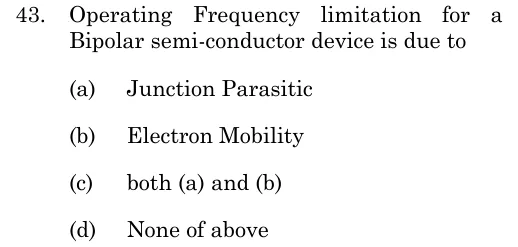 Tap to open full sizeFull solution
A BJT's high-frequency limit has two parts: the RC delay of the junction capacitances and , and the carrier transit time across the base, which depends on mobility through .
- Q.441 markExcluded from evaluation by ISRO
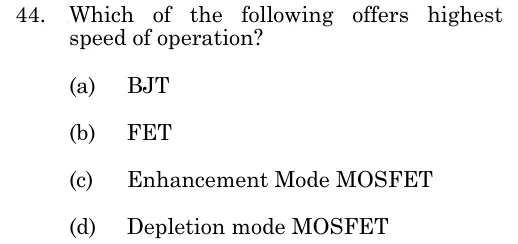 Tap to open full size
Earlier, ISRO's key gave D.
- Q.451 markOfficial answer: A
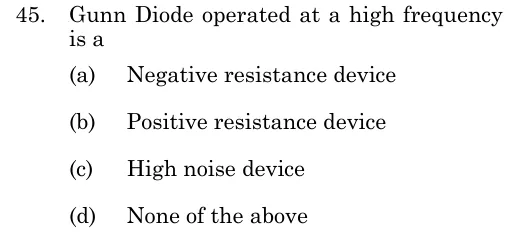 Tap to open full size
- Q.461 markOfficial answer: D
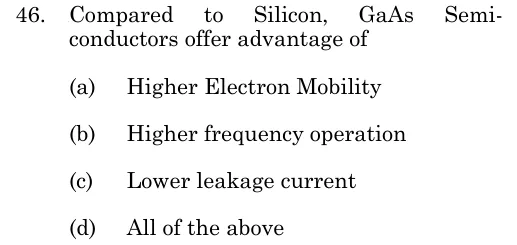 Tap to open full size
Electronic Devices › Semiconductors
Full solutionGaAs has a lighter electron effective mass (higher mobility) and a wider direct bandgap (lower ), giving better high-frequency performance and lower leakage than Si.
- Q.471 markOfficial answer: B
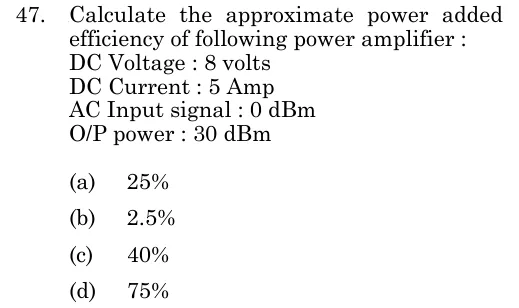 Tap to open full size
- Q.481 markOfficial answer: D
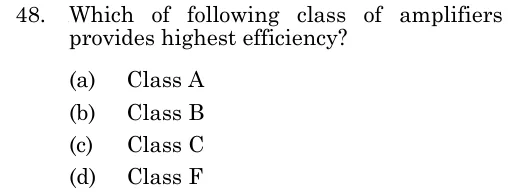 Tap to open full size
- Q.491 markOfficial answer: A
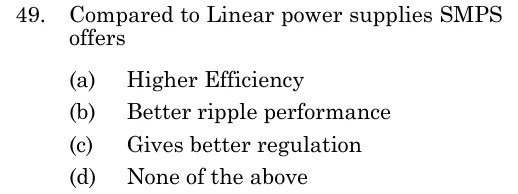 Tap to open full size
- Q.501 markOfficial answer: D
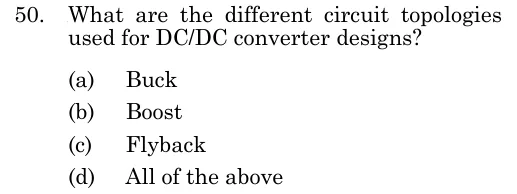 Tap to open full size
- Q.511 markOfficial answer: B
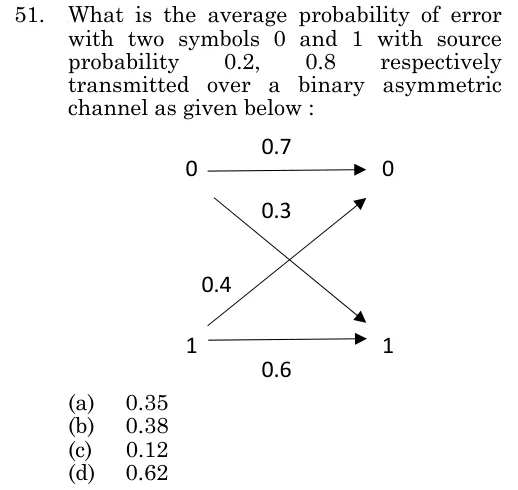 Tap to open full size
- Q.521 markOfficial answer: C
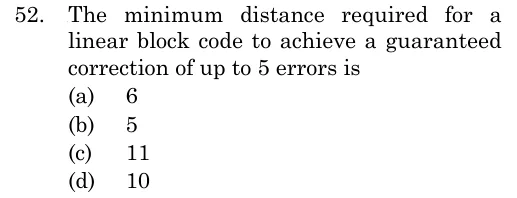 Tap to open full size
- Q.531 markOfficial answer: D
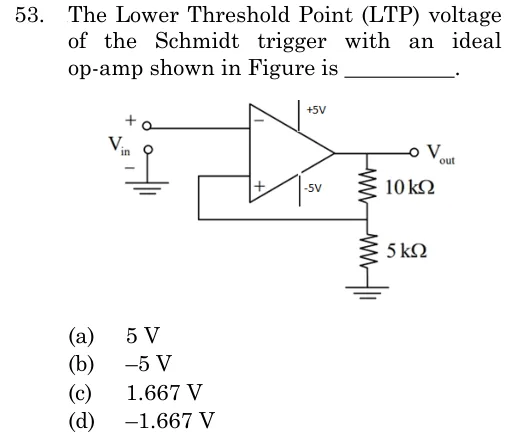 Tap to open full size
Analog Electronics › Filters & waveforms
Full solutionIn a Schmidt trigger the thresholds are the feedback fraction times each saturation level: , with set by the resistor divider at the + input. The LTP uses the negative saturation level.
- Q.541 markOfficial answer: A
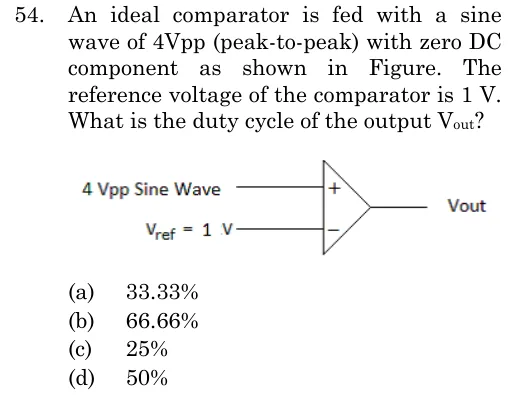 Tap to open full size
Analog Electronics › Filters & waveforms
Full solutionFind the angles where the sine wave crosses the reference level. The output is high only while the input exceeds the reference on the non-inverting side, and the duty cycle is that conduction angle divided by .
- Q.551 markOfficial answer: B
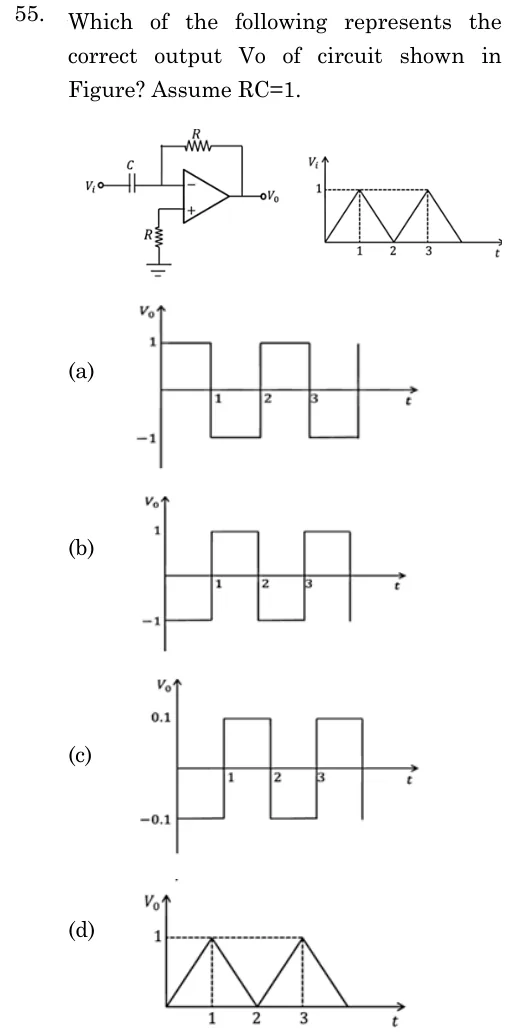 Tap to open full sizeFull solution
A capacitor at the input with a feedback resistor gives an inverting differentiator, . A triangular input has a constant slope on each segment, so the output is a square wave of opposite sign to the slope.
- Q.561 markOfficial answer: C
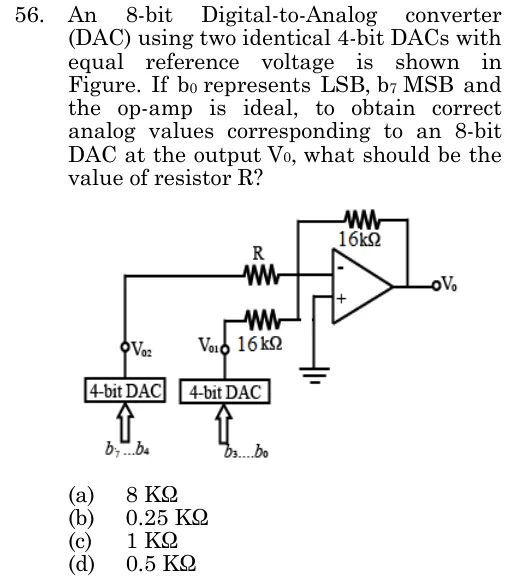 Tap to open full size
Digital Electronics › ADC & DAC
Full solutionBuild an 8-bit DAC from two 4-bit DACs with an inverting summer. The upper nibble must be weighted 16 times the lower nibble, so the upper input resistor must be 1/16 of the lower one: .
- Q.571 markOfficial answer: A
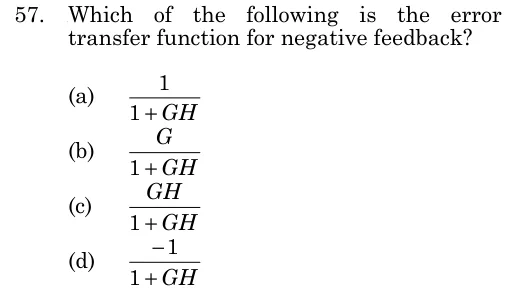 Tap to open full size
Control Systems › Block diagrams & SFG
Full solutionWrite the error as and eliminate using ; this gives . The same denominator appears in every loop transfer function, and the numerator tells you which signal you are measuring.
- Q.581 markOfficial answer: C
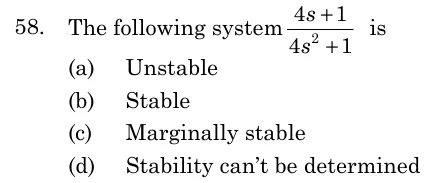 Tap to open full size
Control Systems › Routh–Hurwitz
Full solutionSimple poles on the imaginary axis with none in the right half-plane make a system marginally stable. A row of zeros in the Routh array signals roots symmetric about the origin, found from the auxiliary polynomial.
- Q.591 markOfficial answer: A
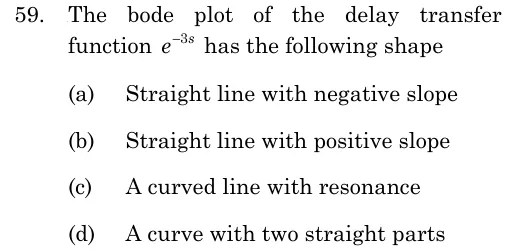 Tap to open full size
Control Systems › Bode & margins
The question and its official answerA pure delay has constant gain () and a phase that decreases linearly with frequency, with no corner, peak or resonance.
- Q.601 markOfficial answer: C
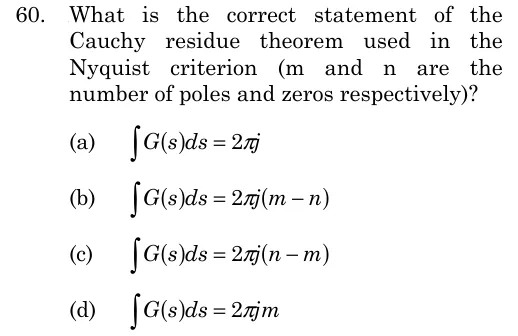 Tap to open full size
Earlier, ISRO's key gave B.
Full solutionEach zero inside the contour adds to the residue sum of and each pole adds , so the contour integral is times (zeros minus poles).
- Q.611 markOfficial answer: C
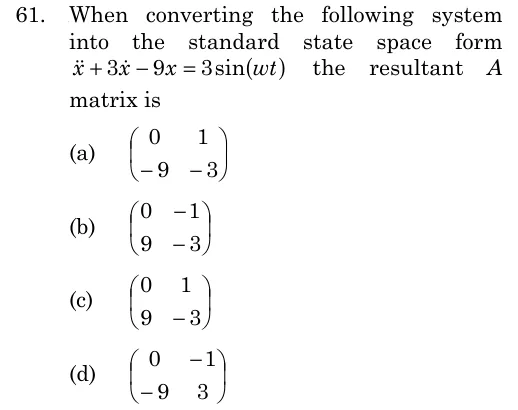 Tap to open full sizeFull solution
Take and , then move every term except the highest derivative to the right-hand side. The coefficients of and in that equation form the last row of .
- Q.621 markOfficial answer: A
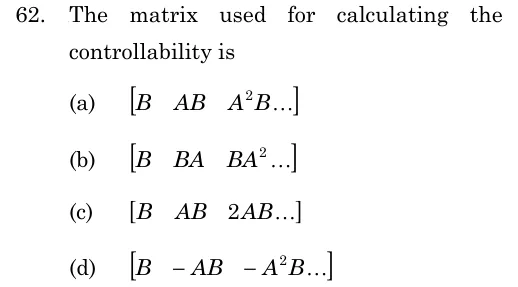 Tap to open full sizeFull solution
Reachable states from the origin are spanned by ; the system is controllable iff this matrix has rank .
- Q.631 markOfficial answer: C
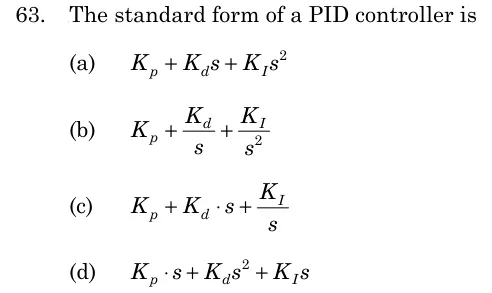 Tap to open full size
Control Systems › Compensators & PID
Full solutionIn the Laplace domain, differentiation is multiplication by and integration is division by , so a PID controller is .
- Q.641 markOfficial answer: A
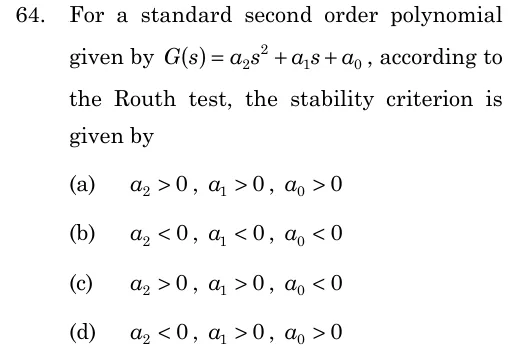 Tap to open full size
Control Systems › Routh–Hurwitz
Full solutionFor a second-order polynomial the Routh first column is . Stability needs no sign change, so all three coefficients must have the same sign, taken positive in the standard form.
- Q.651 markOfficial answer: A
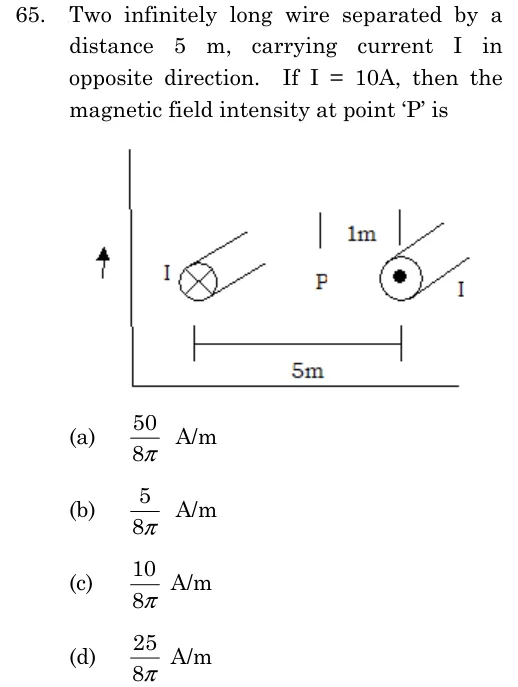 Tap to open full size
Electromagnetics › Magnetostatics
Full solutionWith currents in opposite directions, the fields of the two wires point the same way at any point between them, so their magnitudes add.
- Q.661 markOfficial answer: A
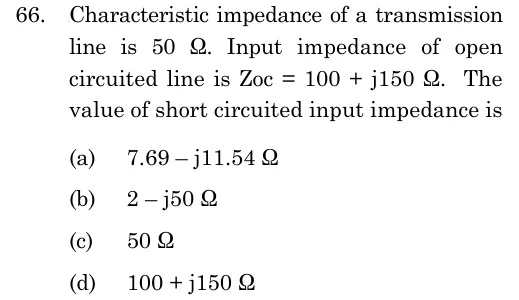 Tap to open full size
Electromagnetics › Transmission lines
Full solutionFor any uniform line, , so the characteristic impedance is the geometric mean of the open- and short-circuit input impedances and either one follows from the other.
- Q.671 markOfficial answer: C
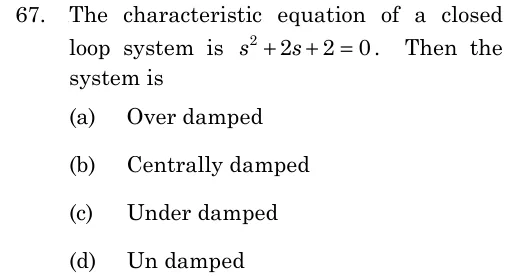 Tap to open full size
Control Systems › Time response
Full solutionRead the damping ratio off the characteristic polynomial by comparing it with . A value means complex-conjugate roots in the left half-plane and an under damped response.
- Q.681 markOfficial answer: A
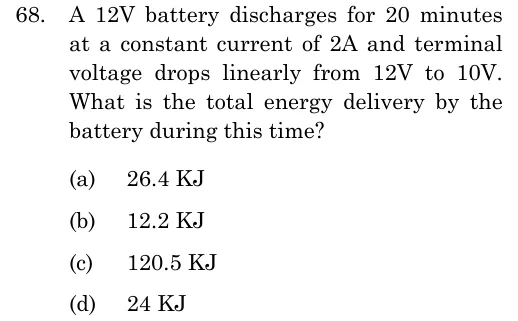 Tap to open full size
Networks (Electric Circuits) › Laws & node/mesh
Full solutionWith constant current and a voltage that changes linearly with time, the energy is current times the average voltage times the time: .
- Q.691 markOfficial answer: A
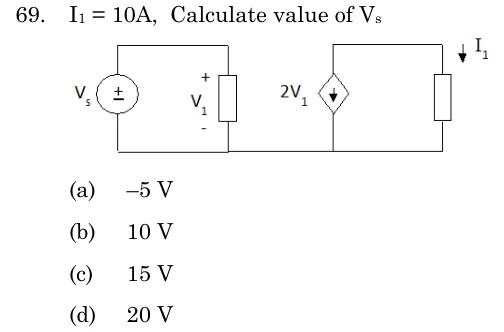 Tap to open full size
Networks (Electric Circuits) › Laws & node/mesh
Full solutionA circuit made of parts joined only through one common wire has no current between them. The right-hand loop therefore obeys KCL on its own, and the control voltage is fixed by alone.
- Q.701 markOfficial answer: A
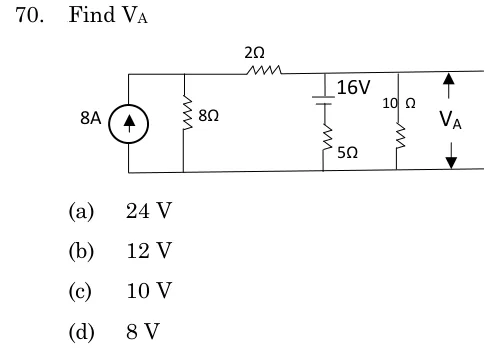 Tap to open full size
Networks (Electric Circuits) › Laws & node/mesh
Full solutionTurn the current source with its parallel resistor into a voltage source with a series resistor, then write one KCL equation at the single remaining node.
- Q.711 markOfficial answer: B
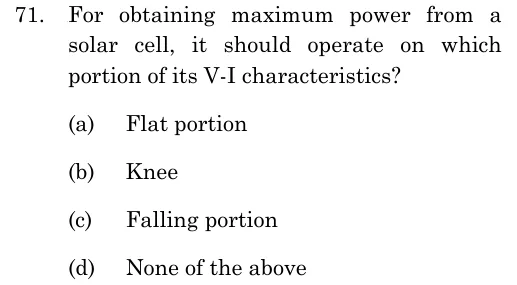 Tap to open full size
Electronic Devices › Optoelectronics
Full solutionPower is , which is zero at both ends of the V-I curve. It is largest at the knee, where .
- Q.721 markOfficial answer: B
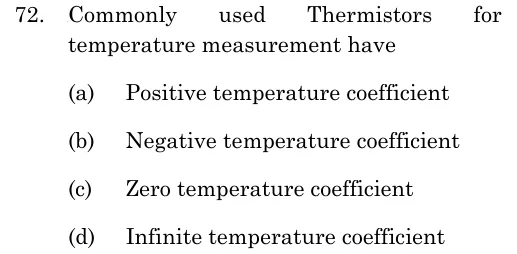 Tap to open full size
- Q.731 markOfficial answer: B
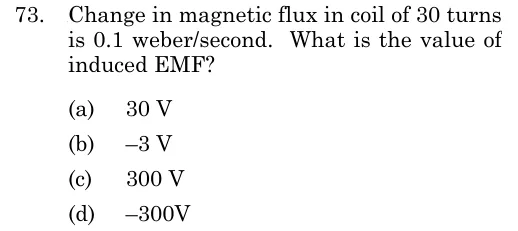 Tap to open full size
Electromagnetics › Maxwell's equations
Full solutionInduced EMF in an -turn coil is : multiply the turns by the flux rate, and keep the minus sign from Lenz's law.
- Q.741 markOfficial answer: A
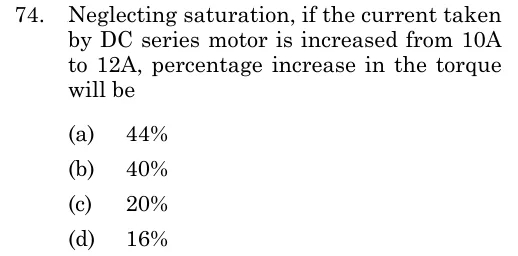 Tap to open full size
- Q.751 markOfficial answer: A
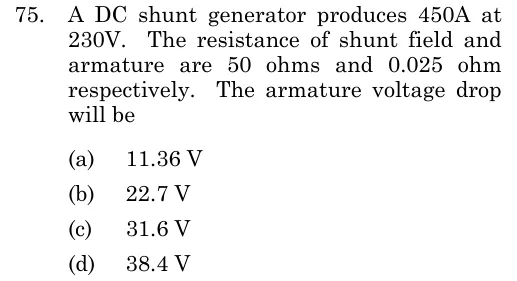 Tap to open full size
- Q.761 markOfficial answer: C
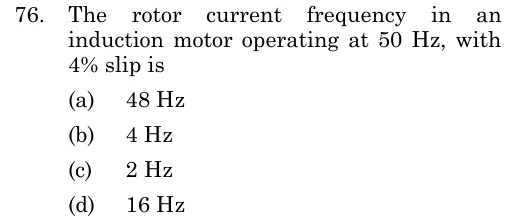 Tap to open full size
- Q.771 markOfficial answer: B
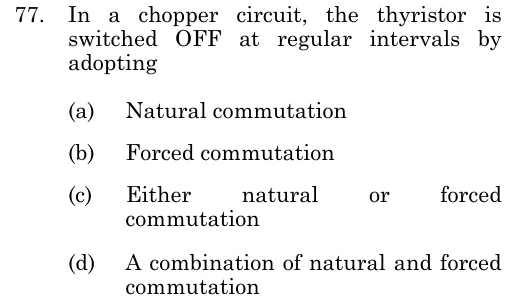 Tap to open full size
- Q.781 markOfficial answer: C
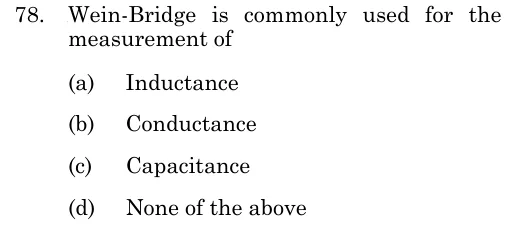 Tap to open full size
- Q.791 markOfficial answer: A
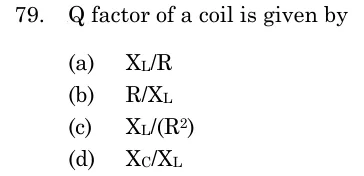 Tap to open full size
Networks (Electric Circuits) › AC, power & resonance
Full solutionQ measures how little energy a coil loses: times the peak stored energy divided by the energy lost per cycle. For a series - coil this reduces to .
- Q.801 markOfficial answer: D
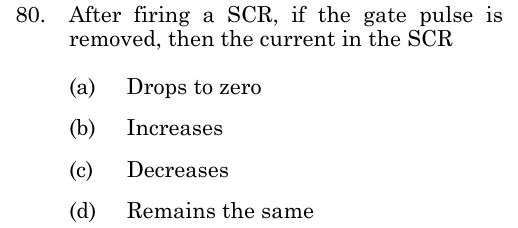 Tap to open full size
Part B: Aptitude Q.81 to Q.95
- Q.811 markOfficial answer: D
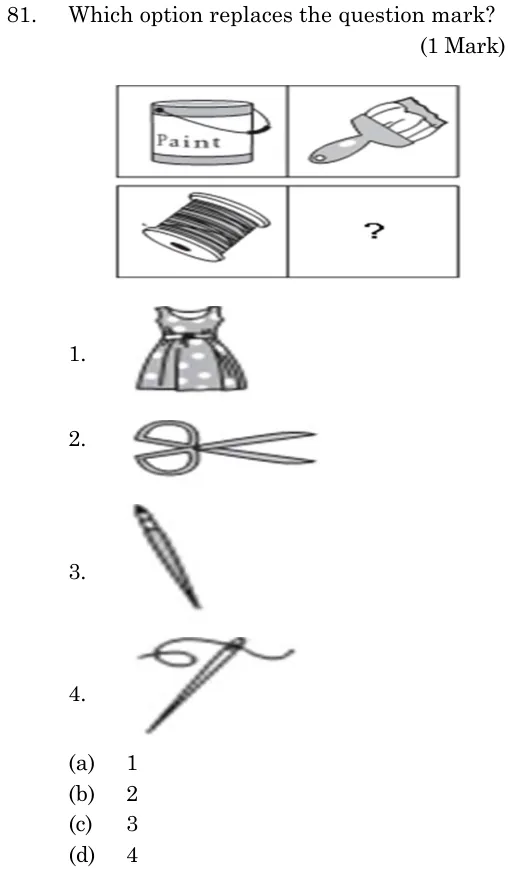 Tap to open full sizeFull solution
In picture analogies, find the relation in the complete row (material to the tool that applies it) and carry the same relation to the incomplete row.
- Q.821 markOfficial answer: D
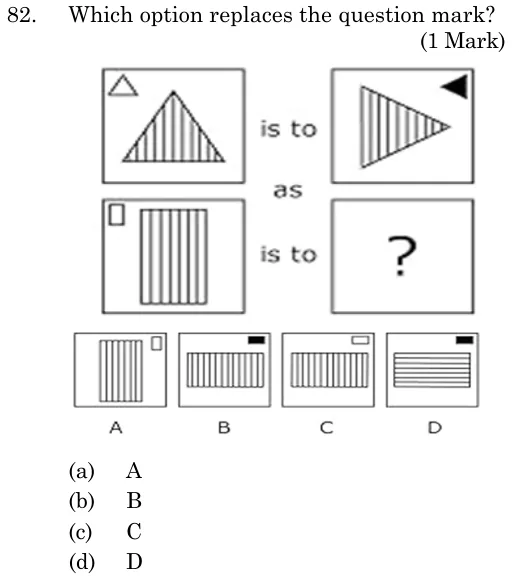 Tap to open full size
Earlier, ISRO's key gave B.
The question and its official answerIn a figure analogy, list every change in the example pair separately (outline shape, shading direction, small symbol's fill, orientation and corner) and apply each one exactly as drawn, not as you expect it to behave.
- Q.832 marksOfficial answer: B
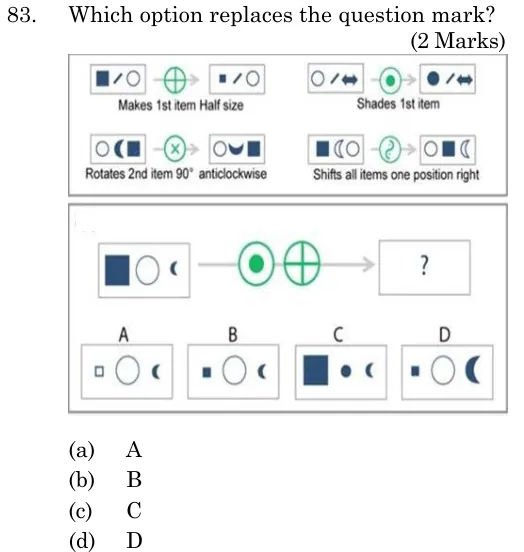 Tap to open full sizeFull solution
Work out which item each operator acts on. Both operators here change only the 1st item, so the 2nd and 3rd items pass through untouched.
- Q.841 markOfficial answer: A
 Tap to open full size
- Q.851 markOfficial answer: A
 Tap to open full sizeFull solution
To show a survey underestimates a group, find the option that moves members of that group out of the reported count (here, dishonest people who reported being honest). Anything that adds people to the count, or only changes the degree of those already in it, cannot cause an underestimate.
- Q.862 marksOfficial answer: A
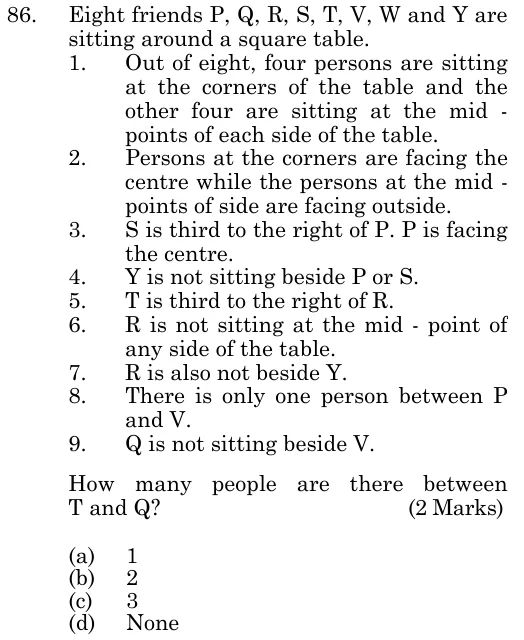 Tap to open full sizeFull solution
In a circular seating puzzle, fix one person, number the seats, and decide which way a person's right hand points from the direction they face (towards the anticlockwise side when facing the centre). Then place people with the direct conditions and test each possible position for the others against the negative conditions.
- Q.871 markOfficial answer: A
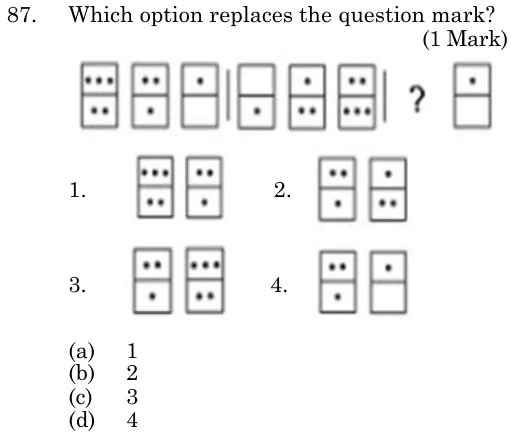 Tap to open full sizeFull solution
The three groups of dominoes alternate between counting down and counting up. The last group must count down again, so with at its end the missing dominoes are and .
- Q.881 markOfficial answer: C
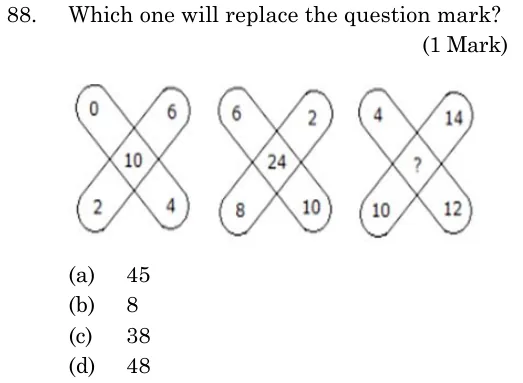 Tap to open full sizeFull solution
In number-figure puzzles, test the simplest relation first: the sum of the outer numbers compared with the centre. Confirm that one rule fits every complete figure before applying it to the incomplete one.
- Q.892 marksOfficial answer: C
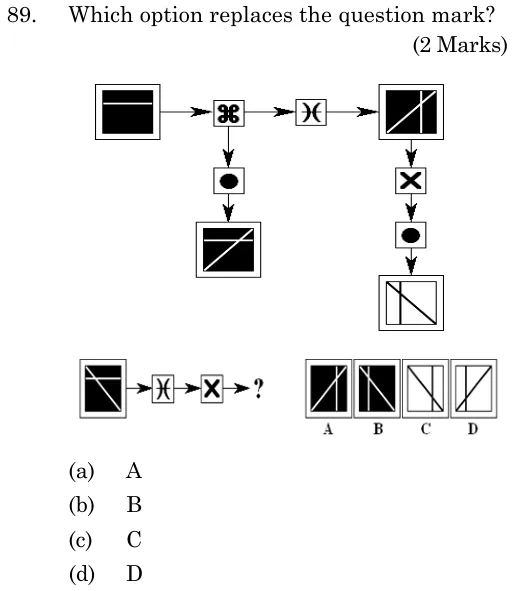 Tap to open full sizeThe question and its official answer
Assign one operation to each symbol using the chains where it appears together with symbols already decoded. Then apply the operations to the query tile in order. Track three things separately: colour, the direction of the diagonal, and the position of the straight line.
- Q.901 markOfficial answer: C
 Tap to open full sizeFull solution
Combine an "all" statement with a "some" statement. The members picked out by "some" also fall under the "all" group, which gives a new "some" statement. A conclusion that brings in an idea the facts never mention (such as "better" or "simple") is not forced.
- Q.911 markOfficial answer: D
 Tap to open full sizeFull solution
A course of action must be a sensible, proportionate response to the problem in the statement. An unverified allegation calls for an inquiry, not punishment, and the regulator's directive is not the thing at fault.
- Q.922 marksOfficial answer: D
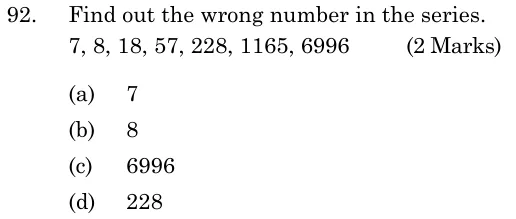 Tap to open full sizeFull solution
When each term is a multiple of the previous one plus a growing amount, find the rule from the early terms, then test whether the later terms continue from it. The wrong term is the one that fails while the terms after it still agree with the rule applied to the correct value.
- Q.931 markOfficial answer: A
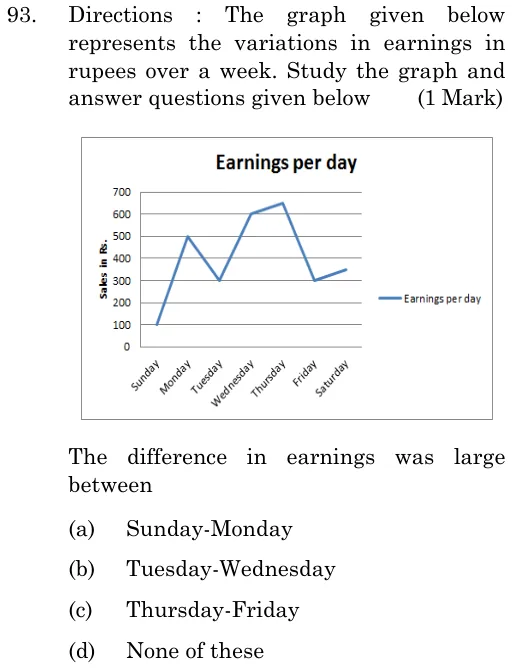 Tap to open full size
General Aptitude › Data interpretation
Full solutionRead each point off the line graph, take the absolute difference for each pair of consecutive days given, and compare. A steep segment of the line marks a large change.
- Q.941 markOfficial answer: C
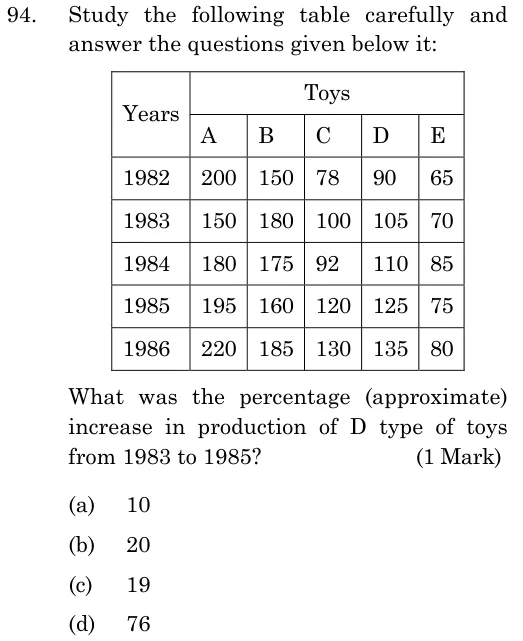 Tap to open full size
General Aptitude › Data interpretation
Full solutionPercentage change is the change divided by the starting value, times 100. Here the starting year is 1983.
- Q.952 marksOfficial answer: A
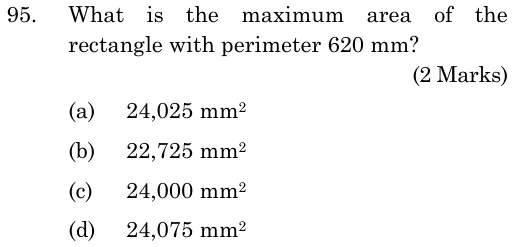 Tap to open full sizeFull solution
For a fixed perimeter, the rectangle of largest area is a square: with fixed, .