
IAE Academy

ISRO EC 2023 Q.30: solution and answer

ISRO 2023 · ECQ.30 · 1 mark · MCQ

Resistors R1, R2 and R3 are connected in series across a voltage source 'V' and R4 is connected in parallel with R3. R1 to R4 are to be chosen from available resistor values 3 Ω, 6 Ω, 10 Ω and 15 Ω. What will be the ratio of maximum current to minimum current through R1 by choosing resistor values appropriately?
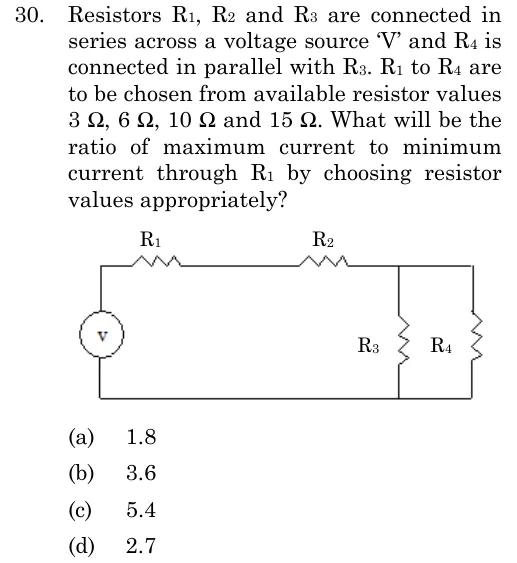
ISRO EC 2023 question 30: A voltage source V on the left branch of a rectangular loop.Tap to open full size
Figure from the ISRO EC 2023 paper. It is part of the question.
Figure description

A voltage source V on the left branch of a rectangular loop. The top wire carries R1 and then R2 in series. At the right end, R3 and R4 hang as two vertical resistors in parallel, both connected between the top wire and the bottom return wire back to the source. So the source drives R1 + R2 + (R3 parallel R4).

  1. (A)

    1.8

  2. (B)

    3.6

  3. (C)

    5.4

  4. (D)

    2.7

Answer and solution

ANSWER

The ratio of maximum to minimum current through R1 is 1.8, option (A).

Official answer: ASource: ISRO's revised and final answer key of 16 February 2024

  1. R1 and R2 are in series with the parallel pair R3 and R4, and the whole network is across the source V. All the source current flows through R1, so .

  2. V is fixed, so the current is largest when the total resistance is smallest and smallest when the total resistance is largest: .

  3. The four values are assigned one to each resistor, so the only choice is which two form the parallel pair; the other two are in series. Using :

  4. Parallel : , series , total . Parallel : , series , total . Parallel : , series , total .

  5. Parallel : , series , total . Parallel : , series , total . Parallel : , series , total .

  6. Hence and , and

KEY IDEA

With a fixed source, the current through R1 is V divided by the total resistance, so the current ratio equals the ratio of the largest to the smallest total resistance over all ways of assigning the four values.

WATCH OUT FOR

Using the same value twice or checking only a few assignments. The largest total comes from putting the two smallest values in parallel, and the smallest total from putting the two largest in parallel, but every pairing should be checked.

From the ISRO EC 2023 paper. Every question of this paper · The full paper (PDF, ISRO) · All 5 ISRO Laws & node/mesh questions, with notes

More ISRO Laws & node/mesh questions