GATE 2026 EC Q.43
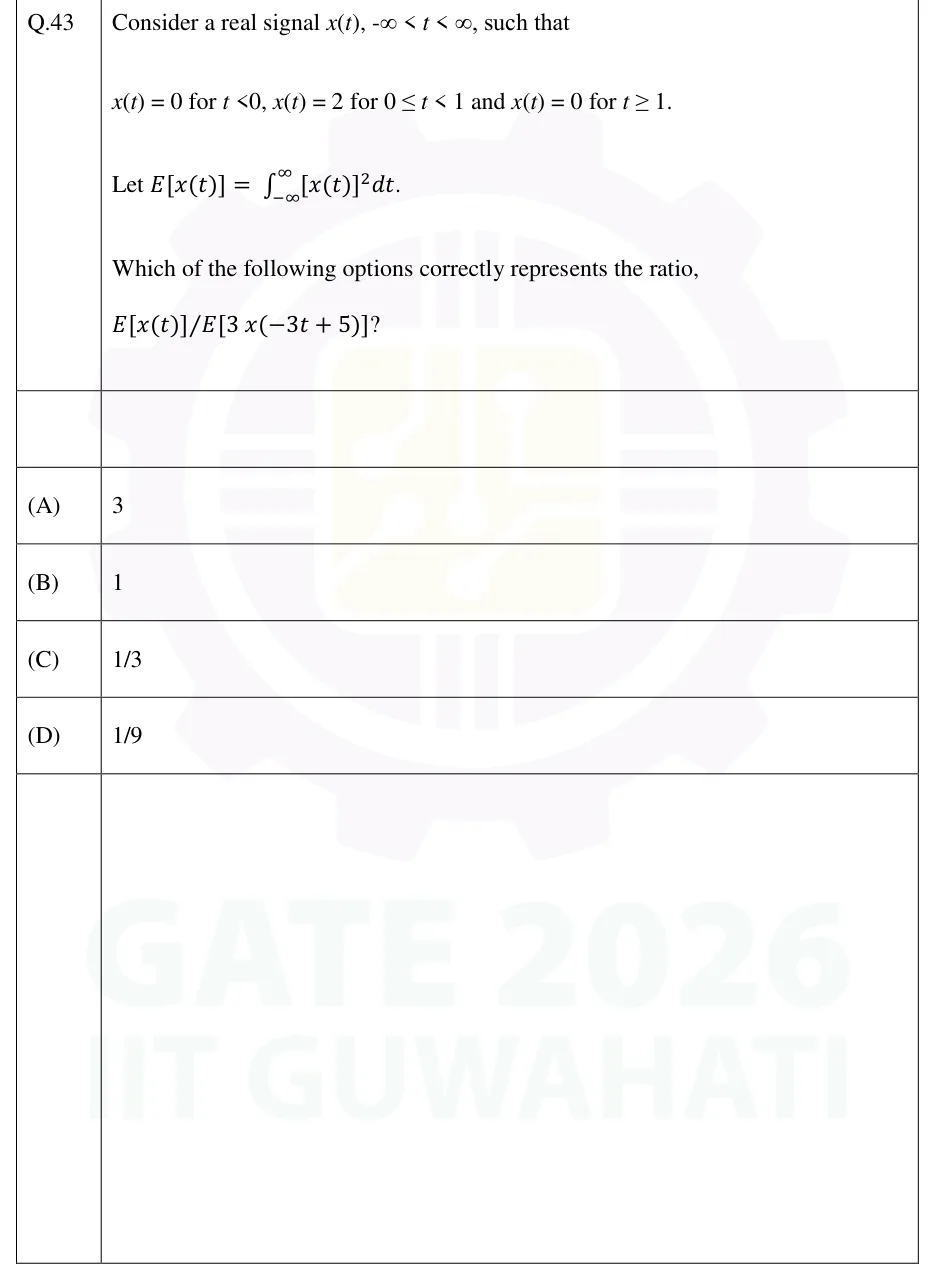
Consider a real signal , , such that
for , for and for .
Let .
Which of the following options correctly represents the ratio,
?
- (A)
- (B)
- (C)
- (D)

GATE EC · EE · IN
Types, operations, energy, power and averages
This topic sets up the vocabulary for the whole Signals and Systems unit: how signals are classified, the standard building-block signals and the unit impulse, how time shifting, scaling and reversal act on a signal, and how to compute energy, power, average and RMS values. Convolution, Fourier series and transforms, and sampling all lean on these definitions, and the calculations here reward precision: the in , the order of shift and scale in , the integer-period test for DT sinusoids and merging same-frequency terms before adding powers are where answers go wrong.
18 previous-year questions · 17 solved · 5 practice questions
A continuous-time (CT) signal is defined for every real ; a discrete-time (DT) signal is defined only at integer (it is a sequence, with nothing in between the samples). Every classification below has a CT and a DT version, and each one is a test you apply directly to the defining expression.
Class | CT test | DT test | Examples |
|---|---|---|---|
Periodic | for all , for some ; the smallest such is the fundamental period (a constant is periodic but has no smallest ) | for all , for some integer ; the smallest is (a constant has ) | , square wave, |
Aperiodic | no such exists | no such integer exists | , , |
Even | , , , | ||
Odd | , which forces | , which forces | , , |
Causal | for | for | , , |
Anticausal | for | for | , |
Energy signal | (then ) | same, with sums | bounded finite-duration pulses, with |
Power signal | (then ) | same, with sums | sinusoids, square waves, DC, , |
Neither | and is or | same | and (); (, ) |
EVEN AND ODD PARTS
Every signal splits this way, uniquely; the DT form is identical with in place of . Example: , so and for .
Symmetry rules worth using
even × even = even, odd × odd = even, even × odd = odd (same in DT).
and ; in DT, .
The derivative of an even signal is odd, and the derivative of an odd signal is even.
For any energy signal, real or complex, : the cross term is the integral of an odd function, which is zero.
For a causal signal, for (because there), so either part alone fixes the signal everywhere except at .
The only signal that is both even and odd is . The sum of a nonzero even signal and a nonzero odd signal is neither.
For complex signals the analogous split is into a conjugate-symmetric part , which satisfies , and a conjugate-antisymmetric part .
EXAM TIP
Decide the class before you integrate. A bounded periodic signal that is nonzero over some interval is a power signal: its energy is infinite, so the question wants . A bounded signal of finite duration is an energy signal: its power is zero. One-sided decaying exponentials such as with are energy signals even though they never reach zero.
These building blocks write piecewise signals compactly: a pulse of height 2 on is , and the unit triangle is , with the ramp defined below.
Convention used throughout these notes: , with and zeros at every nonzero integer . Some texts instead use , so that ; check which one a question means before using any energy or transform result. The value of at is left undefined (some texts take ). It does not change any ordinary integral, but it does make a product such as ill-defined, because sifting needs the signal to be continuous at the impulse.
UNIT STEP, SIGNUM AND RAMP
, so holds for . Derivative chain: , , .
RECTANGULAR AND TRIANGULAR PULSES
For : rect has width and area ; tri has half-width (base ), peak 1 and area . Also . Some texts write the triangle with total base ; read the definition given.
SINC AND COMPLEX EXPONENTIAL
decays, grows, and with gives the rotating phasor of period . With , the real part of is .
SIFTING AND SAMPLING PROPERTIES OF THE IMPULSE
Requires continuous at . When sits exactly on a limit, the value depends on a convention, so that case is left out. The impulse has unit area, , and .
TIME SCALING OF THE IMPULSE
With : , so the impulse is even. Hence .
IMPULSE OF A FUNCTION
The sum runs over the roots of , and every root must be simple (); at a repeated root is not defined. Example: .
DERIVATIVES OF THE IMPULSE
Requires continuous at . For (the doublet): . The doublet is odd, and , not just .
DISCRETE-TIME IMPULSE AND STEP
is an ordinary finite value, unlike . for every nonzero integer : there is no factor in DT.
ANY SIGNAL AS A WEIGHTED SUM OF SHIFTED IMPULSES
The DT form holds sample by sample, since only the term survives. The CT form is the sifting property with , valid wherever is continuous. Both are the starting point for convolution.
EXAM TIP
Three impulse slips. (1) Dropping the : , not . (2) Sifting an impulse that lies outside the limits: . (3) Differentiating a signal with a jump: a jump of height at (value just after minus value just before) puts into , so a derivative sketch that shows only the slopes is incomplete.
For the graph moves right (a delay) when and left when . reflects it about . with compresses the signal in time by the factor (the graph is squeezed towards ), with stretches it, and adds a reflection. These operations act on the argument ; amplitude operations act on the values and can be done at any stage.
WHERE A POINT OF X LANDS UNDER X(AT+B)
Map each breakpoint of this way. A support becomes , with the ends swapped when . This check does not depend on any order of operations.
Sketching x(at+b) step by step: two correct orders
Shift, then scale. (move left by if ); then ; then, if , reflect: .
Scale, then shift. Write . First form (scale by , reflect if ), then replace by : a shift left by , i.e. right by .
The usual error is scaling first and then shifting by instead of . Once the signal has been scaled, the shift is .
Each operation replaces in the current expression, never in the original .
EFFECT OF TIME OPERATIONS ON AREA, ENERGY AND POWER
Shifts change none of these. Time scaling divides area and energy by but leaves the power, average and RMS value of a periodic signal unchanged (its period becomes ). Amplitude scaling by multiplies and by .
WORKED EXAMPLE · EXAMPLE 1: SHIFT, SCALE AND REVERSE TOGETHER
Let for and otherwise. For , find the interval outside which is zero, the expression for on that interval, the value , and the energies and .
Breakpoint mapping with , : and . So is zero outside (ends swapped because ).
Check by operations: lives on ; lives on ; lives on .
On that interval . It equals at (the image of ) and at (the image of ). So .
.
. With , : , which is , as the scaling rule says.
Answer: for and zero outside that interval; ; and .
DT operation | Definition | What it does | Reversible? |
|---|---|---|---|
Shift | , integer | delays by samples if | yes |
Reversal | reflects about | yes | |
Downsampling (decimation) by | keeps every -th sample and discards the rest; | no, in general | |
Upsampling (zero insertion) by | if divides , else | inserts zeros between consecutive samples | yes: downsample by |
EXAM TIP
In DT the order matters and samples can be lost. Upsample by 2 and then downsample by 2 and you get back; downsample first and the odd-indexed samples are gone for good. For , shift first and then decimate: , , , so only odd-indexed samples of survive. Zero insertion keeps the energy unchanged, while decimation can only keep or reduce it; the CT rule has no DT counterpart.
CT SINUSOID AND SUMS OF CT PERIODIC SIGNALS
Take in lowest terms. For non-constant , with fundamental periods , the converse also holds: if is irrational, is not periodic. The LCM is always a period of the sum, and it is the fundamental period unless components cancel: and both have period , but their sum has period . For a sum of sinusoids with nonzero amplitudes at distinct positive frequencies, the fundamental angular frequency is the GCD of the component frequencies, , and ; a DC term does not change this.
DT SINUSOID PERIODICITY
is in rad/sample. Equivalently, is the smallest positive integer for which is a multiple of ; for that is with the smallest positive integer that makes it an integer. The same test applies to . The one exception is a sequence that is identically zero, such as , which trivially has period 1. A sum of periodic sequences is always periodic: is a period, and it is the fundamental period unless components cancel.
DT FREQUENCY IS DEFINED ONLY MODULO 2Π
For integers and . Distinct DT sinusoids need only (or for real cosines). The fastest oscillation is at : .
Property | CT sinusoid | DT sinusoid |
|---|---|---|
Always periodic? | yes (for ), | only if is rational |
Fundamental period | the smallest integer with a multiple of ; equal to only when that is an integer | |
Distinct frequencies | every gives a different signal | and give the same signal |
Oscillation rate | grows without limit as grows | grows up to , then falls back to zero at |
Sum of two periodic signals | periodic if is rational (and, for non-constant signals, only then) | always periodic; is a period |
Average power, amplitude | for | if is not a multiple of ; if it is (every sample is then ) |
WORKED EXAMPLE · EXAMPLE 2: FUNDAMENTAL PERIOD AND POWER
(a) Find the fundamental period and the average power of . (b) Find the fundamental period and the average power of . (c) Is periodic?
(a) Product to sum: , so , with components at Hz and Hz.
Their periods are s and s, ratio (rational), so s. Equivalently rad/s.
The DC term and the two distinct-frequency cosines are orthogonal, so their powers add: (RMS ).
(b) in lowest terms, so ; , so . Hence .
The frequencies and are distinct points of and neither is or , so .
(c) is irrational, so no integer works: is aperiodic, even though the CT signal has period .
Answer: (a) s, . (b) , . (c) No, is aperiodic.
EXAM TIP
Traps. is not periodic (the period ratio is irrational), though it is still a power signal with . More generally, a sum of sinusoids with nonzero amplitudes at distinct nonzero frequencies is periodic exactly when every ratio of two of its frequencies is rational. and have period , not . Sampling a periodic CT signal need not give a periodic sequence: is periodic only if is rational. In DT, has power , not ; in particular for every integer .
ENERGY
Normalised energy, as if were a voltage across . Use , not , for complex signals.
AVERAGE POWER
The window is symmetric about zero, which is why has power . If then ; if then .
POWER OF A PERIODIC SIGNAL
Any one full period, from any starting point. For a periodic signal, .
TIME AVERAGE (DC VALUE)
For a periodic signal this reduces to the average over one period, or . With the symmetric window, and .
POWER OF DC PLUS SINUSOIDS
For a finite sum with real amplitudes, whether or not is periodic. Terms at the same frequency must first be merged into one sinusoid; a negative frequency is the same frequency, since . For with distinct (here and do count as different), .
MERGING TWO SINUSOIDS OF THE SAME FREQUENCY
This is phasor addition, . The powers add directly only when ; for example has amplitude .
Signal (real unless stated) | Energy | Power |
|---|---|---|
, half-width | ||
, | ||
, | ||
, | ||
, | ||
(DC) | ||
, | ||
, may be complex | ||
Square wave between and , any duty cycle | ||
, | ||
(neither) |
EXAM TIP
Two checks worth doing. Scaling: has energy , so compressing a pulse lowers its energy, and has the same energy as . Same frequency: in the powers do not add ( is wrong); the merged amplitude is , so .
AVERAGE (DC) VALUE AND RMS VALUE
Over any one full period of a real waveform . is the average power in : the RMS value is the DC level that would dissipate the same power in a resistor.
DC AND AC PARTS
The AC part has zero mean, so it is orthogonal to the DC part. For with distinct positive : . For a waveform with nonzero mean, the ratio (FF as defined below, with the full-period average) is the ripple factor used for rectifier outputs.
STRAIGHT-LINE SEGMENT SHORTCUT
Valid for any straight-line piece, whatever its slope or duration. Weight each segment's mean (or mean square) by its fraction of the period and add. A flat piece at level is the case .
FORM FACTOR AND CREST (PEAK) FACTOR
For a waveform with nonzero mean, is the full-period average. For a zero-mean AC wave that average is zero, so in FF means the average of over a period, which for a sine, square or symmetric triangle wave equals the average over a positive half-cycle. Sine: FF , CF . Square: FF CF . Triangle: FF , CF . Half-wave rectified sine: FF , CF . Full-wave rectified sine: the same as the sine, FF , CF .
Waveform (peak ) | Average | RMS |
|---|---|---|
Sinusoid | over a full cycle; over a half-cycle | |
Half-wave rectified sine | ||
Full-wave rectified sine | ||
Square wave , 50% duty | ||
Pulse train between and , duty cycle | ||
Symmetric triangle, to | ||
Sawtooth or triangle, to (any rise/fall split) | ||
Sawtooth, to | ||
Two-level wave: for , for | ||
, distinct |
WORKED EXAMPLE · EXAMPLE 3: AVERAGE, RMS AND FORM FACTOR OF A PIECEWISE WAVEFORM
A periodic voltage has period ms. In each period it rises linearly from to V during ms, stays at V for ms, and is V for ms. Find its average value, RMS value, form factor, crest factor, and the RMS value of its AC part.
Average: weight each segment's mean by its duration. V.
Mean square: the ramp from to has mean square , and the flat part has . So .
V.
Form factor ; crest factor .
AC part: V.
Answer: V, V, form factor , crest factor , AC RMS V.
EXAM TIP
RMS values do not add. The RMS of a sum is when the components are mutually orthogonal, for example DC plus sinusoids of distinct frequencies. A half-wave rectified sine keeps half of the full-wave's , so its RMS is , not ; its average is half the full-wave's, . Shifting or time-scaling a periodic waveform, or changing the rise/fall split of a triangle, leaves both its average and its RMS unchanged.
PREVIOUS-YEAR QUESTIONS
Try each question first, then open the answer. One shows the official answer only. We placed each question under a topic ourselves; the exam paper does not label topics.
See these papers in full: GATE ECE 2026 · GATE ECE 2024 · GATE EE 2026 · GATE EE 2025 · GATE EE 2024 · GATE EE 2023 · GATE EE 2020 · GATE EE 2018 · GATE IN 2026 · GATE IN 2025 · GATE IN 2024 · GATE IN 2023 · GATE IN 2020 · GATE IN 2018
Consider a real signal , , such that
for , for and for .
Let .
Which of the following options correctly represents the ratio,
?
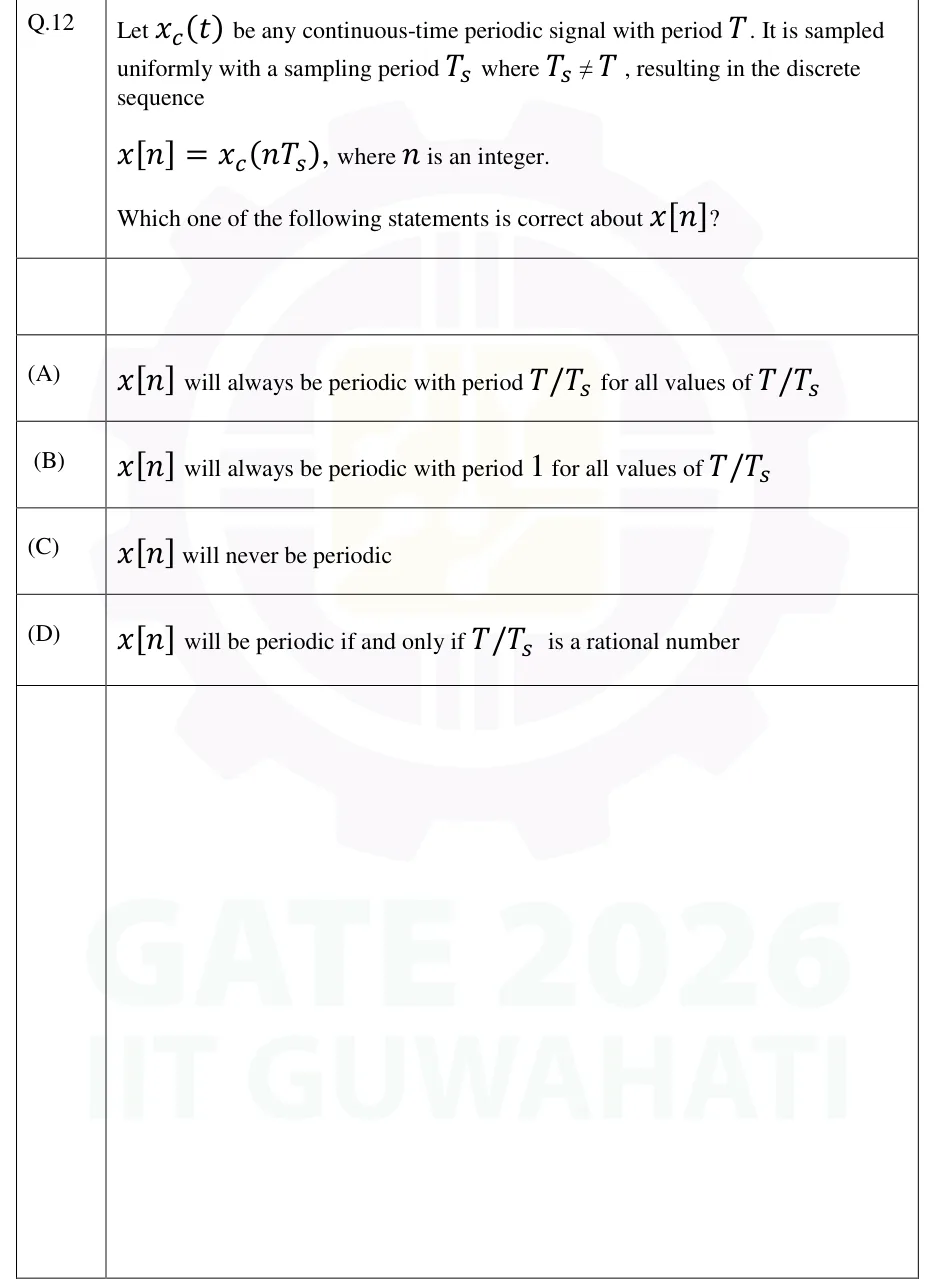
Let be any continuous-time periodic signal with period . It is sampled uniformly with a sampling period where , resulting in the discrete sequence
Which one of the following statements is correct about ?
will always be periodic with period for all values of
will always be periodic with period for all values of
will never be periodic
will be periodic if and only if is a rational number
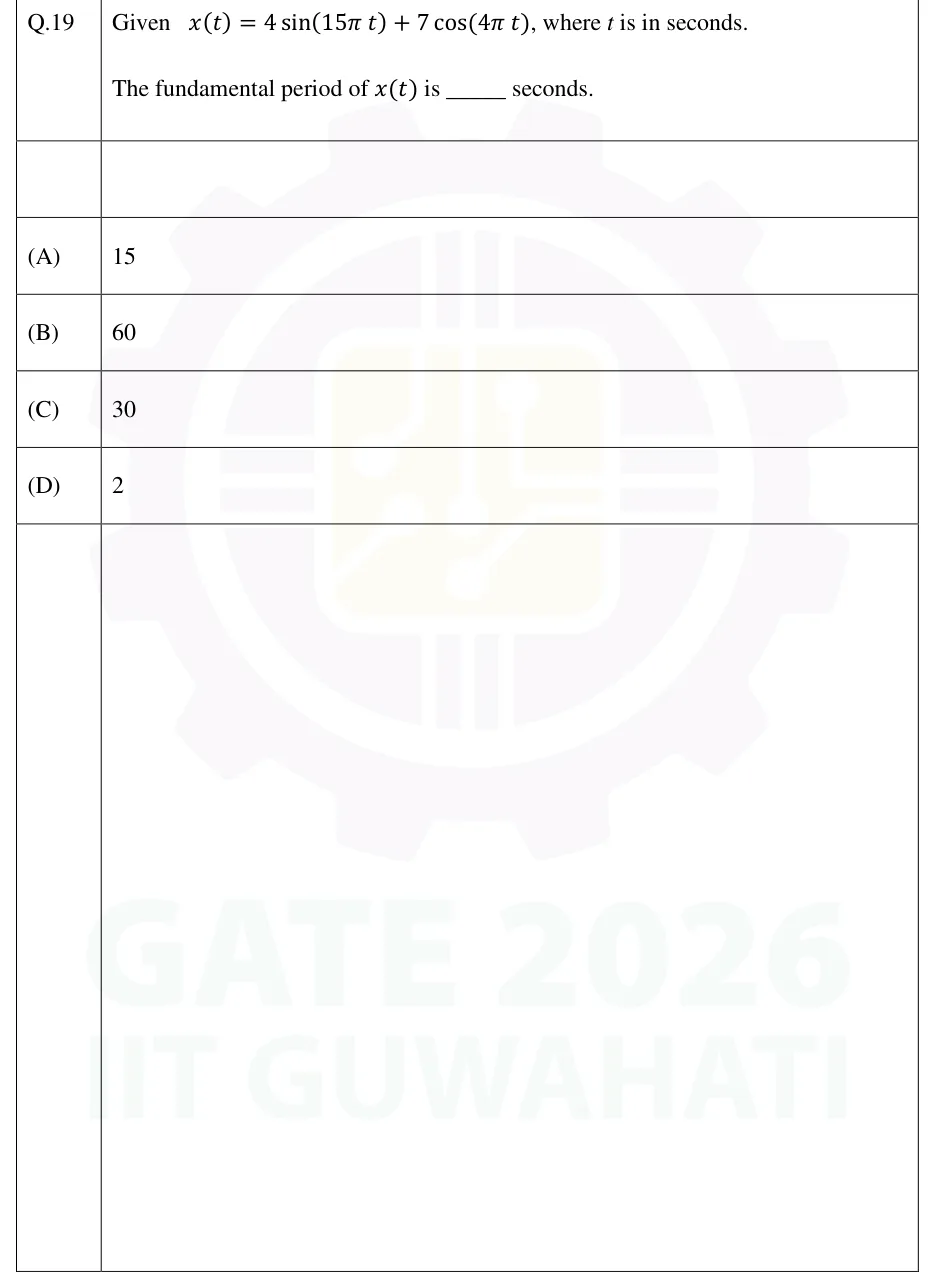
Given , where is in seconds.
The fundamental period of is ______ seconds.
15
60
30
2
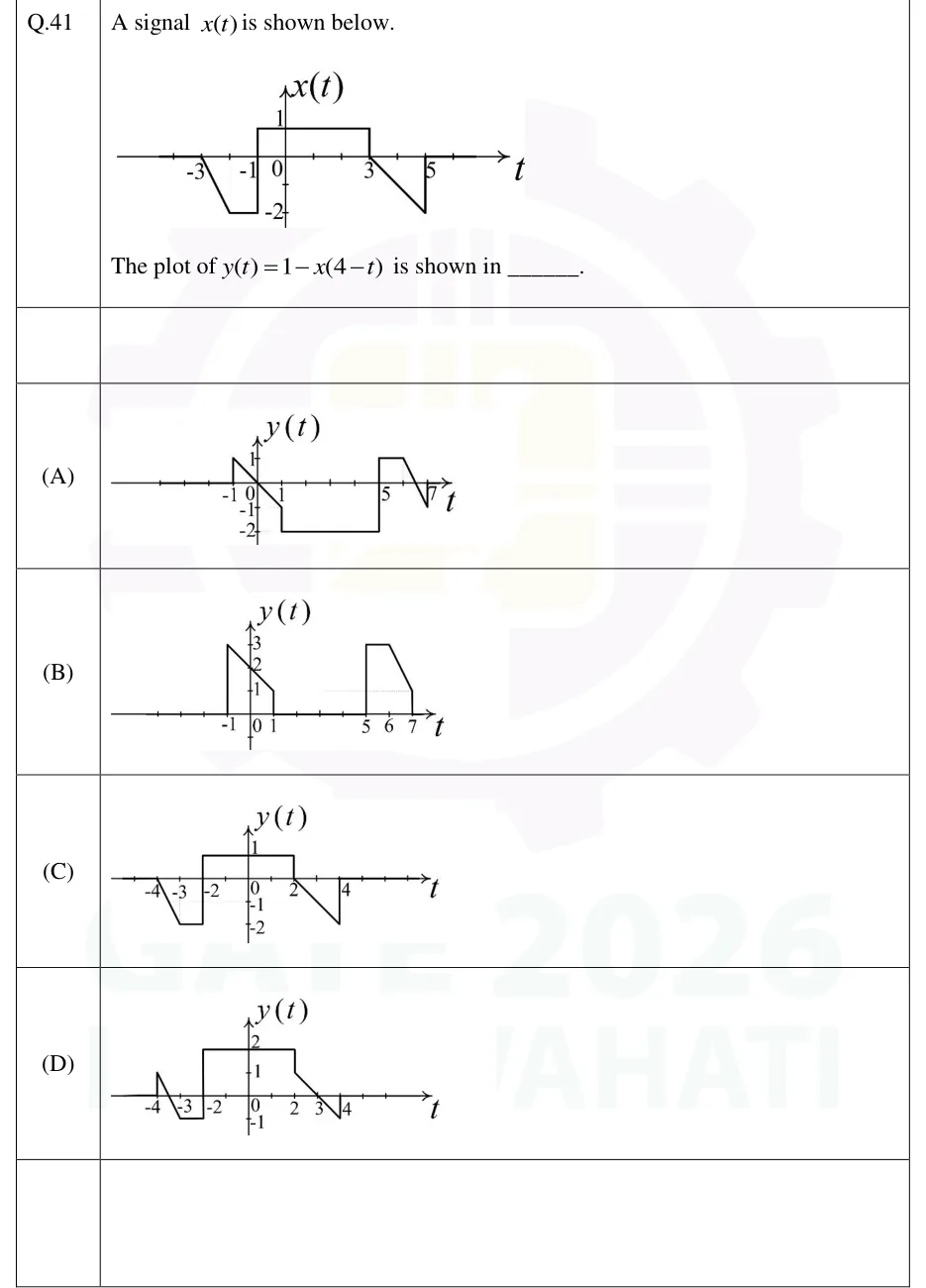
A signal is shown below.
[Figure: ]
The plot of is shown in ______.
 Tap to open full size
Plot of x(t) against t. Horizontal axis t has a tick at every integer, with labels -3, -1, 0, 3, 5. Vertical axis x(t) has labels 1 and -2 (and an unlabelled tick at -1). The waveform is: x(t) = 0 for t < -3. From t = -3 it falls linearly from 0 to -2, reaching -2 at t = -2. It stays at -2 for -2 < t < -1. At t = -1 it jumps vertically from -2 to 1 and stays at 1 for -1 < t < 3. At t = 3 it drops vertically from 1 to 0, then falls linearly from 0 at t = 3 to -2 at t = 5. At t = 5 it jumps vertically back to 0 and stays at 0 for t > 5.
Figure — y(t) = 0 for t < -1; jumps to 1 at t = -1, then falls linearly through 0 at t = 0 to -1 at t = 1; drops to -2 at t = 1 and stays at -2 until t = 5; jumps to 1 at t = 5 and stays at 1 until t = 6; falls linearly from 1 at t = 6 to -1 at t = 7; returns to 0 for t > 7. (t labels -1, 0, 1, 5, 7; y ticks 1, -1, -2.)
Figure — y(t) = 0 for t < -1; jumps to 3 at t = -1, then falls linearly through 2 at t = 0 to 1 at t = 1; drops to 0 at t = 1 and stays at 0 until t = 5; jumps to 3 at t = 5 and stays at 3 until t = 6; falls linearly from 3 at t = 6 to 1 at t = 7; drops to 0 for t > 7. (t labels -1, 0, 1, 5, 6, 7; y ticks 1, 2, 3.)
Figure — y(t) = 0 for t < -4; falls linearly from 0 at t = -4 to -2 at t = -3; stays at -2 until t = -2; jumps to 1 at t = -2 and stays at 1 until t = 2; drops to 0 at t = 2, then falls linearly to -2 at t = 4; jumps back to 0 at t = 4 and stays 0. (t labels -4, -3, -2, 0, 2, 4; y ticks 1, -1, -2.)
Figure — y(t) = 0 for t < -4; jumps to 1 at t = -4, then falls linearly to -1 at t = -3; stays at -1 until t = -2; jumps to 2 at t = -2 and stays at 2 until t = 2; drops to 1 at t = 2, then falls linearly through 0 at t = 3 to -1 at t = 4; jumps back to 0 at t = 4 and stays 0. (t labels -4, -3, -2, 0, 2, 3, 4; y ticks 2, 1, -1.)
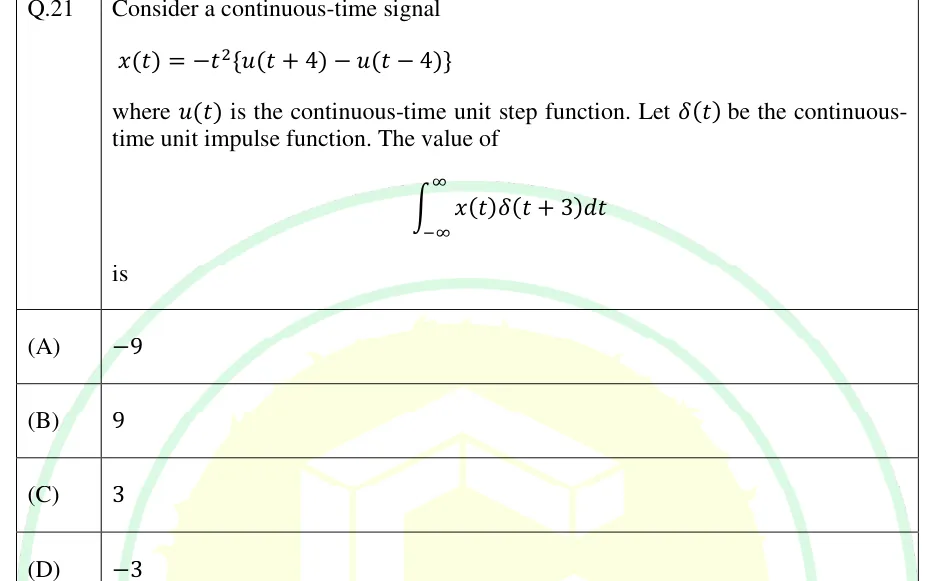
Consider a continuous-time signal
where is the continuous-time unit step function. Let be the continuous-time unit impulse function. The value of
is
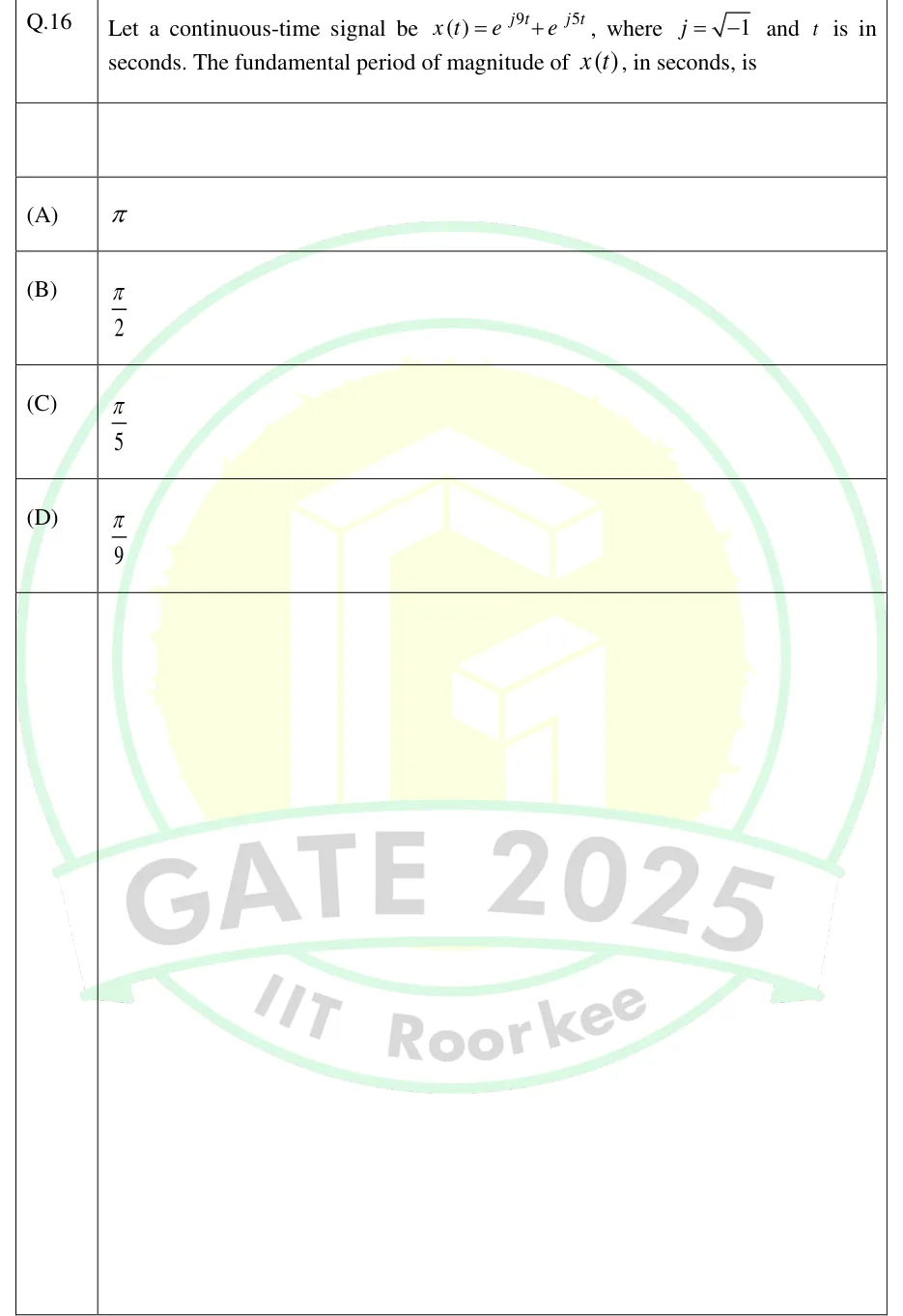
Let a continuous-time signal be , where and is in seconds. The fundamental period of magnitude of , in seconds, is
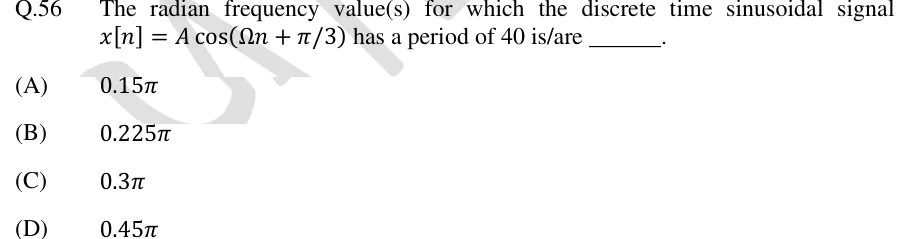
The radian frequency value(s) for which the discrete time sinusoidal signal has a period of 40 is/are ______.
If the energy of a continuous-time signal is and the energy of the signal is , then is ______ (rounded off to 1 decimal place).
The current drawn by a circuit is given as
The root-mean-square value of is ________ A (rounded off to one decimal place).
The period of the discrete-time signal described by the equation below is ________ (Round off to the nearest integer).
Consider the discrete-time signal ,
where .
The smallest for which is ________.
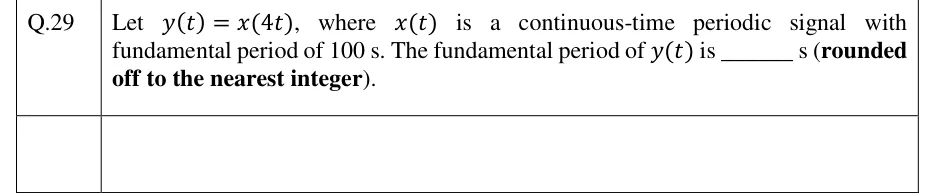
Let , where is a continuous-time periodic signal with fundamental period of 100 s. The fundamental period of is ______ s (rounded off to the nearest integer).
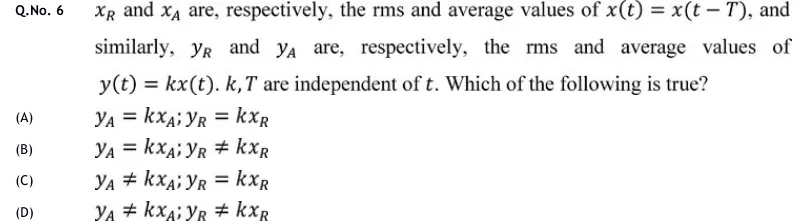
and are, respectively, the rms and average values of , and similarly, and are, respectively, the rms and average values of . are independent of . Which of the following is true?
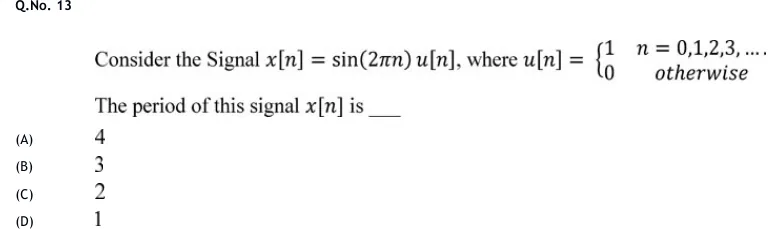
Consider the Signal , where for and otherwise.
The period of this signal is ____
4
3
2
1
Official answer: DSource: Official answer key, GATE 2020 IN (IIT Delhi)
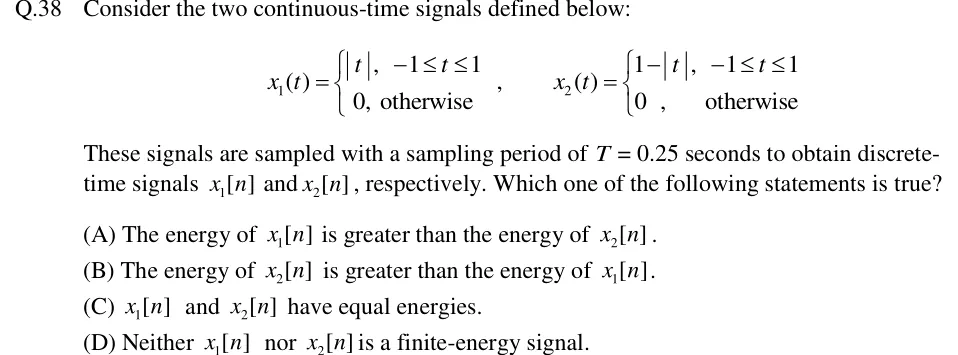
Consider the two continuous-time signals defined below:
These signals are sampled with a sampling period of seconds to obtain discrete-time signals and , respectively. Which one of the following statements is true?
The energy of is greater than the energy of .
The energy of is greater than the energy of .
and have equal energies.
Neither nor is a finite-energy signal.
The signal energy of the continuous-time signal
is
Two periodic signals and have the same fundamental period of 3 seconds. Consider the signal . The fundamental period of in seconds is
1
1.5
2
3
Consider signal . Let denote the unit impulse (Dirac-delta) function. The value of the integral is
2
1
0
3
PRACTICE
The value of is
Answer: (B)
, and lies inside : contribution .
sits at , outside : contribution .
Total . Option A drops the ; options C and D wrongly sift the impulse at .
Which of the following statements about discrete-time signals are TRUE? ( is an integer.)
is periodic with fundamental period .
is periodic with fundamental period .
is periodic with fundamental period .
is periodic with fundamental period .
Answer: (A), (C), (D)
A: , so . True.
B: is irrational, so the sequence is not periodic at all (a DT period must be an integer, and is not). False.
C: ; , so . True.
D: (from ) and (from ), so is a period; the two frequencies are distinct and nothing cancels, so . True.
For , the energy of is ________ (to two decimal places).
Answer: (accepted range )
.
A shift does not change energy; scaling time by divides it by .
.
The RMS value, in volts, of V is ________ (to two decimal places).
Answer: (accepted range )
The two Hz terms share a frequency, so merge them first: , whose squared magnitude is (equivalently ).
The DC term, the merged Hz term and the Hz term are mutually orthogonal: .
V. Adding the two Hz powers separately would give , which is wrong.
A signal is zero outside the interval . For , which option gives the interval outside which is zero, and the instant at which equals ?
, and
, and
, and
, and
Answer: (B)
Map the ends with , : . So and : is zero outside .
By operations: . lives on ; shifting right by (not by ) gives .
. Answer B.
OFFICIAL GATE 2027 SYLLABUS WORDING
Copied from the GATE 2027 syllabus; see all 2027 syllabi.
GATE EC
Continuous-time Signals … Discrete-time Signals
GATE EE
Representation of continuous and discrete time signals, shifting and scaling properties … R.M.S. value, average value calculation for any general periodic waveform
GATE IN
Periodic, aperiodic and impulse signals
Preparing in Kolkata? IAE Academy's course for GATE ECE, GATE EE or GATE IN.