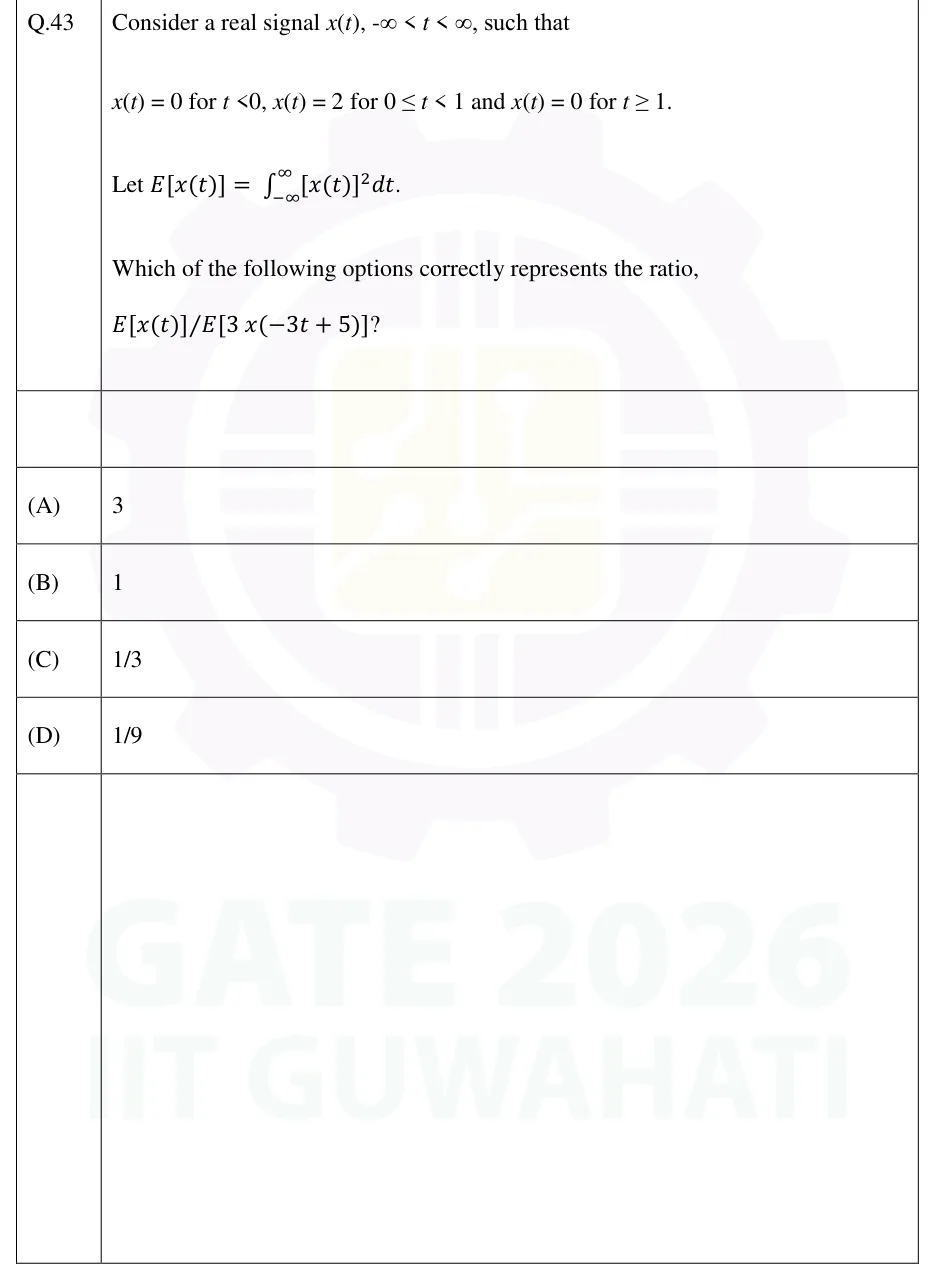
Consider a real signal , , such that
for , for and for .
Let .
Which of the following options correctly represents the ratio,
?
- (A)
- (B)
- (C)
- (D)

Consider a real signal , , such that
for , for and for .
Let .
Which of the following options correctly represents the ratio,
?
ANSWER
and , so the ratio is . The answer is option (C).
Official answer: CSource: Official answer key, GATE 2026 EC (IIT Guwahati)
Energy of the original pulse (height , width ):
Amplitude scaling: , so the factor multiplies the energy by .
Time scaling, reversal and shifting, with : substitute , so . For the limits also swap, and the two sign changes cancel, giving in every case: The shift and the reversal (the sign of ) do not change the energy.
With : .
Combine the two rules: .
Direct check: where , i.e. , an interval of width , and zero elsewhere. Energy , which agrees.
Ratio: which is option (C).
KEY IDEA
Energy scales with the square of the amplitude and inversely with the magnitude of the time-scale factor: . A time shift or a time reversal leaves the energy unchanged.
WATCH OUT FOR
Three common slips: scaling energy by instead of (this gives and a ratio of 1, option B); multiplying by instead of dividing (compression by 3 makes the pulse narrower, so it has less energy, not more; this gives a ratio of 1/27, which is not an option); and thinking the shift or the minus sign on changes the energy.
From the GATE 2026 EC paper. Every question of this paper · Download the full paper · All 18 Signals basics questions, with notes