
IAE Academy

GATE 2026 IN Q.41: solution and answer

GATE 2026 · INQ.41 · 2 marks · MCQ

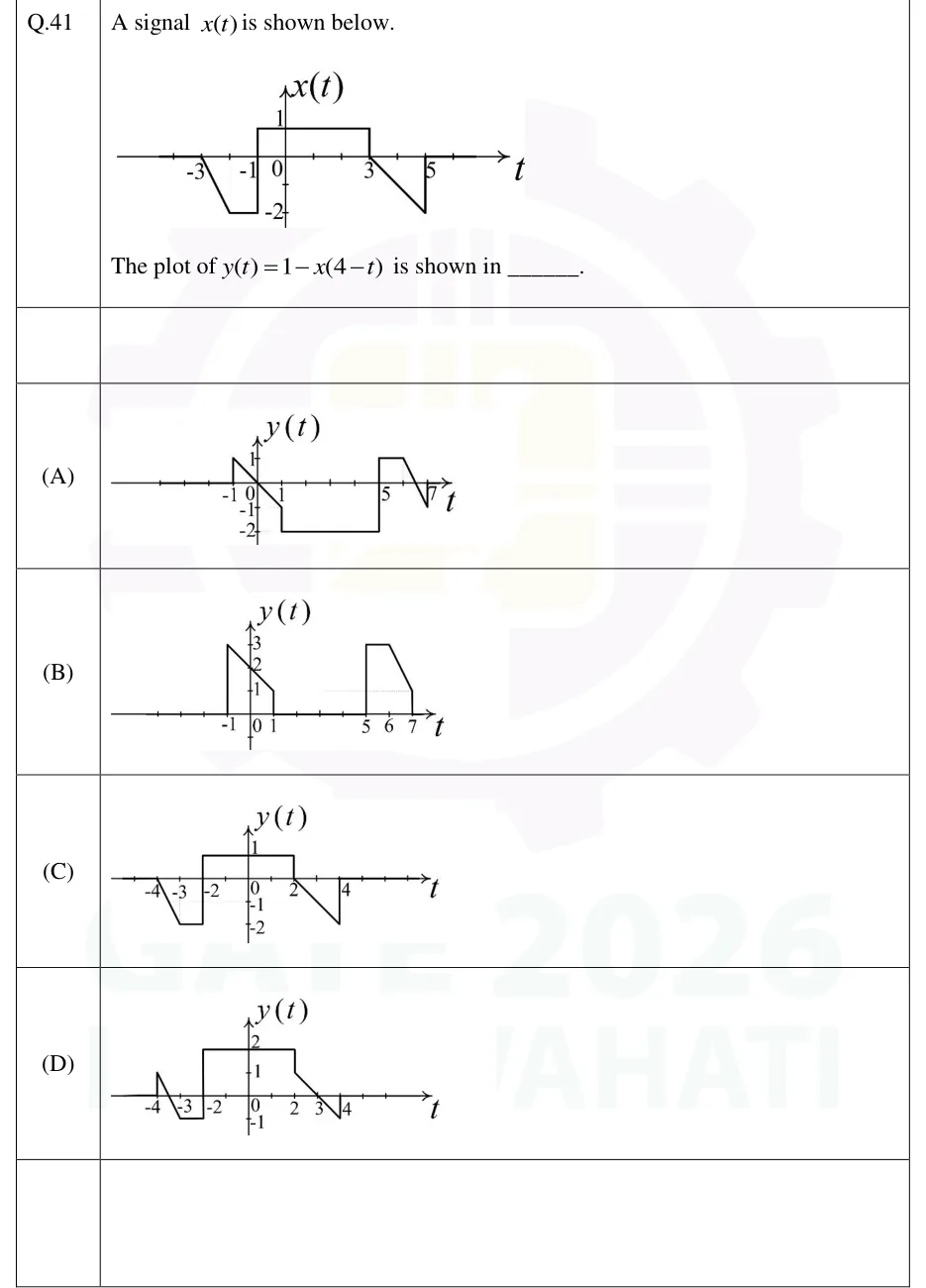
A signal is shown below.

[Figure: ]

The plot of is shown in ______.
GATE 2026 IN question 41: Plot of x(t) against t.Tap to open full size
Figure from the GATE 2026 IN paper. It is part of the question.
Figure description

Plot of x(t) against t. Horizontal axis t has a tick at every integer, with labels -3, -1, 0, 3, 5. Vertical axis x(t) has labels 1 and -2 (and an unlabelled tick at -1). The waveform is: x(t) = 0 for t < -3. From t = -3 it falls linearly from 0 to -2, reaching -2 at t = -2. It stays at -2 for -2 < t < -1. At t = -1 it jumps vertically from -2 to 1 and stays at 1 for -1 < t < 3. At t = 3 it drops vertically from 1 to 0, then falls linearly from 0 at t = 3 to -2 at t = 5. At t = 5 it jumps vertically back to 0 and stays at 0 for t > 5.

  1. (A)

    Figure — y(t) = 0 for t < -1; jumps to 1 at t = -1, then falls linearly through 0 at t = 0 to -1 at t = 1; drops to -2 at t = 1 and stays at -2 until t = 5; jumps to 1 at t = 5 and stays at 1 until t = 6; falls linearly from 1 at t = 6 to -1 at t = 7; returns to 0 for t > 7. (t labels -1, 0, 1, 5, 7; y ticks 1, -1, -2.)

  2. (B)

    Figure — y(t) = 0 for t < -1; jumps to 3 at t = -1, then falls linearly through 2 at t = 0 to 1 at t = 1; drops to 0 at t = 1 and stays at 0 until t = 5; jumps to 3 at t = 5 and stays at 3 until t = 6; falls linearly from 3 at t = 6 to 1 at t = 7; drops to 0 for t > 7. (t labels -1, 0, 1, 5, 6, 7; y ticks 1, 2, 3.)

  3. (C)

    Figure — y(t) = 0 for t < -4; falls linearly from 0 at t = -4 to -2 at t = -3; stays at -2 until t = -2; jumps to 1 at t = -2 and stays at 1 until t = 2; drops to 0 at t = 2, then falls linearly to -2 at t = 4; jumps back to 0 at t = 4 and stays 0. (t labels -4, -3, -2, 0, 2, 4; y ticks 1, -1, -2.)

  4. (D)

    Figure — y(t) = 0 for t < -4; jumps to 1 at t = -4, then falls linearly to -1 at t = -3; stays at -1 until t = -2; jumps to 2 at t = -2 and stays at 2 until t = 2; drops to 1 at t = 2, then falls linearly through 0 at t = 3 to -1 at t = 4; jumps back to 0 at t = 4 and stays 0. (t labels -4, -3, -2, 0, 2, 3, 4; y ticks 2, 1, -1.)

Answer and solution

ANSWER

The answer is (B). falls from 3 to 1 on , is 0 on , is 3 on and falls from 3 to 1 on . Like every option, (B) draws 0 outside , where strictly .

Official answer: BSource: Official answer key, GATE 2026 IN (IIT Guwahati)

  1. Read from the figure piece by piece: for ; a ramp from at down to at ; on ; on ; a ramp from at down to at ; for .

  2. Time operation first. , which is delayed by 4. Equivalently, it is reflected about . The quickest method is to map each point directly: the value appears at . So the breakpoints move to , in reverse order.

  3. Segment by segment, is: a ramp from at up to at (the image of the ramp on ); on ; on ; a ramp from at up to at (the image of the ramp on ); and everywhere else.

  4. Amplitude operations: negate, then add 1. So falls linearly from to on , is on , is on , and falls linearly from to on .

  5. Check two points. First, . is halfway down the ramp from to , so and , which matches the label 2 at in (B). Second, , which matches the level-3 plateau of (B) on .

  6. Eliminate the other options. (C) is , a shift with no reversal: its breakpoints are at . (D) is on . (A) is on . It has the right shape but the constant has the wrong sign, so it sits at instead of on . Only (B) agrees with on every segment where the signal varies.

  7. Caveat on the options: strictly, for and we have , so there. Every option draws on those intervals, so no option is exact everywhere. (B) is the only option that matches on , where the signal actually varies, so (B) is the intended answer.

KEY IDEA

Do the time operation on the argument first and the amplitude operations last. For , the value lands at , which reflects about and reverses the order of the breakpoints. Then negate and add 1. One point check, such as , separates the options quickly.

WATCH OUT FOR

Shifting in the wrong direction is the usual error. Writing as advanced by 4, i.e. , puts the breakpoints near instead of . Other slips: shifting without reversing, which gives (C), . Letting the minus sign act on the constant as well, which gives (A), . Adding 1 without negating first.

From the GATE 2026 IN paper. Every question of this paper · Download the full paper · All 18 Signals basics questions, with notes

More Signals basics questions