IAE Academy

GATE EC · EE · IN

LTI systems

Properties, impulse response, convolution and correlation

A linear time-invariant (LTI) system is described completely by its impulse response or . The output for any input is the convolution of that input with , and causality, stability, memory and invertibility can all be read from . Questions on this topic ask you to test a system equation for linearity, time invariance, causality, memory, invertibility and stability, to evaluate a convolution (often at one instant, or with the width and area rules), to find the response to a sinusoid through the frequency response, and to compute or reason about an autocorrelation or a cross-correlation.

31 previous-year questions · 28 solved · 5 practice questions

1. System properties and the test for each

A system maps an input to an output . Each property below is a statement about every admissible input and every instant. One counterexample disproves a property. A proof must hold in general. Everything here applies to continuous time () and to discrete time (, with integer shifts). Unless a question says otherwise, assume the system is at rest (zero initial conditions) before the input is applied.

LINEARITY (SUPERPOSITION)

Must hold for all inputs and all constants (complex constants if the signals may be complex). It combines additivity () and homogeneity (). Zero input giving zero output is necessary, not sufficient.

TIME INVARIANCE

Discrete time: for every integer . Also called shift invariance.

CAUSALITY AND MEMORY

Both must hold for every . A memoryless (static) system is always causal. A causal system need not be memoryless.

BIBO STABILITY

Every bounded input must give a bounded output. One bounded input with an unbounded output proves the system unstable.

How to run each test

  1. Linearity. Find and . Then compute and compare it with . As a quick first check, set . A nonzero output (for example from ) proves the system is nonlinear. Passing this check proves nothing, because passes it too.

  2. Time invariance. (i) Delay only the input: replace by inside the operator and leave every explicit unchanged. Call the result . (ii) Delay the output: replace every in the output expression by to get . (iii) The system is time-invariant only if for all and all .

  3. Causality. Ask which input instants needs. Check negative as well as positive .

  4. Memory. A delay, an advance, a scaled or reversed argument, an integral or a derivative gives the system memory. A system is memoryless only if its output at each instant is a function of the input at that same instant alone. The function may change with time, as in or .

  5. Invertibility. The system is invertible if distinct inputs always give distinct outputs. To disprove it, find two different inputs with the same output: and for , or and for a differentiator. To prove it, write down the inverse system.

  6. BIBO stability. To disprove it, apply a simple bounded input such as , or and show that the output grows without bound. To prove it, bound using .

EXAM TIP

A straight line is not a linear system. gives for , so it is not linear. It is incrementally linear: a linear system plus a response that does not depend on the input. For the same reason, a system described by a linear constant-coefficient differential or difference equation is linear and time-invariant only when it starts at rest. A nonzero initial condition produces an output even with zero input. A related trap is . It is additive, but it is not homogeneous for complex constants: with and a real , while . It is linear only when inputs and constants are restricted to real values.

EXAM TIP

Delay the input correctly. For , the delayed input is the new signal . Its output is , not . The delayed output is . The two differ, so the system is time-varying. Quick screens, to be confirmed with the formal test: an explicit or as a coefficient (, ), a scaled or reversed argument (, ), or an integration or summation limit that is neither infinite nor of the form (such as or ) each point to a time-varying system. Limits such as and are consistent with time invariance.

2. Property tests on typical system equations

The table applies the six tests to standard system equations. Yes means the system has the property. The note after a colon is the counterexample or the argument. Learn the reasons rather than the table, because a question usually changes one detail of an equation like these. The differentiator is taken as causal: the derivative at can be found from the left, using only for , and its impulse response is zero for .

System

Linear

Time-invariant

Causal

Memoryless

BIBO stable

Invertible

Yes

No

No:

No

Yes

Yes:

Yes

No

Yes

Yes

No: gives

No: whatever is

Yes

No

Yes

Yes

Yes:

No: at whatever is there

No

Yes

Yes

Yes

Yes:

No: and give the same

No

Yes

Yes

Yes

Yes:

Yes, for real :

No: gives

Yes

Yes

Yes

Yes

Yes

Yes

Yes

Yes

No

Yes

Yes:

Yes

No

No:

No

Yes

Yes:

Yes

Yes

Yes

No

No: gives

Yes:

,

Yes

Yes

Yes

No

Yes:

No: gives

Yes

Yes

Yes

No

No: gives

No: and give the same

WORKED EXAMPLE

Test the system for linearity, time invariance, causality, memory, BIBO stability and invertibility.

Solution
  1. Linearity: . The system is linear.

  2. Time invariance: the delayed input gives , with .

  3. The delayed output is . The upper limits differ for , so the system is time-varying.

  4. Causality: needs on , which is in the future. The system is non-causal. (For it happens to use only past values, but one counterexample is enough.)

  5. Memory: the output depends on the input over an interval, so the system has memory.

  6. Stability: is bounded by 1, but for grows without bound. The system is BIBO unstable.

  7. Invertibility: differentiating gives , so , meaning the derivative of evaluated at . The input can be recovered, so the system is invertible.

Answer: Linear, time-varying, non-causal, with memory, BIBO unstable and invertible.

EXAM TIP

Scaled arguments. A system with and is time-varying and non-causal. For it needs future input when . For or it needs future input when . It is still linear, BIBO stable and invertible. Check negative time before calling any system with a scaled argument causal.

3. The impulse response describes an LTI system completely

Any signal can be written as a sum of weighted, shifted impulses: (the sifting property). If the system is time-invariant, its response to is . If it is also linear, superposition gives the output for any input as a convolution with . So the impulse response , measured with the system at rest, describes an LTI system completely. This fails for a nonlinear or time-varying system, whose response to does not determine its response to other inputs. The same argument works in discrete time with and .

CONVOLUTION INTEGRAL

is the integration variable and is held fixed while integrating. In practice the limits shrink to the interval where both factors are nonzero.

CONVOLUTION SUM

Each output sample is a sum of products of samples whose indices add to .

CAUSAL SYSTEM WITH A CAUSAL INPUT

When and are both zero before the origin, is zero there too. If either signal has an impulse at the origin, take the lower limit as so that the impulse is included.

CAUSALITY OF AN LTI SYSTEM

Then uses only present and past input. Necessary and sufficient for an LTI system.

BIBO STABILITY OF AN LTI SYSTEM

Necessary and sufficient for an LTI system. The integral of must be finite, not the integral of . The output is then bounded by . If contains impulses, each term adds to the integral, so (a plain wire) is stable. A doublet term (a differentiator) makes the system unstable.

Property of the LTI system

Continuous time

Discrete time

Causal

for

for

BIBO stable

Memoryless

Invertible

some satisfies

some satisfies

Stable, in transform terms

ROC of contains the -axis, and has no or higher-derivative terms (for a rational : proper)

ROC of contains the unit circle

Causal and stable, rational transfer function

proper and every pole in

proper in (numerator degree denominator degree, in powers of ) and every pole inside

STEP RESPONSE (CONTINUOUS TIME)

Here is the step response, not the Laplace variable. The step response is the running integral of . For a causal , . For a stable system the final value is , the DC gain. The ramp response is the running integral of the step response.

STEP RESPONSE (DISCRETE TIME)

The step response is the running sum of , and is the first difference of the step response.

INTERCONNECTIONS OF LTI SYSTEMS

In any transform domain a cascade multiplies, , and a parallel connection adds, . The order of LTI blocks in a cascade does not change the overall response.

INVERSE SYSTEM

Examples: the delay has inverse . The accumulator has inverse , because . An inverse need not be causal or stable: for the delay is causal, but its inverse, an advance, is not.

LTI SYSTEM FROM A LINEAR CONSTANT-COEFFICIENT EQUATION

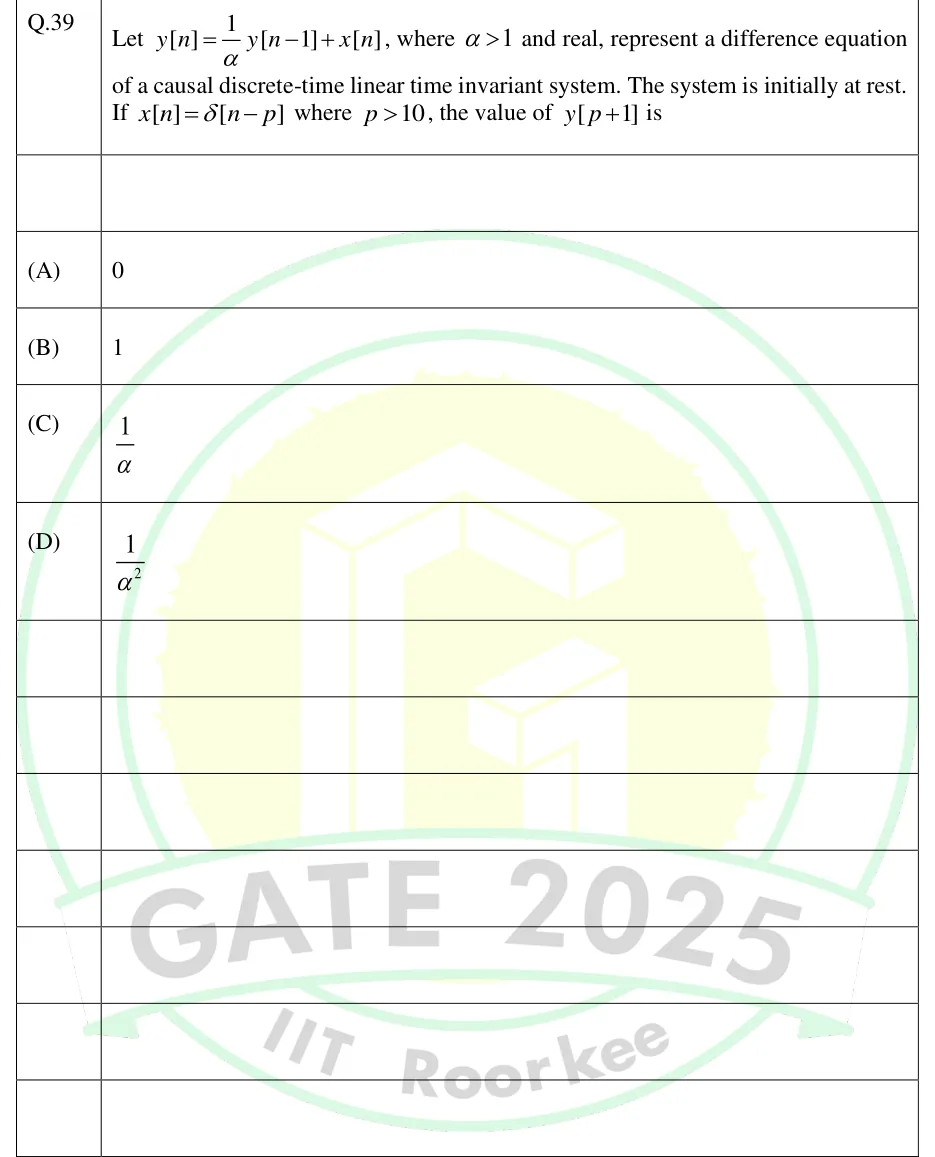
Holds when the system is at rest before the input starts (initial rest), which makes it LTI and causal. is the inverse transform with the ROC to the right of the rightmost pole of , or outside the outermost pole of . Examples: gives and , stable only for . gives and , stable only for . An of finite length is called FIR and one of infinite length IIR. A difference equation with no past outputs () is always FIR, with .

EXAM TIP

Stability traps. (1) The ideal low-pass filter has , which is finite, but diverges, so it is not BIBO stable. It is also non-causal. (2) is unstable because the harmonic series diverges, while is stable. (3) with is stable but non-causal. (4) The integrator and are causal but unstable. (5) A finite-length (FIR) with finite samples is always stable. (6) An improper , such as , contains terms and is not BIBO stable even though it has no finite poles.

EXAM TIP

Only LTI blocks can be reordered. For blocks that are not LTI, the order can matter. Multiplying by and then delaying by 1 gives . Delaying first and then multiplying by gives .

4. Convolution: graphical method, properties and standard results

Graphical convolution (flip and slide)

  1. Write both signals against the integration variable: and . Convolution is commutative, so flip whichever signal is simpler.

  2. Flip: .

  3. Slide: is the flipped copy moved so that its original origin sits at . Increasing moves it to the right.

  4. For each range of , multiply and integrate (or sum) over the overlap only.

  5. The ranges change only where an edge of one signal crosses an edge of the other. If occupies and occupies , the breakpoints are , , and , plus any interior corners of piecewise signals.

  6. Check the result. is zero outside . If neither signal contains an impulse (bounded, piecewise-continuous signals), has no jumps, so neighbouring pieces must agree at every breakpoint. The area of is when both areas are finite.

COMMUTATIVE, ASSOCIATIVE AND DISTRIBUTIVE LAWS

Hold for continuous and discrete convolution. Associativity gives the cascade rule and distributivity gives the parallel rule.

CONVOLUTION WITH AN IMPULSE

Discrete time: . Convolving with an impulse train repeats the signal: . Do not confuse convolution with multiplication by an impulse, which samples: , for continuous at .

SHIFT PROPERTY

Shifts add. The same holds in discrete time with integer shifts.

CONVOLUTION WITH THE UNIT STEP

Convolving with is running integration (or running summation). Convolving with differentiates: .

DIFFERENTIATION PROPERTY

Useful for piecewise-constant signals, whose derivatives are impulses. A result found this way must be integrated back, using the fact that is zero before .

AREA (SUM) PROPERTY

Holds whenever both areas (sums) are finite, for example when and are absolutely integrable (summable). The quickest check on any such convolution. In transform terms it is .

WIDTH AND LENGTH RULE

Continuous time: the widths add, . Discrete time: and are the first indices of and , and each length is counted from the first nonzero sample to the last. The first and last output samples are then single products of nonzero end samples, so they are nonzero; interior samples may be zero.

TIME-SCALING PROPERTY

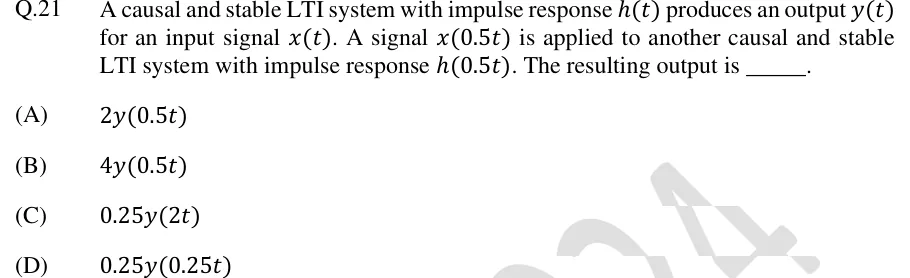
Continuous time only. Scaling both signals by compresses the output time axis by and scales its height by .

CONVOLUTION THEOREM

The ROC of contains the intersection of the ROCs of and . Multiplication in time is convolution in frequency: in the convention, and , without the , in the convention.

Convolution

Result

Condition

, the unit ramp

none

none

: a triangle on with peak at

for ; for

Unit-height pulses of widths

A trapezoid of total width with a flat top of height and length

Starts at the sum of the two start times

none

none

WORKED EXAMPLE

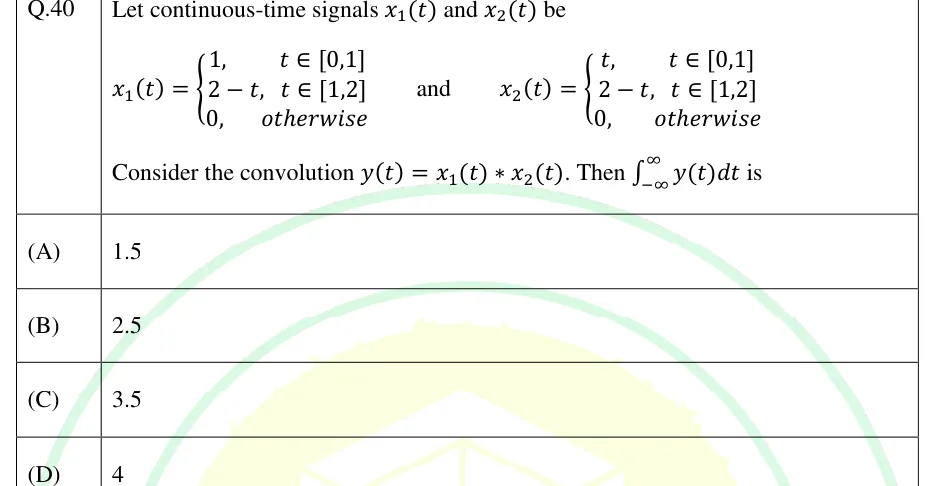
An LTI system has . The input is the pulse . Find for all and the value .

Solution
  1. Flip the exponential: for and zero for . The pulse on .

  2. Breakpoints: starts at 0 and ends at 2, and starts at 0 and never ends. So the ranges are , and .

  3. : the flipped exponential lies entirely to the left of the pulse, so .

  4. : the overlap is , so .

  5. : the overlap is the whole pulse, , so .

  6. .

  7. Shortcut by linearity and time invariance: the step response is and , so . For this gives , as above.

  8. Checks: both pieces give at , so there is no jump. The area is .

Answer: for , for , and for . .

WORKED EXAMPLE

for and for . Both are zero elsewhere. Find .

Solution
  1. Length rule: samples. The first index is and the last is .

  2. Multiply as polynomial coefficients, , adding the products whose positions add to the same total.

  3. .

  4. .

  5. .

  6. .

  7. .

  8. Sum check: and , so must be 12. Indeed .

Answer: for , and zero elsewhere.

EXAM TIP

Symmetry, position and period shortcuts. An even signal convolved with an even signal is even, odd with odd is even, and even with odd is odd. If is symmetric about and about , then is symmetric about . Two unit-height pulses convolve to a trapezoid whose peak value equals the width of the shorter pulse, or to a triangle if the widths are equal. If is periodic with period and is absolutely integrable, is periodic with the same period .

EXAM TIP

One sample only. If a question asks for alone, do not compute the whole convolution. needs only the pairs of samples whose indices add to . The same idea works in continuous time: is a single integral over the overlap at .

5. Eigenfunctions and the response to a sinusoid

Complex exponentials are the eigenfunctions of every LTI system. They come out with the same shape, multiplied by a complex constant that depends only on the system and the frequency. That constant is the transfer function evaluated at the input's complex frequency. Convention used here: the Fourier transform is written in (rad/s), , with the in the inverse transform. In the (Hz) convention, and the transform pair has no . In discrete time the frequency response is , with in rad/sample; it is periodic in with period . The Laplace and z-transforms in this section are bilateral, and each result holds for or in the ROC of .

EIGENFUNCTION PROPERTY (CONTINUOUS TIME)

Holds for all when lies in the ROC of , the bilateral Laplace transform of . The input exists for all time, .

EIGENFUNCTION PROPERTY (DISCRETE TIME)

must lie in the ROC of . With the eigenvalue is the frequency response .

FREQUENCY RESPONSE

Exists as an ordinary function when is absolutely integrable (summable), that is, when the system is BIBO stable. For a real , is even and is odd in frequency.

LTI RESPONSE TO A SINUSOID

Needs a real and a stable system. Discrete time: . For a sum of sinusoids, apply the rule to each term and add (superposition).

RESPONSE TO A CONSTANT (DC GAIN)

The (or ) case of the sinusoid rule. For use : , with .

WORKED EXAMPLE

An LTI system has . Find its output for the input , applied for all time.

Solution
  1. The system is causal and stable (), so exists: .

  2. DC term: , so the constant 3 passes as 3.

  3. At rad/s: , so and .

  4. The cosine term becomes .

  5. Add the two responses (superposition).

Answer: .

EXAM TIP

Sinusoids in, the same frequencies out. is an eigenfunction of every LTI system, but for a real , is one only when is real; otherwise its phase shifts. An LTI system cannot create a frequency that is not in its input. If the output contains a new frequency, the system is nonlinear or time-varying: turns into a DC term plus a term at , and moves to .

EXAM TIP

Eternal versus switched-on sinusoid. The rule above gives the whole output only when the sinusoid has been applied for all time. For into a causal, stable system it gives only the steady-state output; a transient that decays to zero is added to it. A zero of on the -axis (or on the unit circle) blocks that frequency completely, so such a system cannot be invertible.

6. Autocorrelation and cross-correlation

Correlation measures how alike two signals are as one is slid past the other. Unlike convolution, neither signal is flipped. Convention used here: . Some texts define the cross-correlation as , which equals (and ) in this convention. When a question states its own definition, use that one. For real signals, drop the conjugates. The first formulas are for energy signals. Power signals use a time average, given further down.

CROSS-CORRELATION (ENERGY SIGNALS)

Correlation is convolution with the second signal reversed and conjugated. Because of the reversal it is not commutative: .

AUTOCORRELATION (ENERGY SIGNALS)

For a real, even signal, , so .

DISCRETE-TIME CORRELATION

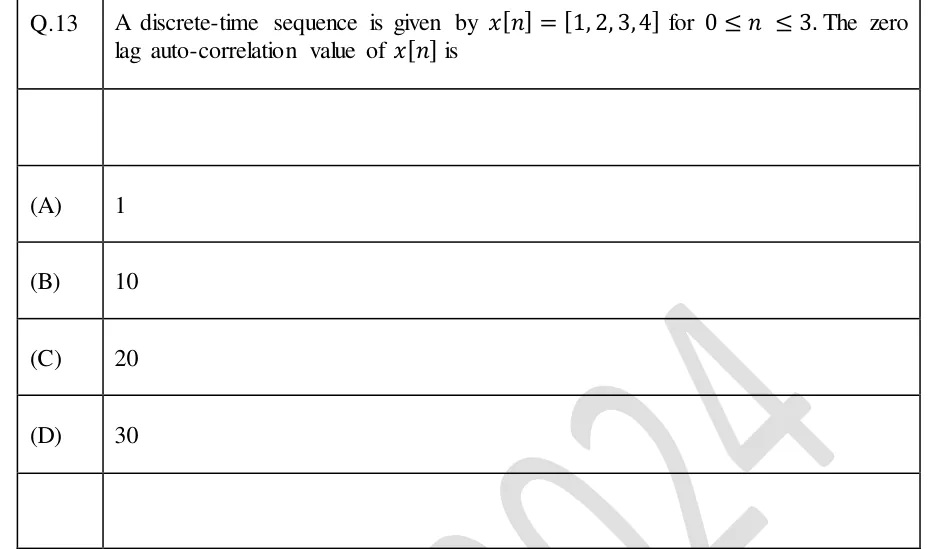
is the integer lag. The length rule of convolution applies: sequences of lengths and give lags, so the autocorrelation of an -sample sequence has lags.

PROPERTIES OF AUTOCORRELATION

For a real signal, is real and even, and its largest value is at . The last line is the area property of convolution; it needs absolutely integrable.

PROPERTIES OF CROSS-CORRELATION

The inequality is the Cauchy-Schwarz inequality. Unlike , the cross-correlation need not peak at .

CORRELATION AND ENERGY SPECTRAL DENSITY

is the energy spectral density. In the convention, (Parseval). Discrete time: and . Because discards phase, and every shifted copy have the same autocorrelation.

AUTOCORRELATION OF POWER SIGNALS

For a periodic signal of period , average over one period; is then periodic with period and returns to its peak at every multiple of . The cross-correlation of power signals uses the same average with in place of . The power spectral density is the Fourier transform of the autocorrelation, , and . Example: has , whatever is, so is its average power and .

CORRELATION THROUGH AN LTI SYSTEM

For , in the convention above. In frequency, and , where is the energy (or power) spectral density.

Feature

Convolution

Correlation

Definition

Reversal

One signal is flipped

No flip, only conjugation

Commutative

Yes

No:

Fourier transform

Support, for on and the other signal on

Typical use

Output of an LTI system

Similarity, delay estimation, energy and power

WORKED EXAMPLE

Find the autocorrelation of and check it against the properties.

Solution
  1. is the pulse moved to occupy . For it overlaps on .

  2. On the overlap the product is , so for , and for .

  3. is real, so is even: for , and zero otherwise. It is a triangle on .

  4. Checks: . The width is , as the convolution width rule requires. The area is .

Answer: for and zero otherwise, with its peak at .

EXAM TIP

Delay estimation depends on the convention. If , then peaks at , while peaks at . Check the question's definition before reading a delay off a peak. Autocorrelation alone cannot locate a signal in time, because and have the same .

PREVIOUS-YEAR QUESTIONS

31 questions from the EC, EE and IN papers

Try each question first, then open the answer. 3 show the official answer only. We placed each question under a topic ourselves; the exam paper does not label topics.

See these papers in full: GATE ECE 2026 · GATE ECE 2025 · GATE ECE 2024 · GATE ECE 2023 · GATE ECE 2022 · GATE ECE 2020 · GATE EE 2026 · GATE EE 2025 · GATE EE 2024 · GATE EE 2023 · GATE EE 2022 · GATE EE 2020 · GATE EE 2018 · GATE IN 2026 · GATE IN 2025 · GATE IN 2024 · GATE IN 2023 · GATE IN 2022 · GATE IN 2020

GATE 2026 EC Q.47

GATE 2026 · ECQ.47 · 2 marks · MCQ

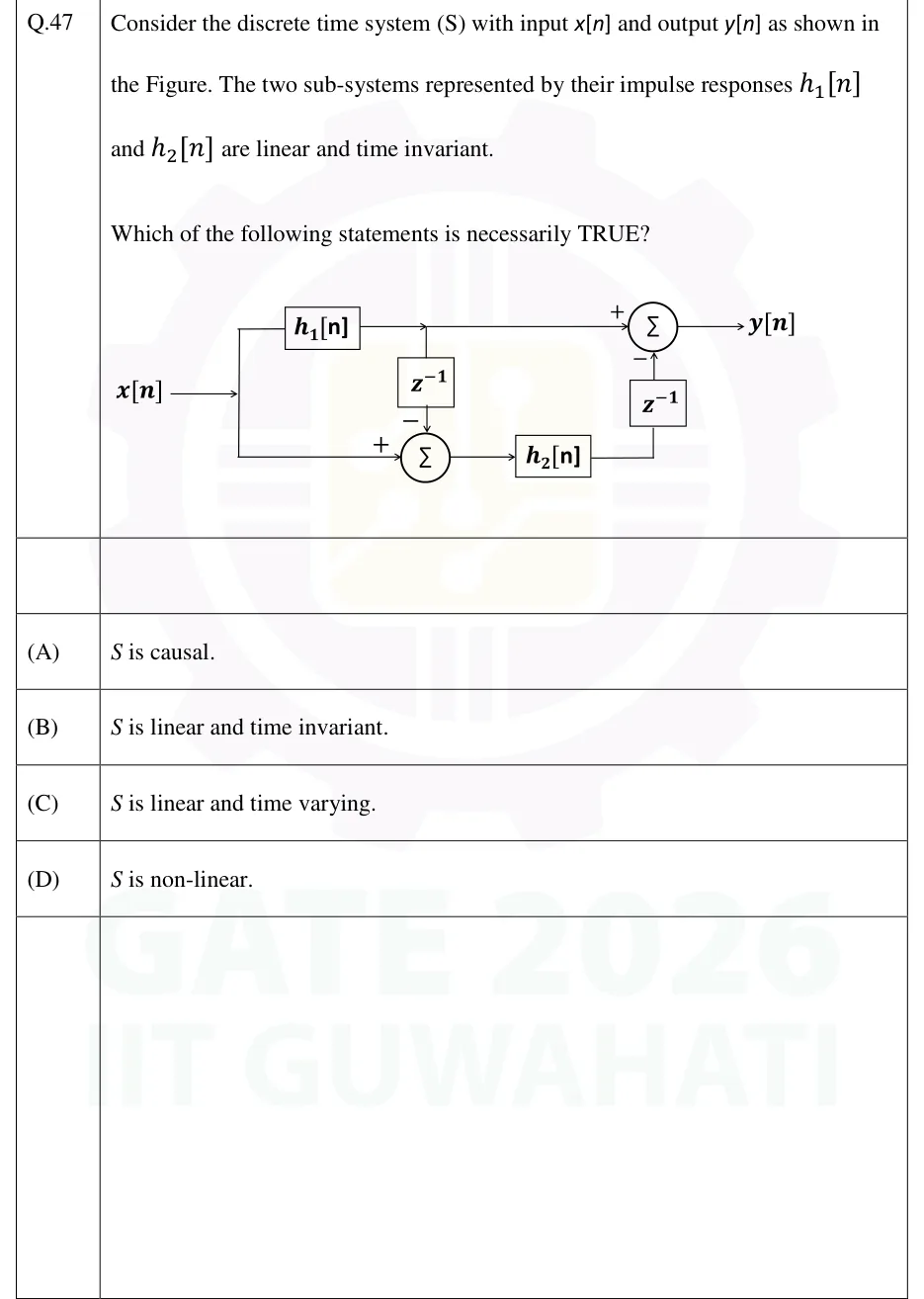
Consider the discrete time system (S) with input and output as shown in the Figure. The two sub-systems represented by their impulse responses and are linear and time invariant.

Which of the following statements is necessarily TRUE?
GATE 2026 EC question 47: Block diagram.Tap to open full size
Figure from the GATE 2026 EC paper. It is part of the question.
Figure description

Block diagram. The input x[n] splits into two paths. Upper path: x[n] feeds block h_1[n]. The output of h_1[n] runs right to the '+' input of an output summing junction, whose output is y[n]. A pick-off on the h_1[n] output line goes down through a z^-1 block into the '−' input of a lower summing junction. Lower path: x[n] also feeds the '+' input of that lower summing junction. The lower summer's output feeds block h_2[n]. The output of h_2[n] goes right and then up through a second z^-1 block into the '−' input of the output summing junction. So y[n] = (h_1 output) − (h_2 output delayed by one sample), and h_2 is driven by x[n] − (h_1 output delayed by one sample).

  1. (A)

    is causal.

  2. (B)

    is linear and time invariant.

  3. (C)

    is linear and time varying.

  4. (D)

    is non-linear.

Answer and solution
GATE 2026 EC Q.47: answer and solution

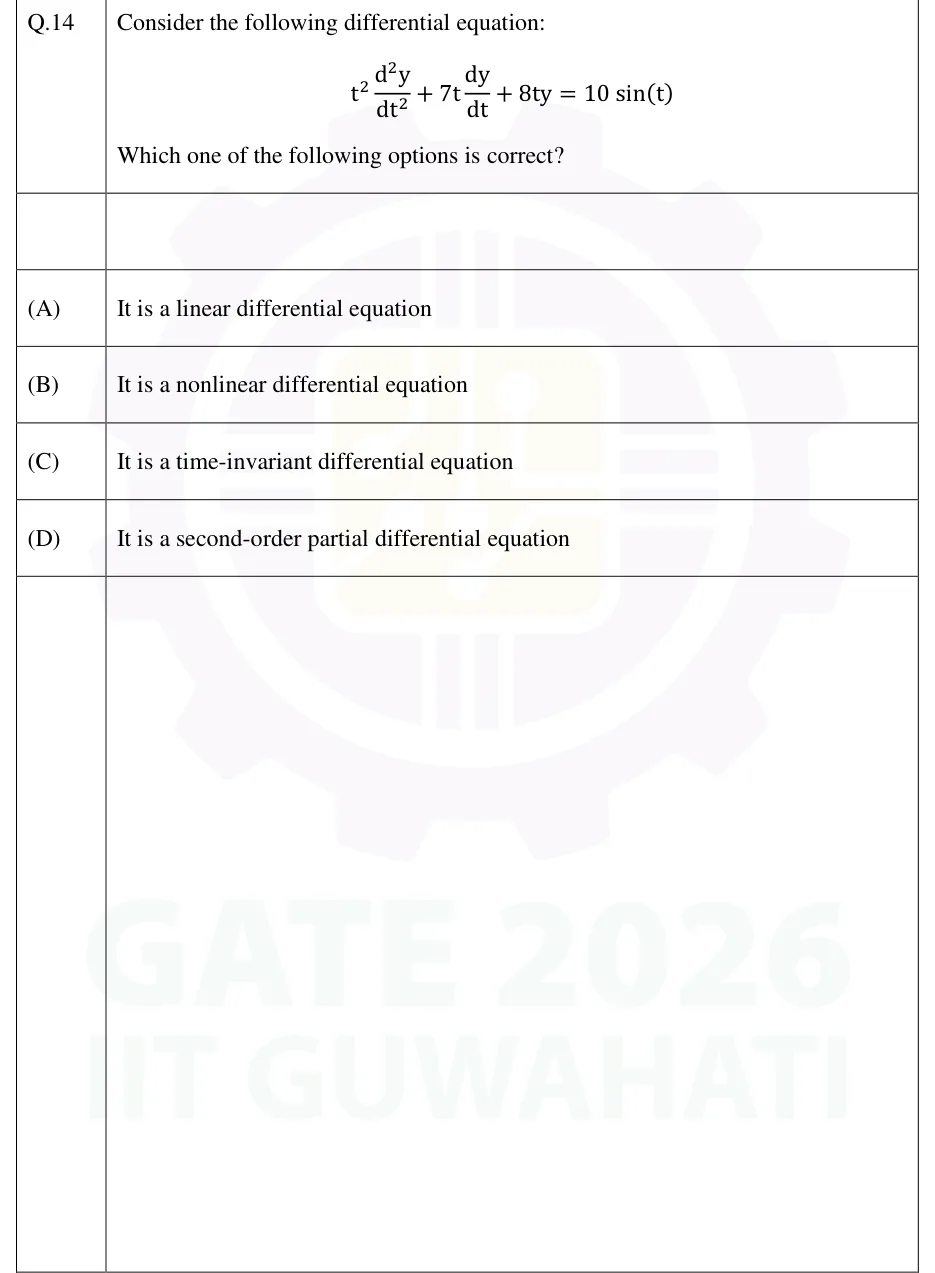
GATE 2026 EE Q.14

GATE 2026 · EEQ.14 · 1 mark · MCQ

Consider the following differential equation:

Which one of the following options is correct?

  1. (A)

    It is a linear differential equation

  2. (B)

    It is a nonlinear differential equation

  3. (C)

    It is a time-invariant differential equation

  4. (D)

    It is a second-order partial differential equation

Answer and solution
See the question in the paper
GATE 2026 EE Q.14: answer and solution

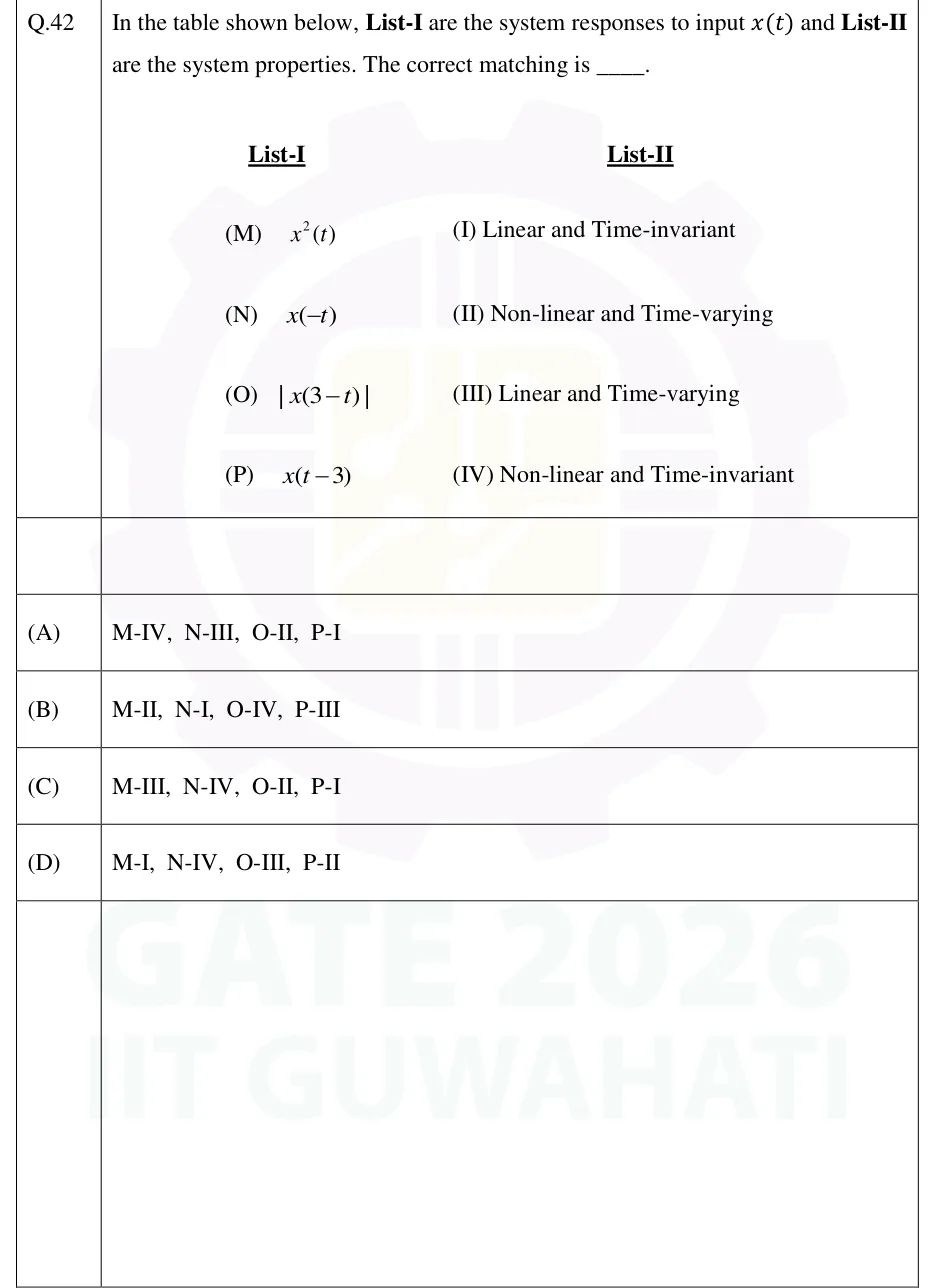
GATE 2026 IN Q.42

GATE 2026 · INQ.42 · 2 marks · MCQ

In the table shown below, List-I are the system responses to input and List-II are the system properties. The correct matching is ____.

| List-I | List-II |
|---|---|
| (M) | (I) Linear and Time-invariant |
| (N) | (II) Non-linear and Time-varying |
| (O) | (III) Linear and Time-varying |
| (P) | (IV) Non-linear and Time-invariant |

  1. (A)

    M-IV, N-III, O-II, P-I

  2. (B)

    M-II, N-I, O-IV, P-III

  3. (C)

    M-III, N-IV, O-II, P-I

  4. (D)

    M-I, N-IV, O-III, P-II

Answer and solution
See the question in the paper
GATE 2026 IN Q.42: answer and solution

GATE 2025 EC Q.17

GATE 2025 · ECQ.17 · 1 mark · MCQ

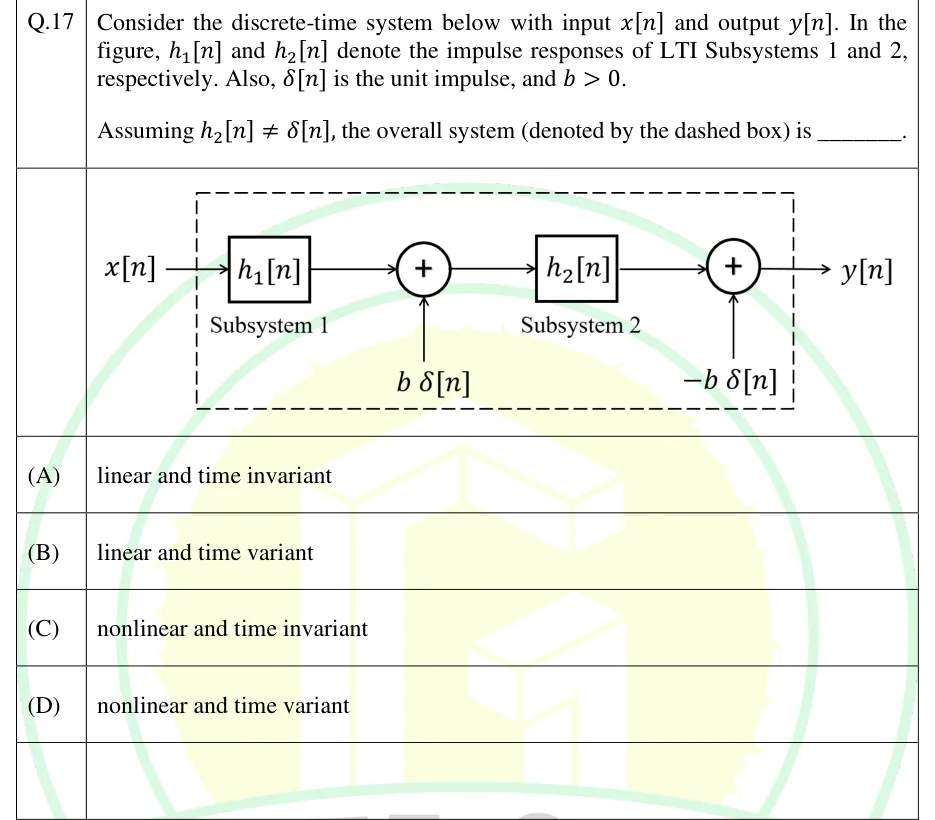
Consider the discrete-time system below with input and output . In the figure, and denote the impulse responses of LTI Subsystems 1 and 2, respectively. Also, is the unit impulse, and .

Assuming , the overall system (denoted by the dashed box) is ________.

GATE 2025 EC question 17: A dashed box encloses the overall system.Tap to open full size
Figure from the GATE 2025 EC paper. It is part of the question.
Figure description

A dashed box encloses the overall system. Input x[n] enters from the left into a block labelled h_1[n] (Subsystem 1). Its output goes to a summing junction (+), whose second input, coming up from below, is b δ [n]. The sum feeds a block labelled h_2[n] (Subsystem 2). Its output goes to a second summing junction (+), whose second input, coming up from below, is -b δ [n]. The output of the second junction leaves the dashed box as y[n]. Both added signals b δ [n] and -b δ [n] are sources inside the dashed box.

  1. (A)

    linear and time invariant

  2. (B)

    linear and time variant

  3. (C)

    nonlinear and time invariant

  4. (D)

    nonlinear and time variant

Answer and solution
GATE 2025 EC Q.17: answer and solution

GATE 2025 EE Q.20

GATE 2025 · EEQ.20 · 1 mark · MCQ

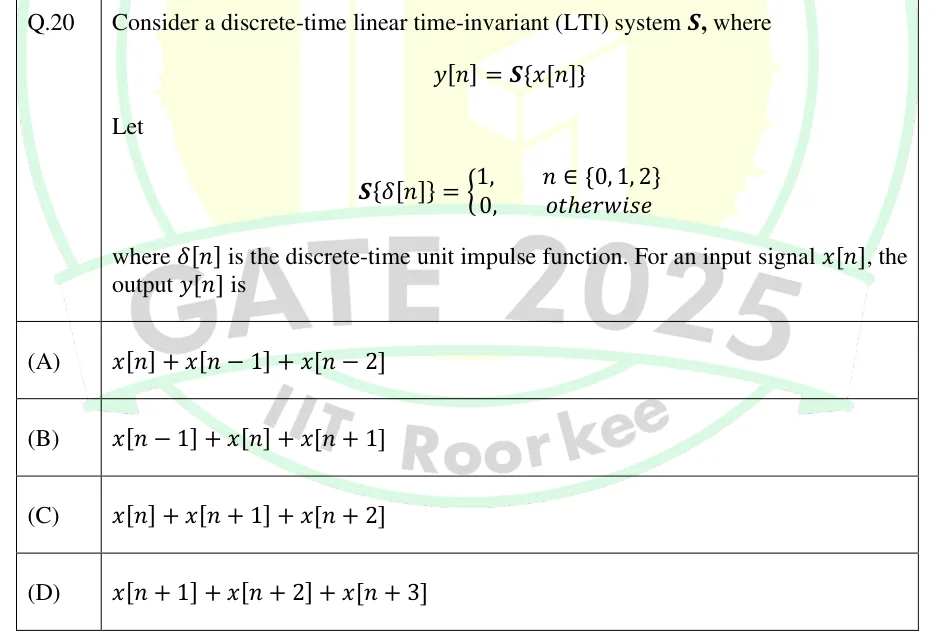
Consider a discrete-time linear time-invariant (LTI) system , where

Let

where is the discrete-time unit impulse function. For an input signal , the output is

  1. (A)

  2. (B)

  3. (C)

  4. (D)

Answer and solution
See the question in the paper
GATE 2025 EE Q.20: answer and solution

GATE 2025 EE Q.42

GATE 2025 · EEQ.42 · 2 marks · MCQ

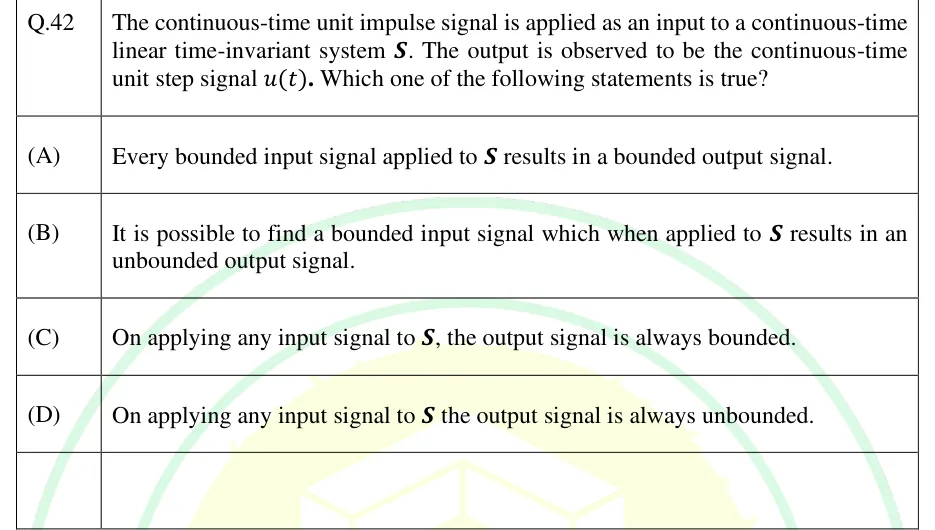
The continuous-time unit impulse signal is applied as an input to a continuous-time linear time-invariant system . The output is observed to be the continuous-time unit step signal . Which one of the following statements is true?

  1. (A)

    Every bounded input signal applied to results in a bounded output signal.

  2. (B)

    It is possible to find a bounded input signal which when applied to results in an unbounded output signal.

  3. (C)

    On applying any input signal to , the output signal is always bounded.

  4. (D)

    On applying any input signal to the output signal is always unbounded.

Answer and solution
See the question in the paper
GATE 2025 EE Q.42: answer and solution

GATE 2024 EE Q.15

GATE 2024 · EEQ.15 · 1 mark · MCQ

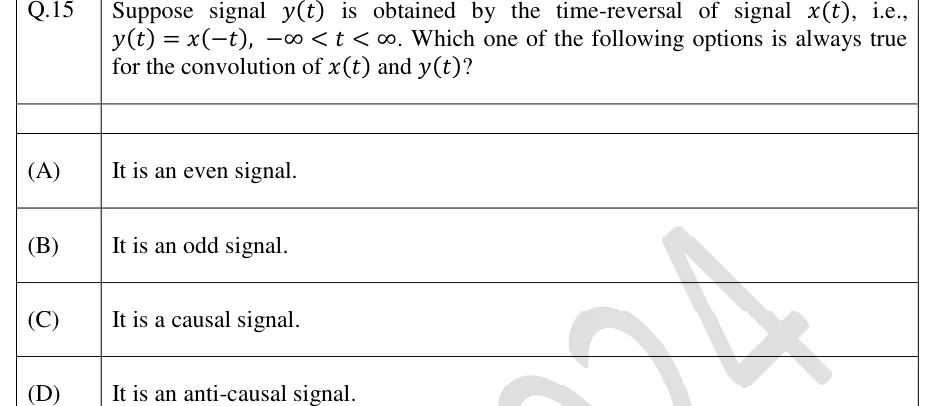
Suppose signal is obtained by the time-reversal of signal , i.e., , . Which one of the following options is always true for the convolution of and ?

  1. (A)

    It is an even signal.

  2. (B)

    It is an odd signal.

  3. (C)

    It is a causal signal.

  4. (D)

    It is an anti-causal signal.

Answer and solution
See the question in the paper
GATE 2024 EE Q.15: answer and solution

GATE 2024 EE Q.38

GATE 2024 · EEQ.38 · 2 marks · MCQ

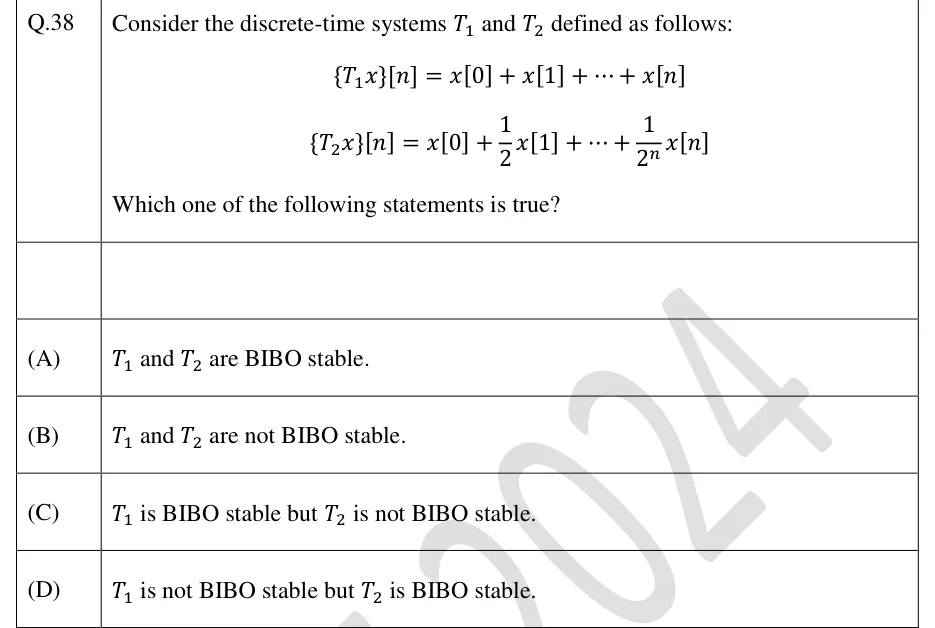
Consider the discrete-time systems and defined as follows:

Which one of the following statements is true?

  1. (A)

    and are BIBO stable.

  2. (B)

    and are not BIBO stable.

  3. (C)

    is BIBO stable but is not BIBO stable.

  4. (D)

    is not BIBO stable but is BIBO stable.

Answer and solution
See the question in the paper
GATE 2024 EE Q.38: answer and solution

GATE 2023 EC Q.58

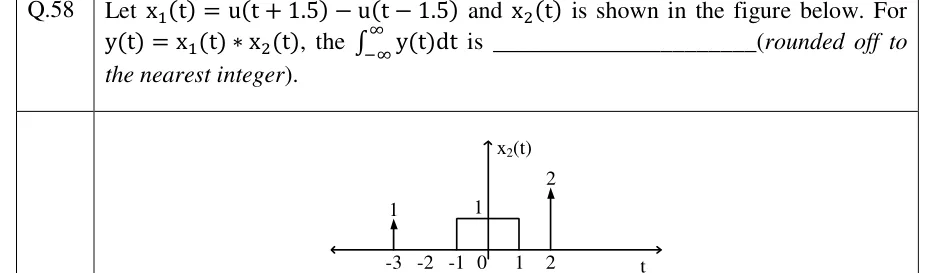
GATE 2023 · ECQ.58 · 2 marks · NAT

Let and is shown in the figure below. For , the is ________ (rounded off to the nearest integer).

GATE 2023 EC question 58: Plot of x_2(t) against t, with ticks marked at -3, -2, -1, 0, 1, 2.Tap to open full size
Figure from the GATE 2023 EC paper. It is part of the question.
Figure description

Plot of x_2(t) against t, with ticks marked at -3, -2, -1, 0, 1, 2. It has three parts: (1) an impulse (upward arrow) at t=-3 labelled 1, i.e. δ (t+3); (2) a rectangular pulse of height 1 from t=-1 to t=1; (3) an impulse (upward arrow) at t=2 labelled 2, i.e. 2 δ (t-2). Everywhere else x_2(t)=0.

Answer and solution
GATE 2023 EC Q.58: answer and solution

GATE 2023 EE Q.27

GATE 2023 · EEQ.27 · 1 mark · MSQ

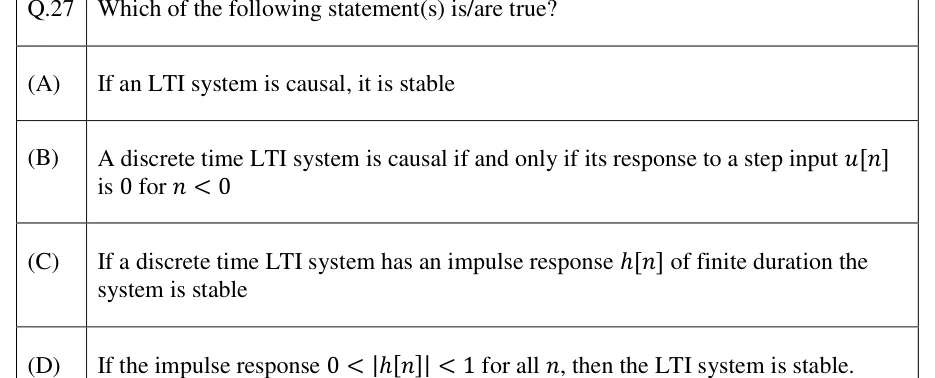
Which of the following statement(s) is/are true?

  1. (A)

    If an LTI system is causal, it is stable

  2. (B)

    A discrete time LTI system is causal if and only if its response to a step input is 0 for

  3. (C)

    If a discrete time LTI system has an impulse response of finite duration the system is stable

  4. (D)

    If the impulse response for all , then the LTI system is stable.

Official answer
See the question in the paper
GATE 2023 EE Q.27: official answer

GATE 2023 EE Q.31

GATE 2023 · EEQ.31 · 1 mark · NAT

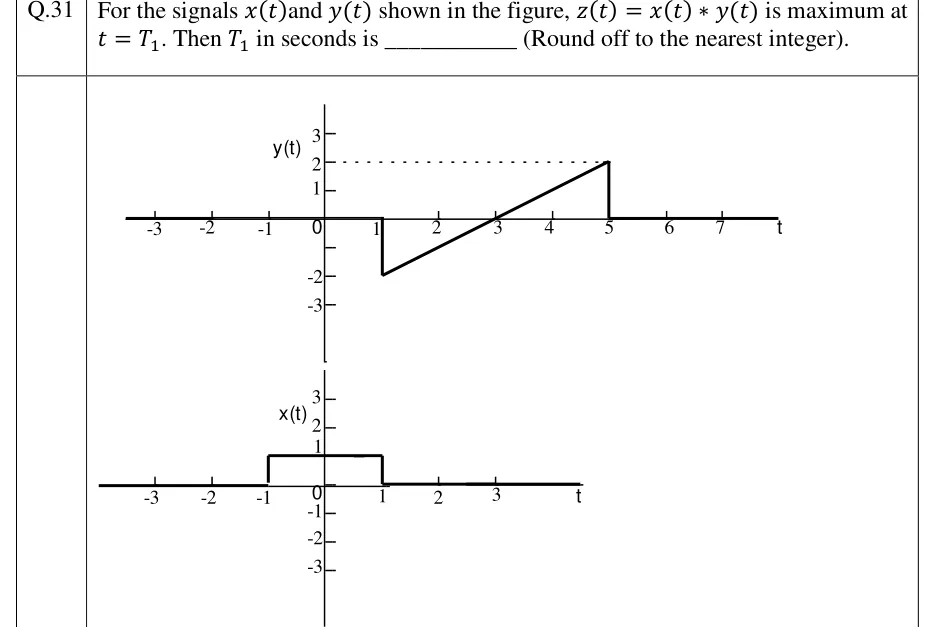
For the signals and shown in the figure, is maximum at . Then in seconds is ________ (Round off to the nearest integer).

GATE 2023 EE question 31: Two plots against t.Tap to open full size
Figure from the GATE 2023 EE paper. It is part of the question.
Figure description

Two plots against t. Upper plot, y(t): zero for t < 1; at t = 1 it jumps down to -2, then rises linearly (slope 1) through 0 at t = 3 to +2 at t = 5 (a dotted line marks the level 2 back to the vertical axis); at t = 5 it drops vertically to 0 and stays zero for t > 5. Vertical axis ticks -3 to 3, horizontal ticks -3 to 7. Lower plot, x(t): a rectangular pulse of height 1 from t = -1 to t = 1, zero elsewhere. Vertical axis ticks -3 to 3, horizontal ticks -3 to 3.

Answer and solution
GATE 2023 EE Q.31: answer and solution

GATE 2022 EC Q.46

GATE 2022 · ECQ.46 · 2 marks · MSQ

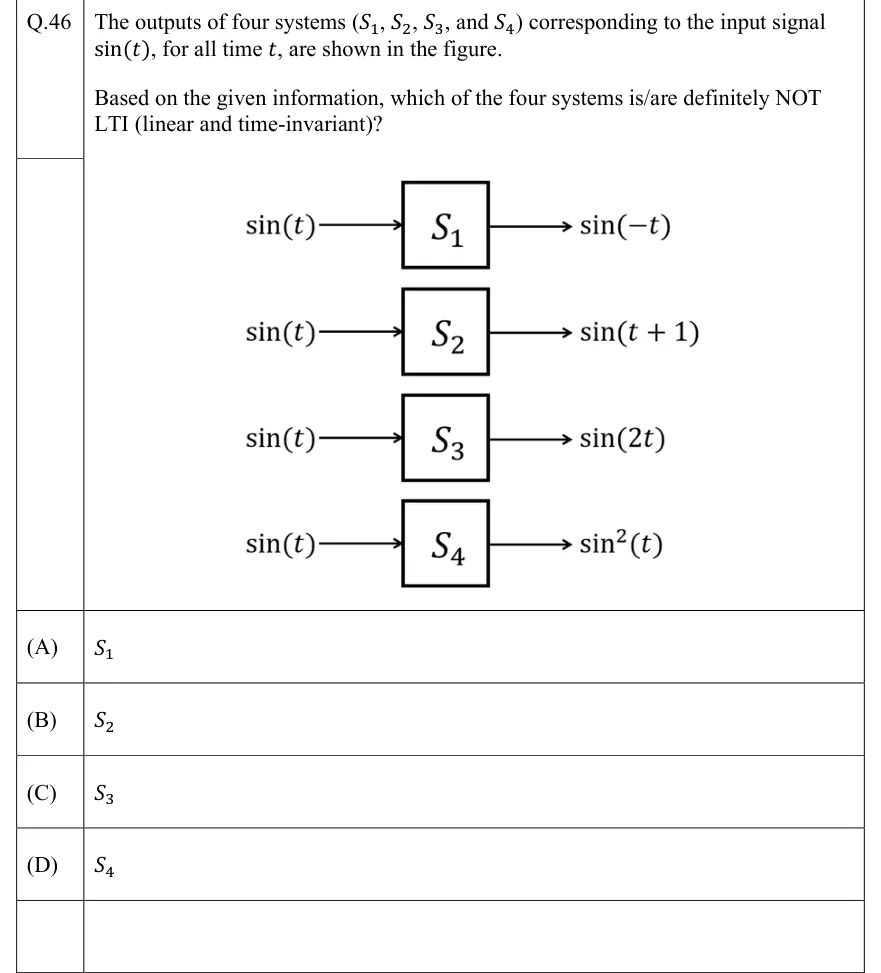
The outputs of four systems (, , , and ) corresponding to the input signal , for all time , are shown in the figure.

Based on the given information, which of the four systems is/are definitely NOT LTI (linear and time-invariant)?

GATE 2022 EC question 46: Four separate blocks stacked vertically, each with input sin (t) on the left and an arrow to the output on the right: sin…Tap to open full size
Figure from the GATE 2022 EC paper. It is part of the question.
Figure description

Four separate blocks stacked vertically, each with input sin (t) on the left and an arrow to the output on the right: sin (t) → S_1 → sin (-t); sin (t) → S_2 → sin (t+1); sin (t) → S_3 → sin (2t); sin (t) → S_4 → sin^2(t).

  1. (A)

  2. (B)

  3. (C)

  4. (D)

Answer and solution
GATE 2022 EC Q.46: answer and solution

GATE 2022 EE Q.48

GATE 2022 · EEQ.48 · 2 marks · MCQ

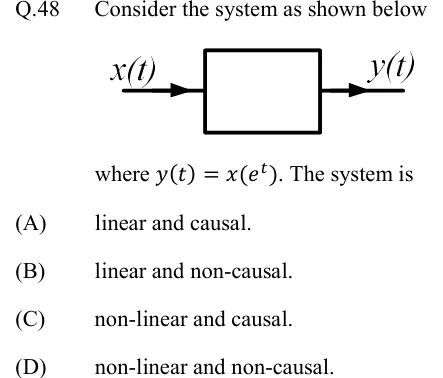
Consider the system as shown below

[Figure: a single block with input and output ]

where . The system is

GATE 2022 EE question 48: A single empty rectangular block.Tap to open full size
Figure from the GATE 2022 EE paper. It is part of the question.
Figure description

A single empty rectangular block. An arrow labelled x(t) enters the block from the left; an arrow labelled y(t) leaves it on the right. There are no other blocks, gains or feedback paths.

  1. (A)

    linear and causal.

  2. (B)

    linear and non-causal.

  3. (C)

    non-linear and causal.

  4. (D)

    non-linear and non-causal.

Answer and solution
GATE 2022 EE Q.48: answer and solution

GATE 2020 EE Q.37

GATE 2020 · EEQ.37 · 2 marks · MCQ

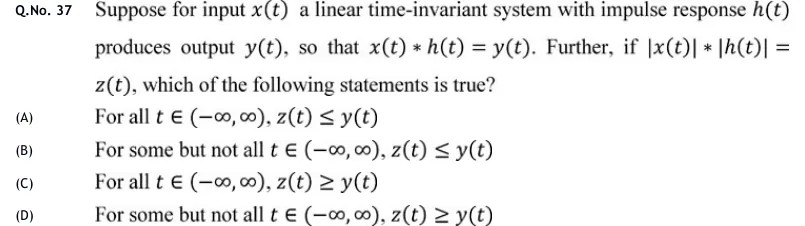
Suppose for input a linear time-invariant system with impulse response produces output , so that . Further, if , which of the following statements is true?

  1. (A)

    For all ,

  2. (B)

    For some but not all ,

  3. (C)

    For all ,

  4. (D)

    For some but not all ,

Answer and solution
See the question in the paper
GATE 2020 EE Q.37: answer and solution

GATE 2020 EE Q.39

GATE 2020 · EEQ.39 · 2 marks · MCQ

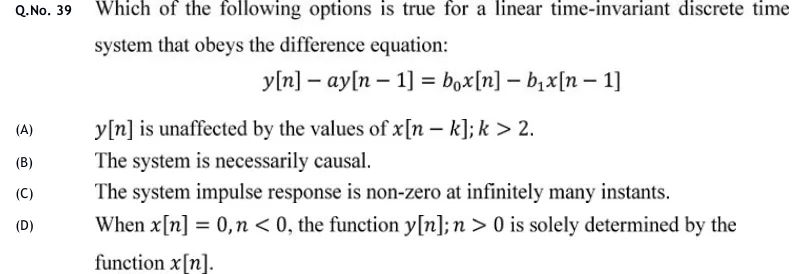
Which of the following options is true for a linear time-invariant discrete time system that obeys the difference equation:

  1. (A)

    is unaffected by the values of .

  2. (B)

    The system is necessarily causal.

  3. (C)

    The system impulse response is non-zero at infinitely many instants.

  4. (D)

    When , the function is solely determined by the function .

Official answer

Official answer: CSource: Official answer key, GATE 2020 EE (IIT Delhi)

See the question in the paper
GATE 2020 EE Q.39: official answer

GATE 2018 EE Q.16

GATE 2018 · EEQ.16 · 1 mark · MCQ

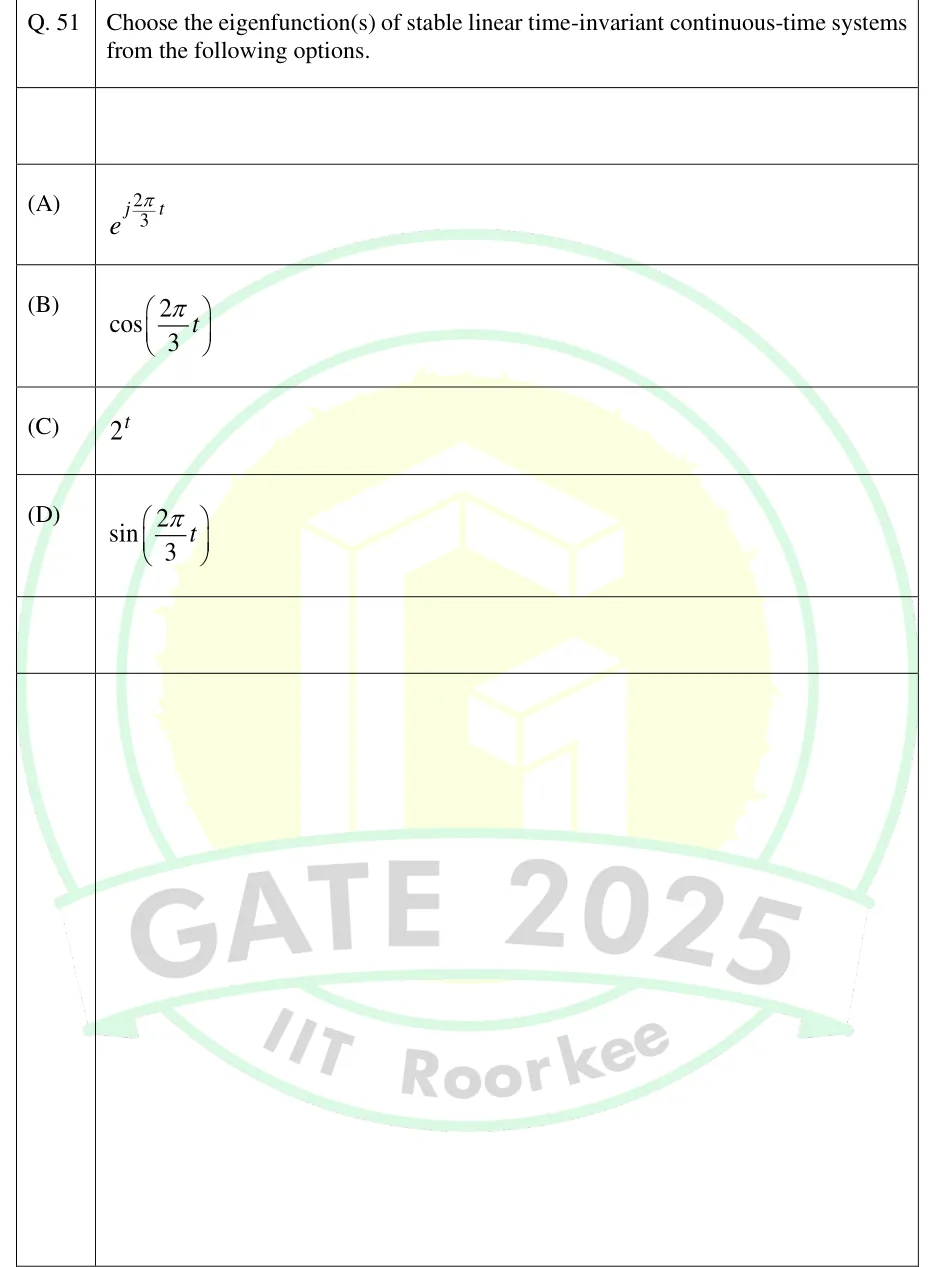
A continuous-time input signal is an eigenfunction of an LTI system, if the output is

  1. (A)

    , where is an eigenvalue

  2. (B)

    , where is an eigenvalue and is a complex exponential signal

  3. (C)

    , where is a complex exponential signal

  4. (D)

    , where is an eigenvalue and is a frequency response of the system

Answer and solution
See the question in the paper
GATE 2018 EE Q.16: answer and solution

PRACTICE

5 questions to test yourself

PRACTICE 12 marks · MSQ

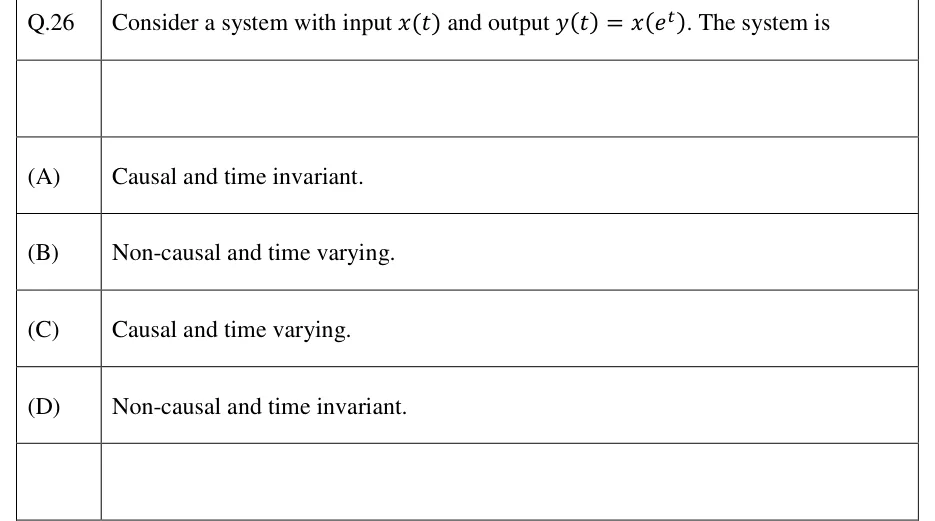
A continuous-time system is described by for all . Which of the following statements is/are correct?

  1. (A)

    The system is linear.

  2. (B)

    The system is time-invariant.

  3. (C)

    The system is causal.

  4. (D)

    The system is BIBO stable.

Answer and solution

Answer: (A), (D)

  1. Linearity: the input gives . A is correct.

  2. Time invariance: the delayed input gives . The delayed output is . These differ for , so B is wrong.

  3. Causality: , and is later than , so the output needs a future input value. Although uses only past input for , the system is non-causal. C is wrong.

  4. Stability: for all gives . D is correct.

PRACTICE 21 mark · MCQ

Which of the following impulse responses describes an LTI system that is both causal and BIBO stable?

  1. (A)

  2. (B)

  3. (C)

  4. (D)

Answer and solution

Answer: (C)

  1. Causality needs for . A is nonzero on and B is nonzero for all , so both are non-causal, even though both are absolutely integrable.

  2. C is zero for , so it is causal, and is finite, so it is stable.

  3. D is causal, but diverges (every half-period adds 2), so it is unstable.

PRACTICE 32 marks · NAT

Let , and define its autocorrelation as . The value of is ______ (rounded to three decimal places).

Answer and solution

Answer: (accepted range )

  1. on and zero elsewhere, so on and zero elsewhere.

  2. The two are both nonzero only on .

  3. .

  4. Check: , and , as requires.

PRACTICE 41 mark · NAT

An LTI system has impulse response . Its input is . The output sample is ______.

Answer and solution

Answer:

  1. , and only have nonzero .

  2. .

  3. Check with the sum rule: the full output is for , which sums to .

PRACTICE 52 marks · MCQ

An LTI system has impulse response . The input is for all integers . The output is

  1. (A)

  2. (B)

  3. (C)

  4. (D)

Answer and solution

Answer: (A)

  1. .

  2. At : and .

  3. So .

  4. Direct check: , and A gives . , and A gives , while B gives .

OFFICIAL GATE 2027 SYLLABUS WORDING

Copied from the GATE 2027 syllabus; see all 2027 syllabi.

GATE EC

LTI systems: definition and properties, causality, stability, impulse response, convolution

GATE EE

linear time invariant and causal systems

GATE IN

continuous-time and discrete-time systems, … linear time invariant systems, impulse response … convolution, correlation

Preparing in Kolkata? IAE Academy's course for GATE ECE, GATE EE or GATE IN.