IAE Academy

GATE 2026 IN Q.42: solution and answer

GATE 2026 · INQ.42 · 2 marks · MCQ

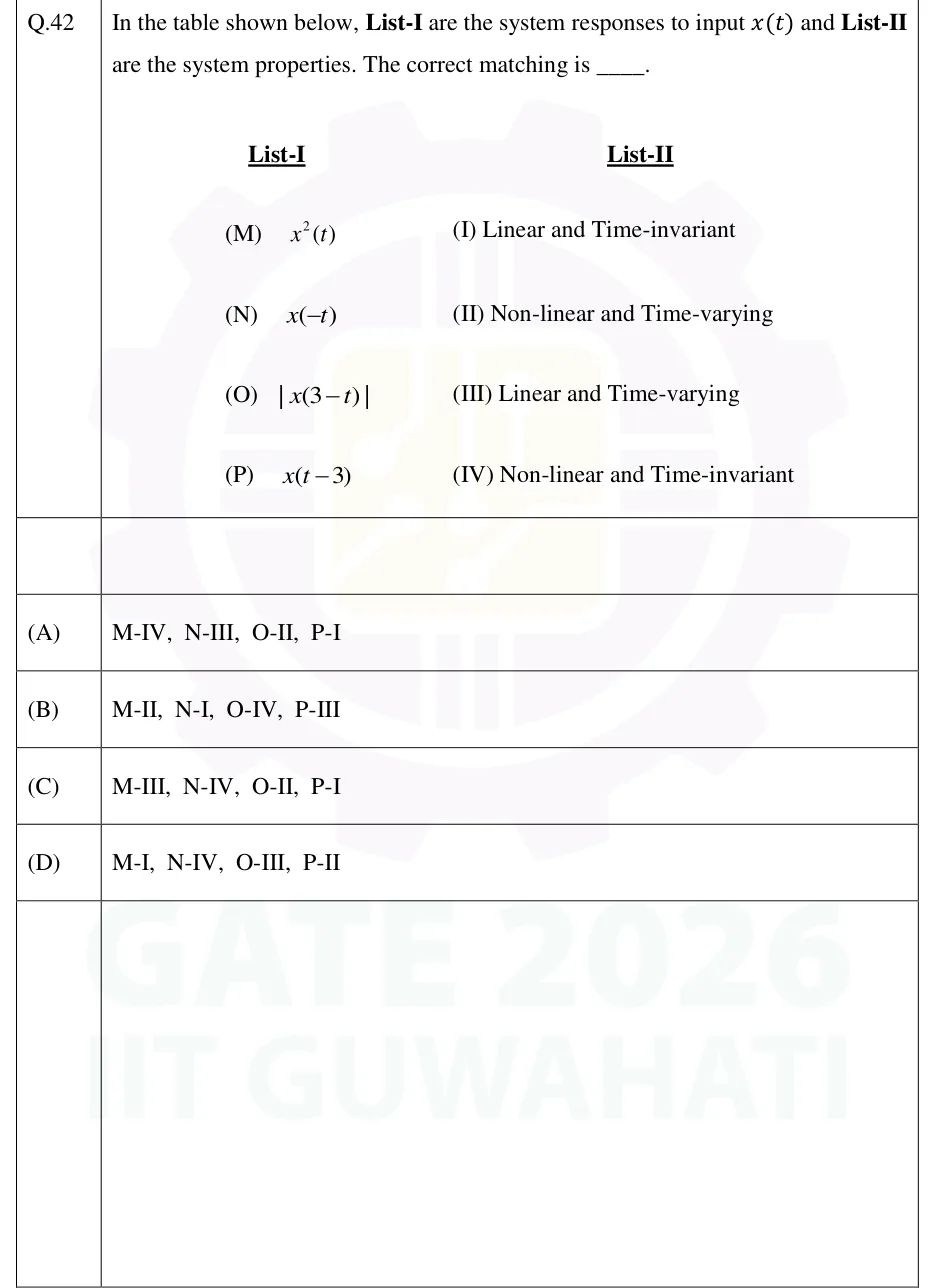
In the table shown below, List-I are the system responses to input and List-II are the system properties. The correct matching is ____.

| List-I | List-II |
|---|---|
| (M) | (I) Linear and Time-invariant |
| (N) | (II) Non-linear and Time-varying |
| (O) | (III) Linear and Time-varying |
| (P) | (IV) Non-linear and Time-invariant |

  1. (A)

    M-IV, N-III, O-II, P-I

  2. (B)

    M-II, N-I, O-IV, P-III

  3. (C)

    M-III, N-IV, O-II, P-I

  4. (D)

    M-I, N-IV, O-III, P-II

See the question in the paper

Answer and solution

ANSWER

The correct matching is M-IV, N-III, O-II, P-I, which is option (A).

Official answer: ASource: Official answer key, GATE 2026 IN (IIT Guwahati)

  1. Tests used. Linearity: and must imply for all constants . Time invariance: feed in the delayed input and compare the output with the delayed output . The two properties are tested separately. What the system does to the amplitude decides linearity, and what it does to the time argument decides time invariance.

  2. (M) . Scaling fails: for and any that is not identically zero, so the system is non-linear. The delayed input gives , so it is time-invariant. This is (IV).

  3. (N) . Superposition holds: the input gives , so the system is linear. With the delayed input the output is , while . The input is shifted one way and the output the other, so for they differ in general. The system is time-varying. This is (III).

  4. (O) . Take : the input gives . That is not unless , so the system is non-linear. With the delayed input the output is , while . As in (N), the time reversal inside the argument turns a delay of the input into an advance of the output, so these differ for . The system is time-varying. This is (II).

  5. (P) . A pure delay obeys superposition, , so the system is linear. The delayed input gives , which equals , so it is time-invariant. This is (I).

  6. Matching: M-IV, N-III, O-II, P-I, which is option (A).

KEY IDEA

Test the amplitude and the time argument separately. A non-linear operation on the amplitude, such as squaring or taking the modulus, makes a system non-linear. Anything done to the time argument other than a pure shift, such as the reversal , makes it time-varying. is only a shift, so it is LTI. and both reverse time, so both are time-varying. and fail scaling, so both are non-linear.

WATCH OUT FOR

Getting the time-invariance test wrong for by substituting everywhere in . That only produces and compares it with itself. The response to the delayed input must be found by delaying first, which gives . A second mistake is to read as a shift by 3 and so call (O) time-invariant, when contains a reversal. A third is to treat the modulus as linear because it keeps the shape of a positive signal.

From the GATE 2026 IN paper. Every question of this paper · Download the full paper · All 31 LTI & convolution questions, with notes

More LTI & convolution questions