
IAE Academy

GATE 2025 EC Q.17: solution and answer

GATE 2025 · ECQ.17 · 1 mark · MCQ

Consider the discrete-time system below with input and output . In the figure, and denote the impulse responses of LTI Subsystems 1 and 2, respectively. Also, is the unit impulse, and .

Assuming , the overall system (denoted by the dashed box) is ________.
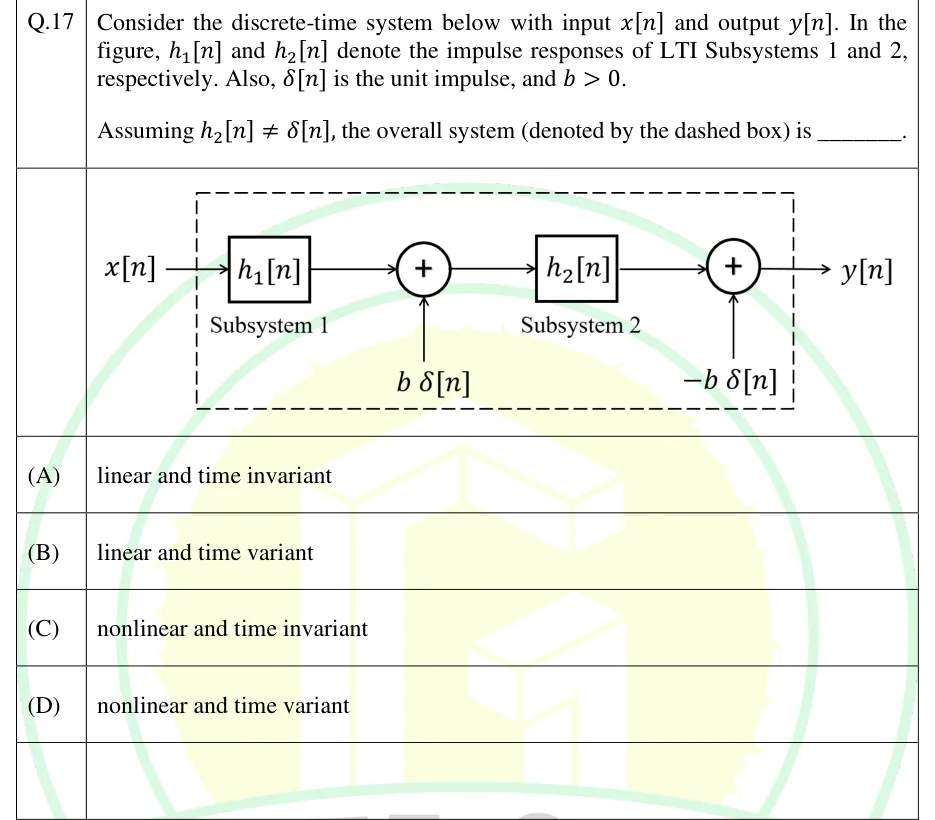
GATE 2025 EC question 17: A dashed box encloses the overall system.Tap to open full size
Figure from the GATE 2025 EC paper. It is part of the question.
Figure description

A dashed box encloses the overall system. Input x[n] enters from the left into a block labelled h_1[n] (Subsystem 1). Its output goes to a summing junction (+), whose second input, coming up from below, is b δ [n]. The sum feeds a block labelled h_2[n] (Subsystem 2). Its output goes to a second summing junction (+), whose second input, coming up from below, is -b δ [n]. The output of the second junction leaves the dashed box as y[n]. Both added signals b δ [n] and -b δ [n] are sources inside the dashed box.

  1. (A)

    linear and time invariant

  2. (B)

    linear and time variant

  3. (C)

    nonlinear and time invariant

  4. (D)

    nonlinear and time variant

Answer and solution

ANSWER

The overall system is nonlinear and time variant: option (D).

Official answer: DSource: Official answer key, GATE 2025 EC (IIT Roorkee)

  1. Input–output relation. The output of Subsystem 1 is . After the first adder the signal is . Subsystem 2 is LTI, so its response to a sum is the sum of its responses, and :

  2. Write and , so

    does not depend on the input. Since and , is not the zero signal. The and do not cancel, because the first one passes through Subsystem 2 and comes out as .

  3. Linearity (zero in, zero out). Put . Then . A linear system must give zero output for zero input (homogeneity with scale factor ), so the system is nonlinear. Superposition gives the same result: input produces , while , and these differ because .

  4. Time invariance (shift test). Apply . The LTI part delays its output by the same amount, so the response is . The original output delayed by is .

  5. The two match for every input and every only if for all and . That means has to be a constant sequence. A constant added offset would not break time invariance, so the question to settle is whether is constant.

  6. is not constant. Suppose for every . Since , , and then . That impulse response keeps the same nonzero value at every , forever in both directions: it never dies out, it is not absolutely summable, and it is nonzero for . This degenerate case is the only way out, and it is not what the question means by an LTI subsystem. For any whose samples die out as , while is nonzero somewhere, so cannot be constant. In other words, is tied to the time origin through and and does not move when the input is delayed. So for some , differs from the response to , and the system is time variant.

  7. The system is nonlinear and time variant, so the answer is option (D).

KEY IDEA

Reduce the block diagram to . That is an LTI response plus a fixed, nonzero signal that does not depend on the input. Because the added signal is nonzero, zero input does not give zero output, so the system is nonlinear. Because the added signal is tied to and is not a constant, it does not move when the input is delayed, so the system is time variant.

WATCH OUT FOR

Three traps. (1) Choosing (A) because every block is LTI, without noticing that the sources inside the dashed box are not part of the input. (2) Thinking and cancel. They do not: the first one passes through and becomes , so they cancel only when , which the question rules out. (3) Choosing (C) by treating the added term like a constant bias. A constant offset keeps a system time invariant, but is a signal fixed to , not a constant.

From the GATE 2025 EC paper. Every question of this paper · Download the full paper · All 31 LTI & convolution questions, with notes

More LTI & convolution questions