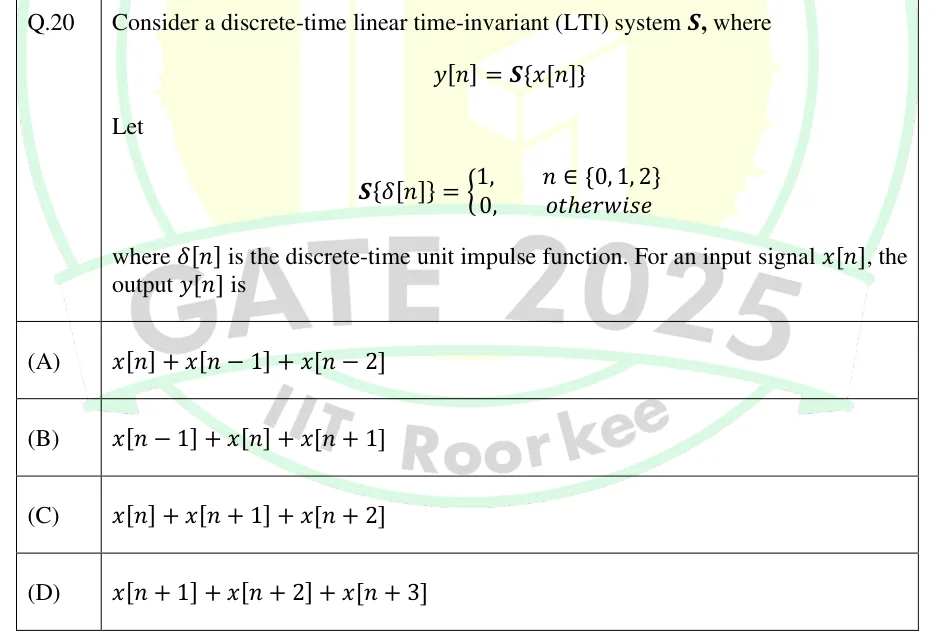
Consider a discrete-time linear time-invariant (LTI) system , where
Let
where is the discrete-time unit impulse function. For an input signal , the output is
- (A)
- (B)
- (C)
- (D)

Consider a discrete-time linear time-invariant (LTI) system , where
Let
where is the discrete-time unit impulse function. For an input signal , the output is
ANSWER
(A)
Official answer: ASource: Official answer key, GATE 2025 EE (IIT Roorkee)
Impulse response. The response of the system to is, by definition, its impulse response: for and otherwise. So
Convolution sum. The output of an LTI system is the convolution of the input with the impulse response:
Evaluate. Only contribute, and each has weight :
Check with time invariance. The input must produce , which is nonzero at . Putting into gives , which is nonzero at exactly . It matches, so option (A) is correct.
Why the other options fail. Put into each one to get its impulse response. (B) gives , which is nonzero at . (C) gives support and (D) gives . All three use a future sample such as , so their impulse responses reach into negative . None of them has the given support .
KEY IDEA
For an LTI system the response to is the impulse response , and . Each nonzero sample adds the term , a copy of the input delayed by . Here , so .
WATCH OUT FOR
The most common slip is flipping the sign of the shift. is nonzero at , and students then write , which is option (C). In the convolution sum, multiplies , so a nonzero at positive means a delay (), not an advance. A quick check is to put into the option you picked and confirm that you get back the given .
From the GATE 2025 EE paper. Every question of this paper · Download the full paper · All 31 LTI & convolution questions, with notes