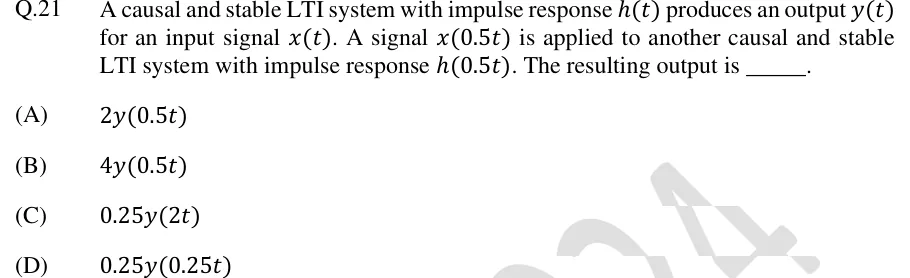
A causal and stable LTI system with impulse response produces an output for an input signal . A signal is applied to another causal and stable LTI system with impulse response . The resulting output is ______.
- (A)
- (B)
- (C)
- (D)

A causal and stable LTI system with impulse response produces an output for an input signal . A signal is applied to another causal and stable LTI system with impulse response . The resulting output is ______.
ANSWER
The resulting output is , which is option (A).
Official answer: ASource: Official answer key, GATE 2024 EC (IISc Bengaluru)
Write the convolution integral for the original system:
Write the output of the new system. Its input is and its impulse response is , so the shifted input is :
Substitute , so . The limits stay to because the scale factor is positive:
Compare with step 1. The integral is the original convolution with replaced by , so it equals . Therefore .
Frequency-domain check, using the time-scaling property : and , so . Since , this gives , which confirms .
This matches option (A).
KEY IDEA
If you stretch both the input and the impulse response by a factor (replace with ), the convolution output is stretched by the same factor and also multiplied by : . The factor appears because the in the convolution integral stretches too. Here , so the output is .
WATCH OUT FOR
Many students say that scaling time in both signals just scales time in the output, and answer with no factor. That misses the Jacobian . The other trap is option (B): each Fourier transform picks up a factor of 2, giving , and a student who stops there forgets that already carries one factor of 2 of its own.
From the GATE 2024 EC paper. Every question of this paper · Download the full paper · All 31 LTI & convolution questions, with notes