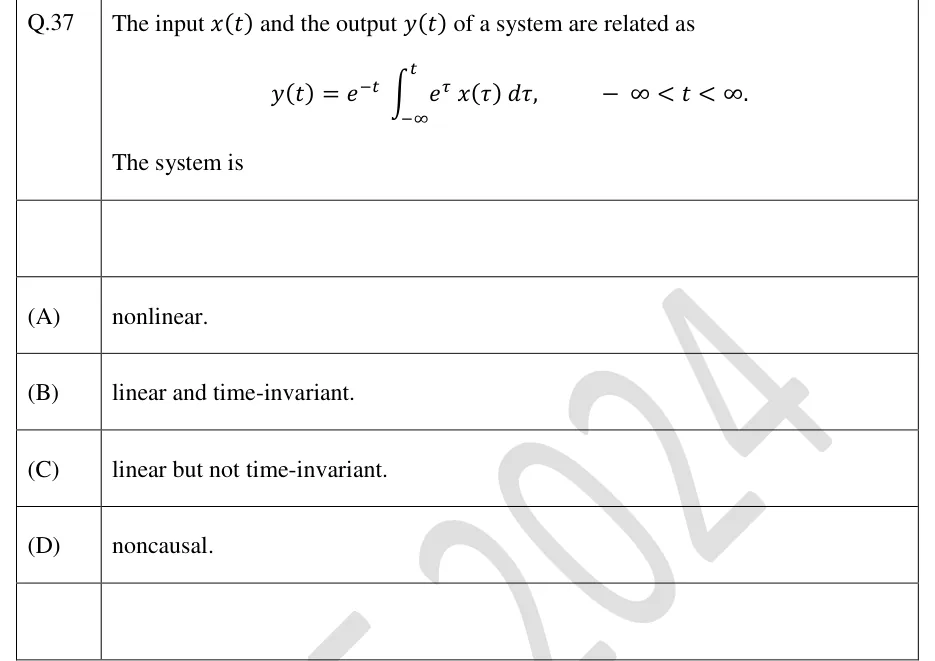
The input and the output of a system are related as
The system is
- (A)
nonlinear.
- (B)
linear and time-invariant.
- (C)
linear but not time-invariant.
- (D)
noncausal.

The input and the output of a system are related as
The system is
nonlinear.
linear and time-invariant.
linear but not time-invariant.
noncausal.
ANSWER
(B) The system is linear and time-invariant. It is the convolution .
Official answer: BSource: Official answer key, GATE 2024 EE (IISc Bengaluru)
Linearity (superposition). appears only to the first power inside the integral, and integration is a linear operation. For the input , The system is linear, which rules out (A).
Move inside the integral. is a constant during the integration over , so The kernel depends on and only through the difference .
Recognise a convolution. Take . The factor is zero for , so it cuts the integral off at : Any system that can be written as is linear and time-invariant.
Direct check of time invariance. Apply the delayed input : Substitute , so and the upper limit becomes : Delaying the input only delays the output, so the system is time-invariant. This rules out (C).
Causality. The upper limit is , so uses only for . Equivalently, for . The system is causal, which rules out (D).
The system is linear and time-invariant. It is also causal, and BIBO stable because is finite. Answer: (B).
KEY IDEA
Move inside the integral to get . The kernel depends only on , so this is the convolution of with . A system that is a convolution is always LTI, and here it is also causal because for .
WATCH OUT FOR
Seeing the explicit multiplying the integral and deciding the system is time-varying, which leads to (C). The factor is cancelled by the inside the integral: combined, they give , which depends only on the elapsed time . A time-dependent factor makes a system time-varying only when nothing cancels it. Test with a delayed input; do not judge from the look of the formula.
From the GATE 2024 EE paper. Every question of this paper · Download the full paper · All 31 LTI & convolution questions, with notes