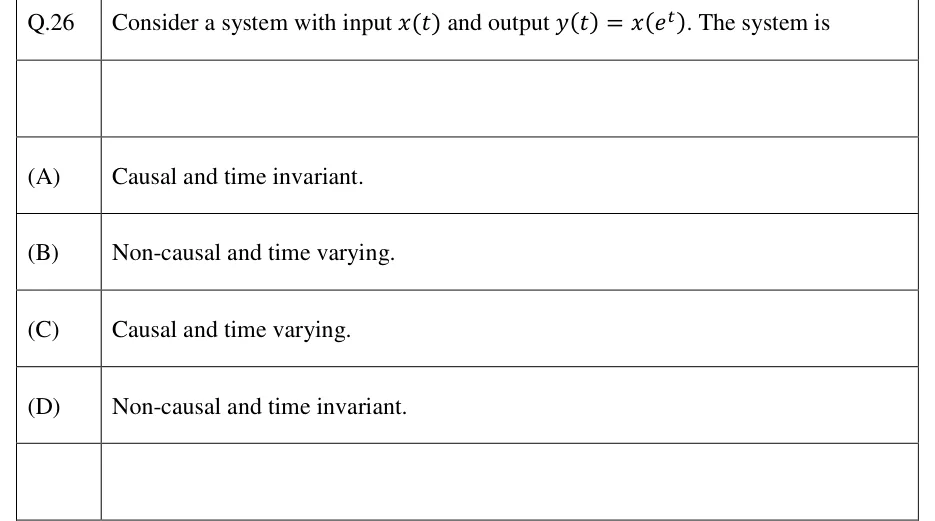
Consider a system with input and output . The system is
- (A)
Causal and time invariant.
- (B)
Non-causal and time varying.
- (C)
Causal and time varying.
- (D)
Non-causal and time invariant.

Consider a system with input and output . The system is
Causal and time invariant.
Non-causal and time varying.
Causal and time varying.
Non-causal and time invariant.
ANSWER
The system is non-causal (since , it always reads a future input value) and time varying (a delayed input gives , not ). Answer: (B).
Official answer: BSource: Official answer key, GATE 2023 EC (IIT Kanpur)
Causality test: a system is causal if depends only on for . Here is the input read at the single instant .
Check one instant: at , , a future value of the input. In fact for every real (the function has its minimum value at ), so the output always depends on a future input value. The system is non-causal.
Time-invariance test: delay the input by to get . Pass it through the system: .
Now delay the original output by : .
Compare the two arguments: and are different functions of . For example, at they are and , and for every . A concrete input shows the outputs really differ: with and , The time axis is warped by , not simply shifted, so a delay at the input does not appear as the same delay at the output. The system is time varying.
Non-causal and time varying, which is option (B).
KEY IDEA
When the output is the input evaluated at a warped time : it is causal only if for every , and time invariant only if (a pure shift). Here is greater than everywhere and is not a pure shift, so the system is non-causal and time varying.
WATCH OUT FOR
Delaying the output wrongly by replacing with only in the input and writing , which makes the system look time invariant. Another slip is checking causality only at , where is easy to overlook, or assuming a very negative makes lie in the past. In fact for every .
From the GATE 2023 EC paper. Every question of this paper · Download the full paper · All 31 LTI & convolution questions, with notes