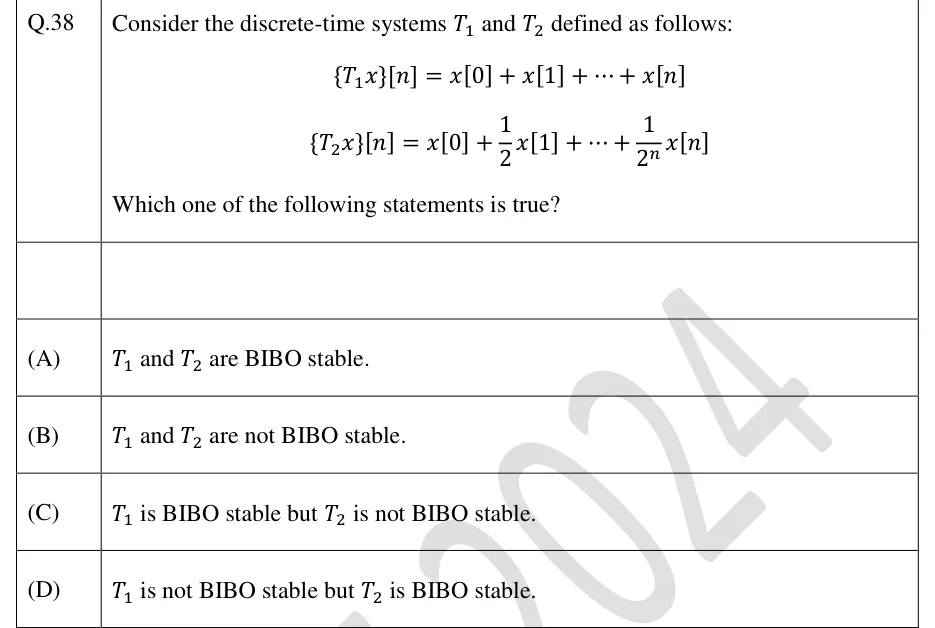
Consider the discrete-time systems and defined as follows:
Which one of the following statements is true?
- (A)
and are BIBO stable.
- (B)
and are not BIBO stable.
- (C)
is BIBO stable but is not BIBO stable.
- (D)
is not BIBO stable but is BIBO stable.

Consider the discrete-time systems and defined as follows:
Which one of the following statements is true?
and are BIBO stable.
and are not BIBO stable.
is BIBO stable but is not BIBO stable.
is not BIBO stable but is BIBO stable.
ANSWER
(D) is not BIBO stable but is BIBO stable. With the constant input , gives , which grows without limit. For any input with , is bounded by .
Official answer: DSource: Official answer key, GATE 2024 EE (IISc Bengaluru)
BIBO stability means that every bounded input, for all , gives a bounded output. One bounded input with an unbounded output is enough to prove instability. Proving stability needs a bound that holds for every bounded input.
is a running sum (accumulator) starting at : . Test it with the bounded input ().
Then as . The output is unbounded, so is not BIBO stable.
is . The weight depends on the absolute index , not on , so is time-varying and the LTI test does not apply. Bound the output directly instead.
For any input with , the triangle inequality and the geometric series give
The bound does not depend on , so every bounded input gives an output bounded by . is BIBO stable.
So is not BIBO stable and is BIBO stable. The answer is option (D).
KEY IDEA
To show a system is BIBO unstable, you only need one bounded input that gives an unbounded output. A constant fed into a running sum gives . To show it is stable, bound for every bounded input. For , the weights add up to a finite total of 2, so for every . This works directly even though is time-varying, so no impulse-response test is needed.
WATCH OUT FOR
Calling unstable because the number of terms grows with . What decides stability is whether the weights have a finite total, and . Another mistake is to treat as LTI and use . is time-varying, because its weights depend on and not on . That test does not apply, even though here it happens to give the right answer. A third mistake is calling stable because every term is bounded. A sum of more and more bounded terms can still grow without limit.
From the GATE 2024 EE paper. Every question of this paper · Download the full paper · All 31 LTI & convolution questions, with notes