
IAE Academy

GATE 2026 EE Q.14: solution and answer

GATE 2026 · EEQ.14 · 1 mark · MCQ

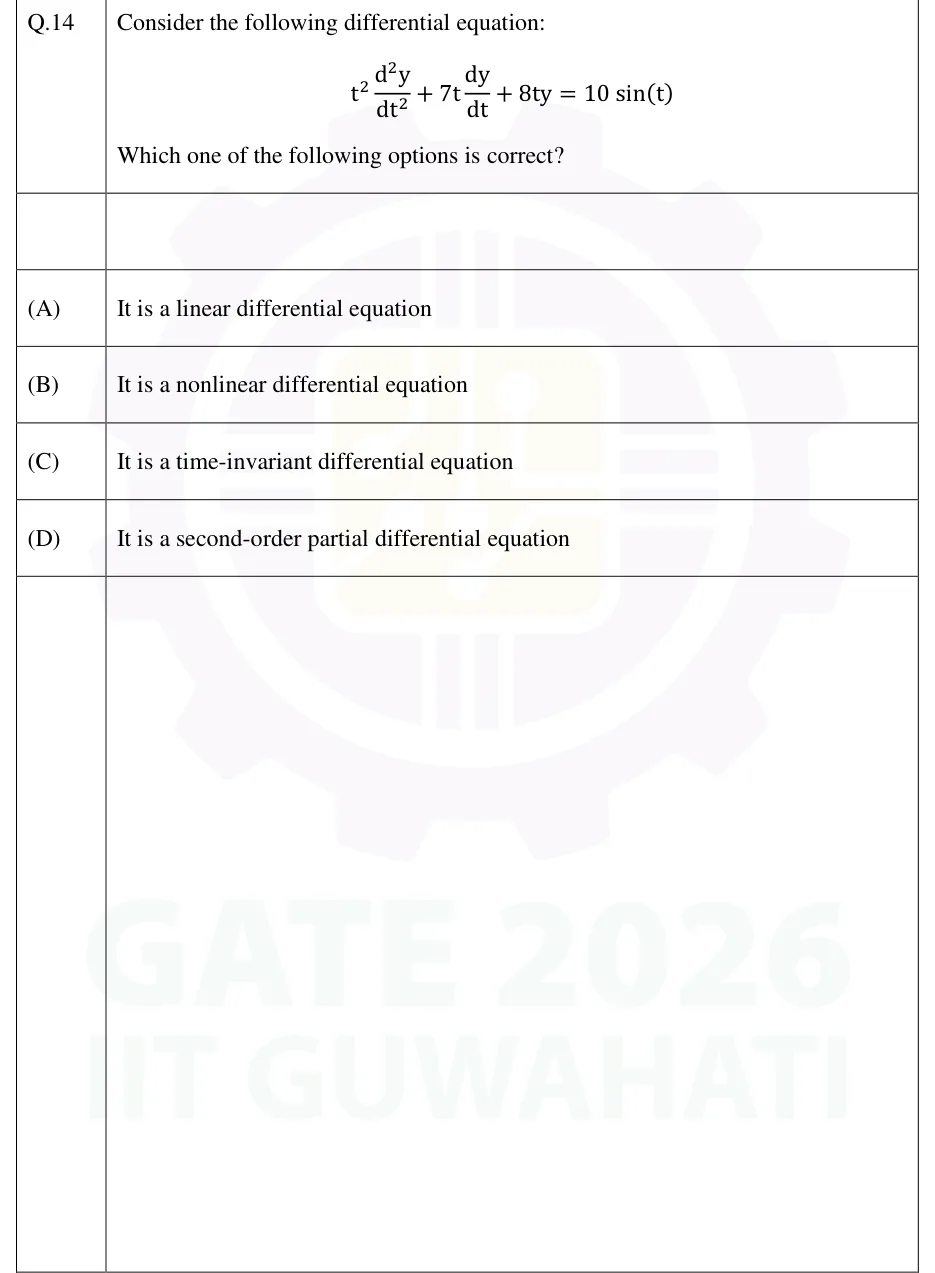
Consider the following differential equation:

Which one of the following options is correct?

  1. (A)

    It is a linear differential equation

  2. (B)

    It is a nonlinear differential equation

  3. (C)

    It is a time-invariant differential equation

  4. (D)

    It is a second-order partial differential equation
See the question in the paper

Answer and solution

ANSWER

(A) It is a linear differential equation. The equation is a linear, time-varying, second-order ordinary differential equation.

Official answer: ASource: Official answer key, GATE 2026 EE (IIT Guwahati)

  1. Linearity test. A differential equation is linear if and each of its derivatives appear only to the first power, are never multiplied by each other, and never sit inside a nonlinear function. The coefficients may depend on the independent variable in any way, and the forcing term on the right may be any function of .

  2. In the terms in are , and . Each appears to the first power and is multiplied only by a function of (, , ). There is no , no and no . The right-hand side contains no at all, so it is only a forcing term.

  3. Superposition check. Write the operator . Because differentiation is linear and each term is a function of times or one of its derivatives, for any constants . So the equation is linear, which rules out (B).

  4. Time-invariance test. A linear system described by a differential equation is time-invariant only when every coefficient is a constant. Here the coefficients , and change with , so the system is time-varying.

  5. Shift check. Let input give output , so . Replace by and put : But for to be the system's response to the delayed input it would have to satisfy . The coefficients differ for , so a delayed input does not in general give a delayed output. (C) is false.

  6. Ordinary vs partial. There is only one independent variable, , and every derivative is an ordinary derivative , with no . The highest derivative is , so it is a second-order ordinary differential equation, not a partial one. (D) is false.

  7. The equation is linear and time-varying. Only (A) is correct.

KEY IDEA

Linearity depends only on how the dependent variable and its derivatives appear: first power, no products of them with each other, no nonlinear functions of them. Coefficients that depend on do not affect linearity. What they do affect is time-invariance: a system described by a differential equation is time-invariant only when every coefficient is constant.

WATCH OUT FOR

Reading the term (or ) as a product of two variables and calling the equation nonlinear. is the independent variable, so is just a coefficient. The equation would be nonlinear only if were multiplied by or by one of its derivatives. The opposite slip is to see "linear" and assume "LTI": coefficients that vary with make the system time-varying, so (C) is false even though (A) is true.

From the GATE 2026 EE paper. Every question of this paper · Download the full paper · All 31 LTI & convolution questions, with notes

More LTI & convolution questions