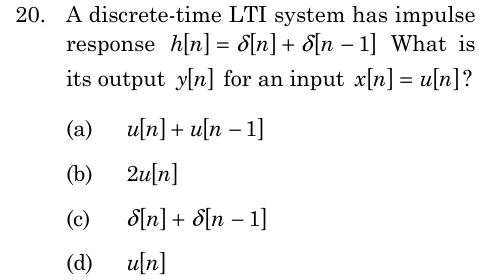
A discrete-time LTI system has impulse response h[n] = δ[n] + δ[n − 1]. What is its output y[n] for an input x[n] = u[n]?
- (A)
u[n] + u[n − 1]
- (B)
2u[n]
- (C)
δ[n] + δ[n − 1]
- (D)
u[n]

A discrete-time LTI system has impulse response h[n] = δ[n] + δ[n − 1]. What is its output y[n] for an input x[n] = u[n]?
u[n] + u[n − 1]
2u[n]
δ[n] + δ[n − 1]
u[n]
ANSWER
The output is , which is option (A).
Official answer: ASource: ISRO's final answer key of 15 May 2026
The output of a discrete-time LTI system is the convolution .
Convolving a signal with a shifted impulse shifts the signal: .
Here . Convolution is linear, so .
Put : .
Check the values: for , , and for . This agrees with .
The other options fail. would give , but the true value is . is only , the response to an impulse, not to a step. alone ignores the delayed branch, so it gives for instead of .
KEY IDEA
Convolution with is a delay by samples, so an impulse response made of impulses gives an output made of delayed copies of the input.
WATCH OUT FOR
Writing by treating the delayed branch as if it also started at . At the delayed copy is still zero, so , not . Another slip is to give itself as the answer, which is the response to an impulse rather than to a step.
From the ISRO EC 2025 paper. Every question of this paper · The full paper (PDF, ISRO) · All 3 ISRO LTI & convolution questions, with notes