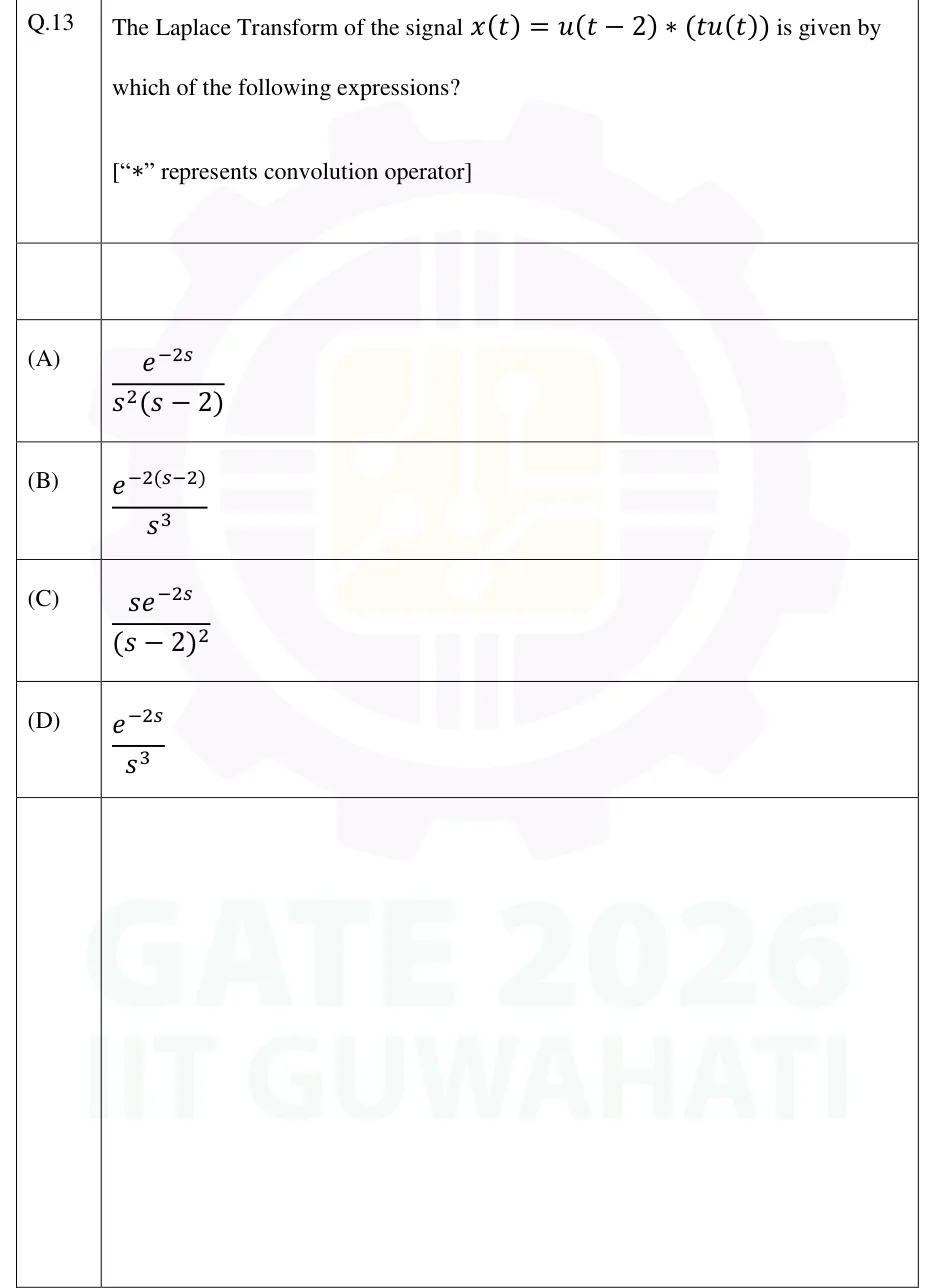
GATE 2026 EC Q.13
The Laplace Transform of the signal is given by which of the following expressions?
["" represents convolution operator]
- (A)
- (B)
- (C)
- (D)

GATE EC · EE · IN
The Laplace transform turns the differential equation of a continuous-time LTI system into algebra in the complex variable , and its region of convergence (ROC) decides which time signal an algebraic actually stands for. The poles, zeros and ROC of the system function answer what GATE asks of such a system: its impulse and step responses, whether it is causal and whether it is stable, what its frequency response looks like, and how it responds to initial conditions.
8 previous-year questions · 8 solved · 7 practice questions
For a signal and a complex variable , the bilateral Laplace transform integrates over all time. Writing shows what it is: the Fourier transform of . The factor can tame a growing signal, which is why has no Fourier transform but does have a Laplace transform.
The set of for which the integral converges absolutely is the region of convergence (ROC). An algebraic expression without its ROC does not define a signal: the same with different ROCs belongs to different signals.
Conventions in these notes. . The Fourier transform is written in (rad/s): , with in the inverse. LHP and RHP mean the open left and right halves of the -plane; the axis belongs to neither. Each result below says whether it is for the bilateral or the unilateral transform, and the ROC it holds in.
BILATERAL LAPLACE TRANSFORM
Converges only for in the ROC, which must be quoted with .
UNILATERAL LAPLACE TRANSFORM
Lower limit , so an impulse at is included. It equals the bilateral transform of the part of from onwards, so, when it exists, its ROC is a right half-plane (the whole plane if that part has finite duration) and is usually not written. For a causal signal the two transforms are identical. This is the version used for differential equations with initial conditions.
LINK TO THE FOURIER TRANSFORM
In the Hz form, . If a pole lies on the axis (as for ) the substitution is not valid.
INVERSE LAPLACE TRANSFORM
Not evaluated directly in practice: partial fractions plus the table of pairs, read with the ROC, is the method.
Properties of the ROC
The ROC depends only on , so it is made of vertical strips parallel to the axis.
The ROC contains no poles. For a rational it is bounded by poles or extends to infinity.
The ROC is one connected region: a right half-plane, a left half-plane, a vertical strip, the whole plane, or empty (then there is no Laplace transform).
Finite-duration, absolutely integrable : the ROC is the entire -plane.
Right-sided (zero for ): if the line is in the ROC, so is every . For rational the ROC is the half-plane to the right of the rightmost pole.
Left-sided (zero for ): the ROC is a left half-plane; for rational , to the left of the leftmost pole.
Two-sided : the ROC is a vertical strip (between two adjacent poles, for rational ) or empty.
A rational whose poles have distinct real parts admits possible ROCs: the half-plane to the left of every pole, the half-plane to the right of every pole, and the strips between adjacent real parts.
The ROC of a sum contains the intersection of the individual ROCs; it can be larger if a pole cancels.
Signal | ROC | |
|---|---|---|
, right-sided ( real) | ||
, left-sided ( real) | ||
with , two-sided | ||
with , finite duration | entire -plane (the pole at cancels) |
WORKED EXAMPLE · SAME X(S), THREE SIGNALS
. Find for every possible ROC and state which of these signals has a Fourier transform.
Partial fractions: with and .
The poles and allow three ROCs: , and . Rule for each term: a pole to the left of the ROC gives a right-sided term with ; a pole to the right of the ROC gives a left-sided term with .
: both poles are left of the ROC, so , causal and growing without bound.
: the pole at is left of the ROC and the pole at is right of it, so , two-sided and decaying in both directions.
: both poles are right of the ROC, so , anti-causal.
Only the strip contains the axis, so only the two-sided signal is absolutely integrable, with .
Answer: : . : , the only one with a Fourier transform. : .
EXAM TIP
Intersect the ROCs of the pieces before writing . has piece ROCs and , which do not overlap, so it has no Laplace transform at all. Likewise the everlasting (for all ) has a Fourier transform made of impulses but no bilateral Laplace transform: its right-sided half needs and its left-sided half needs .
EXAM TIP
Watch the minus sign on left-sided pairs. and have the same algebraic transform ; only the ROC and that minus sign tell them apart.
Almost every transform and inverse transform is built from a handful of right-sided pairs and the properties below. The pairs are written for causal signals, so they are also unilateral transforms. For every rational pair below other than , the left-sided signal has the same algebraic as the causal , with the ROC to the left of the leftmost pole instead of to the right of the rightmost. In the power, exponential and sinusoid pairs all the poles lie on one vertical line , so the two ROCs are simply and .
IMPULSE, STEP, RAMP AND POWERS OF T
Also, for all : , and the derivatives of the impulse (so ).
EXPONENTIALS
Valid for real or complex . The left-sided versions are and , with ROC . For real the hyperbolic pairs follow: and , both with ROC .
SINUSOIDS
real. The poles at lie on the axis, which the ROC does not contain, so putting does not give the Fourier transform of these one-sided sinusoids (theirs contains impulses at ).
SINUSOIDS MULTIPLIED BY T (DOUBLE POLES ON THE JΩ AXIS)
From the sinusoid pairs by multiplication by . Combining them gives : a double pole on the axis gives a term that grows like .
DAMPED SINUSOIDS
and real. Poles at . These are the undamped pairs with replaced by (shift in ).
CAUSAL PERIODIC SIGNAL
is one period: absolutely integrable and zero outside . Example: the wave that is for and for , repeated for , has .
Property | Time domain | -domain (bilateral) | ROC |
|---|---|---|---|
Linearity | contains | ||
Time shift | |||
Shift in | shifted by | ||
Modulation, real | contains | ||
Time scaling, | (flipped if ) | ||
Time reversal | |||
Differentiation in | contains | ||
Multiplication by | |||
Integration | contains | ||
Convolution | contains | ||
Conjugation |
MULTIPLICATION BY POWERS OF T
Same ROC as . With and it gives .
UNILATERAL DIFFERENTIATION (BRINGS IN INITIAL CONDITIONS)
Unilateral transform only. In general . The values are taken at , before the input is applied.
UNILATERAL INTEGRATION
Unilateral transform. The second form carries the value the integral already had at , such as an initial capacitor voltage.
UNILATERAL TIME SHIFT (DELAY)
is the transform of . The whole causal signal must be delayed; is a different signal and does not simply pick up .
DIVISION BY T (UNILATERAL)
Valid when exists. Example: for real .
WORKED EXAMPLE · CHAINING PROPERTIES
Find the Laplace transform, with ROC, of .
Start from , ROC .
Shift in with : , and the ROC moves to .
Multiply by : . The ROC is unchanged.
Sanity check: as (it behaves like ), matching .
Answer: , ROC .
EXAM TIP
Rewrite before you shift. For , write first, so with ROC . Dropping the constant is the usual slip.
EXAM TIP
Differentiation can enlarge the ROC. has ROC , but converges everywhere. That is why the table says the ROC contains rather than equals it.
Both theorems read a time-domain limit straight from , with no inversion. Both are stated for signals that are zero for , and both carry conditions that must be checked before the limit is trusted.
INITIAL VALUE THEOREM
Valid when for and has no impulse (or higher singularity) at ; for a rational this means is strictly proper (numerator degree less than denominator degree). If the numerator degree is equal or higher, divide first: the polynomial part is the impulse terms at the origin, which do not affect , and the theorem applies to the strictly proper remainder.
INITIAL SLOPE
Same conditions ( strictly proper). Subtracting removes the impulse that a jump at puts into the derivative.
FINAL VALUE THEOREM
Valid, for a rational , only if every pole of lies in the open LHP; equivalently, every pole of is in the open LHP except at most a single simple pole at . With a pole in the RHP, a repeated pole at the origin, or any other pole on the axis, has no finite limit and the value the formula returns is not the final value.
Theorem valid? | Actual | ||
|---|---|---|---|
Yes: has its only pole at | |||
No: pole at | , grows without bound | ||
No: poles at | , oscillates with no limit | ||
No: double pole at | , grows without bound |
WORKED EXAMPLE · BOTH THEOREMS, THEN A CHECK BY INVERSION
A causal signal has . Find and , and confirm both by finding .
is strictly proper (degree 2 over degree 3), so the IVT applies: as . So .
The poles of are and , both in the open LHP, so the FVT applies: .
Check: with , , .
, so and .
Answer: , .
EXAM TIP
Divide first when the degrees are equal. For , is infinite, but means , so . Apply the IVT to only.
EXAM TIP
Check the poles of , not of . gives , yet diverges. For the unit-step response of a causal stable , and , so the steady-state value is simply , the DC gain.
For a rational , first make it strictly proper: if , divide, so that is a polynomial in plus a strictly proper remainder. The polynomial terms invert to . Then expand the remainder over its poles and invert term by term, choosing a right-sided or left-sided pair for each pole according to where it lies relative to the ROC.
Procedure
Divide if needed: a constant inverts to and a term to .
Factor the denominator. Write one term per simple pole, terms for a pole of order , and one quadratic term (or a conjugate pair of terms) for each complex pair.
Find the coefficients with the residue formulas below, then check by substituting one convenient value such as into both sides.
For each term: a pole to the left of the ROC gives a right-sided term with ; a pole to the right of the ROC gives a left-sided term with .
Add the terms. In a causal (unilateral) problem every term is right-sided.
COEFFICIENT AT A SIMPLE POLE (COVER-UP)
Each term inverts to if the ROC is to the right of , or to if the ROC is to the left of .
COEFFICIENTS AT A POLE OF ORDER R
Only the top coefficient is plain cover-up; each lower one needs one more derivative. Inversion: for an ROC to the right of , and for an ROC to the left.
COMPLEX-CONJUGATE POLE PAIR (COMPLETE THE SQUARE)
Causal case, ROC , with , , , real and . Residue form of the same result, for a real signal: if the pole has residue , the pair contributes .
WORKED EXAMPLE · REPEATED POLE, TWO DIFFERENT ROCS
Find for when (a) the ROC is and (b) the ROC is .
Form: .
and .
.
Check at : and .
(a) Both poles are left of the ROC: .
(b) The pole at is left of the ROC (right-sided term); the pole at is right of it (left-sided terms, each with a minus sign): .
Answer: (a) ; (b) .
WORKED EXAMPLE · COMPLEX POLES
Find the causal whose transform is .
Complete the square: , so , , and the numerator gives , .
.
.
Residue check: at , , so and , giving , the same signal.
IVT check: as , and .
Answer: .
EXAM TIP
Cover-up gives only the top coefficient of a repeated pole. Covering in the example gives ; using the same trick for gives a wrong number. Differentiate, or substitute a spare value of once the other coefficients are known.
EXAM TIP
An improper hides impulses. , so the causal inverse is . Expanding without dividing first loses the and terms.
For an LTI system with impulse response , the convolution property turns into . The system function (transfer function) is the ratio with every initial condition zero. Its ROC is part of the system: one rational can describe a causal, an anti-causal or a two-sided system.
The exponential is an eigenfunction: an input applied for all , with in the ROC, produces the output .
TRANSFER FUNCTION FROM A DIFFERENTIAL EQUATION
Replace each by , with zero initial conditions. The equation alone does not fix the ROC; a statement such as causal, stable or initially at rest does.
POLE-ZERO-GAIN FORM
Zeros are the roots of the numerator and poles the roots of the denominator, after cancelling common factors. is proper if and strictly proper if . On a pole-zero plot poles are marked and zeros . For real the coefficients are real, so complex poles and zeros come in conjugate pairs. The plot fixes only up to the gain .
In a causal system each pole contributes a mode to . A real LHP pole gives a decaying exponential, a complex pair gives , a simple pole on the axis gives a constant (pole at ) or a sustained sinusoid (pair at ), and a repeated pole multiplies its mode by powers of . Zeros create no modes: they set how much of each mode appears (the residues), and an everlasting input with in the ROC gives zero output.
POLES OF A SECOND-ORDER DENOMINATOR
For the poles lie on a circle of radius , at angle from the negative real axis; puts them on the axis at . For there is a double pole at , and for two real poles . A negative puts the poles in the RHP.
INTERCONNECTED SYSTEMS
The cascade result assumes the second block does not load the first. In the feedback loop is the forward path and the feedback path; with positive feedback the denominator is . Writing and , the negative-feedback system is , so its poles are the roots of (after cancelling any common factor), not the poles of or .
System property | Condition on the ROC | For rational , in terms of poles |
|---|---|---|
Causal: for | a right half-plane (necessary; sufficient only for rational ) | ROC to the right of the rightmost pole |
Anti-causal: for | a left half-plane (necessary; sufficient only for rational ) | ROC to the left of the leftmost pole |
BIBO stable: | contains the axis | proper, no pole on the axis, and the ROC strip includes |
Causal and stable | a right half-plane that contains the axis | every pole in the open LHP, , with proper |
WORKED EXAMPLE · FROM A DIFFERENTIAL EQUATION TO H(T)
A causal LTI system obeys . Find with its poles, zeros and ROC, the impulse response , and the final value of the unit-step response.
With zero initial conditions, , so .
Zero at ; poles at and . Causal means the ROC is ; it contains the axis, so the system is also stable.
Cover-up: and , so and .
Step response: , and has all its poles in the LHP, so .
Answer: , ROC ; zero at , poles at ; ; the step response settles at .
EXAM TIP
A pole in the RHP does not by itself mean unstable. with ROC contains the axis, so it is stable, with . It is not causal. Only a system that is both causal and stable must have every pole in the LHP.
EXAM TIP
Poles on the axis mean not BIBO stable. The causal integrator turns a bounded step into a ramp. The causal , initially at rest and driven by , gives , so , which grows with . A causal system with proper , simple poles on the axis and every other pole in the LHP is often called marginally stable: its stays bounded, but it is still not BIBO stable. An improper is not BIBO stable either: the differentiator has .
EXAM TIP
Stability of a low-order causal system from its coefficients. Take the denominator of after cancelling common factors, with a positive leading coefficient. For first order () or second order (), every root is in the open LHP if and only if every coefficient is positive. From third order on, positive coefficients are necessary but not sufficient: has roots at . At any order, a zero or negative coefficient means some root is not in the open LHP.
EXAM TIP
Cancel common factors, but know what the cancellation hides. is the input-output description, and its causal version is BIBO stable. A realisation that still contains the factor has an internal mode that the input cannot excite and the output cannot see, but a non-zero initial state can; such a system is not internally stable.
EXAM TIP
For a non-rational , a right-half-plane ROC does not prove causality. with ROC is , which is non-zero for . The pole test in the table is for rational .
For a stable system the ROC contains the axis, so the frequency response is evaluated on that axis. For real , : is even and is odd in , and a sinusoid comes out as a sinusoid of the same frequency, scaled and phase-shifted.
SINUSOIDAL STEADY STATE
Stable LTI system with real ; the input is applied for all time, or is the steady state after the transients have died out. .
GEOMETRIC (VECTOR) EVALUATION
is the vector from the zero to the point on the axis; likewise for each pole. Magnitude: product of zero-vector lengths over product of pole-vector lengths. Phase: sum of zero-vector angles minus sum of pole-vector angles, each measured anticlockwise from the positive real direction. if .
Reading a pole-zero plot
A pole pair close to the axis at (small ) makes one pole vector short for near , giving a sharp peak (resonance) near .
A zero on the axis at makes : that frequency is blocked (a notch).
A zero at the origin makes (no DC gain). With more poles than zeros (), as , falling like .
As runs from to , the net phase change is for each real LHP pole, for each real LHP zero, for each real RHP zero, for each complex LHP pole pair, for each complex LHP zero pair and for each complex RHP zero pair. A pole or zero at the origin adds a constant or for .
WORKED EXAMPLE · VECTOR EVALUATION AT ONE FREQUENCY
A causal system has . Find and , and the steady-state output for the input .
Zero at ; poles at (roots of ), both in the LHP, so the system is stable; .
Vectors to . From the zero: , length , angle . From : , length , angle . From : , length , angle .
and .
Direct check: , with magnitude and angle .
The pole at is only one unit from , which is why the gain is large near rad/s.
Answer: , ; the output is .
An all-pass system has constant for every . For a causal stable rational all-pass, each LHP pole is paired with a zero at its mirror image in the RHP. Each zero vector then has the same length as its partner pole vector at every , so only the phase changes.
A minimum-phase system is causal and stable with every zero in the open LHP as well. Then also has every pole in the open LHP; its causal version is stable provided it is proper, which needs the numerator and denominator of to have equal degree. Any causal stable rational with no zeros on the axis factors as : reflect each RHP zero into the LHP to get , and the all-pass factor carries the reflection.
FIRST-ORDER ALL-PASS
Pole at , zero at . The phase falls from to ; the group delay is . The form is the same system times , with phase .
MINIMUM-PHASE CONDITION
Among causal stable systems with the same , the minimum-phase one has the least group delay at every and the least net phase lag over , because each all-pass factor has positive group delay and only adds lag. When the numerator and denominator degrees are equal, is also causal and stable. Some texts also allow zeros on the axis; the open-LHP version is the one used here.
EXAM TIP
Equal magnitude responses, different phase. and have identical , because the vectors from and from to any point have the same length. The first is minimum phase; the second equals , minimum phase times all-pass. A question that gives only cannot tell them apart.
EXAM TIP
No -axis ROC, no frequency response. For , is not its Fourier transform; the correct one is . Substitute only when the ROC contains the axis.
The unilateral transform turns a linear constant-coefficient differential equation with initial conditions into an algebraic equation for , because the differentiation property brings the initial values in automatically. The solution splits into a part driven by the initial conditions (the zero-input response) and a part driven by the input (the zero-state response).
ZERO-INPUT PLUS ZERO-STATE
and are the polynomials that multiply and . collects the initial-condition terms (terms in vanish for a causal input). The natural modes come from the roots of , the forced part from the poles of .
Procedure
Transform both sides with the unilateral rules and .
Collect terms: , and solve for .
Expand in partial fractions, keeping the zero-input and zero-state parts separate if they are asked for, and invert with right-sided pairs. The result holds for .
Check with the IVT and with the FVT (when valid) against the answer.
WORKED EXAMPLE · SECOND-ORDER EQUATION WITH INITIAL CONDITIONS
Solve with and . Identify the zero-input and zero-state responses.
Transform: .
Collect: , so .
Zero-input part: , giving . These initial conditions excite only the mode.
Zero-state part: , giving .
Total: for . Check: ; , so ; and .
Answer: for ; zero-input , zero-state .
CIRCUIT ELEMENTS IN THE S-DOMAIN
Unilateral transform of , and , with the passive sign convention (current entering the terminal). The terms and act as voltage sources in series with the impedances and . With zero initial conditions only the impedances , and remain, and a circuit's transfer function follows by ordinary impedance algebra.
EXAM TIP
Use the values. The unilateral transform with lower limit needs the conditions just before the input is applied. If the right-hand side (after any differentiation of ) has no impulse at , then are continuous at and the and values agree. If it does contain an impulse, some of them differ, and putting values into the formula is an error.
EXAM TIP
Zero-state is not forced, and zero-input is not natural. The zero-state response above contains natural modes too. The natural response is every term from the roots of , here ; the forced response is the term from the input pole, here .
EXAM TIP
Impulse, step and ramp responses. For a causal system at rest, is the zero-state response to . The unit-step response is , so differentiating the step response gives . The unit-ramp response, , is the integral of the step response.
PREVIOUS-YEAR QUESTIONS
Try each question first, then open the answer. We placed each question under a topic ourselves; the exam paper does not label topics.
See these papers in full: GATE ECE 2026 · GATE EE 2024 · GATE EE 2020 · GATE IN 2026 · GATE IN 2024 · GATE IN 2023 · GATE IN 2022
The Laplace Transform of the signal is given by which of the following expressions?
["" represents convolution operator]
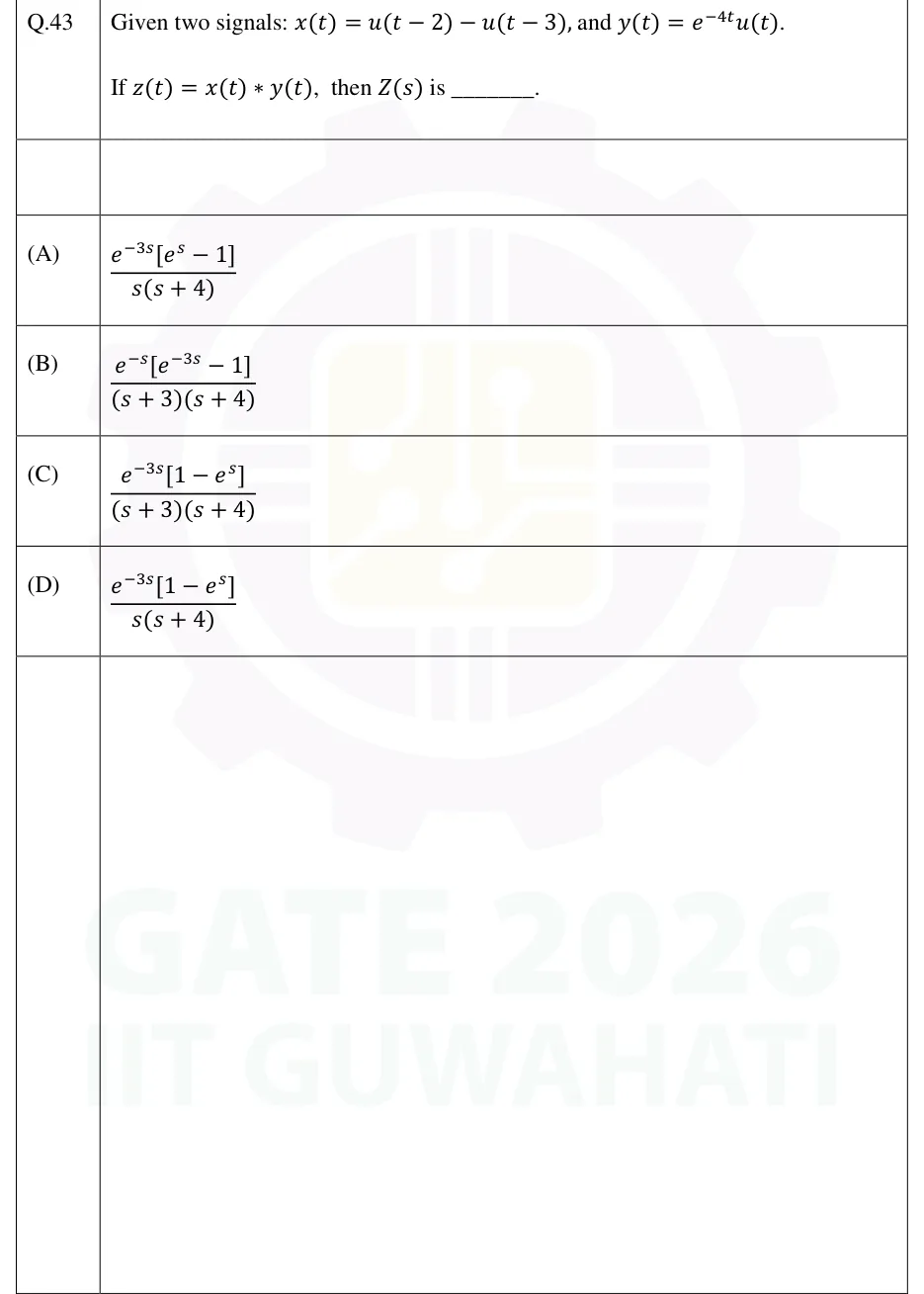
Given two signals: , and .
If , then is ________.
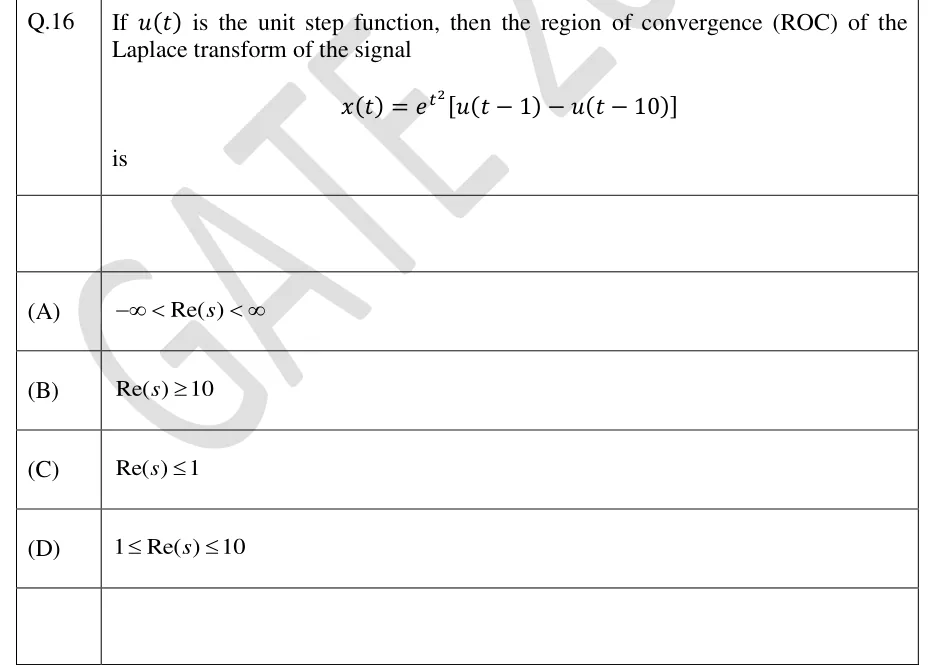
If is the unit step function, then the region of convergence (ROC) of the Laplace transform of the signal
is
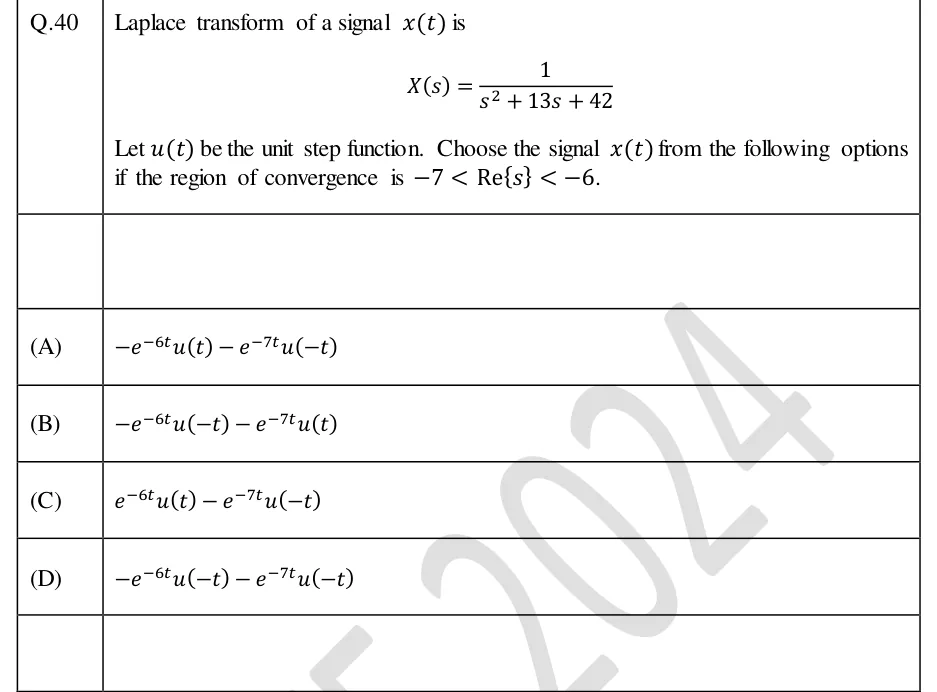
Laplace transform of a signal is
Let be the unit step function. Choose the signal from the following options if the region of convergence is .
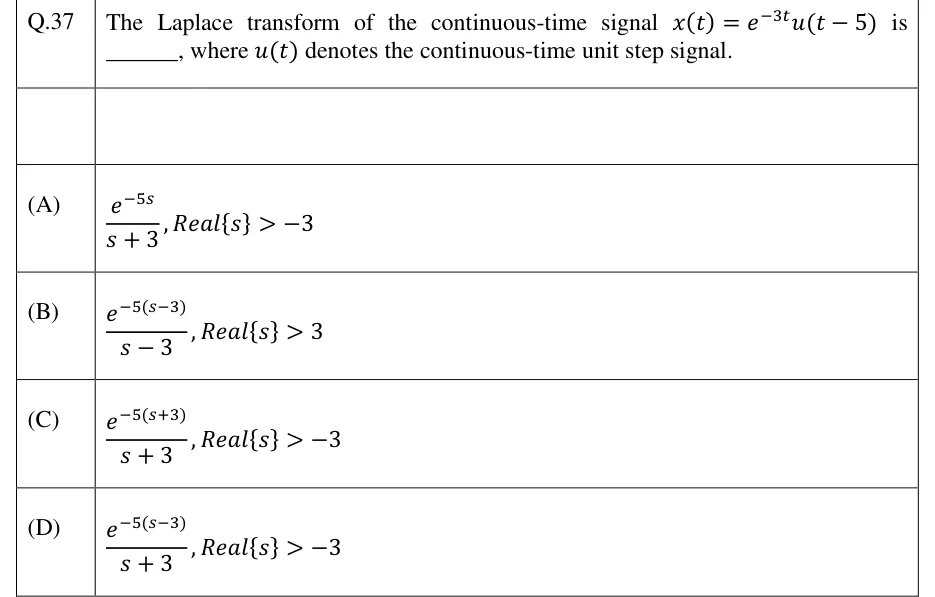
The Laplace transform of the continuous-time signal is ______, where denotes the continuous-time unit step signal.
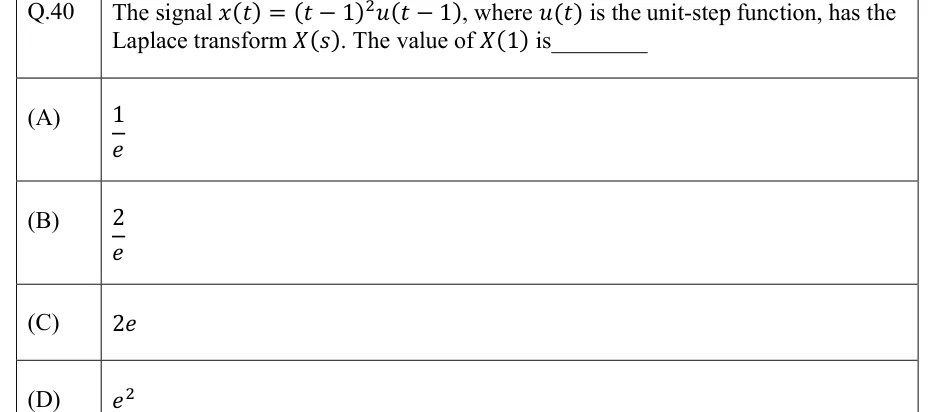
The signal , where is the unit-step function, has the Laplace transform . The value of is ________
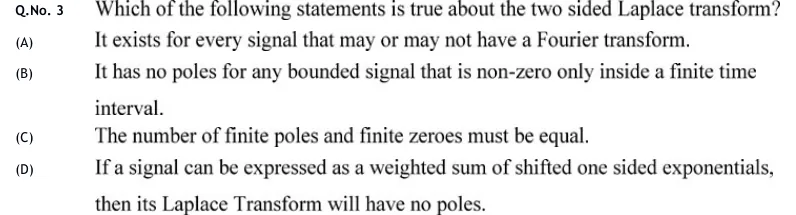
Which of the following statements is true about the two sided Laplace transform?
It exists for every signal that may or may not have a Fourier transform.
It has no poles for any bounded signal that is non-zero only inside a finite time interval.
The number of finite poles and finite zeroes must be equal.
If a signal can be expressed as a weighted sum of shifted one sided exponentials, then its Laplace Transform will have no poles.
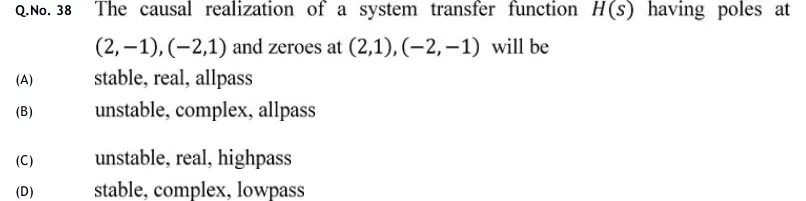
The causal realization of a system transfer function having poles at , and zeroes at , will be
stable, real, allpass
unstable, complex, allpass
unstable, real, highpass
stable, complex, lowpass
PRACTICE
A causal signal has Laplace transform . The value of is ______.
Answer: (accepted range )
. Its poles are the roots of , namely , both in the open LHP, so the final value theorem applies.
.
For , which statement about its Laplace transform is correct?
The ROC is , and the Fourier transform of exists
The ROC is , and the Fourier transform of does not exist
The ROC is , and the Fourier transform of exists
The ROC is empty, so has no Laplace transform
Answer: (B)
is right-sided and converges for .
is left-sided: converges for .
The intersection is non-empty, so exists there.
The strip does not contain . Indeed grows without bound as , so has no Fourier transform.
A causal LTI system has . The input is applied for all . The output is
Answer: (B)
The only pole is at , so the causal system is stable and the sinusoidal steady-state formula applies; with the input applied for all there is no transient.
. The numerator has length and angle ; the denominator has length and angle .
So and (indeed ); the system is all-pass.
.
A causal signal has Laplace transform . The value of is ______.
Answer: (accepted range )
is not strictly proper, so divide first: , so .
The constant is the impulse , which does not affect . Apply the IVT to the remainder: .
Check by inversion: , so and . Applying to the undivided would give .
An LTI system has system function ; its ROC is not specified. Which of the following statements are true?
If the system is causal, it is not BIBO stable.
If the system is BIBO stable, its impulse response is non-zero both for some and for some .
Some choice of ROC makes the system both causal and BIBO stable.
For the BIBO-stable choice of ROC, .
Answer: (A), (B), (D)
Partial fractions: (cover-up: and ).
Causal: ROC , which excludes the axis, so the system is unstable. A is true. C is false, since causal and stable together would need both poles in the LHP.
Stable: ROC . The pole at lies left of the ROC and gives ; the pole at lies right of it and gives . D is true.
That is non-zero on both sides of , so B is true.
A system obeys with and . The value of at s, rounded to two decimal places, is ______.
Answer: (accepted range )
Unilateral transform: .
, so ; the factor cancels.
, so for . Check: and .
.
A causal, stable system has . It is written as , where is minimum phase (causal and stable, all poles and zeros in the open LHP) and is all-pass with for all . Which pair is correct?
and
and
and
and
Answer: (A)
The zero at is in the RHP, so itself is not minimum phase: B is out.
Reflect the zero to : has every pole and zero in the LHP. The leftover factor is , and . The product is , so A is correct.
C: is not constant, so is not all-pass.
D: the product is and the second factor is all-pass, but the first factor has poles at and , so it cannot be causal and stable; it is not minimum phase.
OFFICIAL GATE 2027 SYLLABUS WORDING
Copied from the GATE 2027 syllabus; see all 2027 syllabi.
GATE EC
poles and zeroes
GATE EE
Laplace Transform
GATE IN
Laplace … transforms … transfer function
Preparing in Kolkata? IAE Academy's course for GATE ECE, GATE EE or GATE IN.