
IAE Academy

GATE 2020 EE Q.3: solution and answer

GATE 2020 · EEQ.3 · 1 mark · MCQ

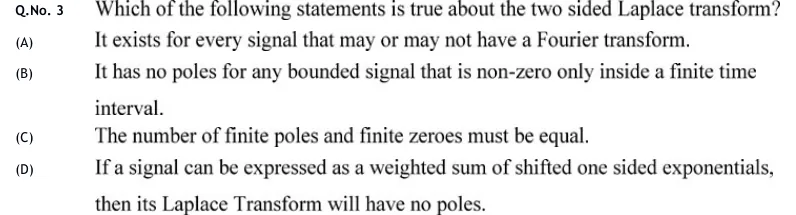
Which of the following statements is true about the two sided Laplace transform?

  1. (A)

    It exists for every signal that may or may not have a Fourier transform.

  2. (B)

    It has no poles for any bounded signal that is non-zero only inside a finite time interval.

  3. (C)

    The number of finite poles and finite zeroes must be equal.

  4. (D)

    If a signal can be expressed as a weighted sum of shifted one sided exponentials, then its Laplace Transform will have no poles.
See the question in the paper

Answer and solution

ANSWER

(B) is true. A bounded signal that is non-zero only over a finite time interval has the entire s-plane as its ROC, so its two-sided Laplace transform has no poles.

Official answer: BSource: Official answer key, GATE 2020 EE (IIT Delhi)

  1. (A) is false. The two-sided transform exists only if some vertical strip of the -plane is a region of convergence (ROC). Take for all . The part for converges only for , and the part for converges only for . No satisfies both, so the ROC is empty and the transform does not exist.

  2. ROC of a finite-duration signal. Let be bounded, , and zero outside . For every , because a continuous function is integrated over a finite interval. So the ROC is the entire -plane.

  3. (B) is true. A pole is a point where becomes unbounded, and a pole can never lie inside the ROC. Here the ROC is the whole -plane, so is finite everywhere and has no finite poles.

  4. Check with a rectangular pulse: gives . The apparent pole at is not a pole, because is finite. The singularity is removable.

  5. (C) is false. For the transform is with ROC . It has one finite pole and no finite zero. In general, a strictly proper rational has fewer finite zeros than finite poles.

  6. (D) is false. Take one shifted one-sided exponential: , with ROC . It has a pole at . A weighted sum of such terms has poles at unless the terms are specially arranged to cancel, as in the rectangular pulse of step 4.

  7. Only statement (B) holds. The answer is (B).

KEY IDEA

A bounded, finite-duration signal gives a Laplace integral over a finite interval of a bounded integrand. That integral converges for every s, so the ROC is the whole s-plane. Poles cannot lie inside the ROC, so there are none. Any apparent pole, such as s = 0 in (1 - e^{-sT})/s, is a removable singularity.

WATCH OUT FOR

Seeing the factor 1/s in the rectangular-pulse transform (1 - e^{-sT})/s and concluding that finite-duration signals have a pole at s = 0. The numerator also vanishes there, so the limit is T and there is no pole. Two other errors: picking (A) because the Laplace transform 'generalises' the Fourier transform (a constant or two-sided signal can have an empty ROC), and picking (D) because only the delay factor e^{-st_0} is remembered and the 1/(s+a) factor is forgotten.

From the GATE 2020 EE paper. Every question of this paper · Download the full paper · All 8 Laplace questions, with notes

More Laplace questions