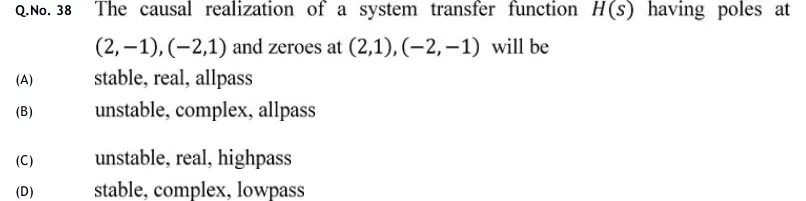
The causal realization of a system transfer function having poles at , and zeroes at , will be
- (A)
stable, real, allpass
- (B)
unstable, complex, allpass
- (C)
unstable, real, highpass
- (D)
stable, complex, lowpass

The causal realization of a system transfer function having poles at , and zeroes at , will be
stable, real, allpass
unstable, complex, allpass
unstable, real, highpass
stable, complex, lowpass
ANSWER
(B) unstable, complex, allpass
Official answer: BSource: Official answer key, GATE 2020 EE (IIT Delhi)
Read each coordinate pair as a point in the s-plane. The poles are and . The zeros are and .
Build the transfer function (unity gain). Each pair of factors is a difference of squares:
Real or complex: a system with a real impulse response has a real-coefficient , so its complex poles come in conjugate pairs. The conjugate of the pole is , which is a zero, not a pole. The poles are not a conjugate pair, the coefficients are complex, and so is complex-valued. The system is complex.
All-pass test: each zero must be the mirror image of a pole about the axis, . Here and . Both zeros pass.
Confirm on the axis. Put , so :
The magnitude is flat, so the system is all-pass. Any other constant gain gives , which is still flat.
Stability from the ROC: the ROC of a causal system lies to the right of its rightmost pole. The pole is in the right half-plane, so the ROC is . That region does not contain the axis, so the causal realization is unstable. The residue of at is , so really does contain a term in , whose magnitude grows without bound.
The system is unstable, complex and all-pass, which is option (B). Every other option fails at least one test: (A) and (D) say stable, (A) and (C) say real, (C) says highpass and (D) says lowpass.
KEY IDEA
Read each property straight from the pole-zero pattern. Zeros that mirror the poles about the axis () give an all-pass. Complex poles without their conjugates give complex coefficients, so the system is complex. A causal system with a right-half-plane pole has ROC , which misses the axis, so it is unstable.
WATCH OUT FOR
Taking the symmetric-looking pattern as proof the system is real. The poles and are symmetric about the origin ( and ), not about the real axis. Symmetry about the origin only makes a function of ; it does not make the coefficients real. A second trap is assuming an all-pass is automatically stable. All-pass describes only . Causality combined with the right-half-plane pole at makes the system unstable, which rules out (A).
From the GATE 2020 EE paper. Every question of this paper · Download the full paper · All 8 Laplace questions, with notes