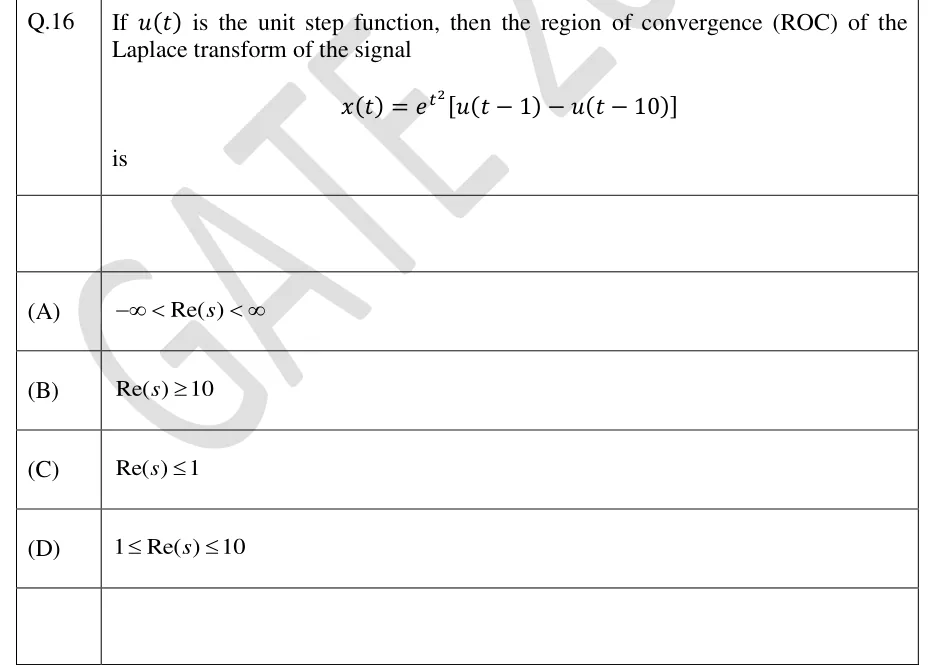
If is the unit step function, then the region of convergence (ROC) of the Laplace transform of the signal
is
- (A)
- (B)
- (C)
- (D)

If is the unit step function, then the region of convergence (ROC) of the Laplace transform of the signal
is
ANSWER
The signal is non-zero only for and is bounded there, so its Laplace integral converges for every . The ROC is the entire -plane, : option (A).
Official answer: ASource: Official answer key, GATE 2024 EE (IISc Bengaluru)
Window: is for and everywhere else. So only on and outside it. The signal has finite duration.
It is also bounded on that interval. increases for , so : a very large number, but finite.
Write out the transform:
Bound the integrand for : . For a fixed real , is monotonic in , so on it is largest at one of the endpoints. The integrand therefore stays below , which is finite.
The integrand is bounded and the interval has finite length , so for every real . The integral converges absolutely whatever is.
Rule: a finite-duration signal that is absolutely integrable has an ROC covering the whole -plane. So the ROC is , which is option (A).
KEY IDEA
How fast a signal grows only matters when the signal lasts forever. A bounded signal of finite duration has a Laplace transform that converges for every , so its ROC is the whole -plane. This holds even for something like , which on its own grows faster than any exponential and has no Laplace transform at all.
WATCH OUT FOR
There are two traps. The first is taking the window edges and as limits on and picking (D) . Time limits never become ROC boundaries: those come from exponential growth rates or pole locations. The second is seeing and deciding the transform cannot exist, or that it needs a large as in (B). Because of the window, the integral runs over a finite interval of a bounded function, so it converges everywhere.
From the GATE 2024 EE paper. Every question of this paper · Download the full paper · All 8 Laplace questions, with notes