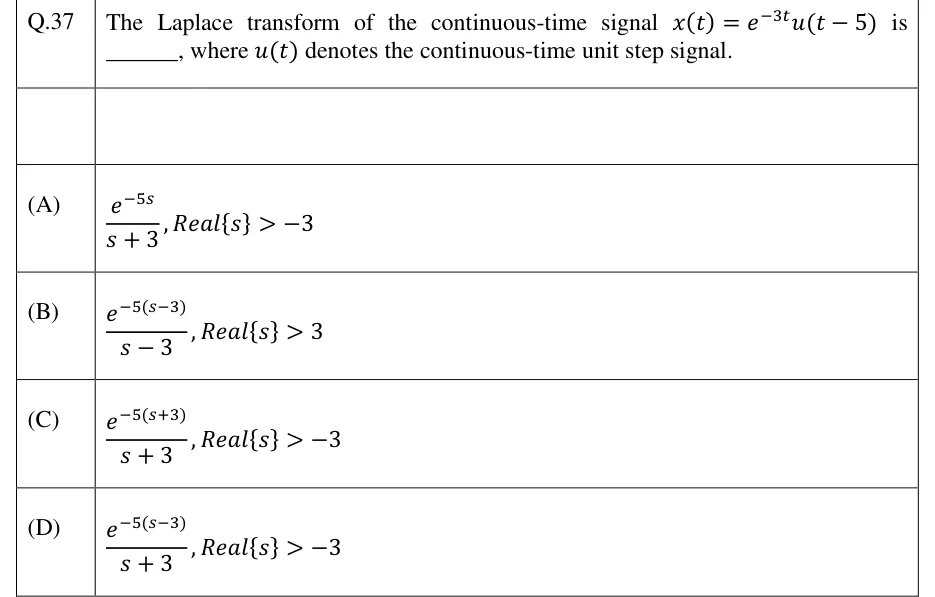
The Laplace transform of the continuous-time signal is ______, where denotes the continuous-time unit step signal.
- (A)
- (B)
- (C)
- (D)

The Laplace transform of the continuous-time signal is ______, where denotes the continuous-time unit step signal.
ANSWER
The answer is (C): with .
Official answer: CSource: Official answer key, GATE 2023 IN (IIT Kanpur)
The step switches on at , but the exponential is written in terms of , not . To use the time-shift property, rewrite it in terms of :
Base pair: , with .
Time-shift property: . It leaves the ROC unchanged because is finite for every . With : , .
Multiply by the constant :
Check by direct integration. is zero for , so The upper limit goes to zero only when , which gives . The signal is right-sided, so this right half-plane ROC is what we expect.
Rule out the others. (A) leaves out the factor , so it treats the signal as . (B) is the transform of . (D) has the wrong sign inside the exponent of the numerator. The answer is option (C).
KEY IDEA
The time-shift property only works when the whole function is shifted, not just the step. So first write . The constant multiplies the transform, and the ROC stays . The same result follows from shifting in : , where gives .
WATCH OUT FOR
The usual mistake is to apply the time shift to the step alone and write (option A). That drops the factor , because is not the same as . Getting the sign of the exponential wrong leads to (B) or (D).
From the GATE 2023 IN paper. Every question of this paper · Download the full paper · All 8 Laplace questions, with notes