GATE 2026 EC Q.46
Consider a real baseband signal , for (in seconds) .
If 99% of energy of lies within Hz, then which of the following options is TRUE for the value of ?
- (A)
- (B)
- (C)
- (D)

GATE EC · EE · IN
The Fourier transform describes a signal by how much of each frequency it contains, and the frequency response describes how an LTI system scales and phase-shifts each of those frequencies. With a short list of standard pairs and the properties table (shift, scaling, duality, modulation, Parseval) you can find transforms, energies and filter outputs without integrating. Reading the magnitude and phase of then tells you whether a system distorts a signal, and by how much it delays the carrier (phase delay) and the envelope (group delay) of a narrowband signal. The same ideas carry over to sequences through the discrete-time Fourier transform (DTFT).
22 previous-year questions · 22 solved · 6 practice questions
The Fourier transform (FT) resolves a signal into complex exponentials . is complex: is the magnitude spectrum and the phase spectrum. Convention used in these notes: angular frequency in rad/s, with the factor in the inverse transform. You will also see the same function written ; here and mean the same thing. The Hz form, in , is given alongside every result because questions use both.
FOURIER TRANSFORM PAIR (Ω FORM, USED IN THESE NOTES)
in rad/s. The sits only in the inverse, so it reappears in duality, the multiplication property, Parseval's theorem and the formula for .
FOURIER TRANSFORM PAIR (F FORM)
in Hz; symmetric, with no factor outside the integrals. Convert with , and for impulses use , so becomes .
SINC CONVENTION
Normalised sinc, with zeros at . Some texts use under the same name; every sinc result below is also written in explicit form, so nothing depends on the convention.
Existence. The Dirichlet conditions are sufficient (not necessary) for to exist as an ordinary function:
is absolutely integrable: .
has a finite number of maxima and minima in any finite interval.
has a finite number of finite discontinuities in any finite interval. At a jump, the inverse transform converges to the midpoint of the jump.
A finite-energy signal () also has a transform, converging in the mean-square sense. is square-integrable but not absolutely integrable, and its transform is a rectangle.
Signals such as , , , and every periodic signal have a transform only in the generalised sense, with impulses in . Growing signals such as have no Fourier transform at all.
LINK WITH THE LAPLACE TRANSFORM
is the bilateral Laplace transform. Example: , , has ROC , which contains the axis. If the ROC boundary is the axis (poles on the axis, as for with ROC ), the Fourier transform exists only with impulses and the substitution misses them. If the ROC excludes the axis altogether (as for , ROC ), there is no Fourier transform.
EXAM TIP
Trap: , but , not . The impulse carries the average value of . In the same way, ; putting in gives only the second term.
Two pulse shapes recur. is the unit-height pulse of width centred at : it is 1 for and 0 for . is the unit-height triangle with base from to : it equals for and 0 otherwise. is times convolved with itself, which is why its transform is a sinc squared.
(rad/s) | (Hz) | Condition / note | |
|---|---|---|---|
flat spectrum | |||
unit magnitude, linear phase | |||
dual of | |||
real and even | |||
imaginary and odd | |||
no impulse: has zero average | |||
; generally | |||
; in rad/s | |||
; in rad/s | |||
; real, even, positive | |||
; a Gaussian maps to a Gaussian; | |||
zeros at (), | |||
for , else | for , else ; | ideal LPF impulse response; equals | |
zeros at , | |||
for , else | for , else ; | a triangle (dual of the pair); total area of is | |
; an impulse train maps to an impulse train | |||
Hilbert transformer (dual of the pair) |
RECTANGULAR PULSE AND SINC
Pulse of width and height 1. , the pulse area. First nulls at , i.e. : a narrower pulse has a wider main lobe.
IDEAL LOWPASS SPECTRUM AND ITS TIME FUNCTION
The dual of the rect–sinc pair. Peak value at , zeros at (). This is of the ideal lowpass filter with cutoff rad/s.
ONE-SIDED AND TWO-SIDED EXPONENTIALS
, so its transform is . For both signals grow and have no Fourier transform; gives or , which need impulses.
UNIT STEP AND SIGNUM
The impulse in is the transform of its average value: . has zero average, so it has no impulse.
GAUSSIAN
A narrow Gaussian in time (large ) gives a wide Gaussian in frequency. In the form, exactly.
PERIODIC IMPULSE TRAIN
Every Fourier-series coefficient of the impulse train equals , which gives impulses of area . This pair is the basis of sampling theory.
EXAM TIP
Width and bandwidth move in opposite directions. Halving the pulse width from to moves the first null from to rad/s and halves . This is the scaling property at work.
Take and . The table gives each property in both conventions. The factors are where the two forms differ, and they are where most factor slips happen.
Property | Time domain | form | form |
|---|---|---|---|
Linearity | |||
Time shift | |||
Frequency shift | |||
Modulation | |||
Time scaling | , real | ||
Time reversal | |||
Duality | |||
Conjugation | |||
Differentiation in time | |||
Differentiation in frequency | |||
Integration | |||
Convolution | |||
Multiplication |
TIME SCALING (WITH SHIFT)
Real . Compressing in time () stretches the spectrum and lowers it. Since , the delay is , not .
DUALITY
In the form there is no : . For an even , .
MODULATION
Each shifted copy has half the height. With instead: . If the copies do not overlap, the energy is halved.
DIFFERENTIATION IN TIME AND IN FREQUENCY
Differentiation removes any DC impulse: , and because .
INTEGRATION
The impulse term vanishes only when . Dividing by alone is the classic error.
CONVOLUTION AND MULTIPLICATION
The belongs to the multiplication property in the form only. The convolution property is why an LTI output is .
AREA AND VALUE THEOREMS
Put in the forward integral, or in the inverse. In the form, . If jumps at , the second integral gives the midpoint of the jump.
Symmetry rules for a real signal :
(conjugate symmetry), so the negative-frequency half of the spectrum carries no new information.
and are even; and are odd.
Real and even gives a real and even . Real and odd gives a purely imaginary and odd .
Even part ; odd part .
EXAM TIP
Use duality instead of integrating. From , duality gives , so . Then with no calculus.
WORKED EXAMPLE
Let . (a) Find . (b) Find the energy of . (c) Find , and check from the spectrum. (d) is applied to an ideal highpass filter of unit gain with cutoff 10 rad/s. Find the output energy.
From the pair for (0 otherwise) with , the factor has a flat spectrum of height 1 on .
Modulation by gives two copies of half height centred at rad/s: for and elsewhere. It is real and even, as it must be for a real, even .
Energy by Parseval: .
Area: , since lies outside both bands.
Check: . Directly, as and . The two agree.
The highpass filter keeps , the upper half of each band. Output energy , half of the input energy.
Answer: for rad/s, else 0; ; and ; output energy .
Energy can be computed in either domain. For the Fourier transform this is Parseval's theorem, also called Rayleigh's energy theorem. It turns awkward time integrals such as into areas of rectangles in frequency, and it gives the energy passed by a filter directly from .
PARSEVAL / RAYLEIGH ENERGY THEOREM
For energy signals. Generalised form: .
ENERGY SPECTRAL DENSITY (ESD) AND ENERGY IN A BAND
The band formula is for real . The factor 2 counts the matching negative-frequency band, which carries the same energy because is even.
ESD THROUGH AN LTI SYSTEM
The phase of has no effect on output energy.
ENERGY AUTOCORRELATION AND ESD
. The ESD is the transform of the autocorrelation and carries no phase information, so different signals can share one ESD.
EXAM TIP
Two integrals follow in one line each from the pair for . Area theorem: . Parseval: .
A periodic signal has infinite energy, so its ordinary Fourier integral diverges. In the generalised sense its transform is a train of impulses at the harmonics , with areas times the Fourier-series coefficients .
FOURIER TRANSFORM OF A PERIODIC SIGNAL
. In the form, with .
FOURIER-SERIES COEFFICIENTS FROM THE TRANSFORM OF ONE PERIOD
is the transform of one period of (taken as zero outside that period). The coefficients are samples of .
AVERAGE POWER OF A PERIODIC SIGNAL (PARSEVAL FOR FOURIER SERIES)
Periodic signals are power signals: infinite energy, finite power. A periodic input to a stable LTI system gives .
EXAM TIP
A rectangular pulse train of height 1, pulse width and period has , so . With duty cycle , the harmonics are absent because they fall on the sinc nulls.
For a stable LTI system with impulse response , the input produces the output : complex exponentials are eigenfunctions, and is the eigenvalue. is the frequency response, usually written because it equals the transfer function at . Write : is the gain and the phase shift at each frequency. For a real , is even and is odd.
FREQUENCY RESPONSE
Putting is valid when the system is BIBO stable (), so the ROC contains the axis. For a stable system described by , .
SINUSOIDAL STEADY STATE
Real , stable system, input applied for all time. The frequency is unchanged; only amplitude and phase change. Superpose for several tones.
Distortionless transmission. The output is distortionless if it is a scaled, delayed copy of the input, . Taking transforms, . So over the band the signal occupies, the gain must be constant and the phase must be a straight line through the origin.
DISTORTIONLESS SYSTEM
Here . The conditions are needed only across the band the signal occupies. Adding a multiple of to the phase changes nothing, and a phase of gives , an inverted but undistorted copy. Any other constant phase offset changes the waveform (for a narrowband bandpass signal it shifts only the carrier phase; see below).
Failing either condition distorts the waveform:
Amplitude (magnitude) distortion: is not constant over the band, so components are scaled unequally. An RC lowpass filter rounds the edges of a pulse whose spectrum extends well past rad/s.
Phase (delay) distortion: is not of the form (plus a multiple of ), so components are delayed by different amounts. With a flat gain , , so the energy changes only by the factor , yet the waveform shape changes.
Both are linear distortions: no new frequencies appear. A nonlinear system (such as ) creates new frequencies, which no can describe.
PHASE DELAY AND GROUP DELAY
in radians and in rad/s give seconds. Use the unwrapped phase for . For , at every frequency; conversely, at every frequency only when for some constant . In terms of : and .
What each delay means. Pass a narrowband signal through a system with real whose gain is nearly constant over , where the envelope occupies and . Expand the phase to first order about the carrier: for . Then:
NARROWBAND OUTPUT: ENVELOPE AND CARRIER DELAYS
The envelope (the information) is delayed by the group delay, also called envelope delay. The carrier is delayed by the phase delay. If varies across the band, the envelope is dispersed.
for | |||
|---|---|---|---|
(pure delay) | |||
linear phase with intercept, | |||
(RC lowpass, ) | |||
(RC highpass) | (negative) | ||
(first-order all-pass, ) | |||
cascade |
EXAM TIP
Group delays add in a cascade, so a rational with real poles and zeros can be read factor by factor (each ): a pole at adds ; a zero at subtracts ; a zero at adds ; a delay adds ; a constant gain adds nothing. Example: has , which is 4 s at .
WORKED EXAMPLE
The input is applied to the all-pass system . Find the exact output, write it as envelope times carrier, and compare the envelope and carrier delays with and at rad/s.
at every frequency and . So rad and rad.
Each tone keeps its amplitude and is phase-shifted: .
With : .
The input is . So the envelope is delayed by s and the carrier by s.
At : s and s. These match the exact envelope and carrier delays to within the first-order approximation.
The gain is flat, so there is no amplitude distortion. But because the phase is not linear, so a wideband signal through this system would suffer phase distortion.
Answer: . Envelope delay s, close to s; carrier delay s, close to s.
Discrete time. The same ideas hold for a stable DT LTI system with frequency response (the DTFT of ; see section 7), where is the normalised frequency in rad/sample and is periodic in with period . Distortionless now means with integer , which gives . Phase delay and group delay come out in samples.
DISCRETE-TIME GROUP DELAY; LINEAR-PHASE FIR
A length- FIR filter with symmetric coefficients has with real, so its phase is linear (apart from jumps of where changes sign). Antisymmetric coefficients, , give : the same group delay with a constant phase offset. Example: for gives , a delay of 1 sample.
EXAM TIP
Unwrap the phase before computing . For at rad/s, a calculator returns the principal angle rad, which would give a negative phase delay; the true phase is rad and s. Group delay is unaffected by jumps because it uses the slope.
EXAM TIP
If the phase is given in degrees, convert to radians before dividing by or differentiating. A phase of at rad/s is a phase delay of ms, not s.
EXAM TIP
Phase delay can be negative, as for the RC highpass (a phase lead), while the group delay is positive. A negative describes only the steady-state phase of a sinusoid; it does not mean the output appears before the input.
An ideal filter has unit gain in its passband, zero gain in its stopband, and (with delay ) linear phase in the passband. The impulse responses below are for ; a delay replaces by . For the band filters, and .
Filter | ||
|---|---|---|
Lowpass, cutoff | 1 for , else 0 | |
Highpass, cutoff | 0 for , else 1 | |
Bandpass, | 1 in the band, else 0 | |
Bandstop, | 0 in the band, else 1 |
Why ideal filters cannot be built:
Non-causal: is nonzero for . A delay shifts it right, but the sinc tails extend to , so for some whatever finite is chosen. The same holds for the HPF, BPF and BSF.
Paley–Wiener criterion: a square-integrable gain can belong to a causal filter only if . A gain that is exactly zero over a band makes across that band, so the integral diverges. A causal filter can have zero gain at isolated frequencies, but not over any band, however narrow.
Not BIBO stable: diverges, although has finite energy.
Practical filters approximate the ideal with a finite transition band and a phase that is only approximately linear in the passband.
EXAM TIP
The step response of the ideal LPF (zero delay) is , where . It overshoots to about (about 9%) whatever the cutoff; raising only makes the ringing faster. This is the Gibbs phenomenon.
Bandwidth has several definitions, and a question should say which it means. For a real signal the spectrum is symmetric about , so bandwidth is normally quoted from the positive-frequency half: a lowpass spectrum occupying has bandwidth . The null-to-null bandwidth of a lowpass pulse is quoted both as the full width of the main lobe and as the one-sided width to the first null, so check which is meant. A nonzero signal cannot be both time-limited and band-limited: a pulse of finite duration has infinite absolute bandwidth, and a strictly band-limited signal lasts for all time.
Definition | Meaning | Example |
|---|---|---|
Absolute | range outside which or is exactly zero | has absolute bandwidth rad/s; a time-limited pulse has infinite absolute bandwidth |
3-dB (half-power) | range over which , i.e. | RC lowpass: rad/s, Hz; a bandpass response: between its two half-power points |
Null-to-null (main lobe) | width between the first zeros on either side of the spectral peak | : full main lobe rad/s ( Hz); one-sided, to the first null, rad/s ( Hz) |
Energy (essential) | band holding a stated fraction of the energy | : the fraction in is |
3-DB BANDWIDTH OF A FIRST-ORDER LOWPASS
At the 3-dB point the phase is . The 10–90% step rise time is , so .
The Hilbert transformer is the LTI system that shifts every positive-frequency component by and every negative-frequency component by , with unit gain. It is used to build single-sideband signals and analytic signals.
HILBERT TRANSFORM
Gain 1 at every , phase for . Its is non-causal, so the ideal Hilbert transformer is also unrealisable.
Hilbert transform facts:
and (for ). A constant maps to 0.
Applying the transform twice gives for a signal with no DC component, because for .
and have the same magnitude spectrum (apart from ) and the same energy, and for a real finite-energy they are orthogonal: .
The analytic signal has spectrum for and for .
If is lowpass with bandwidth below , the Hilbert transform of is .
EXAM TIP
Do not confuse the Hilbert transformer with a differentiator. has : phase for and gain . The Hilbert transformer has phase for and gain 1.
Convention. For a sequence the DTFT is written , with the normalised frequency in rad/sample. It is periodic in with period , so every integral over frequency runs over one period, usually to . (and every multiple of ) is the lowest frequency and the highest: is the fastest-varying sequence. If comes from sampling, . The DTFT exists as an ordinary function when , in the mean-square sense when , and only with impulses for sequences such as , and .
DTFT PAIR
Any interval of length may replace to . The DTFT is the -transform on the unit circle, , valid when the ROC of contains .
Condition / note | ||
|---|---|---|
flat spectrum | ||
integer | ||
; real and even | ||
for , else | value at ; zeros at , not a multiple of | |
for , else | real and even; value at | |
(value at ) | for , for , repeated every | ; ideal DT lowpass filter |
impulses at every multiple of | ||
Property | ||
|---|---|---|
Time shift | , integer | |
Frequency shift | ||
Multiplication by | : turns a lowpass response into a highpass one | |
Time reversal | ||
Conjugation | ||
Time expansion by integer | when is a multiple of , else | |
Differentiation in frequency | ||
First difference | ||
Accumulation | ||
Convolution | ||
Multiplication | (periodic convolution) |
DTFT VALUE THEOREMS
Put or in the forward sum, or in the inverse integral. More generally .
PARSEVAL'S THEOREM FOR THE DTFT
The frequency integral spans one period, wide, never to .
DISCRETE-TIME SINUSOIDAL STEADY STATE
Real , stable system (), input applied for all . and give the same sequence and the same response.
WORKED EXAMPLE
A causal LTI system has . (a) Find and the gain at and at . (b) Find the output for . (c) Evaluate .
From with : .
At : . At : , so . The gain falls from 2 to across the band: a lowpass response.
At : , so . Then and rad.
So .
By Parseval, .
Answer: , with gain 2 at and at ; ; the integral is .
PREVIOUS-YEAR QUESTIONS
Try each question first, then open the answer. We placed each question under a topic ourselves; the exam paper does not label topics.
See these papers in full: GATE ECE 2026 · GATE ECE 2025 · GATE ECE 2024 · GATE ECE 2023 · GATE ECE 2022 · GATE ECE 2020 · GATE ECE 2018 · GATE EE 2025 · GATE EE 2024 · GATE EE 2023 · GATE EE 2022 · GATE EE 2018 · GATE IN 2025 · GATE IN 2023 · GATE IN 2022 · GATE IN 2020 · GATE IN 2018
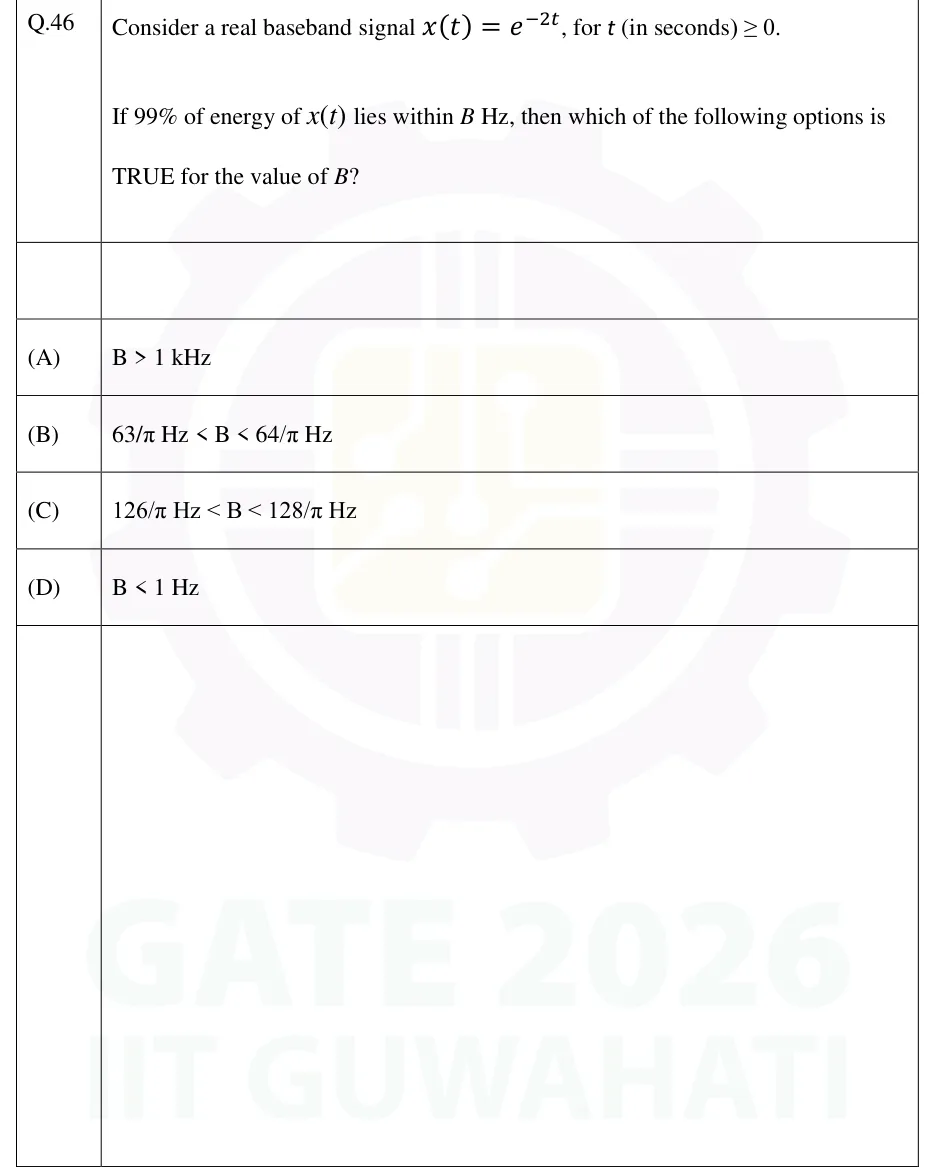
Consider a real baseband signal , for (in seconds) .
If 99% of energy of lies within Hz, then which of the following options is TRUE for the value of ?
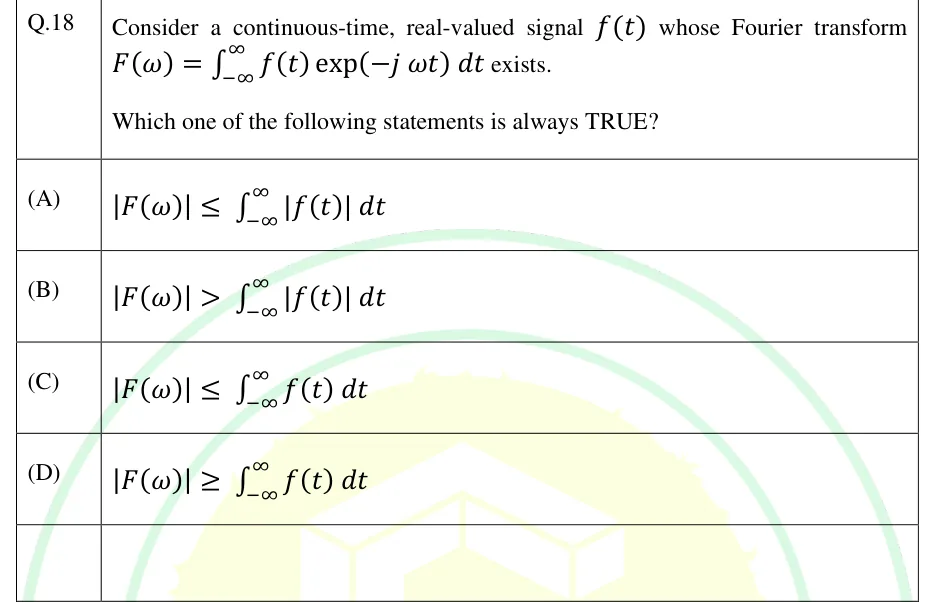
Consider a continuous-time, real-valued signal whose Fourier transform exists.
Which one of the following statements is always TRUE?
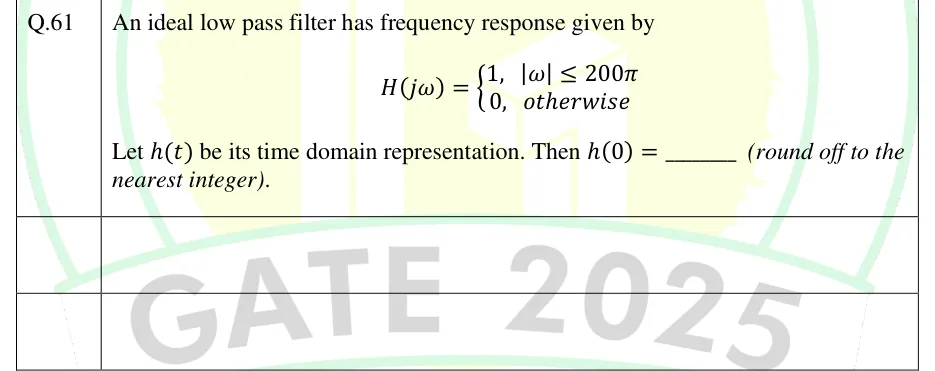
An ideal low pass filter has frequency response given by
Let be its time domain representation. Then ______ (round off to the nearest integer).
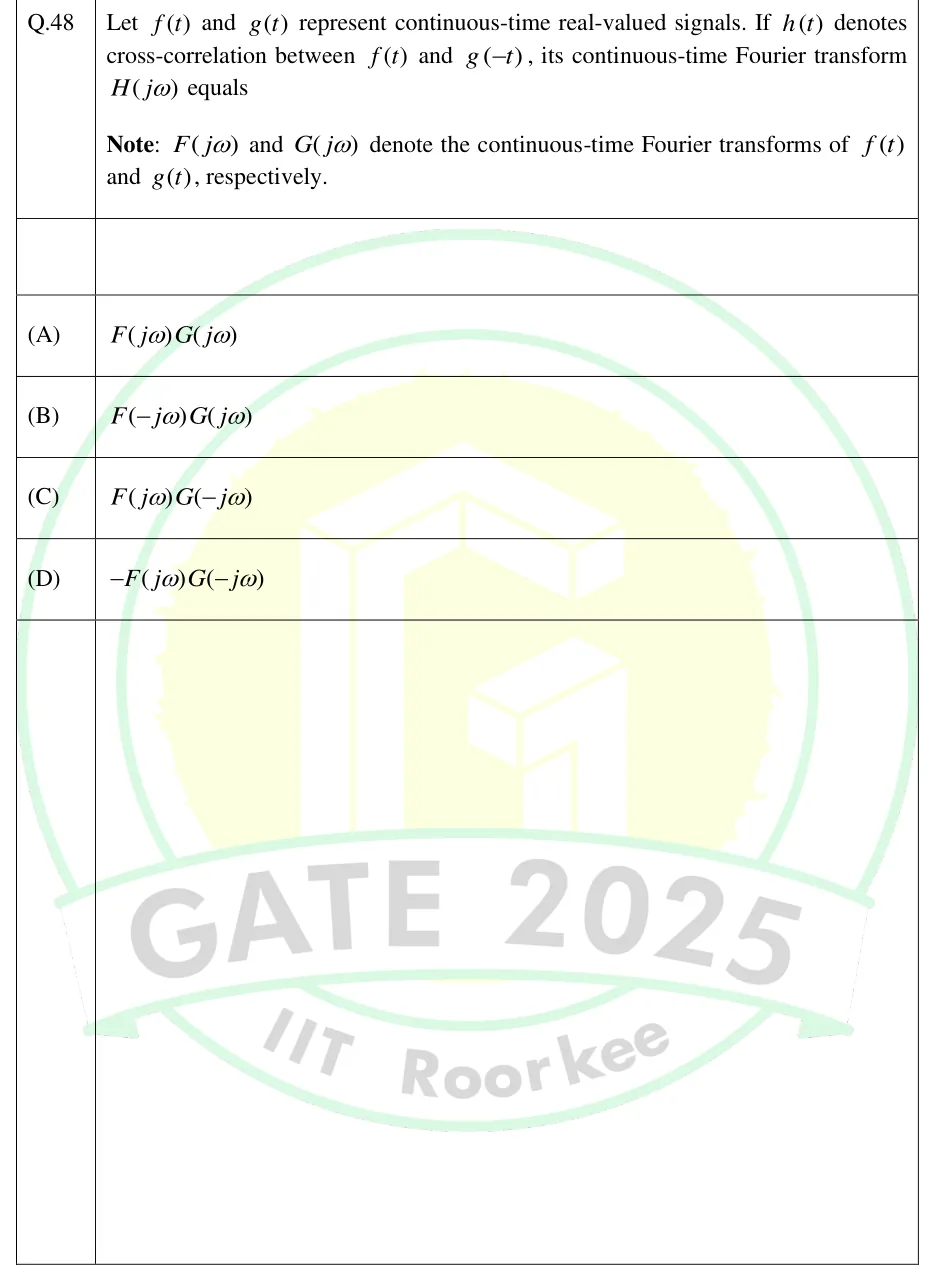
Let and represent continuous-time real-valued signals. If denotes cross-correlation between and , its continuous-time Fourier transform equals
Note: and denote the continuous-time Fourier transforms of and , respectively.
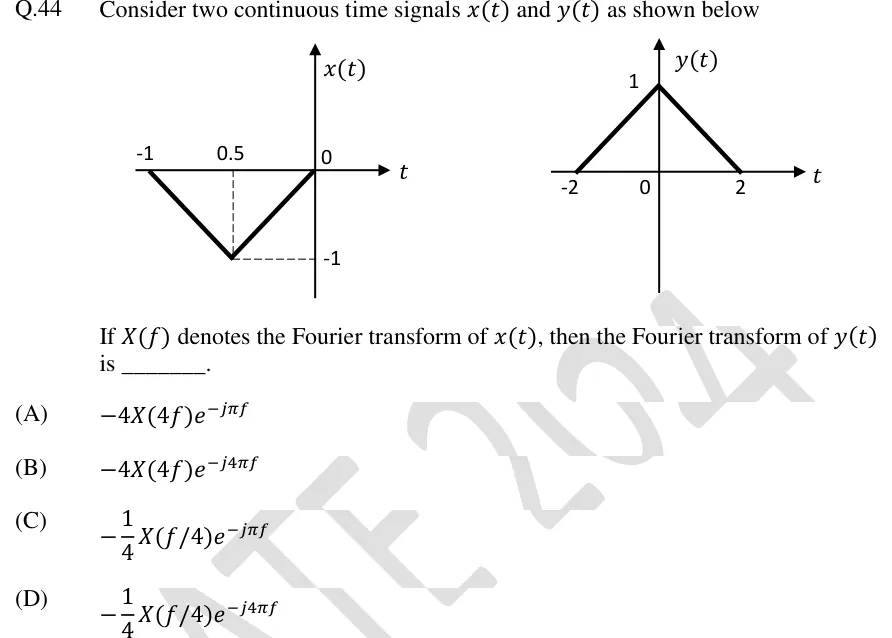
Consider two continuous time signals and as shown below
[Figure: and ]
If denotes the Fourier transform of , then the Fourier transform of is ______.
 Tap to open full size
Two sketches side by side. Left: x(t) versus t. It is an inverted triangle lying entirely below the axis: it is 0 at t = -1, falls linearly to a minimum of -1, then rises linearly back to 0 at t = 0, and is zero outside [-1, 0]. The minimum sits exactly halfway between -1 and 0, marked by a vertical dashed line down from a tick labelled '0.5' (printed without a minus sign, though its position is t = -0.5) and a horizontal dashed line across to the level labelled -1 on the vertical axis. The origin is labelled 0. Right: y(t) versus t. It is an upright triangle: 0 at t = -2, rising linearly to a peak of 1 at t = 0, falling linearly to 0 at t = 2, and zero outside [-2, 2]. The ticks are labelled -2, 0, 2 on the t-axis and 1 on the vertical axis.
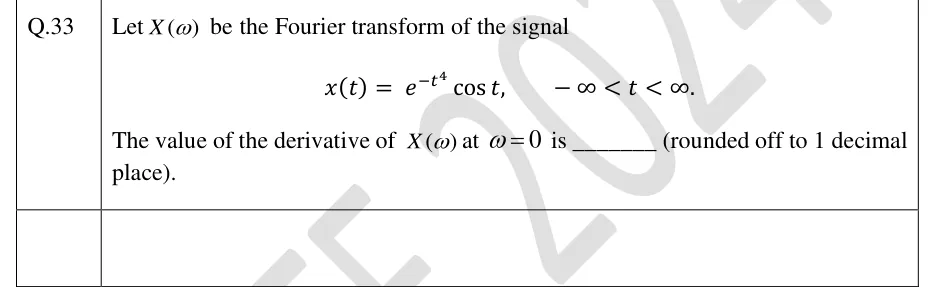
Let be the Fourier transform of the signal
The value of the derivative of at is ________ (rounded off to 1 decimal place).
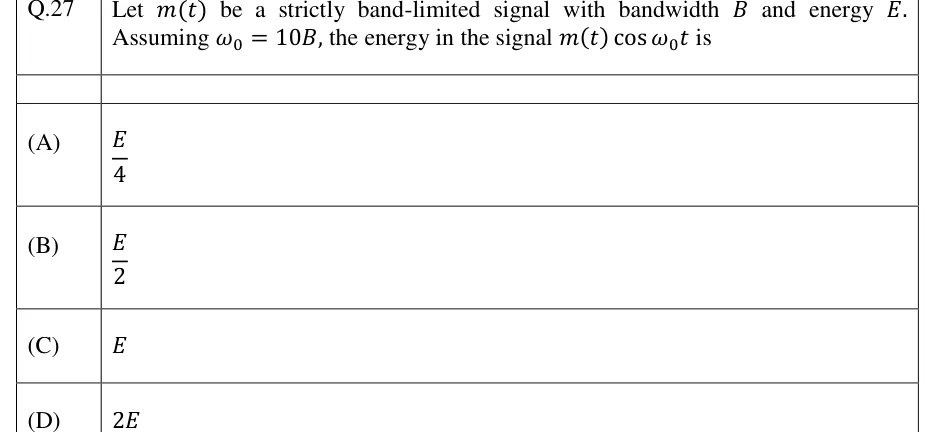
Let be a strictly band-limited signal with bandwidth and energy . Assuming , the energy in the signal is
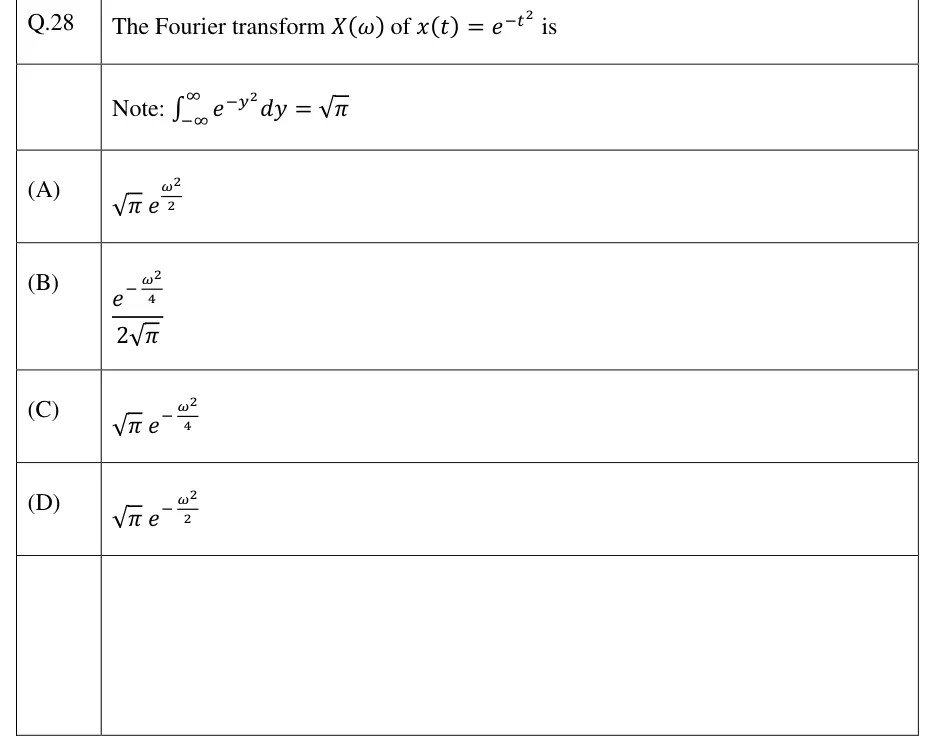
The Fourier transform of is
Note:
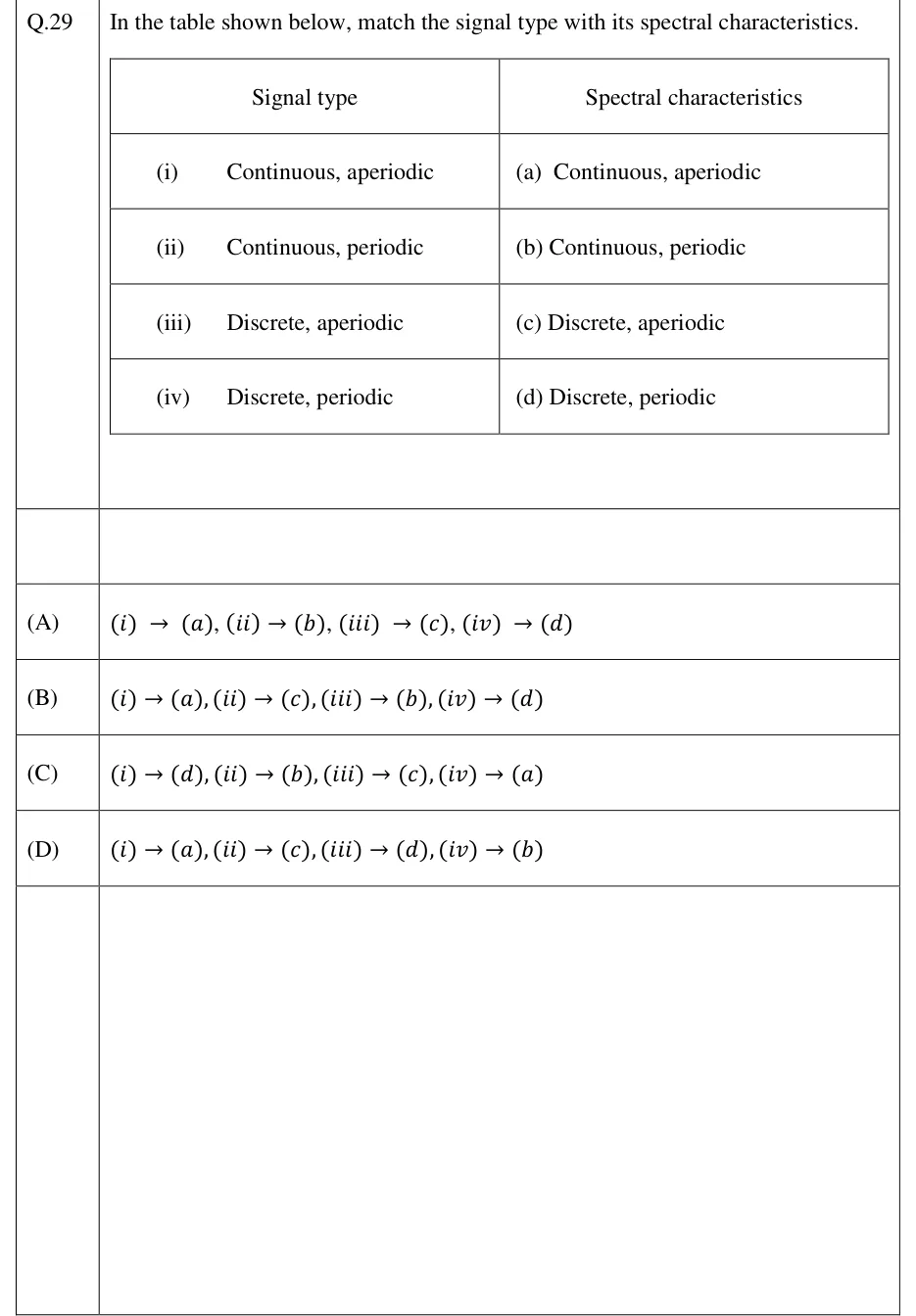
In the table shown below, match the signal type with its spectral characteristics.
| Signal type | Spectral characteristics |
|---|---|
| (i) Continuous, aperiodic | (a) Continuous, aperiodic |
| (ii) Continuous, periodic | (b) Continuous, periodic |
| (iii) Discrete, aperiodic | (c) Discrete, aperiodic |
| (iv) Discrete, periodic | (d) Discrete, periodic |
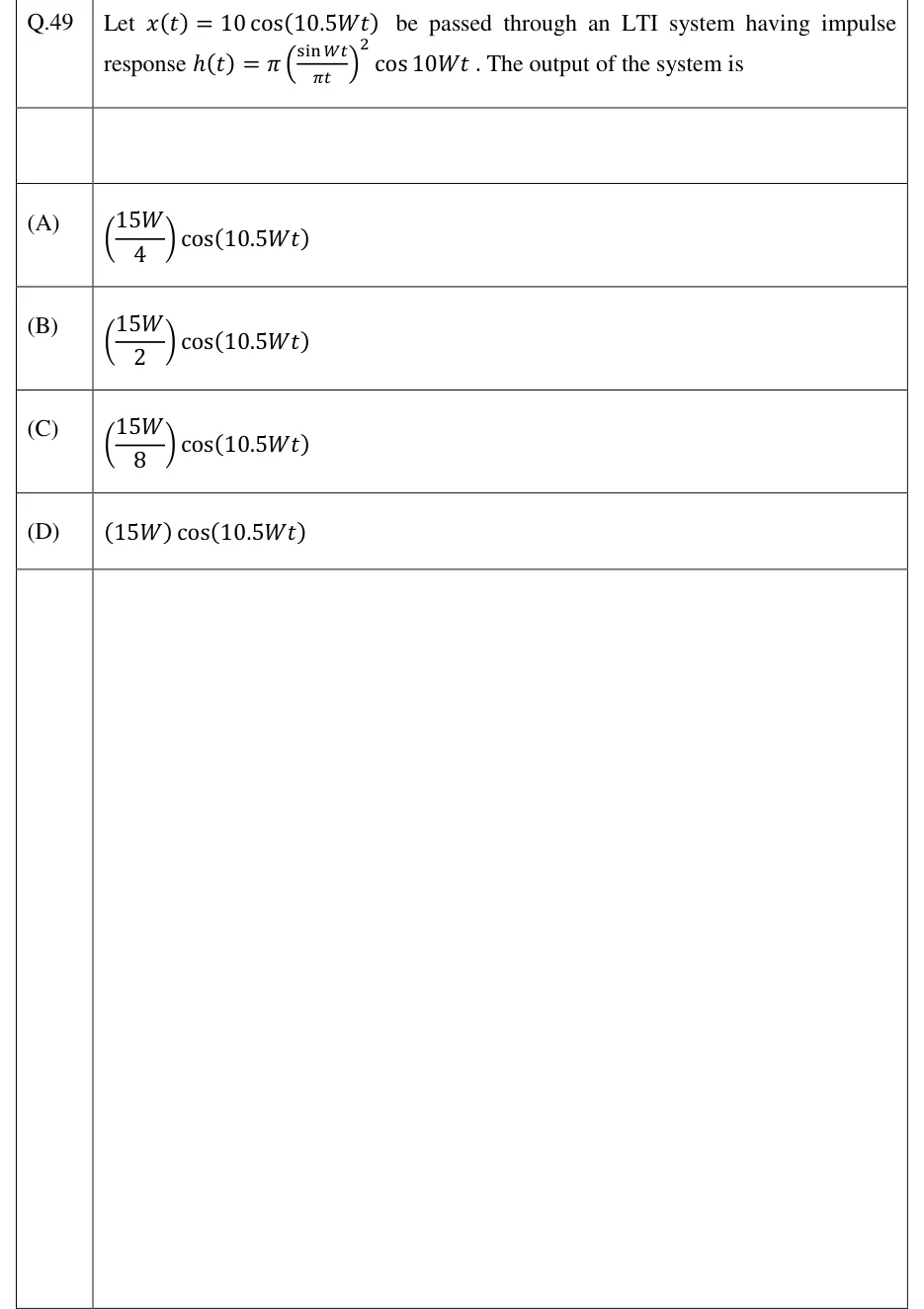
Let be passed through an LTI system having impulse response . The output of the system is
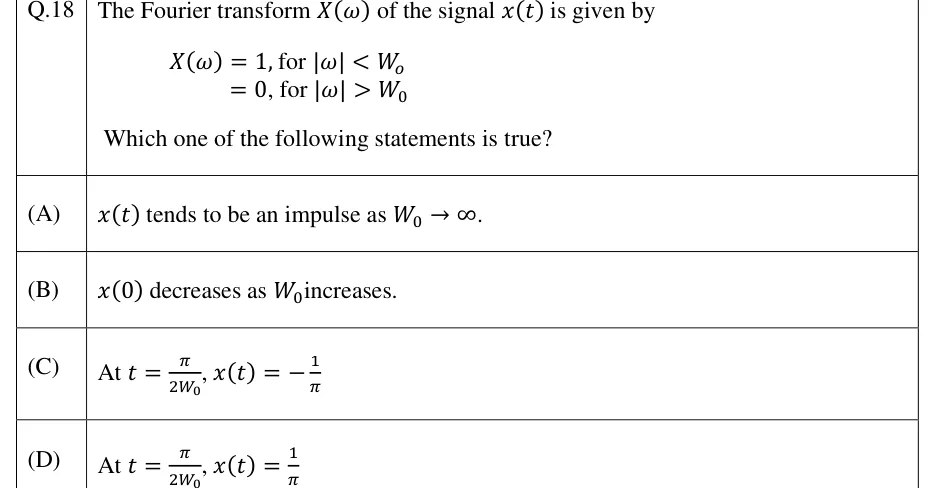
The Fourier transform of the signal is given by
Which one of the following statements is true?
tends to be an impulse as .
decreases as increases.
At ,
At ,
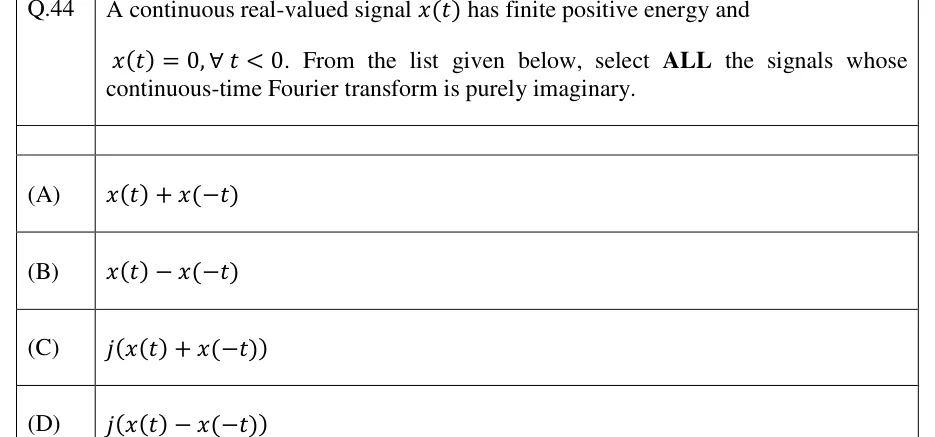
A continuous real-valued signal has finite positive energy and . From the list given below, select ALL the signals whose continuous-time Fourier transform is purely imaginary.
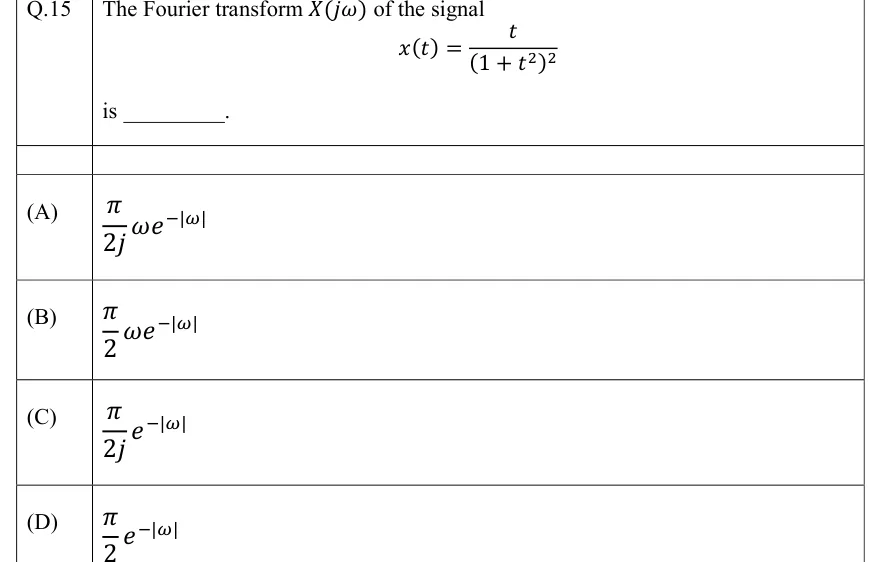
The Fourier transform of the signal
is ________.
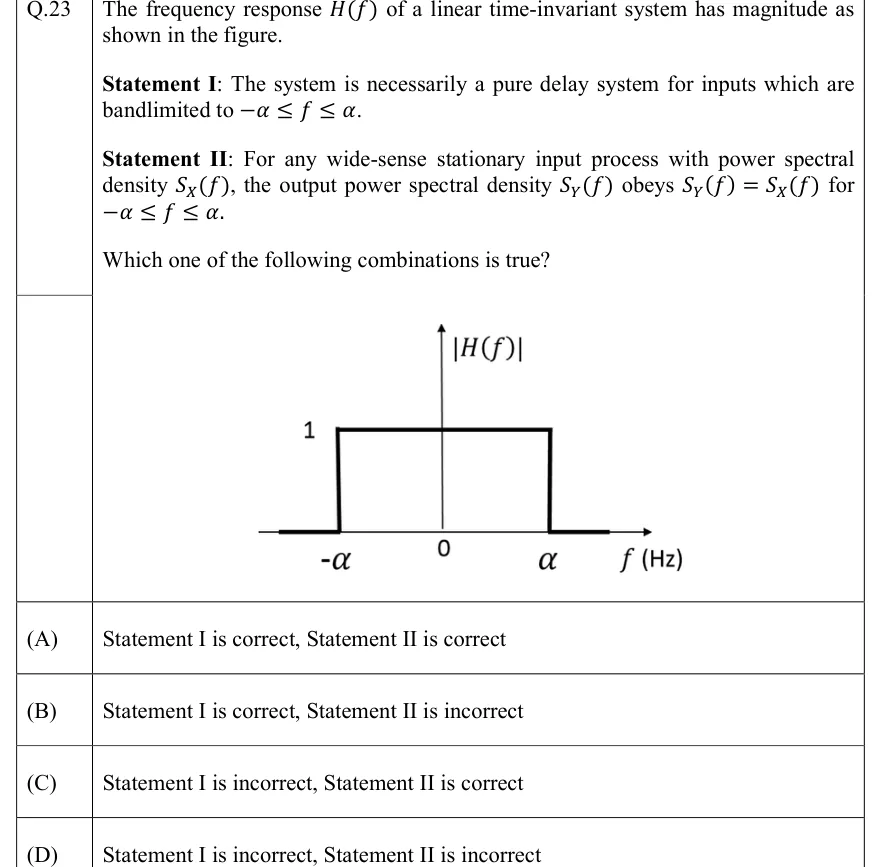
The frequency response of a linear time-invariant system has magnitude as shown in the figure.
Statement I: The system is necessarily a pure delay system for inputs which are bandlimited to .
Statement II: For any wide-sense stationary input process with power spectral density , the output power spectral density obeys for .
Which one of the following combinations is true?
 Tap to open full size
Plot of |H(f)| (vertical axis, labelled |H(f)|) against f (horizontal axis, labelled f (Hz)). The magnitude is a rectangle centred on the origin: |H(f)| = 1 for - α ≤ f ≤ α (level marked 1 on the left) and |H(f)| = 0 outside, with vertical edges at f = - α and f = α. The origin is marked 0. Only the magnitude is shown; no phase plot is given.
Statement I is correct, Statement II is correct
Statement I is correct, Statement II is incorrect
Statement I is incorrect, Statement II is correct
Statement I is incorrect, Statement II is incorrect
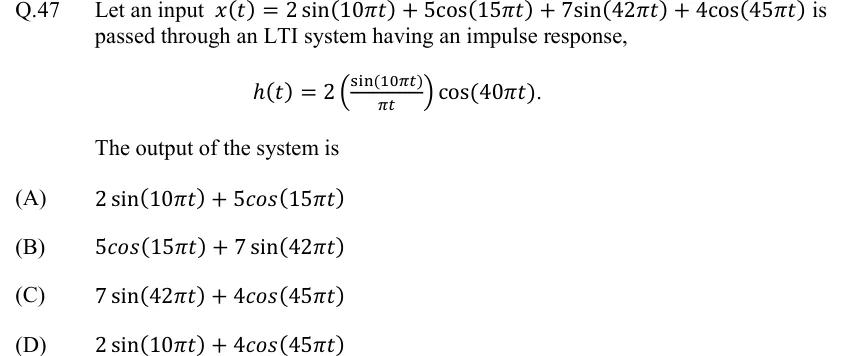
Let an input is passed through an LTI system having an impulse response,
The output of the system is
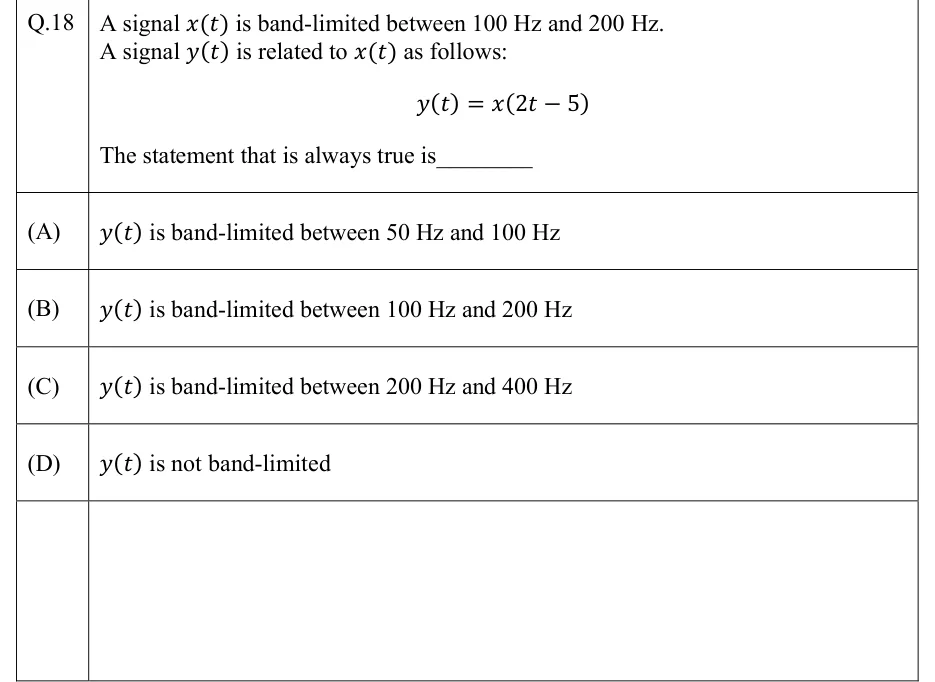
A signal is band-limited between 100 Hz and 200 Hz. A signal is related to as follows:
The statement that is always true is ________
is band-limited between 50 Hz and 100 Hz
is band-limited between 100 Hz and 200 Hz
is band-limited between 200 Hz and 400 Hz
is not band-limited
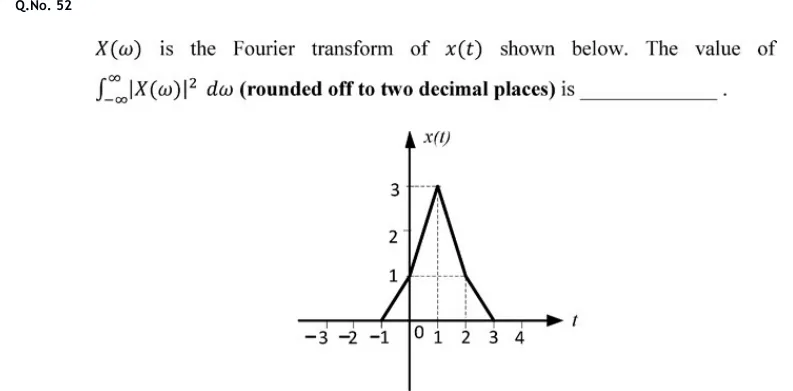
is the Fourier transform of shown below. The value of (rounded off to two decimal places) is ______.
 Tap to open full size
Plot of x(t) against t (t-axis marked -3, -2, -1, 0, 1, 2, 3, 4; vertical axis marked 1, 2, 3). x(t) is piecewise linear: zero for t < -1; rises linearly from (-1, 0) to (0, 1); rises more steeply from (0, 1) to the peak (1, 3); falls from (1, 3) to (2, 1); falls from (2, 1) to (3, 0); zero for t > 3. Dashed guide lines: a horizontal one from the vertical axis at level 3 to the peak, a horizontal one at level 1 from the vertical axis to t = 2, and vertical ones at t = 1 (up to the peak) and t = 2 (up to level 1).
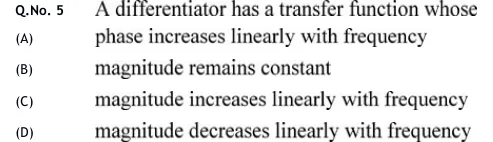
A differentiator has a transfer function whose
phase increases linearly with frequency
magnitude remains constant
magnitude increases linearly with frequency
magnitude decreases linearly with frequency
Consider the signal . Let be the Fourier transform of . The value of is ____
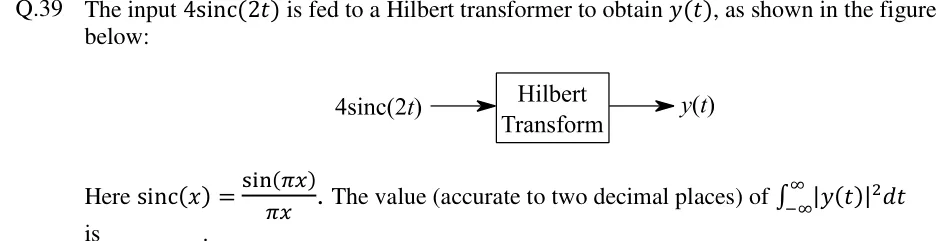
The input is fed to a Hilbert transformer to obtain , as shown in the figure below:
[Figure]
Here . The value (accurate to two decimal places) of is ______.
 Tap to open full size
A single block labelled 'Hilbert Transform'. An arrow labelled 4 sinc(2t) enters it from the left, and an arrow labelled y(t) leaves it on the right. There are no other blocks or feedback paths.
The Fourier transform of a continuous-time signal is given by where and denotes frequency. Then the value of at is ________ (up to 1 decimal place). ( denotes the logarithm to base )
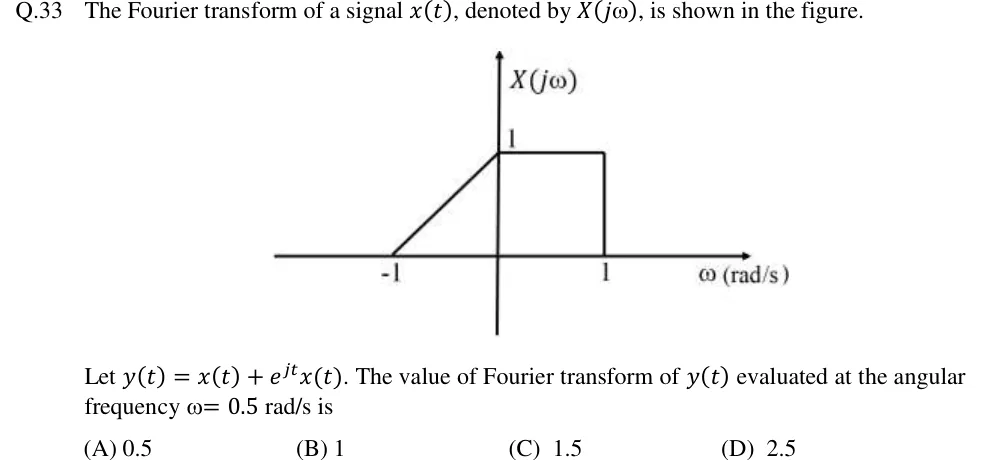
The Fourier transform of a signal , denoted by , is shown in the figure.
Let . The value of Fourier transform of evaluated at the angular frequency rad/s is
 Tap to open full size
Plot of X(j ω) (vertical axis) against ω in rad/s (horizontal axis). X(j ω) = 0 for ω < -1. From ω = -1 it rises linearly (a straight ramp) to the value 1 at ω = 0 (the value 1 is marked on the vertical axis). It then stays flat at 1 from ω = 0 to ω = 1, and drops vertically to 0 at ω = 1. X(j ω) = 0 for ω > 1. Labelled ticks on the horizontal axis: -1 and 1.
0.5
1
1.5
2.5
PRACTICE
A continuous-time signal has Fourier transform . The Fourier transform of is
Answer: (A)
Write : scale first, then delay by s.
, and a delay of s multiplies by .
Check by the other order: ; replacing by scales every to and divides by 2, giving . Option B forgets that the shift is scaled too.
The signal is applied to an ideal lowpass filter with for rad/s and otherwise. The energy of the output signal, , is ______ (rounded off to three decimal places).
Answer: (accepted range )
, so .
By Parseval, .
Check: the input energy is and the fraction passed is , so .
The signal is passed through an ideal Hilbert transformer with frequency response . The output is
Answer: (A)
The transformer has unit gain and shifts every positive-frequency component by , so a real sinusoid with becomes .
. Also .
The output is .
A real signal has Fourier transform given by for rad/s and otherwise. The value of is ______ (rounded off to three decimal places).
Answer: (accepted range )
: the area under the spectrum divided by .
The spectrum is a triangle of base 8 rad/s and height 1, with area .
.
A sequence has for respectively, and for every other . Its DTFT is . Which of the following statements is/are correct?
Answer: (A), (B), (C)
. A is correct.
. B is correct.
By Parseval the integral equals . C is correct.
, not 3. The value 3 is , which needs the factor inside the integral. D is wrong.
A stable LTI system has transfer function . Phase delay is and group delay is , where is the unwrapped phase. Which of the following statements is/are correct?
for every .
The group delay at is s.
The phase delay equals the group delay at rad/s.
The phase delay at rad/s is s.
Answer: (A), (B), (D)
, so the gain is 1 at every frequency (an all-pass). A is correct.
, so . At , s. B is correct.
At : , so s. D is correct.
At , s, which is not s, so C is wrong. The phase is not linear, so the two delays differ.
OFFICIAL GATE 2027 SYLLABUS WORDING
Copied from the GATE 2027 syllabus; see all 2027 syllabi.
GATE EC
frequency response, group delay, phase delay … Fourier transform
GATE EE
Applications of Fourier Transform for continuous and discrete time signals
GATE IN
Fourier … transforms … frequency response
Preparing in Kolkata? IAE Academy's course for GATE ECE, GATE EE or GATE IN.