IAE Academy

GATE 2023 EC Q.29: solution and answer

GATE 2023 · ECQ.29 · 1 mark · MCQ

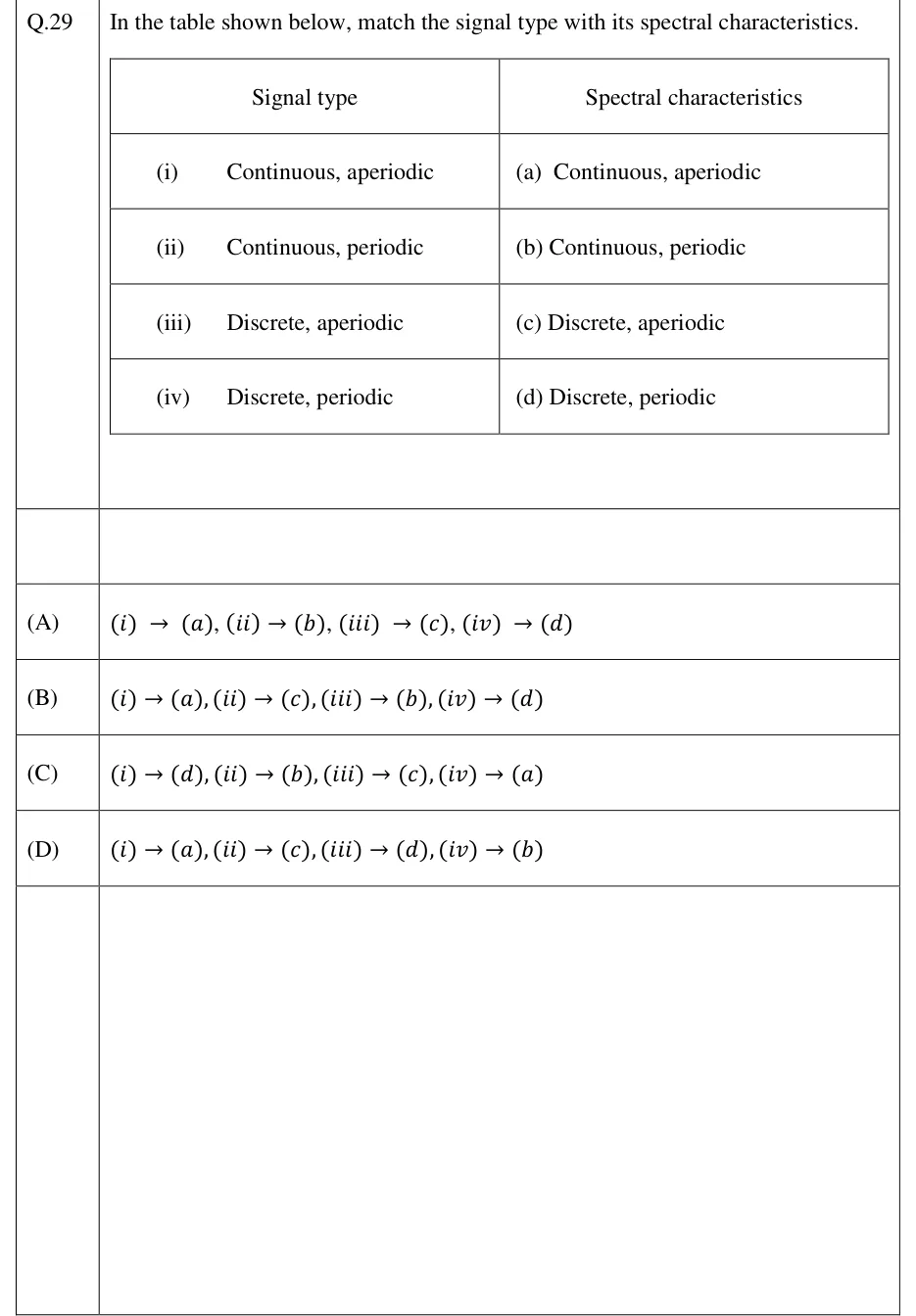
In the table shown below, match the signal type with its spectral characteristics.

| Signal type | Spectral characteristics |
|---|---|
| (i) Continuous, aperiodic | (a) Continuous, aperiodic |
| (ii) Continuous, periodic | (b) Continuous, periodic |
| (iii) Discrete, aperiodic | (c) Discrete, aperiodic |
| (iv) Discrete, periodic | (d) Discrete, periodic |

  1. (A)

  2. (B)

  3. (C)

  4. (D)

See the question in the paper

Answer and solution

ANSWER

The matching is (i) → (a), (ii) → (c), (iii) → (b), (iv) → (d), which is option (B).

Official answer: BSource: Official answer key, GATE 2023 EC (IIT Kanpur)

  1. Duality rule between the two domains: periodic in one domain discrete in the other, and discrete (sampled) in one domain periodic in the other. The complementary pairs also hold: aperiodic in one domain continuous in the other, and continuous in one domain aperiodic in the other.

  2. (i) Continuous-time, aperiodic : the transform is the CTFT . Aperiodic in time gives a continuous spectrum, and continuous time gives an aperiodic spectrum, so (i) (a).

  3. (ii) Continuous-time, periodic with period : the tool is the continuous-time Fourier series, whose spectrum has lines only at , where . Periodic in time gives a discrete spectrum, and continuous time gives an aperiodic spectrum, so (ii) (c).

  4. (iii) Discrete-time, aperiodic : the transform is the DTFT , which satisfies because for every integer . Discrete time gives a periodic spectrum, and aperiodic time gives a continuous spectrum, so (iii) (b).

  5. (iv) Discrete-time, periodic with period : the tool is the discrete-time Fourier series (the DFT form). Its coefficients exist only at integer and repeat, , so the spectrum is discrete and periodic: (iv) (d).

  6. The matching is (i) (a), (ii) (c), (iii) (b), (iv) (d), which is option (B).

KEY IDEA

Periodicity and discreteness trade places between time and frequency. A signal that is periodic in one domain is discrete in the other, and one that is discrete in one domain is periodic in the other. So CTFT gives continuous and aperiodic, CTFS gives discrete and aperiodic, DTFT gives continuous and periodic, and DTFS/DFT gives discrete and periodic.

WATCH OUT FOR

Picking option (A) by assuming the spectrum keeps the time signal's own properties, e.g. that a continuous periodic signal has a continuous periodic spectrum. The properties swap roles: periodicity in time makes the spectrum discrete (ii → c), and sampling in time makes the spectrum periodic (iii → b). Option (D) wrongly gives the DTFT of an aperiodic sequence a discrete spectrum. The DTFT is a continuous function of ; only a periodic sequence has a discrete spectrum.

From the GATE 2023 EC paper. Every question of this paper · Download the full paper · All 22 Fourier transform questions, with notes

More Fourier transform questions