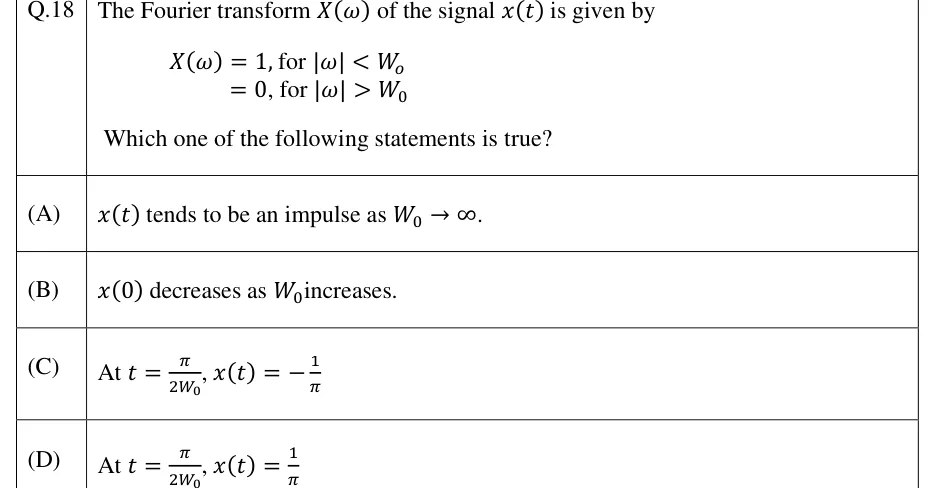
The Fourier transform of the signal is given by
Which one of the following statements is true?
- (A)
tends to be an impulse as .
- (B)
decreases as increases.
- (C)
At ,
- (D)
At ,

The Fourier transform of the signal is given by
Which one of the following statements is true?
tends to be an impulse as .
decreases as increases.
At ,
At ,
ANSWER
(A) is correct. As , tends to an impulse. Here , and as the spectrum widens to for all it becomes the transform of .
Official answer: ASource: Official answer key, GATE 2023 EE (IIT Kanpur)
Inverse Fourier transform of the rectangular (ideal low-pass) spectrum:
Value at the origin (area under the spectrum divided by ): This grows as increases, so (B) is false.
At : This value is positive and depends on . It is never , and it equals only for the one value . The question leaves general, so (C) and (D) are both false.
As , for every . Since , . You can see this in the sinc itself: its peak grows without bound, its main lobe (between the zeros at ) has width , which shrinks to zero, and its total area stays . So (A) is true.
Only statement (A) is true.
KEY IDEA
Time and bandwidth trade off. A rectangular spectrum of half-width gives , whose peak is , main-lobe width is and area is . As the band widens without limit, the pulse gets taller and narrower while its area stays 1, which is an impulse. Equivalently, a flat spectrum is the transform of .
WATCH OUT FOR
Forgetting the factor, or taking or . At that leads students to a -free value like , so they pick (C) or (D). The correct value, , depends on . A second trap is thinking falls as grows because 'the sinc gets narrower'. The pulse does narrow, but its peak rises.
From the GATE 2023 EE paper. Every question of this paper · Download the full paper · All 22 Fourier transform questions, with notes