
IAE Academy

GATE 2022 EC Q.23: solution and answer

GATE 2022 · ECQ.23 · 1 mark · MCQ

The frequency response of a linear time-invariant system has magnitude as shown in the figure.

Statement I: The system is necessarily a pure delay system for inputs which are bandlimited to .

Statement II: For any wide-sense stationary input process with power spectral density , the output power spectral density obeys for .

Which one of the following combinations is true?
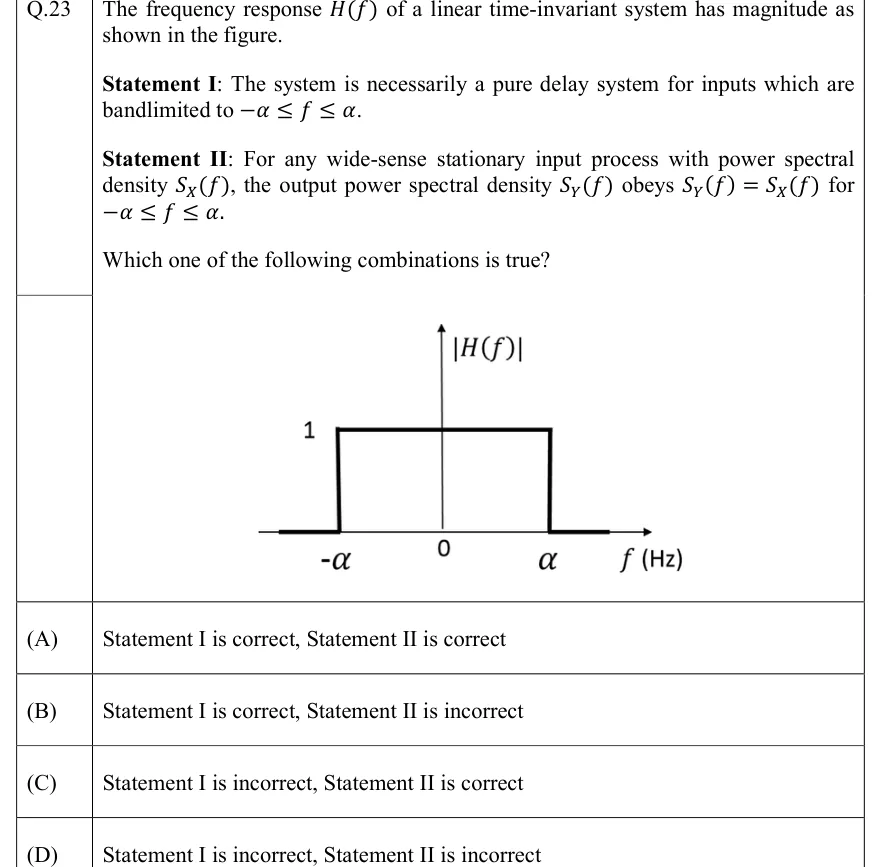
GATE 2022 EC question 23: Plot of |H(f)| (vertical axis, labelled |H(f)|) against f (horizontal axis, labelled f (Hz)).Tap to open full size
Figure from the GATE 2022 EC paper. It is part of the question.
Figure description

Plot of |H(f)| (vertical axis, labelled |H(f)|) against f (horizontal axis, labelled f (Hz)). The magnitude is a rectangle centred on the origin: |H(f)| = 1 for - α ≤ f ≤ α (level marked 1 on the left) and |H(f)| = 0 outside, with vertical edges at f = - α and f = α. The origin is marked 0. Only the magnitude is shown; no phase plot is given.

  1. (A)

    Statement I is correct, Statement II is correct

  2. (B)

    Statement I is correct, Statement II is incorrect

  3. (C)

    Statement I is incorrect, Statement II is correct

  4. (D)

    Statement I is incorrect, Statement II is incorrect

Answer and solution

ANSWER

(C) Statement I is incorrect, Statement II is correct.

Official answer: CSource: Official answer key, GATE 2022 EC (IIT Kharagpur)

  1. What the figure gives. Only the magnitude is specified: for and outside. The phase is not given. So inside the band the response can be with any phase function .

  2. What a pure delay needs. A pure delay means . For every input bandlimited to this requires across the band: unit magnitude and a phase that is linear in and passes through the origin, . In particular .

  3. Counter-example for Statement I. Take for and outside, i.e. , a real impulse response. Its magnitude is exactly the figure. For any input bandlimited to the output is . A pure delay would need , but here . Concretely, the constant input (spectrum , inside the band) gives , while for every . Any other phase that is not linear through the origin fails in the same way (a Hilbert-type phase , for example). The magnitude alone cannot force a pure delay, so Statement I is incorrect.

  4. PSD through an LTI system. For a WSS input, . Taking Fourier transforms (the PSD is the Fourier transform of the autocorrelation) gives Only appears, so the phase has no effect.

  5. Apply it to the band. For we have , so for every WSS input, whatever the phase is. (In the counter-example, gives , which agrees.) Statement II is correct.

  6. Statement I is incorrect and Statement II is correct, so the answer is option (C).

KEY IDEA

For a WSS input, the output power spectrum depends only on , so a flat unit magnitude over passes through unchanged. Keeping the waveform intact (a pure delay) needs more than that: the phase must also be linear through the origin, , and a magnitude plot says nothing about phase.

WATCH OUT FOR

Reading a flat unit-magnitude band as "distortionless" and picking (A). This forgets that a pure delay also needs linear phase through the origin: or a Hilbert-type phase has the same magnitude and is not a delay. A second slip is writing instead of and then worrying that the unknown phase makes Statement II false.

From the GATE 2022 EC paper. Every question of this paper · Download the full paper · All 22 Fourier transform questions, with notes

More Fourier transform questions