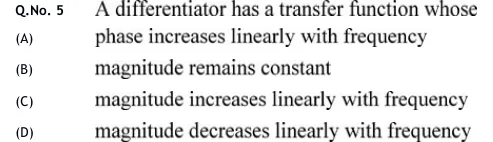
A differentiator has a transfer function whose
- (A)
phase increases linearly with frequency
- (B)
magnitude remains constant
- (C)
magnitude increases linearly with frequency
- (D)
magnitude decreases linearly with frequency

A differentiator has a transfer function whose
phase increases linearly with frequency
magnitude remains constant
magnitude increases linearly with frequency
magnitude decreases linearly with frequency
ANSWER
(C). The magnitude increases linearly with frequency, because gives .
Official answer: CSource: Official answer key, GATE 2020 IN (IIT Delhi)
Time-domain definition. An ideal differentiator gives .
Differentiation property of the Laplace/Fourier transform. (with zero initial condition), so . On the -axis this is .
Magnitude. for . It is directly proportional to frequency, so it increases linearly with : a straight line through the origin on a linear scale, or a slope of on a Bode plot.
Phase. for every . The phase is constant, not linear in , so (A) is false.
Check the other options. (B) needs independent of (a pure gain or an all-pass system), which is not. (D) needs , which is the integrator , not the differentiator.
Only option (C) holds.
KEY IDEA
Differentiating in time multiplies the transform by (by on the frequency axis). So an ideal differentiator has . Its magnitude grows in direct proportion to frequency, and its phase stays fixed at .
WATCH OUT FOR
Mixing up magnitude and phase and picking (A). The phase of is a constant , not linear in ; linear phase belongs to a pure time delay . The other common slip is swapping differentiator and integrator: (option D) is the integrator .
From the GATE 2020 IN paper. Every question of this paper · Download the full paper · All 22 Fourier transform questions, with notes