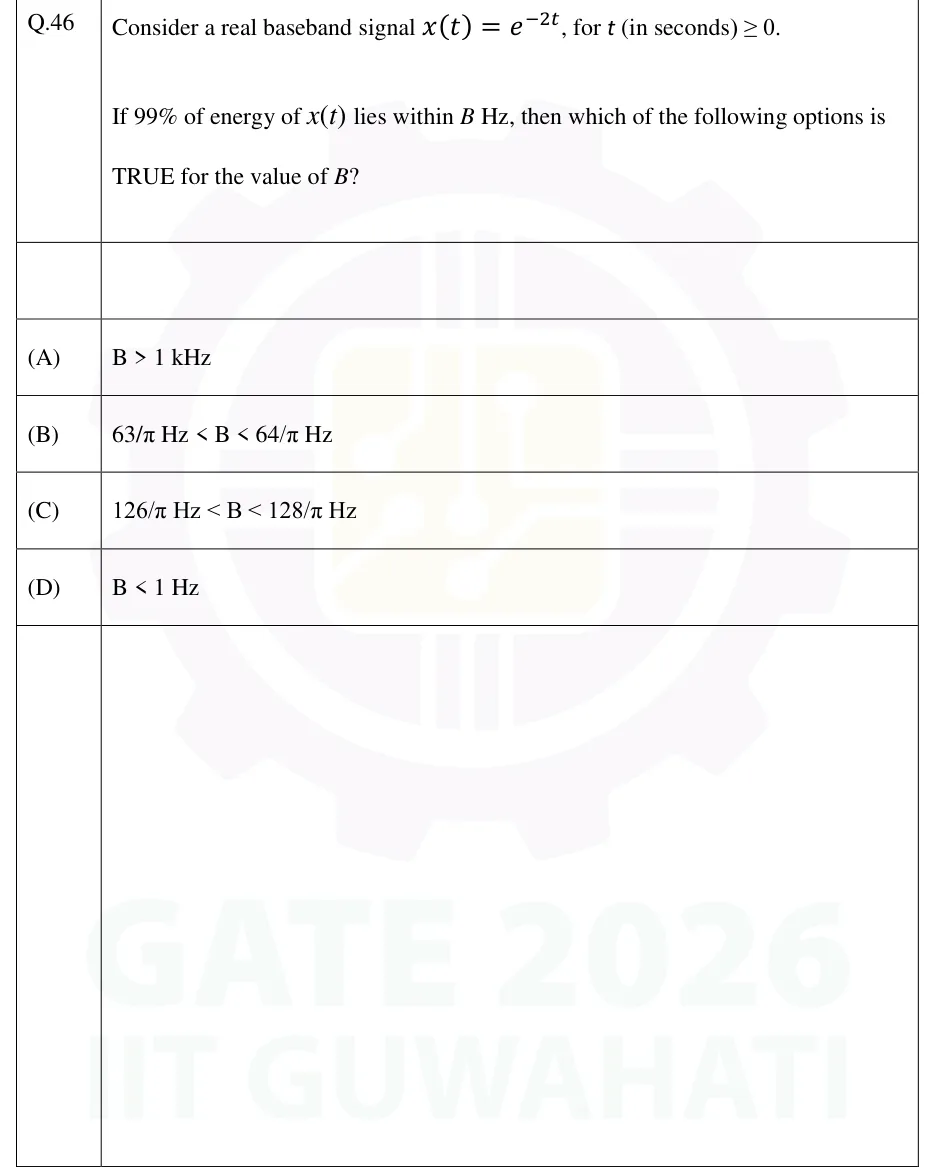
Consider a real baseband signal , for (in seconds) .
If 99% of energy of lies within Hz, then which of the following options is TRUE for the value of ?
- (A)
- (B)
- (C)
- (D)

Consider a real baseband signal , for (in seconds) .
If 99% of energy of lies within Hz, then which of the following options is TRUE for the value of ?
ANSWER
Option (B): . The 99% energy bandwidth is .
Official answer: BSource: Official answer key, GATE 2026 EC (IIT Guwahati)
Total energy (time domain): .
Fourier transform in Hz: , so .
Energy inside the band (Parseval / Rayleigh): for a real baseband signal, a bandwidth of Hz means the band , i.e. both sides of the spectrum. Since is even,
Energy fraction: . As a check, this tends to as , as it must.
Set it equal to 0.99: , so
(For a small angle , ; the correction here is only about , so lies well inside .)
Bandwidth: .
Place it among the options: , so , which is option (B). Option (A) is far too large and option (D) far too small. Cross-check in rad/s: gives , so and , the same result.
KEY IDEA
Use Rayleigh's (Parseval's) theorem. The total energy is and . Integrating this over the two-sided band gives the energy fraction . Setting that equal to gives .
WATCH OUT FOR
Working in rad/s, getting , then dividing by instead of . That gives Hz, which is the trap option (C). A second slip is integrating only without doubling for the negative frequencies. The fraction then tops out at and can never reach .
From the GATE 2026 EC paper. Every question of this paper · Download the full paper · All 22 Fourier transform questions, with notes