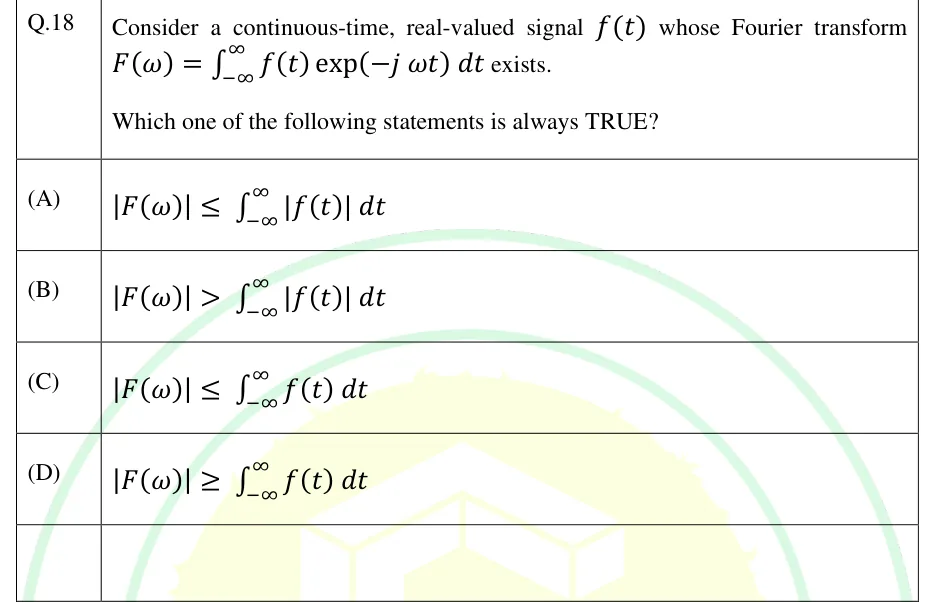
Consider a continuous-time, real-valued signal whose Fourier transform exists.
Which one of the following statements is always TRUE?
- (A)
- (B)
- (C)
- (D)

Consider a continuous-time, real-valued signal whose Fourier transform exists.
Which one of the following statements is always TRUE?
ANSWER
(A) is always true. It follows from the triangle inequality for integrals, because .
Official answer: ASource: Official answer key, GATE 2025 EC (IIT Roorkee)
Triangle inequality for integrals. The magnitude of an integral is never more than the integral of the magnitude:
Unit magnitude of the kernel. For real and , , so This is statement (A). It holds for any whose transform exists: if is not absolutely integrable, the right-hand side is infinite and the inequality is trivially true.
(B) is ruled out because it is the exact negation of the bound just proved, so it is false for every signal at every . For example, for any , at we get (equality, not ).
(C) fails for a signal that integrates to zero. With for and otherwise, take : a pulse on and a pulse on . Then , while At , , so is false.
(D) fails at a spectral null. Take : , while is at . Then .
Only (A) is always true.
KEY IDEA
. The area under bounds the spectrum's magnitude at every frequency. The bound is reached at when , which is why the strict inequality in (B) can never hold.
WATCH OUT FOR
Choosing (C) or (D) because . The signed area only gives the spectrum's value at . It bounds in neither direction: it can be zero or negative while elsewhere, which breaks (C), and can fall to zero at a spectral null, which breaks (D). A bound that holds at every frequency needs the absolute value inside the integral.
From the GATE 2025 EC paper. Every question of this paper · Download the full paper · All 22 Fourier transform questions, with notes