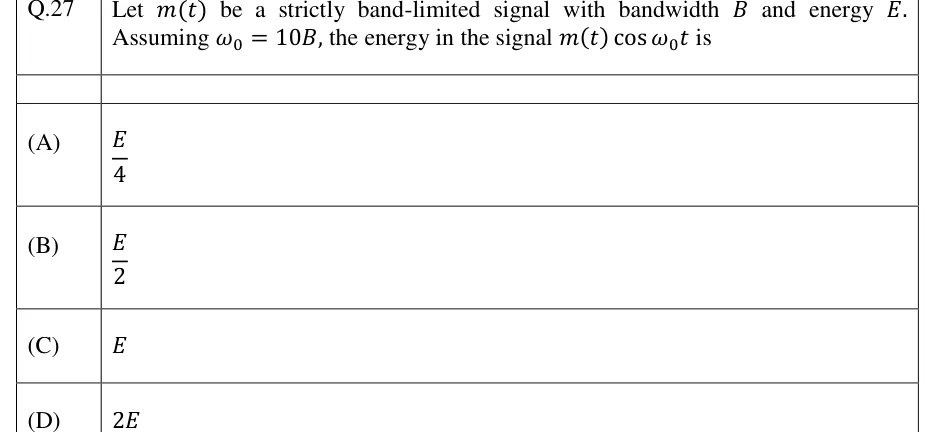
Let be a strictly band-limited signal with bandwidth and energy . Assuming , the energy in the signal is
- (A)
- (B)
- (C)
- (D)

Let be a strictly band-limited signal with bandwidth and energy . Assuming , the energy in the signal is
ANSWER
The energy of is , option (B).
Official answer: BSource: Official answer key, GATE 2023 EC (IIT Kanpur)
Modulation property of the Fourier transform: with ,
is zero outside , where is the bandwidth in rad/s ( if is in rad/s, if is in Hz). The two shifted copies occupy and .
The copies are disjoint when the lower edge of the right copy lies above the upper edge of the left copy: , i.e. . With this holds whichever unit is in, since and . So the two copies do not overlap.
Parseval's theorem: The cross term is zero at every , because wherever one copy is non-zero the other is zero.
A frequency shift does not change the area under , so each shifted copy carries energy :
Time-domain check: , so The second integral is the real part of the Fourier transform of evaluated at . is band-limited to and , so that integral is zero and . Answer: (B).
KEY IDEA
Multiplying by splits the spectrum into two half-amplitude copies at . When exceeds the signal bandwidth the copies do not overlap. Each copy then carries , so the total is . It is the same as saying the average of is .
WATCH OUT FOR
Picking because and the cosine "only shifts the spectrum", which forgets the factor on each copy. Or picking by squaring that and counting only one of the two copies. The given is there to guarantee there is no spectral overlap. Without it the cross term would not vanish and the energy would not be exactly .
From the GATE 2023 EC paper. Every question of this paper · Download the full paper · All 22 Fourier transform questions, with notes