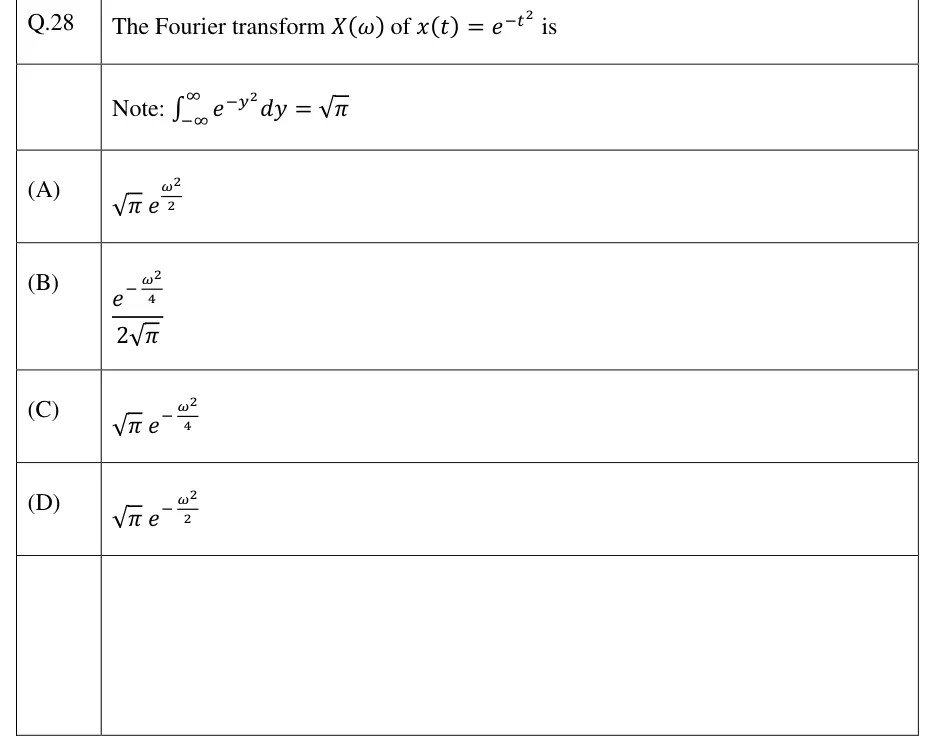
The Fourier transform of is
Note:
- (A)
- (B)
- (C)
- (D)

The Fourier transform of is
Note:
ANSWER
, which is option (C).
Official answer: CSource: Official answer key, GATE 2023 EC (IIT Kanpur)
Start from the definition of the Fourier transform:
Complete the square in the exponent: because , so the square is corrected by adding back .
Take the constant factor out of the integral:
Substitute , so . This moves the path of integration to a line parallel to the real axis. Because is analytic everywhere and as for any fixed , the short vertical sides of the shifted contour contribute nothing, and the integral equals the given Gaussian integral:
Therefore
Quick checks on the options. First, . Option (B) gives , so it is out. Second, is absolutely integrable, so as . Option (A) grows without bound, so it is out. Options (C) and (D) both pass these checks, and the derivation settles it: the exponent is , not . Answer: (C).
KEY IDEA
A Gaussian transforms to a Gaussian. Complete the square in and the leftover term gives the factor . The remaining integral is the given . In general for ; this question is the case .
WATCH OUT FOR
Getting the sign of the completed-square term wrong. Since , the leftover is inside , which gives a decaying . Dropping the produces the growing (the trap in (A)). Another slip is to use the Gaussian-density form , which leads to the exponent in (D). Setting is a fast check: it must give .
From the GATE 2023 EC paper. Every question of this paper · Download the full paper · All 22 Fourier transform questions, with notes