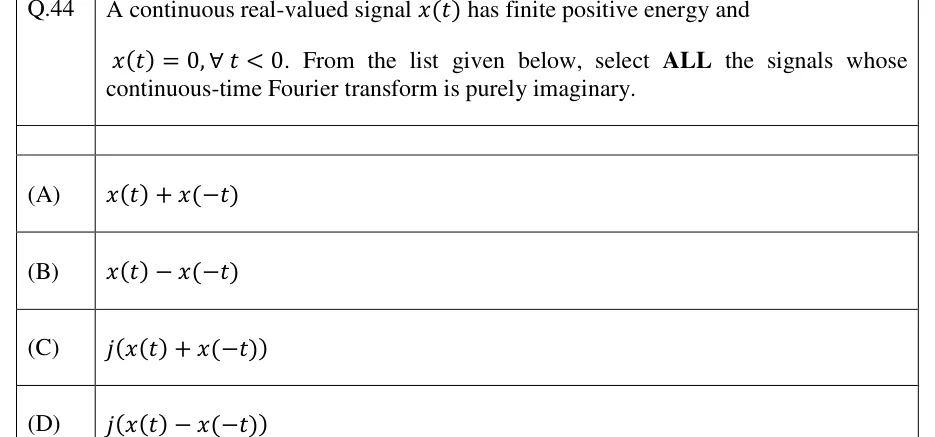
A continuous real-valued signal has finite positive energy and . From the list given below, select ALL the signals whose continuous-time Fourier transform is purely imaginary.
- (A)
- (B)
- (C)
- (D)

A continuous real-valued signal has finite positive energy and . From the list given below, select ALL the signals whose continuous-time Fourier transform is purely imaginary.
ANSWER
The Fourier transforms of and are purely imaginary, so the answer is (B) and (C).
Official answer: B, CSource: Official answer key, GATE 2023 IN (IIT Kanpur)
Let . The transform exists because has finite energy. Time reversal gives . Because is real, conjugate symmetry gives , so .
(A) . This is real, not imaginary. (A real, even signal has a real, even transform.)
(B) . This is purely imaginary. (A real, odd signal has an imaginary, odd transform.)
(C) By linearity, . This is times a real function, so it is purely imaginary.
(D) By linearity, . This is real.
Why the causality and positive-energy conditions are given: since for , for every we have , so the even part and the odd part both equal there. All the energy of sits in and is positive, so neither part is the zero signal, and by uniqueness neither nor is identically zero. So the transforms in (A) and (D) are genuinely nonzero real functions, not trivially zero (a zero function would count as both real and imaginary). Without causality an even could make (B) and (D) vanish.
Hence the transforms of (B) and (C) are purely imaginary. Answer: B, C.
KEY IDEA
For a real signal, . So the even part has transform , which is real, and the odd part has transform , which is imaginary. Multiplying a signal by multiplies its transform by , which turns real into imaginary and imaginary into real. Causality with positive energy makes sure the even and odd parts are both nonzero, so none of the four transforms is trivially zero.
WATCH OUT FOR
Marking only (B) because you remember "real and odd gives imaginary" and forgetting that the factor in (C) turns the real transform of the even part into an imaginary one. The opposite mistake is marking (D) because it "has a in it": there , so its transform comes out real.
From the GATE 2023 IN paper. Every question of this paper · Download the full paper · All 22 Fourier transform questions, with notes