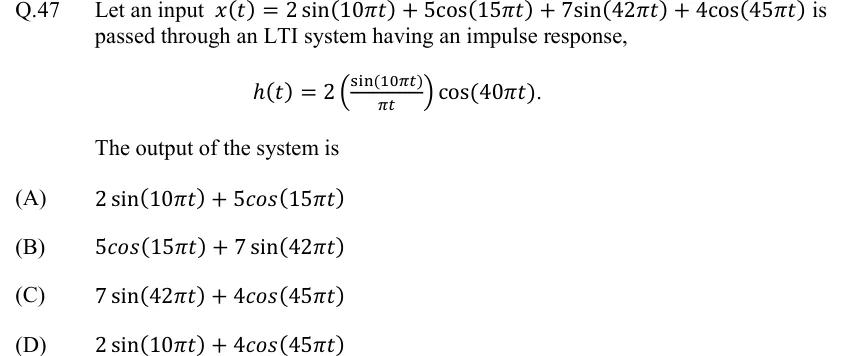
Let an input is passed through an LTI system having an impulse response,
The output of the system is
- (A)
- (B)
- (C)
- (D)

Let an input is passed through an LTI system having an impulse response,
The output of the system is
ANSWER
The output is , option (C). The system is an ideal band-pass filter with unity gain over .
Official answer: CSource: Official answer key, GATE 2022 EE (IIT Kharagpur)
Standard pair (ideal low-pass): . With , the term has spectrum for and outside.
Modulation property: with . Each shifted copy has height , and the two copies (centred at , each wide) do not overlap.
So is an ideal band-pass filter: (passband , i.e. to , with unity gain). Since is real and even, is real, so the filter adds zero phase.
Sinusoid through an LTI system: each input tone at comes out scaled by and shifted by . Here is real and non-negative, so every passed tone keeps its amplitude and phase.
Check each input frequency against the passband : is blocked, is blocked, passes with gain 1, and passes with gain 1. No tone sits on a band edge, so there is no ambiguity.
Therefore , which is option (C).
KEY IDEA
is an ideal low-pass impulse response, , multiplied by . That multiplication shifts the low-pass band to , so the system is an ideal band-pass filter over . The factor 2 cancels the from modulation, so the gain is exactly 1. An LTI system passes each sinusoid on its own, scaled by , so we only need to check which input frequencies fall inside the band.
WATCH OUT FOR
The usual slip is to ignore the factor and treat as a low-pass filter with cutoff . That keeps the low tones and points to option (A), which is wrong. A second slip is to drop the of the modulation property. That gives a passband gain of 2, and the resulting is not among the options. A third is to mix up rad/s and Hz and read the band as 30 to 50 Hz. The input tones are at 5, 7.5, 21 and 22.5 Hz, and none of those would fall inside a 30 to 50 Hz band.
From the GATE 2022 EE paper. Every question of this paper · Download the full paper · All 22 Fourier transform questions, with notes