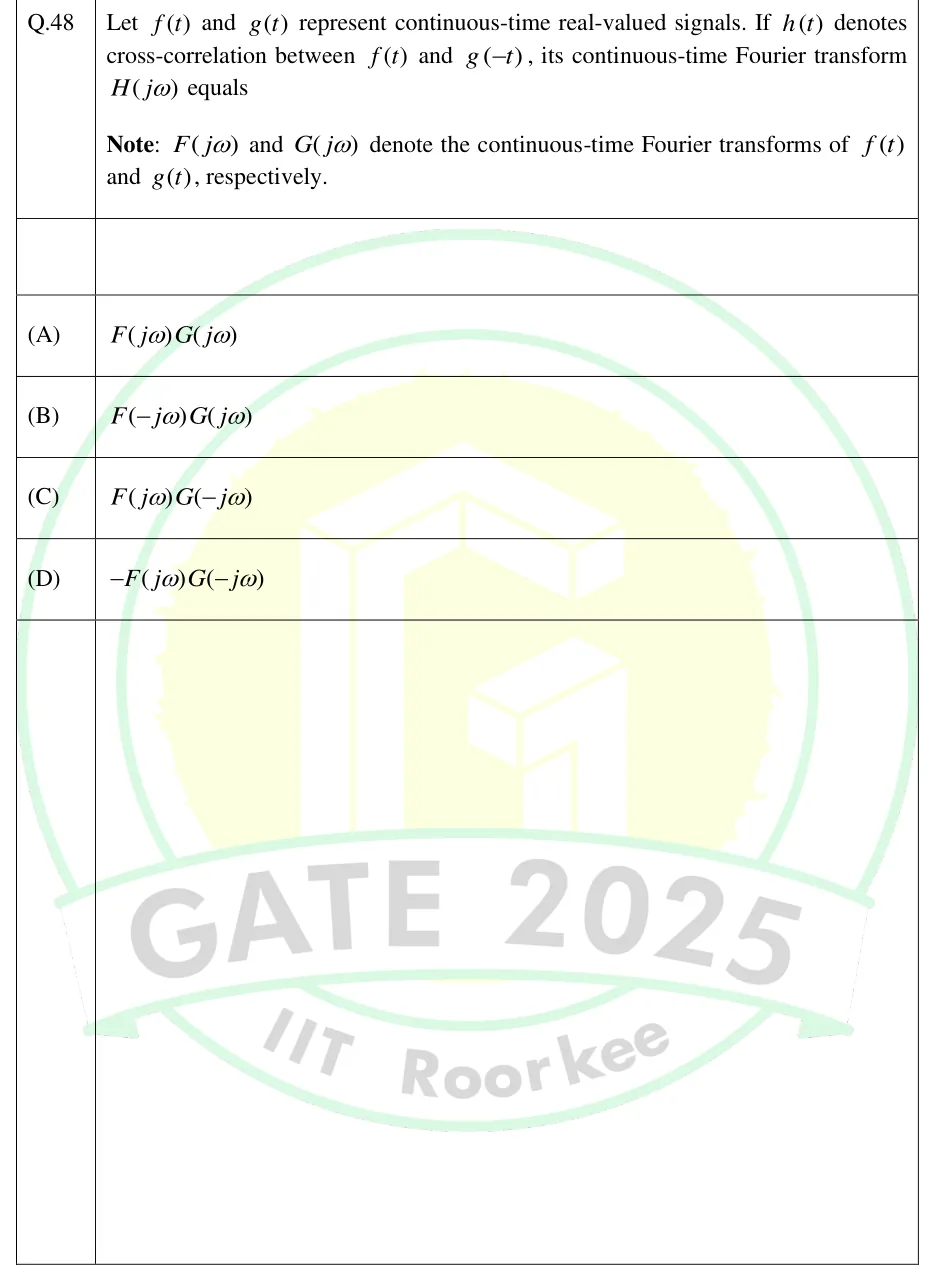
Let and represent continuous-time real-valued signals. If denotes cross-correlation between and , its continuous-time Fourier transform equals
Note: and denote the continuous-time Fourier transforms of and , respectively.
- (A)
- (B)
- (C)
- (D)

Let and represent continuous-time real-valued signals. If denotes cross-correlation between and , its continuous-time Fourier transform equals
Note: and denote the continuous-time Fourier transforms of and , respectively.
ANSWER
The cross-correlation of with is the convolution , so . The answer is option (A).
Official answer: ASource: Official answer key, GATE 2025 IN (IIT Roorkee)
Definition of cross-correlation for real signals: Here and .
Substitute : Correlating with a time-reversed signal is the same as convolving with the original signal.
Convolution property of the Fourier transform: , so .
Check with the correlation theorem: for real . Time reversal gives . Because is real, , so and again.
Option (C), , is the transform of the cross-correlation of with itself, not with . Option (B), , is the transform of the correlation taken in the other order, with . Option (D) is (C) with a minus sign that has no source. The answer is (A).
KEY IDEA
Cross-correlation is convolution with the second signal time-reversed: . If the second signal is already , the two reversals cancel, , and the convolution property gives .
WATCH OUT FOR
Using the correlation theorem as with instead of the transform of . That gives option (C), which is the answer for correlating with and ignores the time reversal the question builds in. Swapping the order of the two signals gives option (B).
From the GATE 2025 IN paper. Every question of this paper · Download the full paper · All 22 Fourier transform questions, with notes