IAE Academy

GATE EC · EE · IN

Fourier series

A Fourier series writes a periodic signal as a sum of sinusoids at integer multiples of one fundamental frequency, so a question about a waveform becomes a question about a list of coefficients. With it you read off the DC value, the harmonic content and the average power of a waveform, spot missing harmonics from symmetry without integrating, and find the steady-state output of an LTI system (a filter or an RC network) driven by a periodic input.

11 previous-year questions · 11 solved · 6 practice questions

1. Periodic signals and the three forms of the series

A continuous-time signal is periodic if for all . The smallest such is the fundamental period (a constant signal has none), and rad/s ( Hz) is the fundamental frequency. The -th harmonic is the component at .

A sum of sinusoids with nonzero amplitudes is periodic if and only if every ratio of their frequencies is rational. The fundamental frequency of the sum is then the greatest common divisor (GCD) of the individual frequencies, that is, the largest of which every frequency is an integer multiple, and is the least common multiple (LCM) of the individual periods.

FUNDAMENTAL OF A SUM OF SINUSOIDS

Valid only when every ratio is rational. Example: has rad/s and s; is not periodic at all.

Convention used on this page. Frequencies are in rad/s with , and means an integral over any one full period ( to , or to , give the same result). In the trigonometric form, is the DC value itself, i.e. the average over a period. Some texts write the DC term as with . Both conventions describe the same series, so check which one a question uses before reading off a number. Where a Fourier transform appears, it is written in : , with the in the inverse.

EXPONENTIAL FOURIER SERIES (SYNTHESIS AND ANALYSIS)

Holds for real or complex . is the average (DC) value. Plotting and against gives the two-sided line spectrum.

ORTHOGONALITY OF THE HARMONICS

and are integers. Multiplying the synthesis equation by and averaging over a period removes every term except , which is where the analysis formula comes from. The same orthogonality is why harmonic powers simply add in Parseval's theorem (Section 4).

TRIGONOMETRIC FOURIER SERIES

For real , with the DC value (convention above).

TRIGONOMETRIC COEFFICIENTS

Here ; the factor is for and but for .

COMPACT (AMPLITUDE-PHASE) FORM

For real . This is the one-sided spectrum: is the physical peak amplitude of the -th harmonic, and its phase.

RELATIONS BETWEEN THE COEFFICIENTS

For real and . is the angle of the phasor , so and . The shortcut is right only when ; when , add or subtract .

Form

Basis functions

Coefficients

Spectrum

Exponential

,

complex

two-sided; for real , is even and is odd in

Trigonometric

, , ,

real , ,

not plotted directly

Compact

,

and

one-sided;

EXAM TIP

Reading coefficients off a sum of sinusoids needs no integral. Expand each term with Euler's formula: , so . A sine term gives and . The index is the term's frequency divided by the fundamental of the whole signal, not of that term alone. A negative amplitude is a phase of : has and .

2. Existence and convergence: Dirichlet conditions and the Gibbs phenomenon

The analysis integral gives numbers whenever is absolutely integrable over a period, but the series built from them need not equal at every instant. Two separate results matter.

If has finite energy over one period, , the series converges in the mean-square sense: the energy of the error between and the partial sum goes to zero as terms are added, even though individual points may still disagree. For point-by-point convergence, the Dirichlet conditions are used.

Dirichlet conditions (sufficient, not necessary; all three together):

  1. is absolutely integrable over one period: . ( on , repeated, fails this.)

  2. has a finite number of maxima and minima in one period. ( on , repeated, fails this.)

  3. has a finite number of discontinuities in one period, and each is a finite jump.

VALUE OF THE SERIES AT A JUMP

When the Dirichlet conditions hold, the series equals wherever is continuous and the midpoint of the jump at a discontinuity . The partial sums are taken symmetrically, to . A square wave switching between and has series value at every switching instant.

Gibbs phenomenon. Near a jump, the partial sum overshoots and rings. As grows the ripples crowd towards the jump and the region they occupy narrows, but the peak overshoot does not shrink. It tends to about of the jump height on each side of the jump (more exactly times the jump, the value of ). The mean-square error still goes to zero, because the overshoot occupies a vanishing width. For a square wave between and (jump ), the partial sums peak near however many terms are kept.

EXAM TIP

Gibbs ringing appears only at jump discontinuities. A continuous waveform with kinks, such as a triangle wave or a rectified sine, has partial sums that converge uniformly, with no persistent overshoot. Adding more terms never removes the overshoot at a jump; it only narrows it.

EXAM TIP

The Dirichlet conditions are sufficient, not necessary. The impulse train is not an ordinary function, so they do not apply to it, yet in the generalised-function sense it has a perfectly good series with for every .

3. Symmetry shortcuts

Before integrating anything, test the waveform for symmetry. Each symmetry forces a whole family of coefficients to zero and lets you integrate over half a period and double the result. Even and odd symmetry are judged about the time origin as drawn, so moving the origin can change them; half-wave symmetry does not depend on where the origin is placed. Moving the origin never changes or the power. In the table below, the trigonometric column and the words "real" and "imaginary" assume is real.

Symmetry

Condition

What survives (trigonometric)

Exponential coefficients

Even

and cosines ; every

real,

Odd

sines only; , every

purely imaginary,

Half-wave

odd harmonics only;

for every even , including

Even + half-wave (quarter-wave)

both of the above

odd-harmonic cosines only

real, nonzero only for odd

Odd + half-wave (quarter-wave)

both of the above

odd-harmonic sines only

imaginary, nonzero only for odd

Real signal

, , all real

: even, odd

HALF-PERIOD COEFFICIENT FORMULAS

For an even signal the DC value is also . Under half-wave symmetry every even- coefficient is zero, so these formulas are used for odd only.

Symmetry check, in order:

  1. Find the DC value , the average over one period. Areas usually give it without an integral.

  2. Subtract it. Hidden symmetry often appears only after removing the DC: a square wave (50% duty cycle) between and becomes a square wave, which is half-wave symmetric and, with a suitable origin, odd or even.

  3. Check even or odd about . If neither, see whether moving the time origin makes it so; a shift by only multiplies by .

  4. Check half-wave symmetry: shift the waveform by half a period and flip its sign. If it lands on itself, only odd harmonics exist.

  5. Integrate only the families that survive, over half a period, with the factor .

EXAM TIP

Half-wave symmetry, , is not the same as . The second means the true period is , so, counted against , it is the odd harmonics that vanish. Also, the sawtooth on is odd but not half-wave symmetric, so it contains every harmonic.

4. Properties of the Fourier series and Parseval's theorem

Let and , both with period and . The properties below give the coefficients of a new waveform from a known one without integrating again.

Property

Signal

Coefficients

Note

Linearity

same period

Time shift

unchanged; phase changes linearly with

Frequency shift

an integer

Modulation

an integer; the line spectrum is copied to harmonics away, at half height

Time reversal

equals for real

Conjugation

real gives

Even and odd parts

,

and

for real

Time scaling

,

(unchanged)

period becomes , fundamental

Differentiation

DC is lost; harmonic is scaled by

Integration

,

only if (otherwise the result grows and is not periodic); the lower limit changes only the DC, which is found separately

Multiplication

discrete convolution of the coefficient sequences

Periodic convolution

integral over one period only

TIME SHIFT AND TIME REVERSAL

A shift leaves every and the power unchanged. A shift of half a period gives .

DIFFERENTIATION AND INTEGRATION

Differentiating removes the DC and boosts high harmonics; integrating smooths. The integration rule needs zero DC in . Any other running integral (textbooks often write the lower limit as ) differs from this one only by a constant, so the DC of the result must be found from the waveform.

TIME SCALING

Compressing in time by keeps the same coefficients, DC value and power, but places them at harmonics of . Only the frequency axis stretches.

Parseval's power theorem. The average power of a periodic signal (normalised to a resistor) equals the sum of the powers of its harmonics. Harmonics are orthogonal over a period, so the cross terms average to zero and the powers simply add.

PARSEVAL'S POWER THEOREM

The trigonometric forms need real . A DC level carries power and a sinusoid carries . The RMS value is .

TOTAL HARMONIC DISTORTION

RMS of all harmonics above the fundamental divided by the RMS of the fundamental (DC excluded). For a symmetric square wave, .

EXAM TIP

Two-sided versus one-sided power. In the exponential form the -th harmonic of a real signal carries . Forgetting the negative-frequency term halves the answer. In the compact form the same power is , and makes the two agree.

EXAM TIP

Powers add only across different frequencies. Parseval adds power harmonic by harmonic, so two terms at the same frequency must first be combined into one phasor: has power , not . A cosine and a sine at the same frequency are the exception, because they are orthogonal: has power .

EXAM TIP

Differentiation trick for piecewise-linear waveforms. Differentiate until the waveform becomes a known one: a square wave, or impulses, where an impulse of area at in every period contributes to . Read off those coefficients, then divide by once per differentiation. The DC value is lost on the way, so find separately as the average. A triangle wave's derivative is a square wave, so the triangle's () are the square wave's divided by .

5. Series of standard waveforms and how fast the coefficients decay

Each waveform below has period and , with the time origin placed as stated. A different origin changes only the phases (time-shift property), and a different DC level changes only . The sinc function here is , with and zeros at every nonzero integer.

COEFFICIENTS FROM THE FOURIER TRANSFORM OF ONE PERIOD

is one period of (zero outside that period) and is its Fourier transform in (rad/s). The series coefficients are samples of the single pulse's transform at the harmonics, scaled by . The transform of the periodic signal itself is a train of impulses of area at ; in the Hz convention it is , with . Example: a rectangular pulse of height and width has , which gives the pulse-train coefficients below.

SQUARE WAVE (ODD, AMPLITUDE A)

on and on : odd and half-wave symmetric. Power , of which the fundamental carries . Shifted to be even ( for ): .

RECTANGULAR PULSE TRAIN

Height , width , centred on (even, so is real); the second form is for . With duty cycle : DC , power , and whenever is a nonzero integer. At the even harmonics vanish; at every third harmonic vanishes.

TRIANGULAR WAVE (EVEN, ZERO MEAN)

for : at , at . Even and half-wave symmetric; power . The unipolar version between and is .

SAWTOOTH WAVE (ODD)

on , rising from to and jumping back. Odd but not half-wave symmetric, so every harmonic is present; power . The ramp on is .

PERIODIC IMPULSE TRAIN

for every : a flat line spectrum that never decays. Impulses of area at give . The average power is infinite.

FULL-WAVE RECTIFIED SINE

is the frequency of the sine before rectification. The period halves to , so the fundamental is and only even multiples of appear. DC ; RMS (power , the same as the unrectified sine).

HALF-WAVE RECTIFIED SINE

The period is unchanged. DC , fundamental amplitude , then even harmonics only. RMS (power ). It equals half of (the sine plus its full-wave rectified version).

Waveform

Smoothness

falls as

Harmonics present

Impulse train

impulses in

no decay ()

all

Square wave, pulse train, sawtooth

jumps in

square: odd only; pulse train: all except where is a nonzero integer; sawtooth: all

Triangle, full-wave and half-wave rectified sine

continuous, jumps in (kinks)

triangle: odd only; full-wave: all multiples of ; half-wave: DC, and even multiples of

Waveform made of parabolic arcs (e.g. the integral of a zero-mean triangle)

and continuous, jumps in

set by its symmetry

Pure sinusoid

every derivative continuous

a single harmonic

one

COEFFICIENT DECAY RATE

For a piecewise-smooth periodic . "Decays as" describes the envelope of ; individual coefficients can still be zero, as in a pulse train. Each differentiation multiplies by . A jump in itself () gives ; a kink () gives ; impulses in give no decay. The smoother the waveform, the faster its spectrum falls and the fewer terms a good approximation needs.

WORKED EXAMPLE

A periodic signal has period ms and, over one period, V for ms and for ms. Find (a) its exponential Fourier coefficients, (b) which harmonics are missing, and (c) the fraction of the average power carried by the DC component and the fundamental together.

Solution
  1. This is a rectangular pulse train with V, ms and ms, so the duty cycle is and Hz.

  2. , with . The signal is even, so every is real.

  3. when is a nonzero integer: , so the 1 kHz, 2 kHz, 3 kHz, ... components are absent.

  4. Total power from the time domain: W (normalised to ).

  5. DC: , carrying W.

  6. Fundamental: . Its power uses both : W.

  7. Fraction . Exactly, it is .

Answer: (a) . (b) Harmonics are missing. (c) DC plus fundamental carry of the 2.25 W total.

EXAM TIP

Missing harmonics of a pulse train come from the zeros of the sinc envelope, not from symmetry. A pulse train with is even but not half-wave symmetric, so it has even harmonics (); only every fourth harmonic is absent.

6. Response of an LTI system to a periodic input

Complex exponentials are eigenfunctions of LTI systems: in gives out, where is the frequency response (it exists, for example, for every BIBO-stable system). A periodic input is a sum of such exponentials, so a stable LTI system scales and phase-shifts each harmonic separately. The output is periodic with the same and contains no frequency absent from the input: a harmonic can be removed (where ), never created.

PERIODIC INPUT TO AN LTI SYSTEM

Steady state of a BIBO-stable LTI system, after any switch-on transient has died out. is needed only at the harmonic frequencies .

SINUSOID THROUGH AN LTI SYSTEM (REAL FORM)

For real , so that . DC passes with gain . Output power by Parseval: .

Procedure for a periodic input:

  1. Find of the input: , or the GCD of its frequencies.

  2. List the input's harmonics, from a standard series, from symmetry, or by Euler's formula for a sum of sinusoids.

  3. Evaluate , magnitude and phase, at each harmonic present. For an ideal filter just decide pass or stop for each ; a harmonic sitting exactly on a cutoff edge needs the question to say which side it counts on.

  4. Multiply term by term and reassemble, or add the harmonic powers with Parseval if only output power or RMS is asked.

WORKED EXAMPLE

A square wave switching between V and V (odd, with V on ) has fundamental frequency rad/s. It drives an RC low-pass filter with and ms. Find the output fundamental and third harmonic (amplitude and phase), and compare the ratio of third-harmonic to fundamental amplitude at the output with that at the input.

Solution
  1. Input series with : V. There is no DC and no even harmonic.

  2. , so , with and .

  3. : and . Output fundamental: V, i.e. V.

  4. : and . Output third harmonic: V, i.e. V.

  5. Ratio at the input: . Ratio at the output: , which is exactly .

  6. The filter attenuates the third harmonic times more than the fundamental, so the output is closer to a sinusoid than the input.

Answer: Fundamental V; third harmonic V; the third-to-fundamental ratio falls from at the input to at the output.

EXAM TIP

Distortionless transmission of a periodic signal needs, at every harmonic present, a constant gain and a linear phase ; the output is then . Correct amplitudes with non-linear phase still change the waveform shape.

EXAM TIP

A nonlinear or time-varying system (rectifier, squarer, modulator) can create new frequencies; an LTI system cannot. If the steady-state output for a periodic input contains a frequency the input lacks, the system is not LTI. (A switch-on transient of an LTI system does contain its own natural frequencies, but it dies out in a stable system.)

7. Discrete-time Fourier series (DTFS)

A discrete-time signal is periodic with period (a positive integer) if for all . The smallest such is the fundamental period, and rad/sample is the fundamental frequency. Because for every integer , there are only distinct harmonics, so the series is a finite sum of terms: there is no convergence question and no Gibbs phenomenon in the DTFS itself.

DTFS SYNTHESIS AND ANALYSIS

means any consecutive integers, e.g. to . The coefficients are periodic, . For real , . is the average over one period.

PERIODICITY OF A DISCRETE-TIME SINUSOID

Unlike , a discrete sinusoid need not be periodic: is not, because is irrational. For a sum of periodic sequences, is the LCM of the individual periods.

DTFS PARSEVAL AND THE DFT

The -point DFT of one period is times the DTFS coefficients. Time shift: . Through a stable LTI system: , where is the DTFT of .

STANDARD DTFS PAIRS

The pulse is for and for the rest of the period, repeated every samples (). It is even, so is real. The ratio-of-sines form is for ; at those , , the average. The ratio of sines is the discrete counterpart of the sinc envelope of a continuous pulse train.

Feature

Continuous time (CTFS)

Discrete time (DTFS)

Fundamental

rad/s

rad/sample

Number of distinct harmonics

infinite

Coefficient formula

integral over one period,

sum over one period,

Convergence

Dirichlet conditions; Gibbs overshoot at jumps

always exact (finite sum)

Coefficients as a sequence in

not periodic

periodic with period

Reading DTFS coefficients by inspection. Take . Its period is (), and Euler's formula gives , and . Because repeats every 4, , so for the coefficients are . Parseval check: one period of is , and .

EXAM TIP

A DTFS index outside to is reduced modulo : with , and are the same coefficient, and a question asking for of an 8-periodic signal is asking for .

PREVIOUS-YEAR QUESTIONS

11 questions from the EC, EE and IN papers

Try each question first, then open the answer. We placed each question under a topic ourselves; the exam paper does not label topics.

See these papers in full: GATE ECE 2026 · GATE ECE 2025 · GATE ECE 2023 · GATE ECE 2018 · GATE EE 2026 · GATE EE 2025 · GATE EE 2022 · GATE IN 2026 · GATE IN 2025 · GATE IN 2018

GATE 2026 EC Q.37

GATE 2026 · ECQ.37 · 2 marks · MCQ

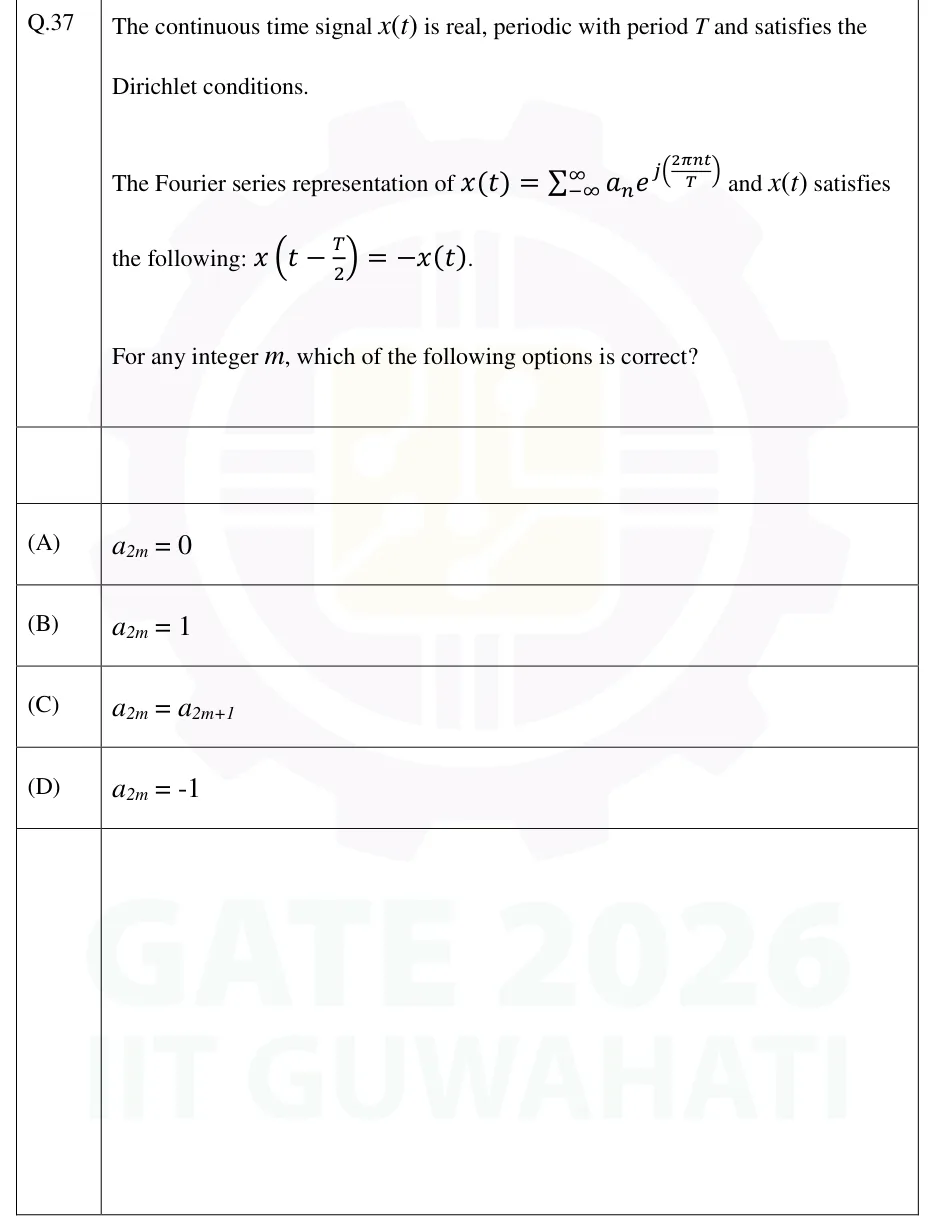
The continuous time signal is real, periodic with period and satisfies the Dirichlet conditions.

The Fourier series representation of and satisfies the following: .

For any integer , which of the following options is correct?

  1. (A)

  2. (B)

  3. (C)

  4. (D)

Answer and solution
See the question in the paper
GATE 2026 EC Q.37: answer and solution

GATE 2026 EC Q.58

GATE 2026 · ECQ.58 · 2 marks · MSQ

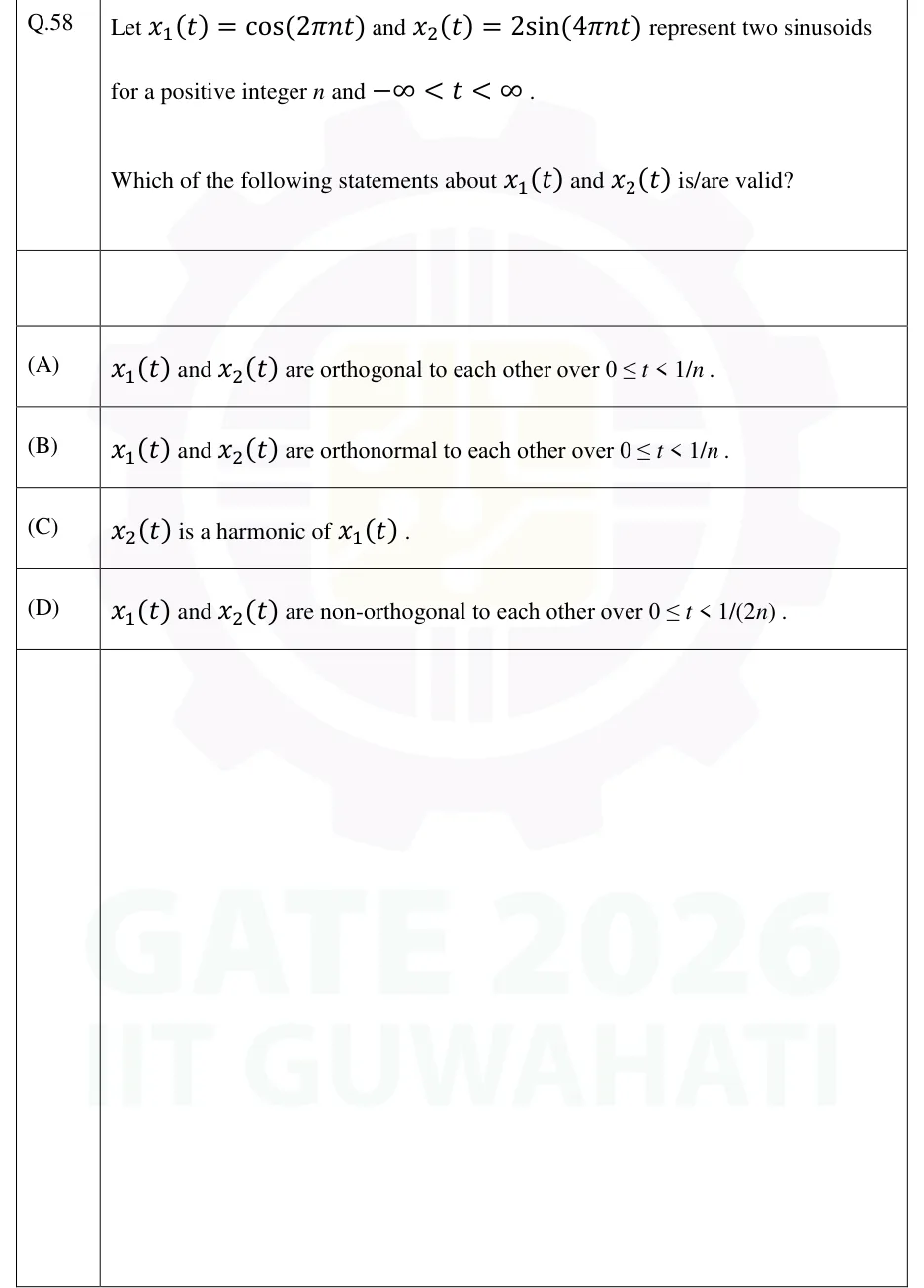
Let and represent two sinusoids for a positive integer and .

Which of the following statements about and is/are valid?

  1. (A)

    and are orthogonal to each other over .

  2. (B)

    and are orthonormal to each other over .

  3. (C)

    is a harmonic of .

  4. (D)

    and are non-orthogonal to each other over .

Answer and solution
See the question in the paper
GATE 2026 EC Q.58: answer and solution

GATE 2026 EE Q.36

GATE 2026 · EEQ.36 · 2 marks · MCQ

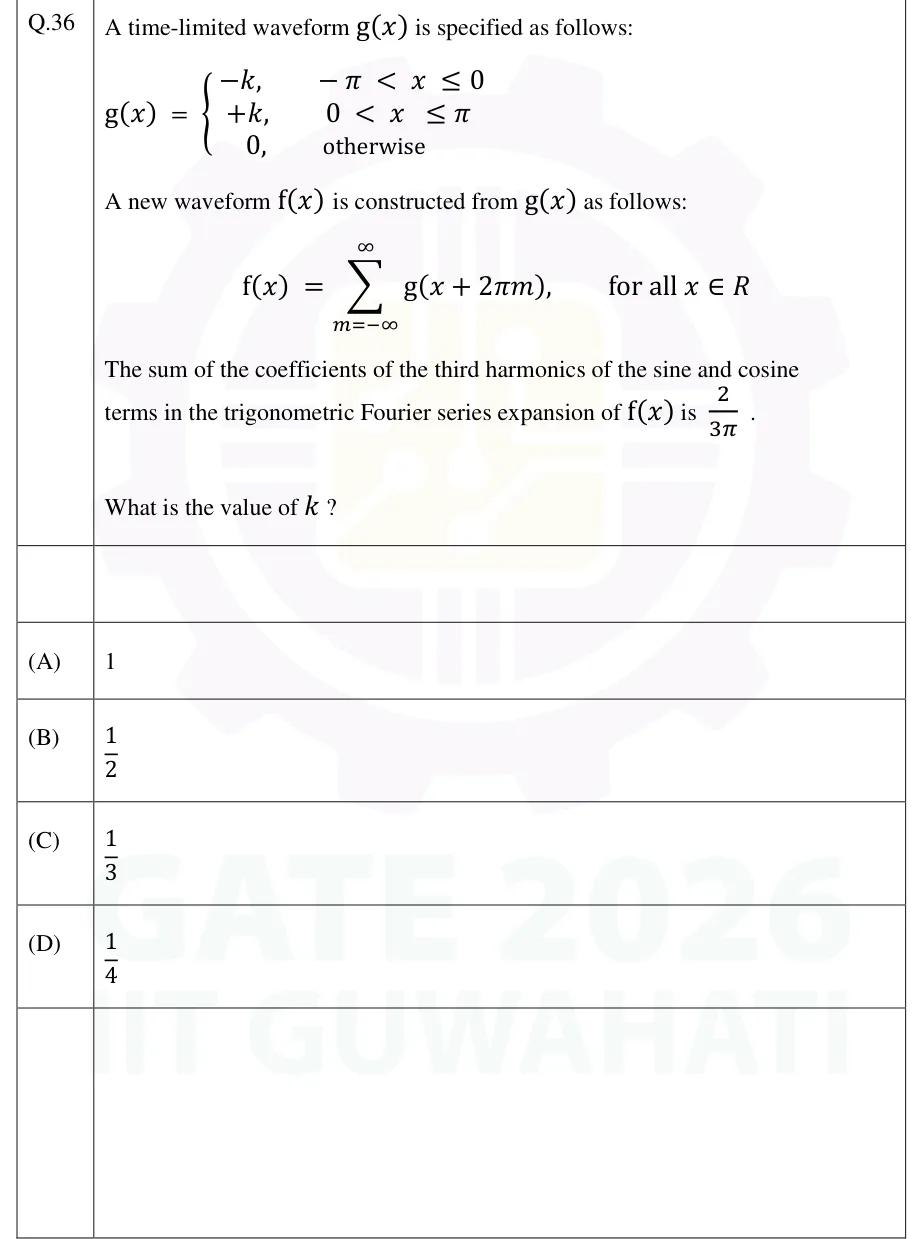
A time-limited waveform is specified as follows:

A new waveform is constructed from as follows:

The sum of the coefficients of the third harmonics of the sine and cosine terms in the trigonometric Fourier series expansion of is .

What is the value of ?

  1. (A)

  2. (B)

  3. (C)

  4. (D)

Answer and solution
See the question in the paper
GATE 2026 EE Q.36: answer and solution

GATE 2025 EC Q.55

GATE 2025 · ECQ.55 · 2 marks · MSQ

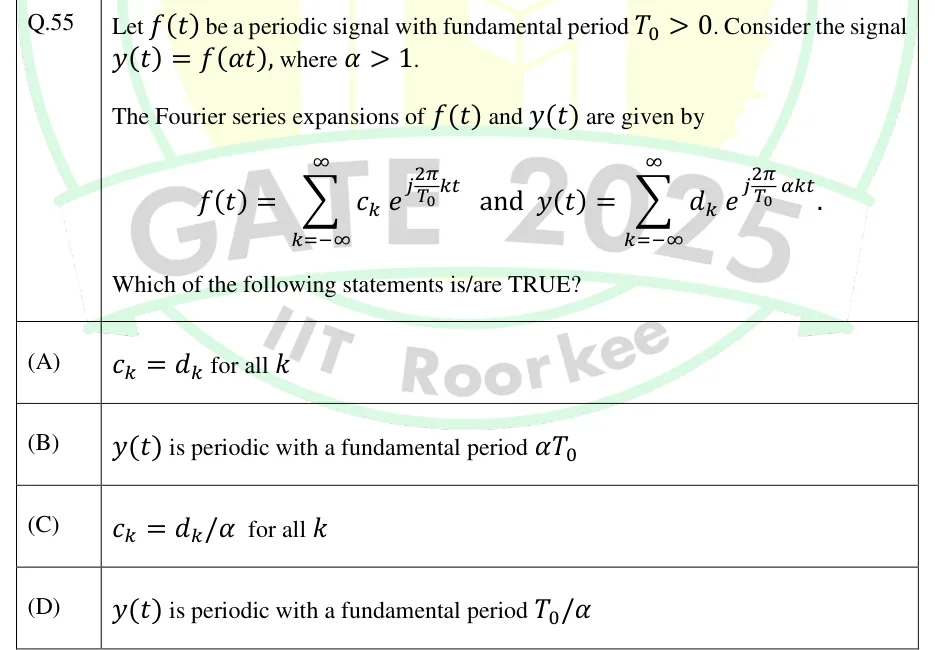
Let be a periodic signal with fundamental period . Consider the signal , where .

The Fourier series expansions of and are given by

Which of the following statements is/are TRUE?

  1. (A)

    for all

  2. (B)

    is periodic with a fundamental period

  3. (C)

    for all

  4. (D)

    is periodic with a fundamental period

Answer and solution
See the question in the paper
GATE 2025 EC Q.55: answer and solution

GATE 2025 IN Q.41

GATE 2025 · INQ.41 · 2 marks · MCQ

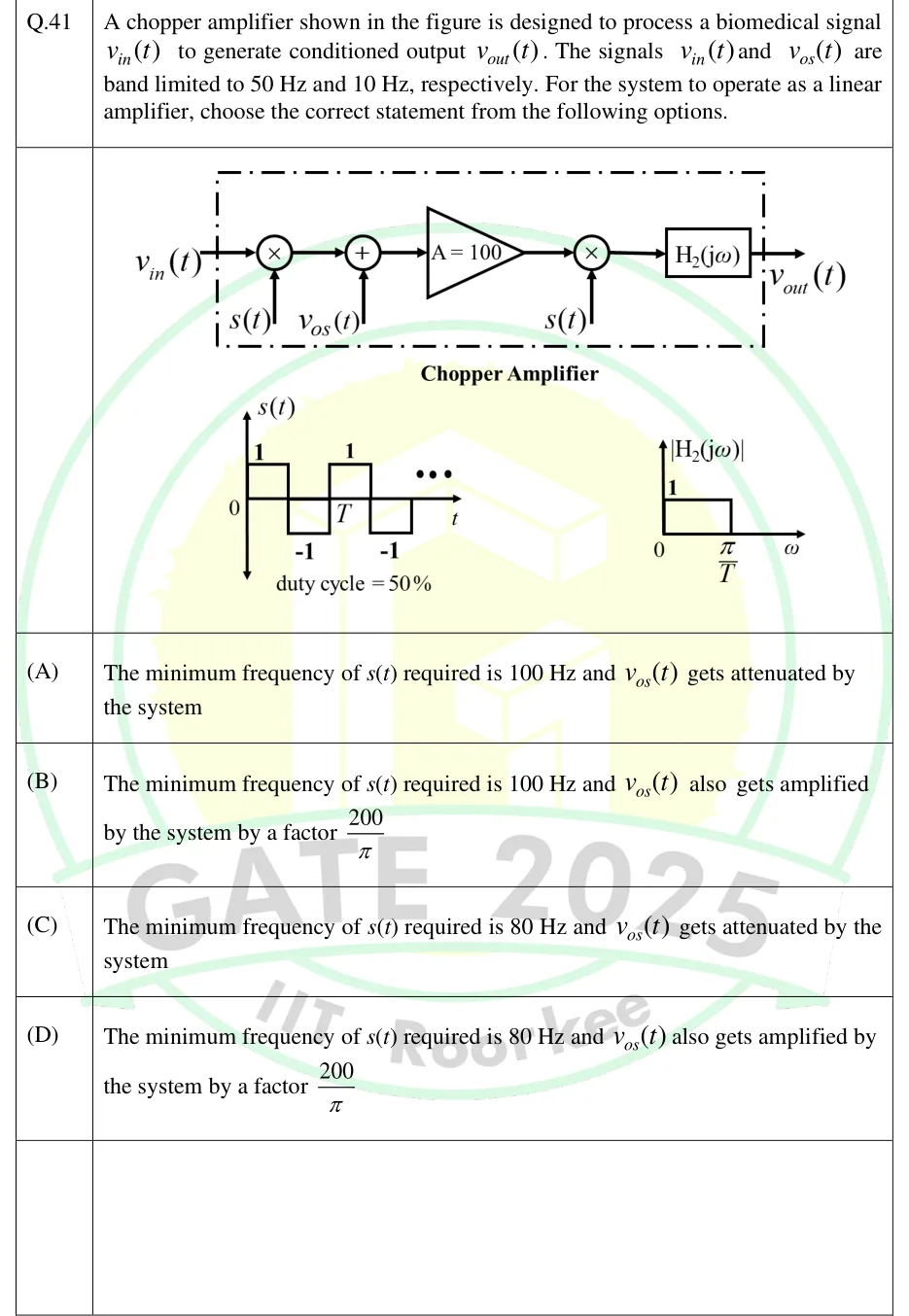
A chopper amplifier shown in the figure is designed to process a biomedical signal to generate conditioned output . The signals and are band limited to 50 Hz and 10 Hz, respectively. For the system to operate as a linear amplifier, choose the correct statement from the following options.

GATE 2025 IN question 41: Block diagram titled 'Chopper Amplifier' inside a dash-dot box.Tap to open full size
Figure from the GATE 2025 IN paper. It is part of the question.
Figure description

Block diagram titled 'Chopper Amplifier' inside a dash-dot box. From left: v_in(t) enters a multiplier (circle with ×) whose second input from below is s(t); its output goes to a summing junction (circle with +) whose second input from below is v_os(t); the sum goes into a triangular amplifier labelled A = 100; the amplifier output goes into a second multiplier (×) whose second input from below is s(t); its output goes into a block H_2(j ω), whose output is v_out(t). Below left, a plot of s(t) versus t: a square wave starting at t = 0, value +1 for the first half-period and -1 for the second half, repeating with period T (the second +1 pulse starts at t = T), continuing with '...'; labelled 'duty cycle = 50%'. Below right, a plot of |H_2(j ω)| versus ω: magnitude 1 from ω = 0 up to ω = π /T, and zero beyond (ideal low-pass filter with cutoff π /T).

  1. (A)

    The minimum frequency of required is 100 Hz and gets attenuated by the system

  2. (B)

    The minimum frequency of required is 100 Hz and also gets amplified by the system by a factor

  3. (C)

    The minimum frequency of required is 80 Hz and gets attenuated by the system

  4. (D)

    The minimum frequency of required is 80 Hz and also gets amplified by the system by a factor

Answer and solution
GATE 2025 IN Q.41: answer and solution

GATE 2023 EC Q.47

GATE 2023 · ECQ.47 · 2 marks · MCQ

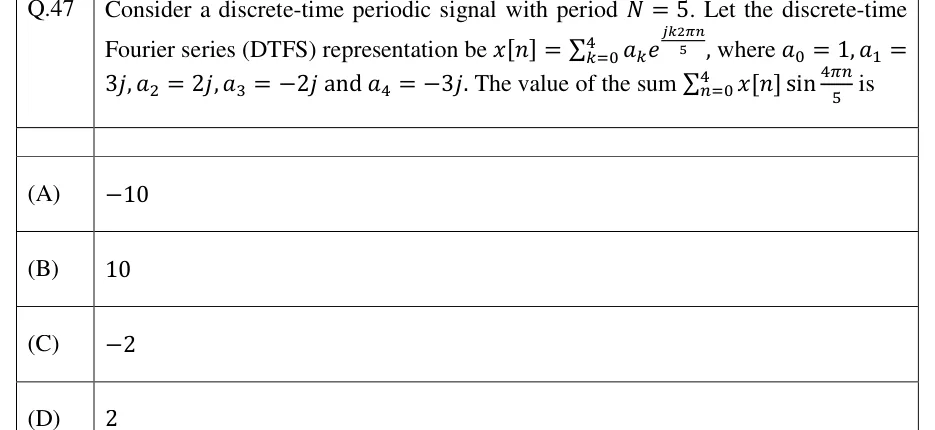
Consider a discrete-time periodic signal with period . Let the discrete-time Fourier series (DTFS) representation be , where , , , and . The value of the sum is

  1. (A)

  2. (B)

  3. (C)

  4. (D)

Answer and solution
See the question in the paper
GATE 2023 EC Q.47: answer and solution

GATE 2022 EE Q.49

GATE 2022 · EEQ.49 · 2 marks · MCQ

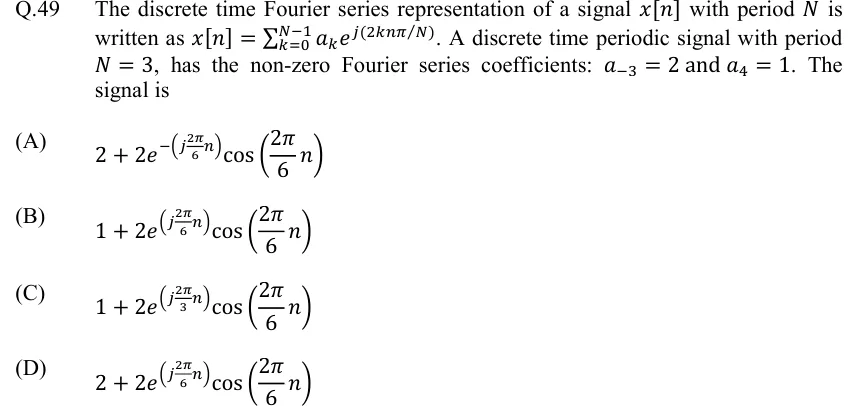
The discrete time Fourier series representation of a signal with period is written as . A discrete time periodic signal with period , has the non-zero Fourier series coefficients: and . The signal is

  1. (A)

  2. (B)

  3. (C)

  4. (D)

Answer and solution
See the question in the paper
GATE 2022 EE Q.49: answer and solution

GATE 2018 EC Q.14

GATE 2018 · ECQ.14 · 1 mark · MCQ

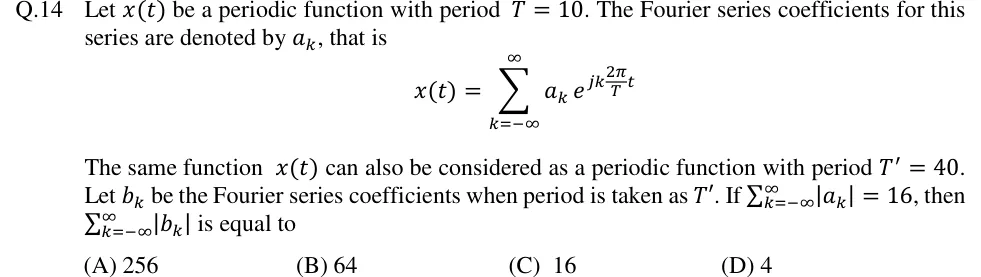
Let be a periodic function with period . The Fourier series coefficients for this series are denoted by , that is

The same function can also be considered as a periodic function with period . Let be the Fourier series coefficients when period is taken as . If , then is equal to

  1. (A)

    256

  2. (B)

    64

  3. (C)

    16

  4. (D)

    4

Answer and solution
See the question in the paper
GATE 2018 EC Q.14: answer and solution

GATE 2018 IN Q.11

GATE 2018 · INQ.11 · 1 mark · MCQ

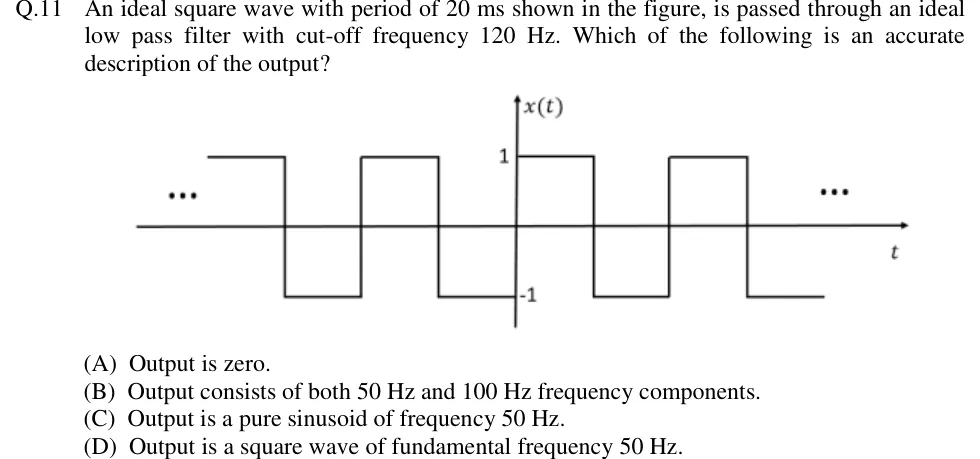
An ideal square wave with period of 20 ms shown in the figure, is passed through an ideal low pass filter with cut-off frequency 120 Hz. Which of the following is an accurate description of the output?

GATE 2018 IN question 11: Plot of x(t) against t: a periodic square wave, continuing both ways (dots at both ends), switching between +1 and -1 with…Tap to open full size
Figure from the GATE 2018 IN paper. It is part of the question.
Figure description

Plot of x(t) against t: a periodic square wave, continuing both ways (dots at both ends), switching between +1 and -1 with equal time at each level (50% duty cycle). It rises from -1 to +1 at t = 0, stays at +1 for half a period, then falls to -1 for the other half. The vertical axis is marked 1 and -1; the horizontal axis is t with no time values printed (the stem gives the period as 20 ms).

  1. (A)

    Output is zero.

  2. (B)

    Output consists of both 50 Hz and 100 Hz frequency components.

  3. (C)

    Output is a pure sinusoid of frequency 50 Hz.

  4. (D)

    Output is a square wave of fundamental frequency 50 Hz.

Answer and solution
GATE 2018 IN Q.11: answer and solution

PRACTICE

6 questions to test yourself

PRACTICE 11 mark · MCQ

A real periodic signal with period satisfies and for all . Its trigonometric Fourier series contains

  1. (A)

    a DC term and cosine terms at all harmonics

  2. (B)

    cosine terms at odd harmonics only, with no DC term

  3. (C)

    sine terms at odd harmonics only, with no DC term

  4. (D)

    cosine terms at even harmonics only, with a DC term

Answer and solution

Answer: (B)

  1. : the signal is even, so every ; only and the cosine coefficients can be nonzero.

  2. is half-wave symmetry: and every even-harmonic coefficient vanishes.

  3. Together, only for odd survive: odd-harmonic cosines and no DC. Answer (B).

PRACTICE 21 mark · NAT

A real periodic signal has exponential Fourier series coefficients , , , with , and for . Its average power, normalised to , is ______ W.

Answer and solution

Answer: (accepted range )

  1. Parseval: , since for a real signal.

  2. and .

  3. W.

  4. Check in trigonometric form: , , , , so W.

PRACTICE 32 marks · NAT

A triangular wave of period ms is even, has its peak value of V at , falls linearly to V at ms, and has zero average. It is applied to an ideal low-pass filter with unity passband gain and a cutoff frequency of kHz. The ratio of the average output power to the average input power is ______ (rounded to three decimal places).

Answer and solution

Answer: (accepted range )

  1. Fundamental kHz. The wave is even and half-wave symmetric: with V, so there is no DC and no 2 kHz component.

  2. The components lie at 1, 3, 5, ... kHz; only the 1 kHz fundamental is below the 2 kHz cutoff.

  3. Output power .

  4. Input power: a linear ramp between and has mean square .

  5. Ratio , independent of .

PRACTICE 42 marks · MSQ

A real periodic signal has period , fundamental frequency and exponential Fourier series coefficients . Which of the following statements is/are correct?

  1. (A)

    has Fourier series coefficients with respect to the same .

  2. (B)

    has fundamental frequency and Fourier series coefficients .

  3. (C)

    has Fourier series coefficients for .

  4. (D)

    has Fourier series coefficients .

Answer and solution

Answer: (A), (B), (D)

  1. (A) A time shift by multiplies by . Correct.

  2. (B) repeats every , so its fundamental is , and the coefficient of is still . Correct.

  3. (C) Differentiation multiplies by ; dividing by it is the integration rule. Incorrect.

  4. (D) Time reversal gives , and for a real signal . Correct.

  5. Answer: A, B, D.

PRACTICE 52 marks · MCQ

The discrete-time signal is periodic with fundamental period . Its discrete-time Fourier series is , with . The pair is

  1. (A)

    ,

  2. (B)

    ,

  3. (C)

    ,

  4. (D)

    ,

Answer and solution

Answer: (A)

  1. : , period 4. : , period 6. So and .

  2. gives . , giving and .

  3. The coefficients repeat every 12, so . Answer (A); (B) is the value of .

PRACTICE 62 marks · NAT

The periodic signal , with in seconds, is built from the triangular pulse for and otherwise. Writing with rad/s, the value of is ______ (rounded to three decimal places).

Answer and solution

Answer: (accepted range )

  1. The period is s and the pulses do not overlap, so one period of is and , where is the Fourier transform of .

  2. The triangle of height 1 on is the convolution of two rectangles of height 1 and width 1, each with transform , so .

  3. For , : .

  4. .

  5. Direct check: the signal is even, so .

OFFICIAL GATE 2027 SYLLABUS WORDING

Copied from the GATE 2027 syllabus; see all 2027 syllabi.

GATE EC

Fourier series

GATE EE

Fourier series representation of continuous and discrete time periodic signals

GATE IN

Fourier series

Preparing in Kolkata? IAE Academy's course for GATE ECE, GATE EE or GATE IN.