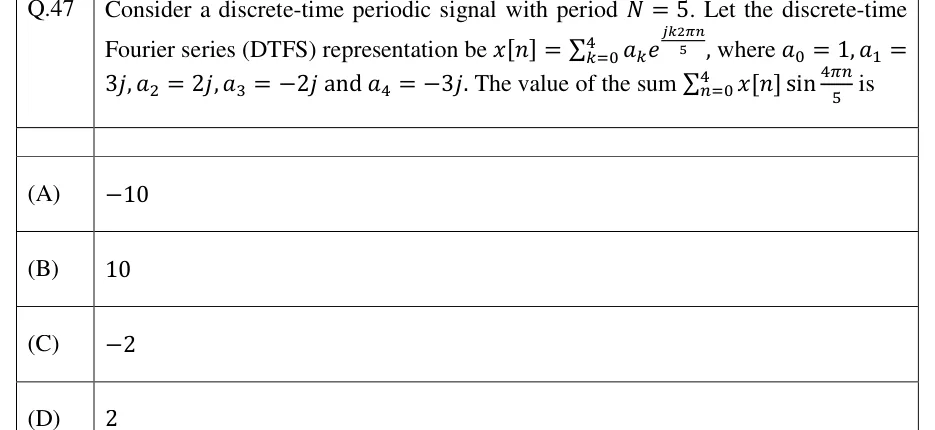
Consider a discrete-time periodic signal with period . Let the discrete-time Fourier series (DTFS) representation be , where , , , and . The value of the sum is
- (A)
- (B)
- (C)
- (D)

Consider a discrete-time periodic signal with period . Let the discrete-time Fourier series (DTFS) representation be , where , , , and . The value of the sum is
ANSWER
The sum is . This is option (A).
Official answer: ASource: Official answer key, GATE 2023 EC (IIT Kanpur)
DTFS analysis equation: . With this gives .
Euler's formula: .
Identify each exponential with an analysis kernel. Since for integer : , which is the kernel. The term is the kernel.
So
Cross-check by writing out. Because and , is real, and , . So .
Orthogonality over one period: the constant term and the term both sum to zero against . Only the term is left, and . That gives , the same result. Answer: option (A).
KEY IDEA
A sum of the form is just , so you never need to compute . Split the sine into two complex exponentials with Euler's formula. Then use -periodicity in (here ) to match each exponential to a coefficient you were given.
WATCH OUT FOR
The usual slip is sending to instead of . The analysis kernel carries a minus sign, so belongs to . Swapping and gives , option (B). Two other mistakes are leaving out the factor from the analysis equation, which gives (options C and D), and forgetting the from Euler's formula.
From the GATE 2023 EC paper. Every question of this paper · Download the full paper · All 11 Fourier series questions, with notes