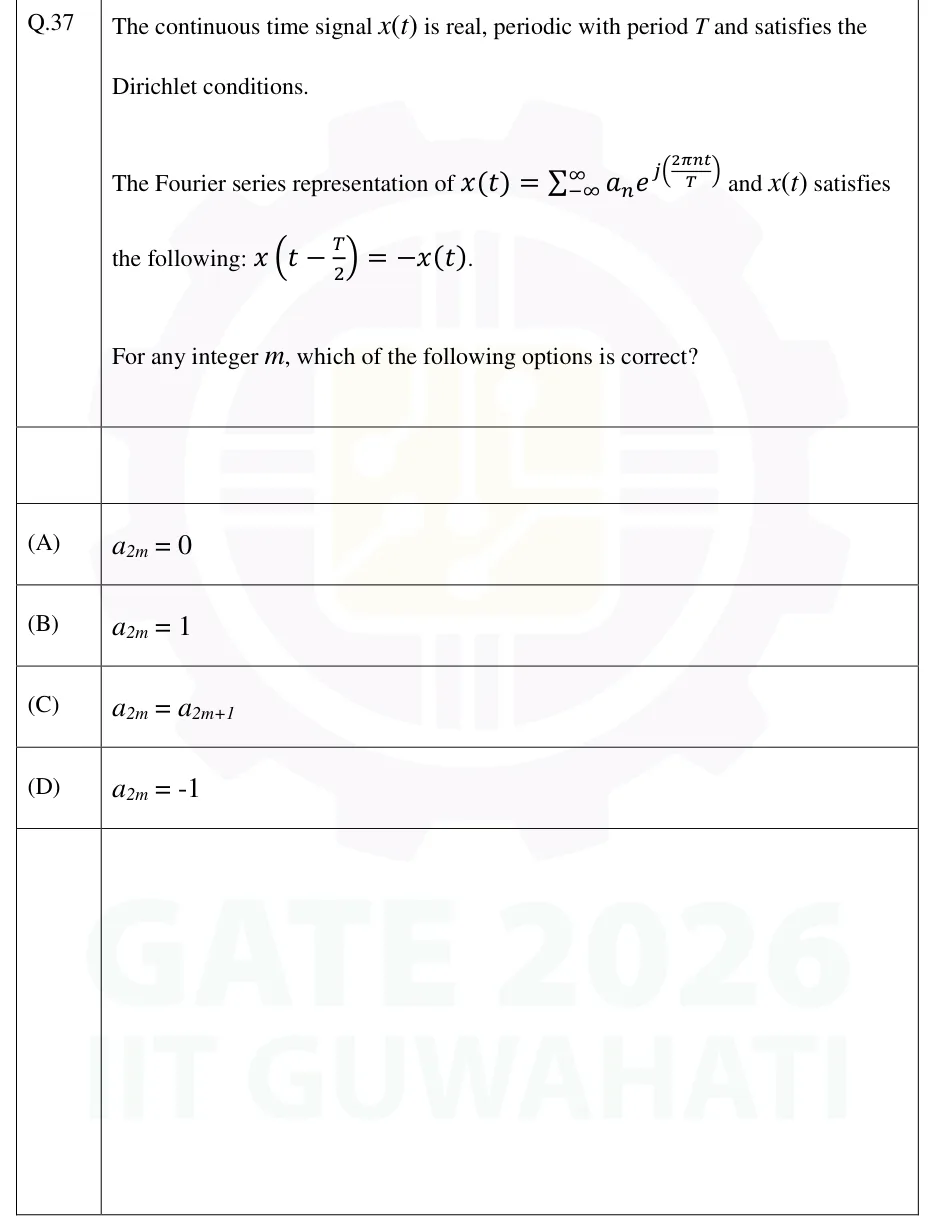
The continuous time signal is real, periodic with period and satisfies the Dirichlet conditions.
The Fourier series representation of and satisfies the following: .
For any integer , which of the following options is correct?
- (A)
- (B)
- (C)
- (D)

The continuous time signal is real, periodic with period and satisfies the Dirichlet conditions.
The Fourier series representation of and satisfies the following: .
For any integer , which of the following options is correct?
ANSWER
(A) . Half-wave symmetry, , makes every even-indexed Fourier coefficient zero, including the DC term.
Official answer: ASource: Official answer key, GATE 2026 EC (IIT Guwahati)
Time-shift property of the Fourier series. Let . If , then . This follows directly from the series:
Put : so .
Match coefficients. The Fourier coefficients of a signal are unique. The given condition therefore means that, for every ,
Odd : , so the equation holds whatever is. Odd harmonics can be present.
Even : , so for every integer . This includes , so and the signal has zero average.
Check the options. (B) and (D) contradict . If (C) held for every , it would force as well. Every coefficient would then be zero and . A nonzero signal can satisfy the condition, for example : here , so (C) fails. Answer: (A), .
KEY IDEA
Shifting by half a period multiplies the -th coefficient by . With half-wave symmetry, , you need , so only odd harmonics survive. Every even-indexed coefficient is zero, and that includes .
WATCH OUT FOR
Students often mix up half-wave symmetry, , with odd symmetry, . Odd symmetry only makes the coefficients purely imaginary. It does not remove the even harmonics. Another slip is to use a shift of a full period instead of , which gives and seems to tell you nothing. Some students also forget that is included, so the DC value is zero as well.
From the GATE 2026 EC paper. Every question of this paper · Download the full paper · All 11 Fourier series questions, with notes