IAE Academy

GATE 2026 EE Q.36: solution and answer

GATE 2026 · EEQ.36 · 2 marks · MCQ

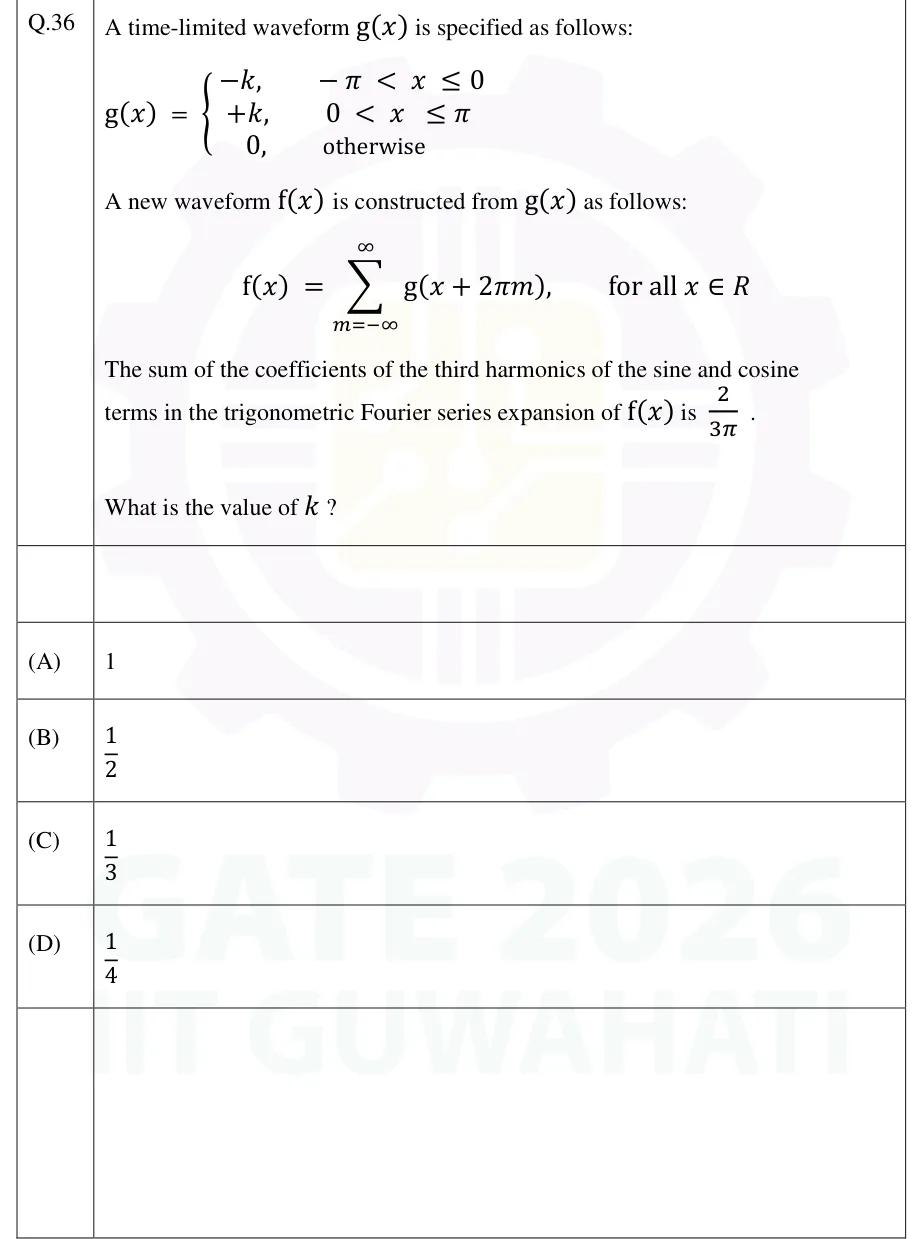
A time-limited waveform is specified as follows:

A new waveform is constructed from as follows:

The sum of the coefficients of the third harmonics of the sine and cosine terms in the trigonometric Fourier series expansion of is .

What is the value of ?

  1. (A)

  2. (B)

  3. (C)

  4. (D)

See the question in the paper

Answer and solution

ANSWER

The periodic extension is an odd square wave of amplitude and period . Its third harmonic has and . Setting gives , which is option (B).

Official answer: BSource: Official answer key, GATE 2026 EE (IIT Guwahati)

  1. Periodic extension: the shifted copies occupy the intervals . These do not overlap and together cover the whole real line, so at every exactly one term of the sum is non-zero. So is a square wave with period (). It equals on and on , and repeats every .

  2. Symmetry: for every except the isolated jump points , and single points do not change a Fourier integral. So is odd over a period. The dc term and every cosine coefficient vanish: and . In particular .

  3. Sine coefficients: is even, so the full-period integral is twice the half-range integral:

  4. Third harmonic (, which is odd): and .

  5. Apply the given condition:

  6. Option (B) is correct.

KEY IDEA

Summing over all is simply the -periodic extension of , which here is an odd square wave. Odd symmetry makes every cosine coefficient zero. The sine series of this square wave is standard: for odd and for even . The \"sum of the third-harmonic coefficients\" is therefore just .

WATCH OUT FOR

Using the peak-to-peak value as the amplitude, which gives and (option D). Another slip is dropping the factor 2 from the half-range integral, which gives and (option A). A third is assuming without checking the symmetry. The waveform swings between and , so its amplitude is , and it is odd, so all .

From the GATE 2026 EE paper. Every question of this paper · Download the full paper · All 11 Fourier series questions, with notes

More Fourier series questions