
IAE Academy

GATE 2025 IN Q.41: solution and answer

GATE 2025 · INQ.41 · 2 marks · MCQ

A chopper amplifier shown in the figure is designed to process a biomedical signal to generate conditioned output . The signals and are band limited to 50 Hz and 10 Hz, respectively. For the system to operate as a linear amplifier, choose the correct statement from the following options.
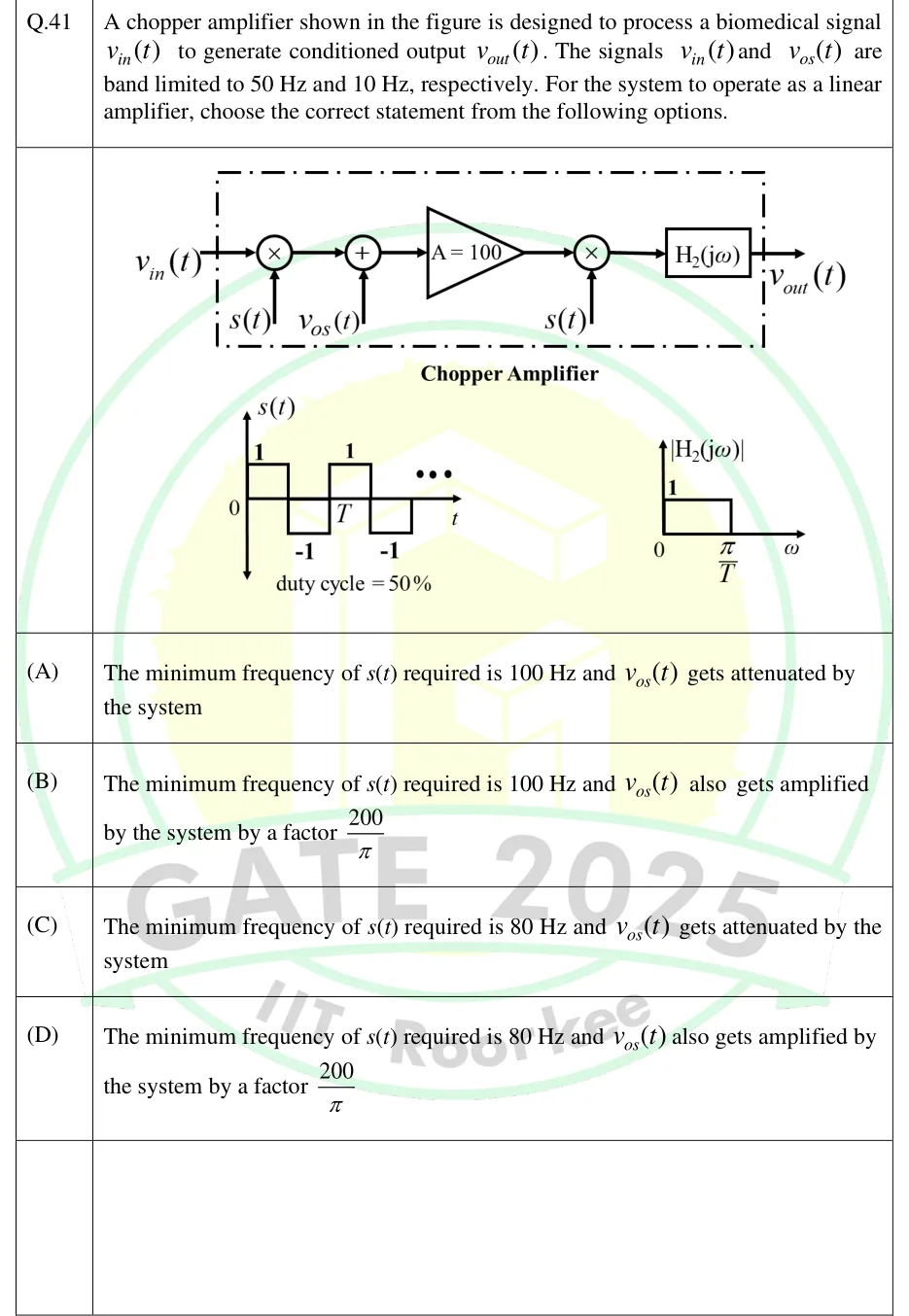
GATE 2025 IN question 41: Block diagram titled 'Chopper Amplifier' inside a dash-dot box.Tap to open full size
Figure from the GATE 2025 IN paper. It is part of the question.
Figure description

Block diagram titled 'Chopper Amplifier' inside a dash-dot box. From left: v_in(t) enters a multiplier (circle with ×) whose second input from below is s(t); its output goes to a summing junction (circle with +) whose second input from below is v_os(t); the sum goes into a triangular amplifier labelled A = 100; the amplifier output goes into a second multiplier (×) whose second input from below is s(t); its output goes into a block H_2(j ω), whose output is v_out(t). Below left, a plot of s(t) versus t: a square wave starting at t = 0, value +1 for the first half-period and -1 for the second half, repeating with period T (the second +1 pulse starts at t = T), continuing with '...'; labelled 'duty cycle = 50%'. Below right, a plot of |H_2(j ω)| versus ω: magnitude 1 from ω = 0 up to ω = π /T, and zero beyond (ideal low-pass filter with cutoff π /T).

  1. (A)

    The minimum frequency of required is 100 Hz and gets attenuated by the system

  2. (B)

    The minimum frequency of required is 100 Hz and also gets amplified by the system by a factor

  3. (C)

    The minimum frequency of required is 80 Hz and gets attenuated by the system

  4. (D)

    The minimum frequency of required is 80 Hz and also gets amplified by the system by a factor

Answer and solution

ANSWER

Option (A): the minimum frequency of s(t) is 100 Hz, and v_os(t) is attenuated (removed) by the system.

Official answer: ASource: Official answer key, GATE 2025 IN (IIT Roorkee)

  1. Signal before the filter. The first multiplier gives . The summer adds , the amplifier multiplies by , and the second multiplier multiplies by again:

  2. Use . is or at every instant, apart from the switching instants, which take up zero time and so do not affect the output. That gives and The input comes back at baseband with gain , whatever the chopping frequency.

  3. Fourier series of . is a square wave with a 50% duty cycle and period . Its average (DC term) is zero and it contains only odd harmonics:

  4. Where the offset term lands (modulation property). Multiplying by copies the to spectrum of into bands centred on . Because has no DC term, no copy stays at baseband. The lowest offset frequency in is therefore .

  5. The filter cutoff in hertz. is an ideal low-pass filter with cutoff , so

  6. Condition 1: pass undistorted. The filter has to pass the whole band of : At the cutoff would be , and the to part of would be lost. So is not enough.

  7. Condition 2: reject the offset. The lowest offset component has to lie above the cutoff: At the offset occupies to and higher odd-harmonic bands. All of that is above .

  8. Conclusion. Both conditions hold when , so the minimum chopping frequency is . At that frequency . The offset is removed (attenuated) by the system, not amplified. This is option (A).

KEY IDEA

The input is multiplied by the ±1 square wave twice. Since , it comes back at baseband with gain . The offset enters between the two multipliers, so it is multiplied only once. Because has no DC term, the offset ends up near the odd harmonics . The output filter's cutoff equals in hertz. It must pass the signal band, which gives . At that frequency the offset band ( to and up) lies outside the passband.

WATCH OUT FOR

One mistake is to take the fundamental amplitude of and conclude that the offset reaches the output with gain (options B and D). That component sits at , above the filter cutoff , so it never reaches . Another mistake is to read the cutoff as a frequency in hertz, or never to check it against the signal band. At the cutoff is only , so part of the signal band is cut off (options C and D).

From the GATE 2025 IN paper. Every question of this paper · Download the full paper · All 11 Fourier series questions, with notes

More Fourier series questions